IC Markets

 3:09
 2:39
 2:10
 2:18
 3:43
 8:42





































US Treasury Keeps Auction Sizes Steady in a $125 Billion Refunding as 10-Year Yields Ease to 4.90%
No increase in note and bond sales for several quarters, a change to the 7-year note and $95 billion of buybacks. What the plan means for yields and the dollar.
 WriterAbir KhanWriterWrites the guides · checks every figure against primary sources View profileAbout Abir →

 Market analysisTanbir Habib RiyadForex & Crypto AnalystForex and crypto analyst · technical and fundamental analysis View profileAbout Tanbir →

 Fact-checking & riskJannatul FerdaushFact-Checker & Risk AnalystFact-checks every figure · risk analysis · Applied Statistics, University of Dhaka View profileAbout Jannatul →

 Trading reviewJowel RanaForex TraderForex trader · reviews guides from a trader's view View profileAbout Jowel →

 Final approvalRanjan N. MondolForex TraderForex trader · signs off every guide View profileAbout Ranjan →

The US Treasury will sell $125 billion of notes and bonds next week in its quarterly refunding, and it expects to keep the size of its regular coupon auctions unchanged “for the next several quarters,” according to the refunding statement published on Wednesday 4 November. The package is a $58 billion 3-year note on Monday 9 November, a $42 billion 10-year note on Tuesday 10 November and a $25 billion 30-year bond on Thursday 12 November.
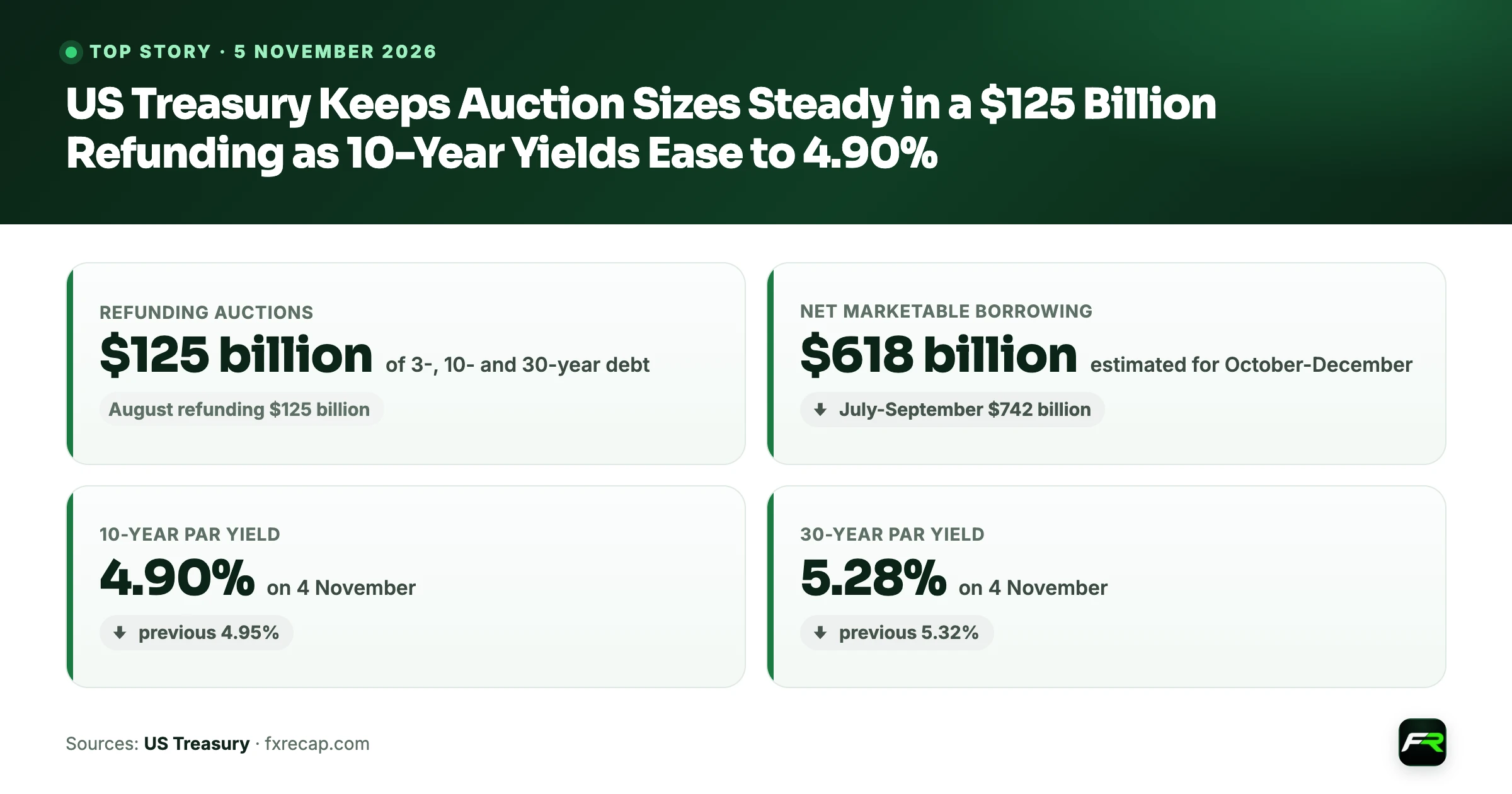
The refunding replaces about $97 billion of privately held debt maturing on 15 November and raises about $28 billion of new cash. Bond markets took the plan calmly. The 10-year par yield published by the Treasury was 4.90% on Wednesday, down from 4.95% on Tuesday and from 5.13% on 21 October.
For currency traders the refunding matters because US yields drive the dollar, especially against the yen. Supply that stays flat removes one reason for long-dated yields to rise, though the auctions themselves, landing alongside the US CPI report, will test demand.
| Refunding auctions (US Treasury) | $125 billion of 3-, 10- and 30-year debt (August refunding $125 billion) |
|---|---|
| Net marketable borrowing (US Treasury) | $618 billion estimated for October-December (July-September $742 billion) |
| 10-year par yield (US Treasury) | 4.90% on 4 November (previous 4.95%) |
| 30-year par yield (US Treasury) | 5.28% on 4 November (previous 5.32%) |
What the Treasury announced
The headline decision is that nothing changes. Auction sizes for 2-, 3-, 5- and 7-year notes stay at $69 billion, $58 billion, $70 billion and $44 billion a month, and the 10-, 20- and 30-year sizes follow their usual cycle of a larger new issue followed by two smaller reopenings. “Treasury believes its current auction sizes leave it well positioned to address potential changes to the fiscal outlook,” the statement says.
Inflation-protected debt is unchanged too: a $19 billion 10-year TIPS reopening in November, a $24 billion 5-year TIPS in December and a $21 billion new 10-year TIPS in January. Any seasonal swings in borrowing needs will be met through Treasury bills, which mature in a year or less and do not add much to long-term supply.
There was one structural change. From March 2027 the 7-year note will become a quarterly new issue with two monthly reopenings, the same pattern as the 10-year. Auctions will stay at the end of each month. Reopenings build bigger, more liquid issues, which can help demand at the margin.
The statement also leaves the door open to change later. Treasury “continues to evaluate potential future changes to nominal coupon and FRN auction sizes, with a focus on trends in structural demand,” and it is watching growing demand for bills, including Federal Reserve purchases of bills for its own portfolio.
A quick note on terms for newer traders. A refunding is the set of longer-term auctions the Treasury holds in February, May, August and November to replace maturing debt. Notes run from 2 to 10 years and bonds for 20 or 30 years. The yield at auction is set by the bids, so the size of each sale and the demand for it feed straight into market interest rates, and from there into currency prices.
How much the government is borrowing
Two days earlier, on 2 November, the Treasury published its borrowing estimates. It expects to borrow $618 billion in privately held net marketable debt in October to December, $10 billion less than it estimated in August, assuming an $850 billion cash balance at the end of December. The January to March quarter is larger at $800 billion, with an assumed end-March cash balance of $1 trillion.
The previous quarter came in close to plan. Treasury borrowed $742 billion in July to September against an August estimate of $739 billion and ended the quarter with $984 billion in cash. It also said its cash account could peak at about $1.025 trillion, plus or minus $50 billion, in late November and late January because of large expected outflows at those times. Swings in that balance affect how much cash sits in the banking system, which money-market traders watch closely.
Buybacks continue. Over the coming quarter the Treasury plans to buy back up to $70 billion of older, less traded securities to support liquidity and up to $25 billion of debt maturing within two years for cash management. Buybacks do not cut total borrowing, but they help the market function smoothly during volatile periods.
Where yields stand
Treasury yields have eased since late October. The 10-year par yield fell from 5.13% on 21 October to 4.90% on 4 November, and the 2-year from 4.81% to 4.58%. Long-dated yields stay high: the 20-year was 5.30% and the 30-year 5.28%, both above the 3-month bill at 4.21%. The Federal Reserve held its target range at 3.75% to 4.00% on 28 October, so short-term bill yields sit near the policy rate.
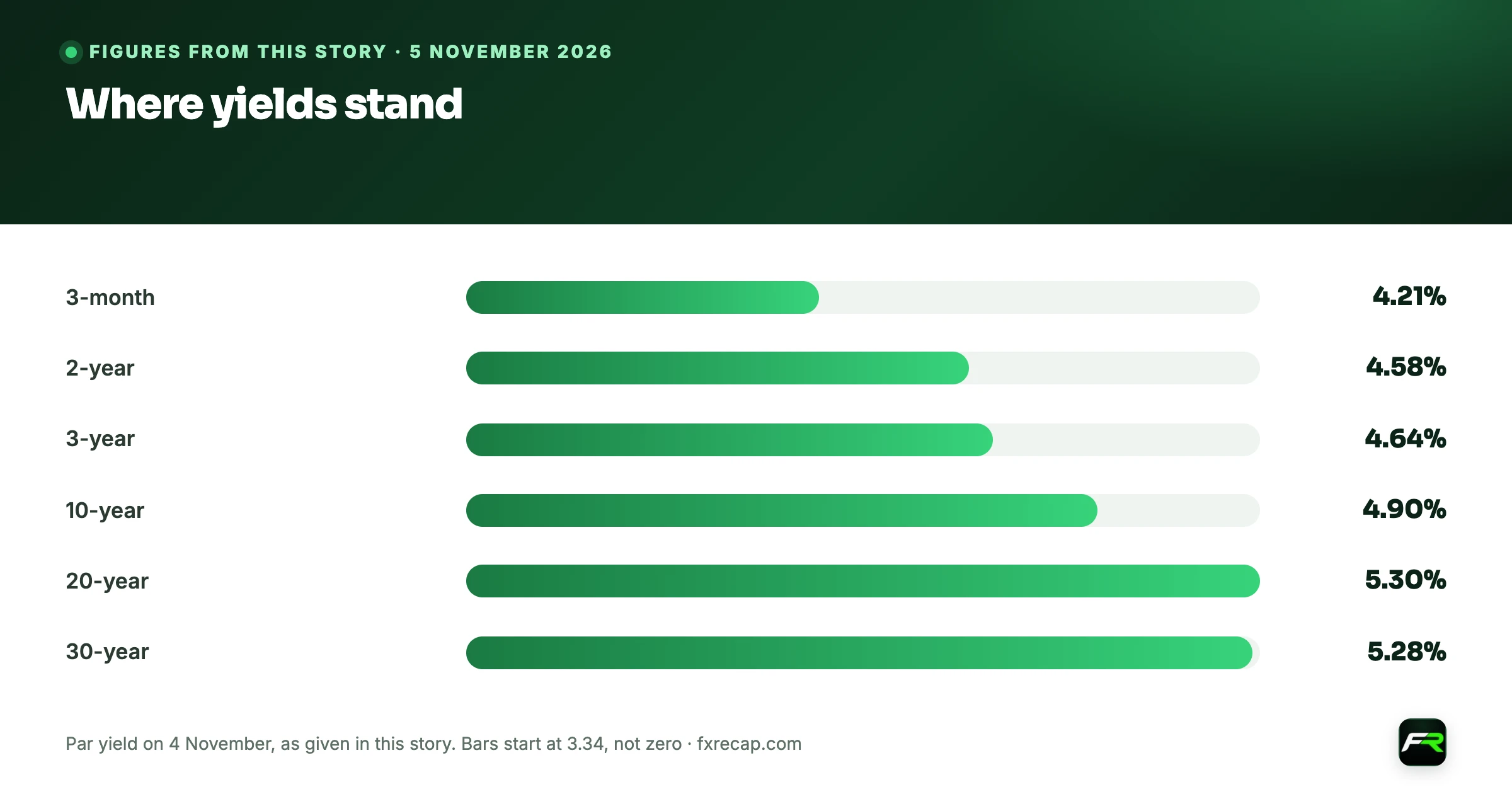
| Maturity | Par yield on 4 November |
|---|---|
| 3-month | 4.21% |
| 2-year | 4.58% |
| 3-year | 4.64% |
| 10-year | 4.90% |
| 20-year | 5.30% |
| 30-year | 5.28% |
A steeper curve, with long yields well above short ones, is often a sign that investors want extra return for holding long-term debt, partly because of large government borrowing. By promising no increase in coupon sizes, Treasury tries to keep that extra return in check. The 10-year auction on 10 November will show whether buyers still want long-dated US debt at these yields.
What it means for the dollar and gold
Lower US yields usually weigh on the dollar, and the dollar was softer this week: on ECB reference rates EUR/USD rose to 1.1267 on 4 November and GBP/USD to 1.3500. USD/JPY held near the top of its recent range at 158.25, because Japanese yields and Bank of Japan policy matter as much for that pair. Gold, which pays no interest, tends to benefit when real yields fall, and spot gold has climbed back above $4,000 this week.
Supply news rarely moves currencies on the day; auction results move them more. A weak 10-year or 30-year sale, with dealers left holding a large share, can push yields up within minutes and lift the dollar against the yen. A strong sale can do the opposite. Because the 10-year auction falls on the same day as the US CPI report on 10 November, the two can combine into one of the busiest days of the month for USD pairs.
What it means for traders
- Mark the auction times: 13:00 New York time (18:00 UTC) on 9, 10 and 12 November. Results are published a few minutes later on TreasuryDirect.
- Watch the 10-year yield around 4.90% and 5.00%. A move back above 5% after the auctions would show that supply is still a concern.
- For USD/JPY, combine yields with Japan's own news. Our USD/JPY analysis sets out the daily levels.
- Keep the calendar close. The US jobs report is due on Friday 6 November and US CPI on 10 November, both on our economic calendar.
Say you buy USD/JPY at 158.20 expecting a weak 10-year auction to lift yields, with a stop at 157.60, 60 pips away. On a $5,000 account risking 1%, you can lose $50, so each pip can be worth about $0.83. With USD/JPY near 158, one pip on 10,000 units is worth about $0.63, so the position is roughly 13,000 units. If CPI and the auction move together against you, a gap can make the loss larger than planned.
Bond auctions and data releases can move currencies quickly, and prices can gap past stop orders. Leverage magnifies losses as well as gains, so trade only with money you can afford to lose. This article is news and education, not a recommendation to buy or sell.
Refunding details and quotes come from the US Treasury's Quarterly Refunding Statement of 4 November 2026 and its marketable borrowing estimates of 2 November. Yields are Treasury daily par yield curve rates. Exchange rates are ECB euro reference rates or derived from them; gold is spot from gold-api.com.
Cite this guide
FX Recap, "US Treasury Keeps Auction Sizes Steady in a $125 Billion Refunding as 10-Year Yields Ease to 4.90%", updated 5 November 2026, https://fxrecap.com/forex-news/top-stories/us-treasury-refunding-125-billion-november-2026
Free to quote with a link. Journalists: data and comment in our press room.
Frequently asked
What did the US Treasury announce in the November 2026 refunding?
It will sell $125 billion of debt next week: a $58 billion 3-year note on 9 November, a $42 billion 10-year note on 10 November and a $25 billion 30-year bond on 12 November. Coupon auction sizes stay unchanged for the next several quarters.
How much will the US Treasury borrow this quarter?
Treasury estimates $618 billion of privately held net marketable borrowing for October to December 2026 and $800 billion for January to March 2027. It borrowed $742 billion in July to September.
What change did the Treasury make to the 7-year note?
From March 2027 the 7-year note becomes a quarterly new issue with two reopenings, like the 10-year note. Auctions stay at the end of each month.
When is the next US quarterly refunding announcement?
The Treasury says the next quarterly refunding announcement will take place on Wednesday 3 February 2027.
Sources: US Treasury: Quarterly Refunding Statement, 4 November 2026 · US Treasury: Treasury Announces Marketable Borrowing Estimates, 2 November 2026 · US Treasury: daily par yield curve rates · ECB: euro foreign exchange reference rates · US Treasury: quarterly refunding documents
The team behind this guide
Researched, checked and approved by five forex specialists
Every guide is written, fact-checked and edited before it goes live, and updated when the facts change. Spotted an error? Tell us.