 IC Markets





























Forex Market Sessions: How Time Works
The forex market runs 24 hours a day, but not every hour is worth trading. This article breaks down the four major sessions (Sydney, Tokyo, London, New York), when they overlap, and how those overlaps affect spreads, volatility, and your actual trading costs. You will also find a full session timetable mapped to Dhaka local time, practical guidance on matching sessions to your strategy, and an honest look at the mistakes traders make when they ignore session logic entirely.
 WriterAbir KhanWriterWrites the guides · checks every figure against primary sources View profileAbout Abir →
 Market analysisTanbir Habib RiyadForex & Crypto AnalystForex and crypto analyst · technical and fundamental analysis View profileAbout Tanbir →
 Fact-checking & riskJannatul FerdaushFact-Checker & Risk AnalystFact-checks every figure · risk analysis · Applied Statistics, University of Dhaka View profileAbout Jannatul →
 Trading reviewJowel RanaCo-Founder & Forex TraderCo-founder · forex trader · reviews guides from a trader's view View profileAbout Jowel →
 Final approvalRanjan NiskrityFounder, Owner & Forex TraderFounder and owner · forex trader · signs off every guide View profileAbout Ranjan →
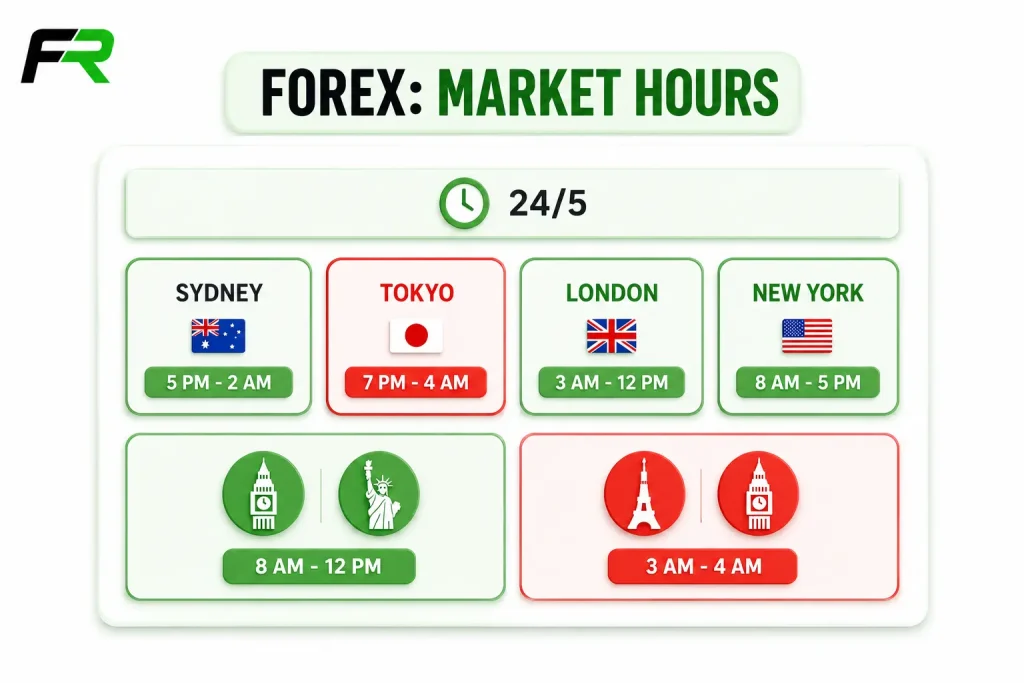
The forex market operates 24 hours a day from the Sydney open on Sunday evening (UTC) until the New York close on Friday evening (UTC). No single exchange opens or closes it. Instead, banks, brokers, and institutional traders across the globe keep quoting prices continuously, as trading activity shifts from one global financial centre to another.
Maintaining a consistent trading schedule is generally more effective than attempting to monitor the market continuously. Some windows are experiencing significantly higher trading volume and tight spreads. Others are so quiet that even small trades can move prices unpredictably. Knowing the difference is one of the most useful advantages for improving trade timing.
This article walks through every major session, how the overlap affects, and how to match your trading schedule to the conditions that best match your trading strategy.
How the Forex Market Works Around the Clock?
Unlike stock markets, forex has no central exchange. It runs as an over-the-counter (OTC) market, meaning trades happen directly between participants: banks, institutions, brokers, and retail traders, all connected through electronic networks.
The market generally opens around 22:00 UTC on Sunday and closes around 22:00 UTC on Friday, although these times shift during daylight saving periods. That is roughly 120 hours of continuous trading each week.
Within that window, four major financial centres become the most active trading centers: Sydney, Tokyo, London, and New York. Each has its own peak hours, its own preferred currency pairs, and its own trading characteristics.This is important for understanding how forex trading works in practice.
The Four Sessions, GMT Hours
| Session | GMT Hours (Approx.) | Financial Hub |
| Sydney | 22:00 – 07:00 | Sydney, Australia |
| Tokyo | 00:00 – 09:00 | Tokyo, Japan |
| London | 08:00 – 17:00 | London, UK |
| New York | 13:00 – 22:00 | New York, US |
These hours shift slightly with daylight saving time changes in each region, and the shifts don’t happen on the same calendar dates worldwide, so the overlap windows can compress or widen by an hour for a few weeks each spring and fall.
Session Overlaps: Where the Real Volume Is
| Overlap | GMT Window | Why It Matters |
| Sydney – Tokyo | 00:00 – 07:00 | Best window for AUD, NZD, and JPY pairs |
| Tokyo – London | 08:00 – 09:00 | Shorter overlap; still useful for JPY crosses against European currencies |
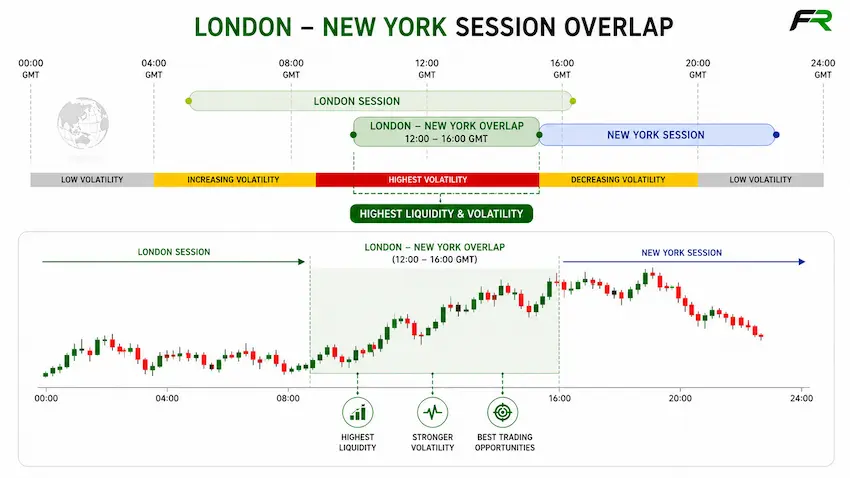
| London – New York | 13:00 – 17:00 | The busiest window of the day; more than half of daily forex volume |
The Four Major Forex Sessions
Sydney Session
| Hours: 22:00 UTC (Sunday) to 07:00 UTC |
Sydney generally records the lowest trading volume among the four major forex sessions. This means price moves tend to be modest compared to what happens later in the day. AUD and NZD currency pairs typically experience increased activity during the Sydney session, along with some movement in Asian crosses.
The Sydney session usually marks the beginning of the trading week and generally experiences lower market activity than later sessions. Spreads can be slightly wider, and major pairs like EUR/USD or GBP/USD tend to often move within narrower ranges.
For traders in Dhaka (UTC+6), the Sydney session runs from around 04:00 to 13:00 local time. Price volatility is generally lower than during the London or New York sessions.
Tokyo Session
| Hours: 00:00 UTC to 09:00 UTC |
The Tokyo session marks the beginning of the main Asian trading period. Volume increases noticeably, especially on major currency pairs involving JPY: USD/JPY, EUR/JPY, and AUD/JPY are the most active.
The session overlaps briefly with Sydney in its early phase, creating a small but useful window of increased liquidity for Asia-Pacific pairs. Moves tend to be more measured than during London or New York hours, which makes Tokyo suitable for traders who prefer defined ranges over sharp breakouts.
For Dhaka-based traders, Tokyo runs from around 06:00 to 15:00 local time, a reasonable daytime window especially for JPY pairs or quieter, more structured conditions.
It is also important to remember: The Bank of Japan has occasionally intervened in the foreign exchange market, particularly during periods of excessive yen volatility. Keep an eye on the economic calendar during this session.
London Session
| Hours: 07:00 UTC to 16:00 UTC |
London remains the world’s largest foreign exchange trading centre, accounting for approximately 38% of global FX turnover according to the latest BIS Triennial Survey. Trading activity increases significantly when London opens. Spreads tighten, volume surges, and major pairs often develop stronger directional momentum.
EUR/USD, GBP/USD, EUR/GBP, and USD/CHF are particularly active during London hours. Institutional trading activity during London hours frequently influences short-term market direction.
Major currency pairs often experience their tightest spreads during the London session and the London-New York overlap. The difference between trading during London hours versus a quiet session can be significant if you are paying close attention to forex spreads.
For traders in Dhaka (UTC+6), the London session runs from 13:00 to 22:00 local time, a genuinely convenient afternoon and evening window for traders who work during the day.
New York Session
| Hours: 13:00 UTC to 22:00 UTC |
New York continues the trading activity after London and brings its own character to the market. US economic data releases, Federal Reserve commentary, and American institutional trading all are released during these hours, creating some of the sharpest intraday moves of the day.
USD pairs dominate. EUR/USD, USD/JPY, USD/CAD, and GBP/USD all see heavy volume. Many major US economic releases, including Nonfarm Payrolls, CPI, and Federal Reserve announcements, occur during New York trading hours.
For traders in Dhaka, New York runs from 19:00 to 04:00 local time. The earlier part of this window (19:00 to 23:00 local) overlaps with the tail end of London, which is where liquidity and volatility are usually highest.
Session Overlaps: Where the Real Action Happens
Overlaps are the windows where two major sessions run simultaneously. They bring together higher liquidity, often result in tighter spreads further, and generate more consistent price movement than any single session alone.
Sydney-Tokyo Overlap (03:00 to 07:00 UTC)
A modest overlap, mainly relevant for AUD, NZD, and JPY pairs. Volume is not dramatic, but conditions are more active than pure Sydney hours. Useful for Asia-Pacific focused traders.
Tokyo-London Overlap (07:00 to 09:00 UTC)
This two-hour window can be more active than many traders expect, particularly around the London open at 08:00 UTC. European traders coming online often react to positions built overnight in Asia, which can lead to stronger price movements on EUR/JPY and GBP/JPY.
London-New York Overlap (13:00 to 17:00 UTC)
| The London-New York overlap is generally considered the most active trading period of the forex day. Both the world’s largest forex centre (London) and the world’s largest economy (US) are active simultaneously. Trading volume is typically highest during the London-New York overlap, spreads tighten to their lowest, and major news from both regions can hit within the same few hours. For Dhaka traders, this falls between 19:00 and 23:00 local time. |
EUR/USD is often at its most actively traded during the London-New York overlap. Big institutional orders, US economic data releases, and London traders adjusting or closing positions all arrive at once. For day traders, this overlap is the most active trading period of the day.
A Practical Session Reference by UTC
| Session | Opens (UTC) | Closes (UTC) | Most Active Pairs |
| Sydney | 22:00 (Sun) | 07:00 | AUD/USD, NZD/USD |
| Tokyo | 00:00 | 09:00 | USD/JPY, EUR/JPY, AUD/JPY |
| London | 07:00 | 16:00 | EUR/USD, GBP/USD, USD/CHF |
| New York | 13:00 | 22:00 | EUR/USD, USD/JPY, USD/CAD |
| London+NY Overlap | 13:00 | 17:00 | All major pairs |
How Sessions Affect Spreads, Volatility, and Strategy
Session timing does not just affect when to trade. It affects how you trade, how your trading costs change, and which strategies are more effective.
Many brokers offer their narrowest spreads during the London session and the London-New York overlap because of higher market liquidity. During low-volume sessions like Sydney, the same broker may quote wider spreads on EUR/USD simply because fewer market makers are actively competing. Understanding how forex spreads work and how they shift across sessions helps you calculate true trading costs more accurately.
Volatility usually reflects trading session activity too. Breakout traders often prefer the London open and session overlap because volatility is usually higher. Many range traders prefer quieter Asian trading hours when volatility is comparatively lower.
News events are session-specific. US economic releases (NFP, CPI, Fed statements) hit during New York hours. European data drops at the London open. Japanese data tends to arrive before or during Tokyo hours. Using forex indicators and candlestick patterns becomes far more reliable when you also account for when those sessions are active.
Matching Sessions to Your Trading Strategy
The best trading session depends on your strategy, preferred currency pairs, and availability. The right one depends on what you are trying to do.
- Breakout or momentum trading: The London open (07:00-09:00 UTC) and the London-New York overlap (13:00-17:00 UTC) are the most suitable trading periods. Pair this approach with forex trading strategies built for trending conditions.
- Range trading: Tokyo and late New York (after 18:00 UTC) often produce tighter, more predictable ranges, well suited to strategies built around defined support and resistance.
- Swing trading: Session timing matters less for entries, but stop-loss and take-profit placement becomes more important when holding through session transitions.
- New traders: Starting with a demo account during London or overlap hours gives you active market conditions to practice in before encountering the lower liquidity and less consistent price movement of off-peak sessions.
What Happens on Weekends and Public Holidays
The forex market is closed from Friday evening (22:00 UTC) until Sunday evening (22:00 UTC). Any positions held over the weekend are exposed to gap risk: if major news breaks while markets are closed, price can open significantly higher or lower than where it closed on Friday.
This is particularly relevant for traders using tight stop-losses. A price may move beyond your stop-loss level entirely. Understanding forex risk management in the context of weekend gaps is something every trader holding positions into Friday close should consider carefully.
Major public holidays in financial centres can reduce market liquidity and increase spreads. Check your broker’s published holiday schedule and include it in your trading plan.
A Note on Daylight Saving Time
The session times listed above are standard UTC times. But London, New York, Sydney, and Tokyo all observe daylight saving at different times of year, and not all of them shift on the same date. This means the overlap windows change throughout the year depending on the time of year.
For example, when the US shifts to summer time but Europe has not yet done so, tDaylight saving changes temporarily alter the timing and duration of session overlaps. Most platforms include a built-in session clock that handles this automatically. You can cross-reference against a reliable forex market hours reference when in doubt.
Which Session Fits Which Pair
| Currency Pair | Best Session(s) | Why |
| EUR/USD | London – New York overlap | Both currencies most active during this window |
| GBP/USD | London, London – New York overlap | GBP liquidity concentrated in London hours |
| USD/JPY | Tokyo, New York | Active during both home sessions for each currency |
| AUD/USD, NZD/USD | Sydney – Tokyo overlap | Both currencies’ home markets active |
| EUR/JPY, GBP/JPY | Tokyo – London overlap | Bridges both currencies’ home sessions |
| USD/CHF, EUR/GBP | London, London – New York | European and US hours cover both currencies |
For Traders Based in South Asia
If you are trading from Dhaka (UTC+6), here is how the sessions map to your local clock:
| Session / Event | Your Local Time (UTC+6) |
| Sydney open | 04:00 |
| Tokyo open | 06:00 |
| Tokyo close | 15:00 |
| London open | 13:00 |
| London-NY overlap | 19:00 to 23:00 |
| New York close | 04:00 (next day) |
The most suitable trading period for most Dhaka-based traders is the London session and especially its overlap with New York, which runs through the evening hours. This gives access to the highest-volume, tightest-spread conditions of the entire trading week at a time that fits a normal working schedule.
Avoid opening trades simply because the market is open. Liquidity is generally lower during the Sydney-only session, particularly for European currency pairs. The trading costs and execution risks in those conditions is higher than most traders expect.
Putting It Together
The forex market runs continuously through the week, but it is not a flat, continuous trading week. It has a shape: quiet patches, active windows, and peak overlap zones where most of the highest trading activity occurs during specific sessions and overlaps.
Sydney starts things gently. Tokyo brings steady Asian flow. London significantly increases trading volume and institutional participation. New York increases market activity further, especially when US data hits. The London-New York overlap is the most active period, where liquidity peaks and major pairs move with the most conviction.
Your job as a trader is to know which session fits your strategy, match your schedule to it as much as possible, and resist the urge to open unnecessary trades simply because the market is technically open.
If you are still getting familiar with how currency pairs behave across sessions, spending time with forex charts during different windows will help traders understand how market behaviour changes throughout the trading day. Watch how EUR/USD behaves at 02:00 UTC versus 14:00 UTC. The difference becomes clear after regular observation.
Session awareness will not make every trade profitable. But it will stop you from trading during less favourable market conditions at the worst possible times. If you are new to all of this, the beginner’s guide to forex trading is a solid next step from here.
Finally
The forex market never closes during the week, but that doesn’t mean every hour deserves your attention. Trading around the clock isn’t the goal trading at the right time is.
Match your strategy to the session that suits it. Breakout traders should lean into the London open and the London-New York overlap. Range traders often do better sticking to Tokyo’s calmer hours. Neither is right or wrong, just different tools for different styles.
Spend a bit of time simply watching how price behaves across sessions before risking real money on a schedule. You’ll notice the difference between a quiet Sydney hour and a busy London-New York overlap almost immediately.
At the end of the day, session awareness won’t guarantee winning trades. But it will keep you out of the market when conditions are working against you, and that alone makes it worth building into your routine.
The team behind this guide
Researched, checked and approved by five forex specialists
Every guide is written, fact-checked and edited before it goes live, and updated when the facts change. Spotted an error? Tell us.
Related Articles
 Education
20 min read
Education
20 min read

 Education
7 min read
Education
7 min read
 Education
6 min read
Education
6 min read
 Education
7 min read
Education
7 min read
 Education
9 min read
Education
9 min read
 Education
7 min read
Education
7 min read