IC Markets

























Best Forex Brokers in Nepal
Nepal Rastra Bank has said online forex trading is illegal for Nepali citizens. The rule, why the ads persist, and the legal way to learn.
 WriterAbir KhanWriterWrites the guides · checks every figure against primary sources View profileAbout Abir →
 Market analysisTanbir Habib RiyadForex & Crypto AnalystForex and crypto analyst · technical and fundamental analysis View profileAbout Tanbir →
 Fact-checking & riskJannatul FerdaushFact-Checker & Risk AnalystFact-checks every figure · risk analysis · Applied Statistics, University of Dhaka View profileAbout Jannatul →
 Trading reviewJowel RanaCo-Founder & Forex TraderCo-founder · forex trader · reviews guides from a trader's view View profileAbout Jowel →
 Final approvalRanjan NiskrityFounder, Owner & Forex TraderFounder and owner · forex trader · signs off every guide View profileAbout Ranjan →
Key takeaways
- Online forex trading is illegal for Nepali citizens, according to Nepal Rastra Bank's public notices.
- Sending money abroad to fund trading is not a permitted foreign exchange transaction.
- Paying a local "forex helper" through eSewa or Khalti is the most common way Nepalis lose money.
- The legal way to learn is a demo account; non-residents follow their own country's rules.
This one is not a grey area. Nepal Rastra Bank (NRB) has publicly stated that online forex trading is illegal for Nepali citizens. It has issued notices naming the activity, warned banks and payment providers about facilitating it, and asked law enforcement to act against people promoting it. There is no licensed broker, no permitted funding route, and no recourse if something goes wrong.
Nepali social media is full of forex ads regardless, so this page is direct about the reality: what NRB has actually said, why the marketing keeps coming, exactly how people lose money, and the one thing you can do legally, which is learn on a demo account.
Is forex trading legal in Nepal?
No, for citizens. NRB's public notices cover three things: trading foreign exchange online through leveraged platforms is prohibited for citizens; sending money abroad to fund such trading is not a permitted foreign exchange transaction; and promoting forex platforms, running "training-plus-deposit" schemes, or recruiting investors are specifically targeted.
Nepal keeps tight control over foreign currency because reserves are limited and inward remittances from Nepalis working abroad are a major part of the economy. Speculative outflows run directly against what that system is built to allow, so the position is strict and unlikely to loosen in the near term. If you are a non-resident Nepali living somewhere the activity is legal, the rules that apply to you are your country of residence's, not NRB's.
A "forex helper" or "agent" who takes your eSewa or Khalti payment and credits a trading account for you is the most common way money disappears in Nepal. There is no legitimate version of this arrangement.
Why the ads keep coming
Affiliate marketing pays a commission per funded account, and Nepal is an inexpensive audience to advertise to. The person in the video promising an easy second income is paid whether you make money or not, and often whether you can withdraw or not. The mismatch between how confident the ad sounds and how clear NRB's position is should tell you which one to trust.
The pitches follow a pattern: a signal group that is free to join but wants you to sign up through a broker link, a "mentor" who offers a course bundled with an account, or an "account manager" who will trade your deposit for a share of the profit. Every one of those routes ends with your money in the hands of someone with no licence and no obligation to you.
It is worth understanding the economics from the promoter's side, because it explains the tone. An affiliate is paid a fixed amount, often between USD 200 and USD 1,000, the first time someone they referred funds a real account. Their income depends on volume of sign-ups, not on whether those people trade well or ever withdraw. That is why the videos are so confident, why the "proof" screenshots are cropped, and why the person never mentions the NRB notices. A pitch built on a commission you cannot see is not advice.
What NRB actually enforces
The public notices and the actions that follow them target the supply side: the people running local "forex training" businesses that also take deposits, the operators of pooled-investment schemes, and the promoters recruiting others. NRB has also written to banks and payment providers asking them not to facilitate the funding. Individual retail traders quietly using an offshore account from home have not been a stated enforcement priority. That is not the same as it being allowed, and it does nothing about the fact that there is no one to help you if the money goes missing.
How people actually lose money
It is rarely the trade. The chain breaks at the funding or the withdrawal, because every link in it is unauthorised.
- You pay a local "helper" by eSewa or Khalti, who credits an MT4 or MT5 login.
- You trade for a while and, on paper, you are up.
- You try to withdraw, and the helper goes quiet, or the platform asks for a "tax" or "fee" to be paid first.
- There is no broker dispute process because you never dealt with the broker, and no realistic way to go to the authorities because the activity itself is not permitted.
If a withdrawal requires you to pay a fee, a tax, or a "verification amount" up front, it is a scam every time. A real broker deducts fees from the payout; it never asks for money in to send money out.
The one legal way to learn
A demo account is fully open to you. There is nothing in NRB's position that stops you studying the market, learning a platform, and practising with virtual money, because nothing crosses the border and there is no real deposit. Used properly, it is not a toy.
- Pick one broker's demo and load a realistic balance, not an inflated one.
- Trade it at the position sizes you would use with real money, with stops and a journal entry for every trade.
- Give it three months. If your account is flat or up and you followed your own rules, you have learned something worth having. If it is down, you found that out for free.
- Do not add "demo money" when you blow up. Reset once and learn from why.
The one thing a demo cannot replicate is how you behave when real money is on the line. That gap is real, but it is far smaller than the one you create by sending money to a Telegram agent and losing all of it before you have learned anything at all. If your situation changes and you move abroad, you revisit the rules for where you then live, and you start with the habits already built.
If the rules ever change
There is no sign of NRB's position softening. If it ever did, a legitimate setup would look the same as anywhere: a broker on a verifiable FCA, ASIC or CySEC licence, a funding method that works, a small test deposit and a full test withdrawal before trusting the account with real size, and position sizing that keeps a single loss to one or two per cent of the account. Until an official statement changes, the current notices are the rule, and this guide will be updated if that happens.
For reference, this is how the brokers we rate highest compare. It is here so you can recognise a real, well-regulated firm. It is not a way around NRB's position, and there is still no clean way to fund an account from Nepal.
| Broker | Our rating | Regulation | Platforms | Support |
|---|---|---|---|---|
1
 IC Markets
|
4.9 | ASIC, CySEC +3 | MT4, MT5, cTrader +1 | 24/7 · live chat, email |
2
 XM
XM
|
4.8 | CySEC, DFSA +2 | MT4, MT5, App | 24/7 · live chat |
3
 Exness
|
4.8 | FSCA, CMA +2 | MT4, MT5, WebTrader +1 | 24/7 · live chat |
4
 FP Markets
|
4.8 | ASIC, CySEC +3 | MT4, MT5, cTrader +1 | 24/7 · live chat |
5
 Pepperstone
|
4.8 | FCA, ASIC +5 | MT4, MT5, cTrader +2 | live chat & email |
Best times to trade from Nepal
Nepal is GMT+5:45, so the Tokyo session runs from roughly 05:45 to 14:45 local time. The most active window is the first couple of hours after the Tokyo open. The London open, and the step-up in volatility that comes with it, lands around 13:45 to 14:45. For anyone learning on a demo, the Tokyo hours are the calmest, most range-bound part of the day and a sensible place to practise.
We get messages from Nepal every week asking which broker is safe. The honest answer is that the question skips the real problem, which is that NRB has said this is not allowed and there is no clean way to fund an account. If you want to learn to trade, a demo account and a journal for three months will teach you more than any live account funded through an agent, and it will not cost you your savings.
Sujan funded an account through a local "forex helper" who took eSewa payments and credited an MT4 login. He was up a small amount on paper, tried to withdraw, and the helper went quiet within a day. He could not realistically go to NRB or the police, because he had been trading in the first place. He treats it now as tuition he did not need to pay, and he warns friends off the "helpers" more than the trading itself.
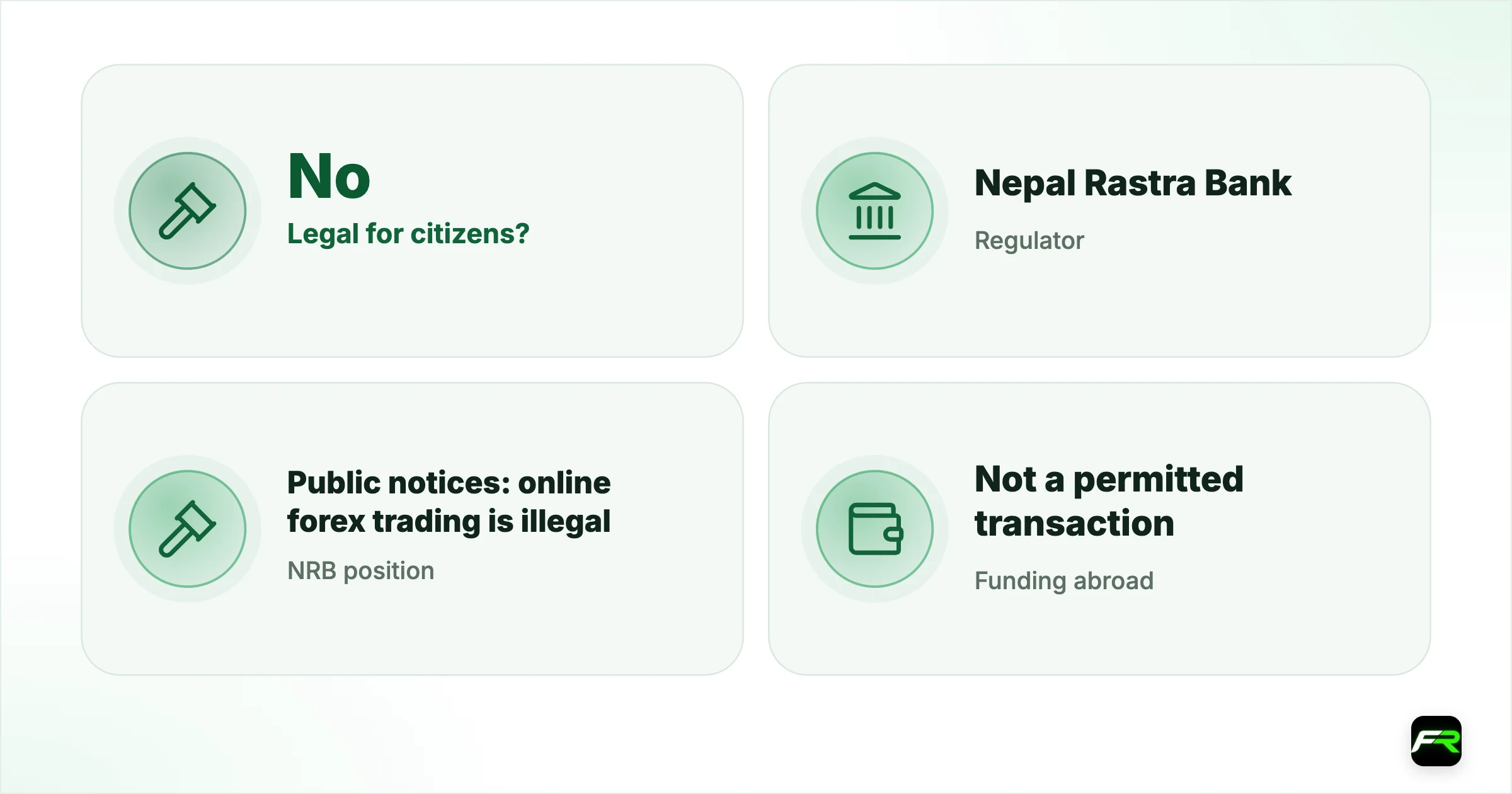
| Legal for citizens? | No |
|---|---|
| Regulator | Nepal Rastra Bank |
| NRB position | Public notices: online forex trading is illegal |
| Funding abroad | Not a permitted transaction |
| The one legal option | A demo account with virtual money |
| Time zone | GMT+5:45; Tokyo session ~05:45–14:45 local |
Sources and where to check it yourself
- Nepal Rastra Bank: official notices on foreign exchange and online forex
Frequently asked
Can Nepali citizens trade forex online?
No. Nepal Rastra Bank has stated in public notices that online forex trading is illegal for citizens, and funding an account abroad is not a permitted foreign exchange transaction. There is no licensed broker.
What happens if I trade forex from Nepal anyway?
You are acting against NRB's stated position, with no local recourse if the broker or a funding agent fails. Promoters and scheme operators are the main enforcement target, but the activity is not permitted for anyone.
Why is forex advertised so heavily in Nepal if it is illegal?
Affiliate marketing pays a commission per funded account and Nepal is inexpensive to advertise to. The promoter earns whether or not you profit or can withdraw, so the pitches are as confident as possible.
Is there any legal way to learn forex in Nepal?
Yes. A demo account with virtual money is fully open to you, because nothing crosses the border and there is no real deposit. Trade it at realistic sizes with a journal for three months and it teaches almost everything a live account would.
Do the rules apply to Nepalis working abroad?
A non-resident Nepali trades under the law of their country of residence. NRB's restriction applies to residents inside Nepal.
A forex agent is holding my money. What can I do?
Recovery is generally not realistic, because you dealt with the agent rather than a broker and there is no dispute process. Do not pay anyone who offers to recover it for a fee, save all records, and warn others.
The team behind this guide
Researched, checked and approved by five forex specialists
Every guide is written, fact-checked and edited before it goes live, and updated when the facts change. Spotted an error? Tell us.