IC Markets





























Cent Account vs Standard Account: Which Is Better for a $10 to $100 Start?
A cent account shows your balance in cents and lets you trade positions a hundred times smaller, so a $10 to $100 balance can use normal stops at sensible risk. Here is how it works, the costs and when to move up.
 WriterAbir KhanWriterWrites the guides · checks every figure against primary sources View profileAbout Abir →
 Market analysisTanbir Habib RiyadForex & Crypto AnalystForex and crypto analyst · technical and fundamental analysis View profileAbout Tanbir →
 Fact-checking & riskJannatul FerdaushFact-Checker & Risk AnalystFact-checks every figure · risk analysis · Applied Statistics, University of Dhaka View profileAbout Jannatul →
 Trading reviewJowel RanaCo-Founder & Forex TraderCo-founder · forex trader · reviews guides from a trader's view View profileAbout Jowel →
 Final approvalRanjan NiskrityFounder, Owner & Forex TraderFounder and owner · forex trader · signs off every guide View profileAbout Ranjan →
A cent account shows your balance and profits in cents instead of dollars, so a $10 deposit appears as 1,000. More importantly, positions are much smaller: a cent lot is usually a hundredth of a standard lot. That lets a very small balance trade with normal stop distances while risking only 1% to 2% per trade, which a standard account cannot do below about $500.
Cent accounts are a stepping stone between demo and full-size trading. They feel like real trading because they are real money, but the stakes are small. This page compares the two account types and shows when it makes sense to move up.
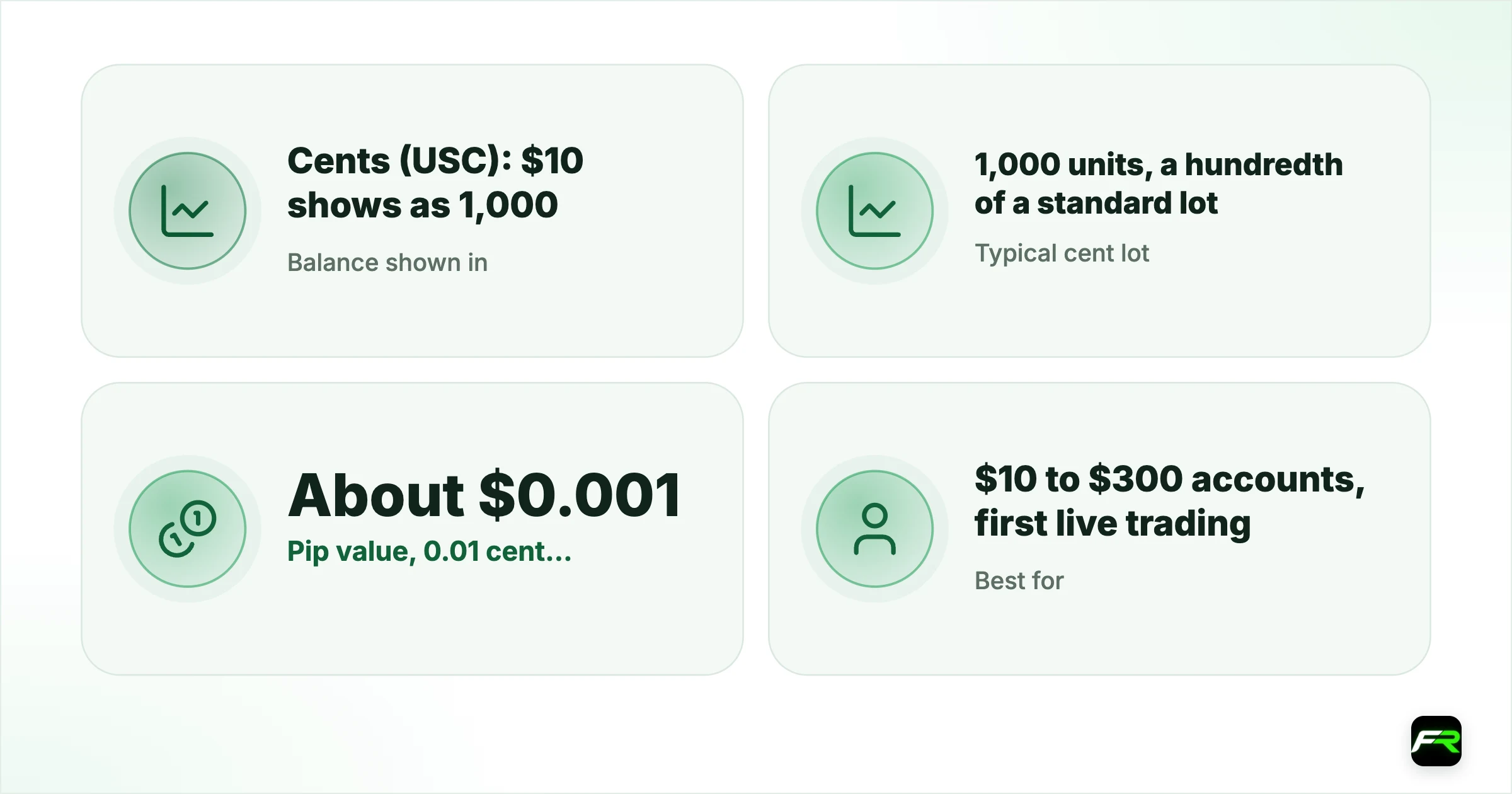
| Balance shown in | Cents (USC): $10 shows as 1,000 |
|---|---|
| Typical cent lot | 1,000 units, a hundredth of a standard lot |
| Pip value, 0.01 cent lot EUR/USD | About $0.001 |
| Best for | $10 to $300 accounts, first live trading |
| Watch for | Wider spreads, limited symbols, offshore entities |
Side by side
| Cent account | Standard account | |
|---|---|---|
| Balance display | Cents (1,000 = $10) | Dollars |
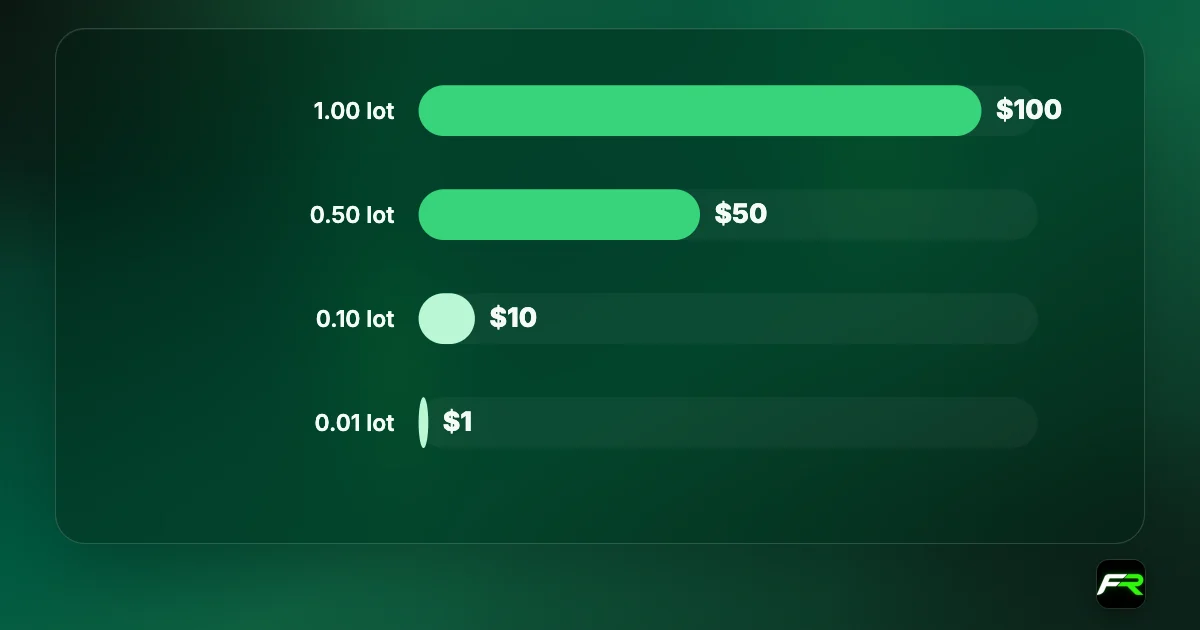
| Contract per 1.00 lot | Often 1,000 units | 100,000 units |
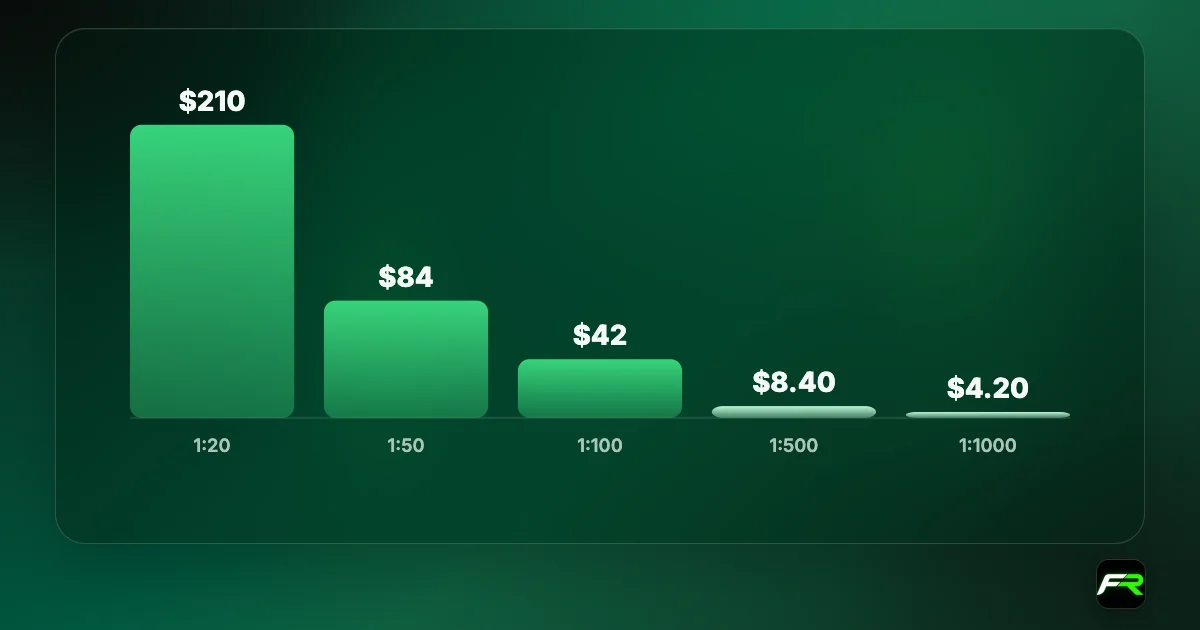
| Pip value per 1.00 lot, EUR/USD | Around $0.10 | About $10 |
| Smallest trade, EUR/USD pip value | Around $0.001 | About $0.10 |
| Typical minimum deposit | Very low | Low to moderate |
| Symbols | Main pairs and gold, fewer extras | Full range |
| Usual entity | Often offshore | Offshore or regulated |
Exact contract sizes and minimums vary by broker. Read the Specification on your account; our guides to Exness Standard Cent, LiteFinance cent, RoboForex cent and FXTM micro list each one.
Why cent accounts fit small balances
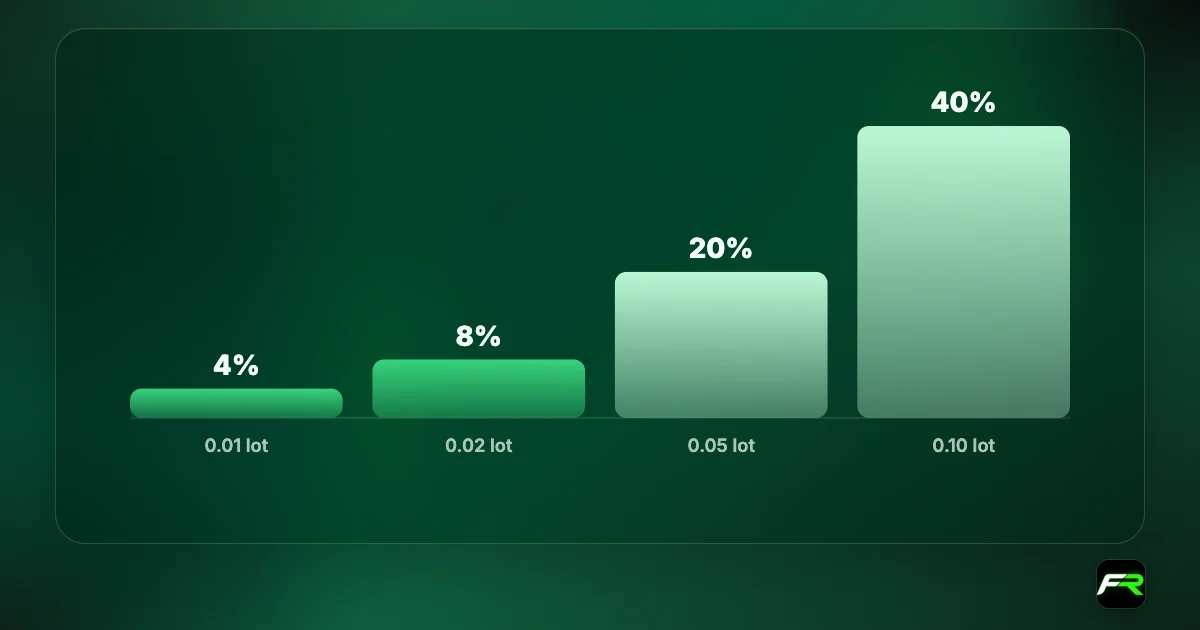
On a standard account, the smallest trade on EUR/USD is 0.01 lots, about $0.10 per pip. With a $50 balance, a 25-pip stop at that size risks $2.50, 5% of the account. A cent account lets you trade a fraction of that, so the same 25-pip stop can risk $0.50, which is 1%. The strategy stays the same; only the position size shrinks to fit the balance.
What it costs
Cent accounts are usually commission-free, with costs built into the spread. Spreads can be slightly wider than on raw accounts at the same broker. Because positions are small, the dollar cost per trade is tiny, but as a share of each trade's expected profit it is similar to a standard account. Swaps apply in the same way, scaled down.
The psychology of cents
Seeing 1,000 instead of $10 can make losses feel smaller or bigger than they are, depending on the person. Some traders take cent trading less seriously and develop bad habits; others feel the pressure of a large-looking number. Track results in dollars and percentages, not cent balances, so the move to a standard account later does not change how you see your numbers.
A trader in Kumasi deposits $30 on a cent account, shown as 3,000 cents. Each trade risks 30 cents of real money, 1% of the account, with 20 to 30-pip stops on EUR/USD and GBP/USD. After three months the account is at $33, a 10% gain, with a written journal of 72 trades. The trader moves to a standard account with $400 and keeps the same 1% rule, now risking $4 per trade.
When to move up to a standard account
- Your balance is large enough that 0.01 standard lots fits a 1% to 2% risk with your usual stop, roughly $400 to $500 for major pairs.
- You have followed a written plan for at least two to three months.
- The cent account lacks instruments or features you now need.
- You are ready for losses to feel real in dollars, not cents.
Moving funds between account types
Many brokers let you hold a cent account and a standard account side by side and move money between them in the client area. Internal transfers are usually free and quick, and the balance converts from cents to dollars automatically. Keep the cent account open for testing new ideas at tiny size after you move up; it is a cheap way to check a strategy with real fills before risking full-size positions.
Swaps and leverage on cent accounts
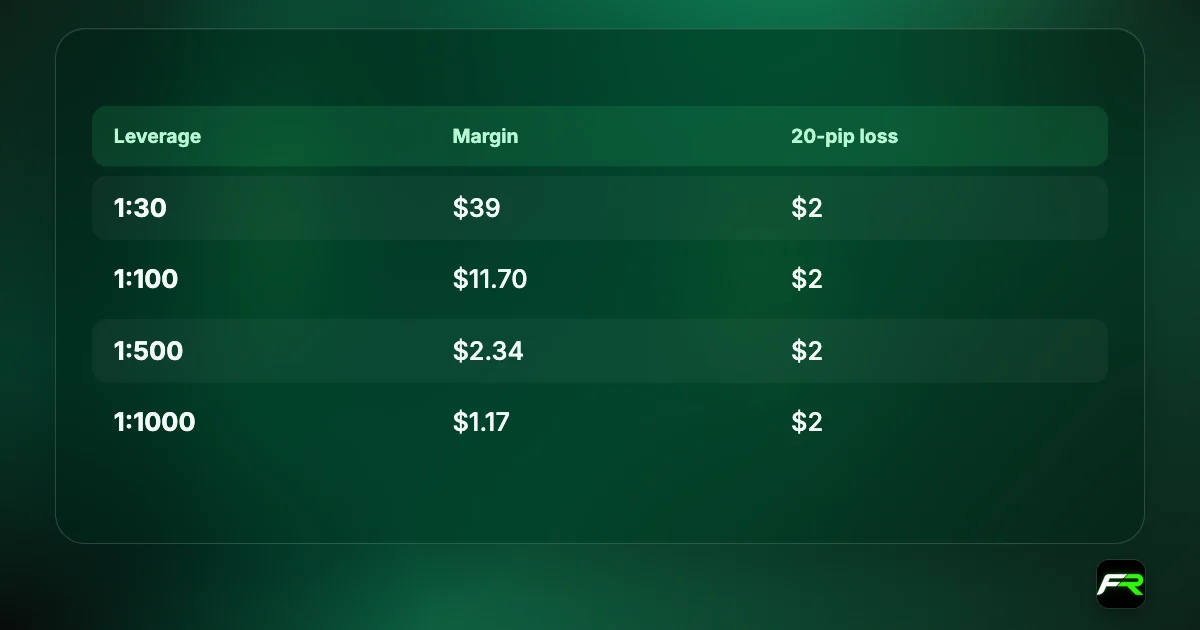
Swaps on cent accounts work like those on standard accounts, scaled to the smaller contract, and are shown in cents. Leverage is often high, since cent accounts usually sit with offshore entities. As on any account, the leverage setting does not change risk per pip; the position size does. Treat the maximum position the platform allows as irrelevant and size from your stop.
Regulation and entity
Cent accounts are mostly offered through brokers' offshore entities. That can mean higher leverage and fewer protections than an account with a top-tier regulator. Check which company holds the cent account and its licence on the regulator's register. Our guide to offshore and locally regulated brokers explains the differences.
Cent accounts vs demo accounts
A demo account uses virtual money and teaches the platform without risk. Cent accounts use real money in small amounts and teach discipline under real pressure: slippage, emotions and the temptation to break rules. Many traders find the jump from demo straight to a standard account too big, and a cent account fills the gap. See our demo account guide for the first step.
Common mistakes on cent accounts
- Trading the maximum size the cent account allows, which can be large relative to the balance.
- Treating it as a game and skipping stop losses.
- Comparing cent profits with standard-account traders' dollar results.
- Staying on cent forever instead of moving up once the plan works.
Set the same written rules on the cent account that you will use on a standard account: risk per trade, maximum trades per day, and when to stop for the week.
Small amounts do not make bad habits harmless. The behaviour you build on a cent account carries over when the money is bigger.
Frequently asked
What is a cent account in forex?
An account that shows balances in cents and uses smaller contracts, often a hundredth of a standard lot. A $10 deposit shows as 1,000. It lets very small accounts trade with normal stop distances at sensible risk.
Is a cent account better for beginners?
For small balances, often yes. It allows real-money trading at tiny risk, which builds discipline without large losses. Check the broker's entity, spreads and symbols before choosing one.
How much is 1 lot on a cent account?
Commonly 1,000 units of the base currency, a hundredth of a standard lot, so about $0.10 per pip on EUR/USD. Brokers differ, so read the contract size in the symbol's Specification window.
When should I switch from cent to standard?
When your balance lets 0.01 standard lots fit a 1% to 2% risk with your usual stop, roughly $400 to $500 on major pairs, and you have followed a plan for a few months.
Are cent accounts regulated?
They are usually offered by brokers' offshore entities, which have lighter regulation than top-tier regulators. Check the company holding the account and its licence on the regulator's register.
Do cent accounts have higher spreads?
Sometimes slightly higher than raw accounts at the same broker, usually with no commission. Because positions are small, the dollar cost is tiny, but compare spreads before choosing.
Official sources: ESMA: CFD product intervention measures
Related reading
The team behind this guide
Researched, checked and approved by five forex specialists
Every guide is written, fact-checked and edited before it goes live, and updated when the facts change. Spotted an error? Tell us.