IC Markets



































IC Markets vs FP Markets
These two are near-twins. Both Australian, both watched by strict regulators, both cheap. The useful answer is that one is cheaper on one account type and the other is cheaper on the other, so the choice depends on how you plan to trade. Here is which suits you.
 WriterAbir KhanWriterWrites the guides · checks every figure against primary sources View profileAbout Abir →
 Market analysisTanbir Habib RiyadForex & Crypto AnalystForex and crypto analyst · technical and fundamental analysis View profileAbout Tanbir →
 Fact-checking & riskJannatul FerdaushFact-Checker & Risk AnalystFact-checks every figure · risk analysis · Applied Statistics, University of Dhaka View profileAbout Jannatul →
 Trading reviewJowel RanaCo-Founder & Forex TraderCo-founder · forex trader · reviews guides from a trader's view View profileAbout Jowel →
 Final approvalRanjan NiskrityFounder, Owner & Forex TraderFounder and owner · forex trader · signs off every guide View profileAbout Ranjan →


IC Markets and FP Markets share many similarities in pricing, regulation, and trading platforms, although they differ in several important areas. Both Australian, both regulated by respected financial authorities, both cheap. The better choice depends largely on the account type and trading style you intend to use. So the choice depends on how you plan to trade. Here is which suits you.
IC Markets and FP Markets share many similarities. Both are Australian, born two years apart in Sydney. Both brokers are regulated by respected financial authorities, including ASIC and CySEC through relevant entities. Client funds are held in segregated client accounts in accordance with applicable regulatory requirements.
Both run MT4 and MT5, both offer spreads starting from 0.0 pips on Raw accounts. Neither broker generally offers deposit bonuses under their ASIC and CySEC regulated entities. Availability may vary by jurisdiction. Both brokers maintain strong regulatory credentials, although independent trust ratings differ between review providers.
Quick Answer
| Best for | Winner | Why |
|---|---|---|
| Commission-free trading | IC Markets | Tighter gap, about 1.10 pips against 1.19 |
| Raw account trading | FP Markets | $6 per round turn against $7 |
| Starting small | FP Markets | $100 to open, against $200 |
| Fast, reliable trades | IC Markets | Built for speed, favoured by rapid traders |
| Trading real shares | FP Markets | IRESS gives thousands, if your country allows it |
| Copying other traders | IC Markets | More options built in |
| Paying by PayPal | IC Markets | FP Markets does not take it |
Comparison Table
| IC Markets | FP Markets | |
|---|---|---|
| Started | 2007, Sydney | 2005, Sydney |
| Smallest deposit | $200 | $100 |
| Commission-free gap (EUR/USD) | About 1.10 pips | About 1.19 pips |
| Raw account | 0.0 pips + $3.50 per side ($7 round turn) | 0.0 pips + $3 per side ($6 round turn) |
| Watched by | ASIC and CySEC, both strict, plus offshore arms | ASIC and CySEC, both strict, plus offshore arms |
| Software | MT4, MT5, cTrader, TradingView | MT4, MT5, IRESS, TradingView |
| Things you can trade | About 3,500 | Over 10,000, but see the catch below |
| Copy trading | Built in, several options | Fewer options |
| PayPal | Yes | No |
| Free credit | None | None |
| Max leverage | 1:500 (some sites say 1:1000) | 1:500 |
Check these on each broker’s own site before you trust them. Sources disagree on IC Markets’ top leverage, listing each broker 1:500 and 1:1000, and on how many copy-trading options FP Markets has. Gaps also move through the day, so treat these as normal-hours figures.
Trading Costs
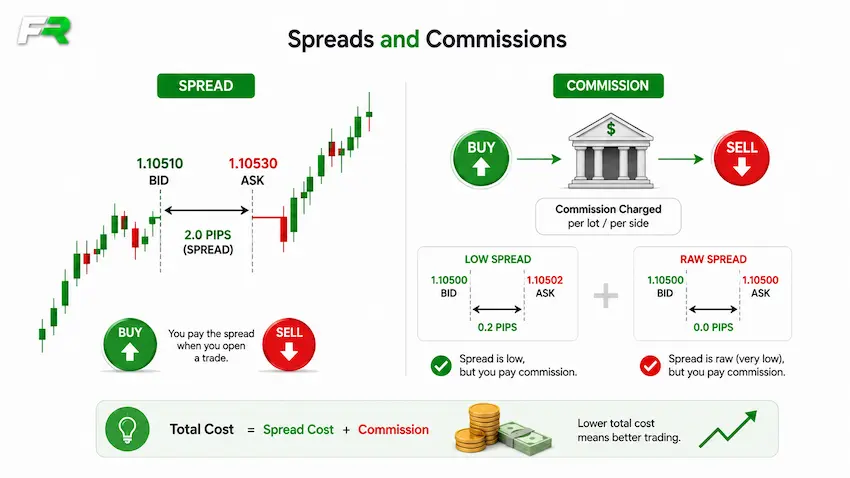
Trading costs are one of the most important factors when comparing these brokers, and it is where most comparisons get lazy and say “each broker is competitively priced.”
If you trade commission-free, IC Markets is cheaper.
Its spread on EUR/USD averages about 1.10 pips against FP Markets’ 1.19. Small, but it holds across nearly every currency pair, not just one or two.
If you use a raw account, FP Markets is cheaper.
The two brokers drop the spread to almost nothing. Then FP Markets Raw account commission varies by account currency and entity, so $6 to open and close a trade. IC Markets charges $3.50 per side, so $7. Although the difference appears small, it can become meaningful for high-frequency traders over time.
So there is no single cheaper broker here. There is only a cheaper broker for how you trade. If you are new and not ready for commission accounts, IC Markets costs you less. If you have mmt5oved on to a raw account, FP Markets costs you less.
One more consideration beginners miss: a raw account is not always the lower-cost option than commission-free. You have to trade often enough for the smaller spread to make up for the fee. Many new traders begin with a standard spread account before considering a raw spread account as their trading volume increases, and switch only when your trading volume makes it worth it.
Which Broker Is Safer?
From a regulatory perspective, each broker offers a comparable level of oversight under their regulated entities.
A regulator is the body that watches a broker and can punish it. Both brokers are watched by ASIC in Australia and CySEC in Cyprus. The two brokers are strict. Each broker keeps customer money in a separate account, so the company cannot spend it. Each broker has operated for many years under regulated entities.
There is one small wrinkle worth knowing. Others point out that Investor compensation and protections depend on the regulated entity under which the account is opened.These pull in opposite directions and neither is a reason to pick one over the other.
The thing that matters far more: check which arm of the broker will hold your account. Each broker company runs several, and the protection you get under the Australian or European arm generally provides greater regulatory safeguards than under their offshore ones. Your country decides which you get, so verify before opening an account before you deposit rather than after.
Platforms
Both give you MT4 and MT5, the standard software nearly everyone learns on. Each broker adds TradingView charts. After that they split.
IC Markets adds cTrader. It is popular with people who trade fast or run automated strategies, and its raw account on cTrader can carry lower fees than the MetaTrader version.
FP Markets adds IRESS instead. This is the one that lets you buy real shares directly rather than bet on their price. It is a serious tool, and is generally aimed at experienced equity traders on day one.
Neither choice is better. They serve different people. If you have no view on cTrader or IRESS, this section should not be the deciding factor on its own.
What You Can Trade
FP Markets advertises over 10,000 things to trade. IC Markets offers about 3,500. That looks like a significant difference.
Read the important limitation. Almost all of FP Markets’ extra range sits inside IRESS, and IRESS is not available everywhere. It is restricted by country, and it needs a much larger deposit to open. If you cannot get IRESS where you live, FP Markets drops to roughly 144 markets on MT4 and MT5, which is far fewer than IC Markets gives everyone.
So the 10,000 number is real, but only if your country is on the list. IC Markets treats every customer the same, which is quietly the more more consistent product offering for most people. IC Markets primarily offers CFDs. Availability of share investing depends on entity and platform.
Check whether IRESS is available to you before you let that number decide anything.
Leverage
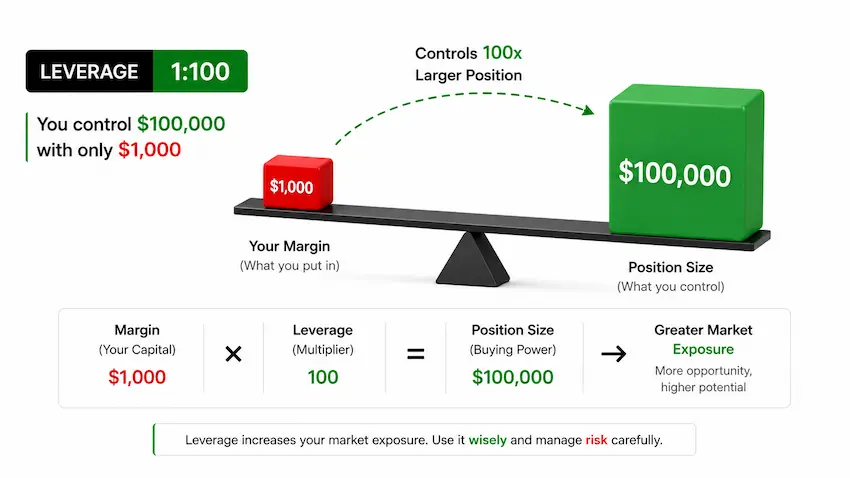
Leverage means borrowing from your broker so you can trade more than you have.
Maximum leverage depends entirely on the regulated entity. Retail ASIC/CySEC clients are limited to 1:30. Offshore entities may offer higher leverage. Either way, if you sign up under the Australian or European arm, you are capped at 1:30, because strict regulators require it.
Regulatory leverage limits are designed to reduce retail trading risk. Leverage grows your losses exactly as fast as your wins, and heavy leverage is the most common way beginners lose everything. If you are new, the low cap is intended to improve retail investor protection.
Final Verdict
choose FP Markets if you are starting with a small amount, since $100 gets you in against IC Markets’ $200. Choose it too if you are already trading enough to use a raw account, because $6 per round beats $7 and that spreads compounds. And choose it if IRESS is available where you live and you want real shares.
choose IC Markets if you are new and trading commission-free, because its gaps are tighter across the board and that is the account you will start on. choose it if you want cTrader, if you want to copy other traders, or if you want PayPal. IC Markets reports one of the industry’s largest trading volumes, although customer numbers are not directly comparable.
If you want it in one line: start on IC Markets, and consider FP Markets once you move to a raw account. That is based on the pricing structure, it is what the numbers say. Both are well-established regulated brokers, which is not something you can say about most pairs. Both brokers are well-established choices depending on your trading requirements.
FAQ
Which is cheaper, IC Markets or FP Markets?
It depends on your account. Commission-free, IC Markets is cheaper because its gaps are tighter. On a raw account, FP Markets is cheaper at $6 per round turn against $7.
Which is safer?
Neither, really. Both are watched by ASIC and CySEC, both keep their money separate, and both have long operating history under regulatory oversight. What matters more is which arm of the broker your country puts you under.
Does either give a bonus?
No. Neither offers welcome or deposit bonuses. Their strict regulators restrict them, which is a good sign rather than a mean one.
Can I trade real shares?
FP Markets offers thousands through IRESS, but only if your country allows it and you can meet the larger deposit. IC Markets offers shares on international exchanges to everyone.
Which is better for a complete beginner?
IC Markets, narrowly. You will start commission-free, and that is the account where its pricing wins. FP Markets is the better choice if $200 is a stretch and $100 is not.

Why you can trust FX Recap
FX Recap is an independent Forex media platform. Every broker score comes from our published methodology, including live account testing, regulatory verification, and real trader feedback, so you can make smarter trading decisions.
Read our methodologyAdvertising Disclosure
We prioritize rigorous, unbiased broker testing through our published methodology. Forex and CFD trading carries significant risk of loss, so read our Risk Notice before you trade. While our ratings stay objective, we receive compensation that may influence list placement. Learn how we make money.
Current Offers & Promotions
 Promotion
IC Markets 100% Deposit Bonus 2026
IC Markets is offering new and existing traders a 100% deposit bonus on their first deposit, plus a 50% bonus…
View Offer