IC Markets




































Australian Employment Falls 39,300 as the Jobless Rate Edges Up to 4.7%
Part-time jobs dropped 73,700 in September while full-time work grew. AUD/USD slipped below 0.6960 as traders weighed the RBA's next move in November.
 WriterAbir KhanWriterWrites the guides · checks every figure against primary sources View profileAbout Abir →
 Market analysisTanbir Habib RiyadForex & Crypto AnalystForex and crypto analyst · technical and fundamental analysis View profileAbout Tanbir →
 Fact-checking & riskJannatul FerdaushFact-Checker & Risk AnalystFact-checks every figure · risk analysis · Applied Statistics, University of Dhaka View profileAbout Jannatul →
 Trading reviewJowel RanaCo-Founder & Forex TraderCo-founder · forex trader · reviews guides from a trader's view View profileAbout Jowel →
 Final approvalRanjan NiskrityFounder, Owner & Forex TraderFounder and owner · forex trader · signs off every guide View profileAbout Ranjan →
Australia's labour market lost ground in September. Employment fell by 39,300 people to 14,782,700, and the unemployment rate rose 0.1 percentage point to 4.7%, the Australian Bureau of Statistics said on Thursday. The participation rate, the share of people working or looking for work, dropped 0.2 point to 66.8%.
The Australian dollar dipped on the news. AUD/USD fell from about 0.6980 at 00:00 UTC to a low of 0.6949 in the following hour and was trading near 0.6960 at 03:05 UTC. The data comes two and a half weeks after the Reserve Bank of Australia raised its cash rate to 4.60%, and three weeks before its next decision.
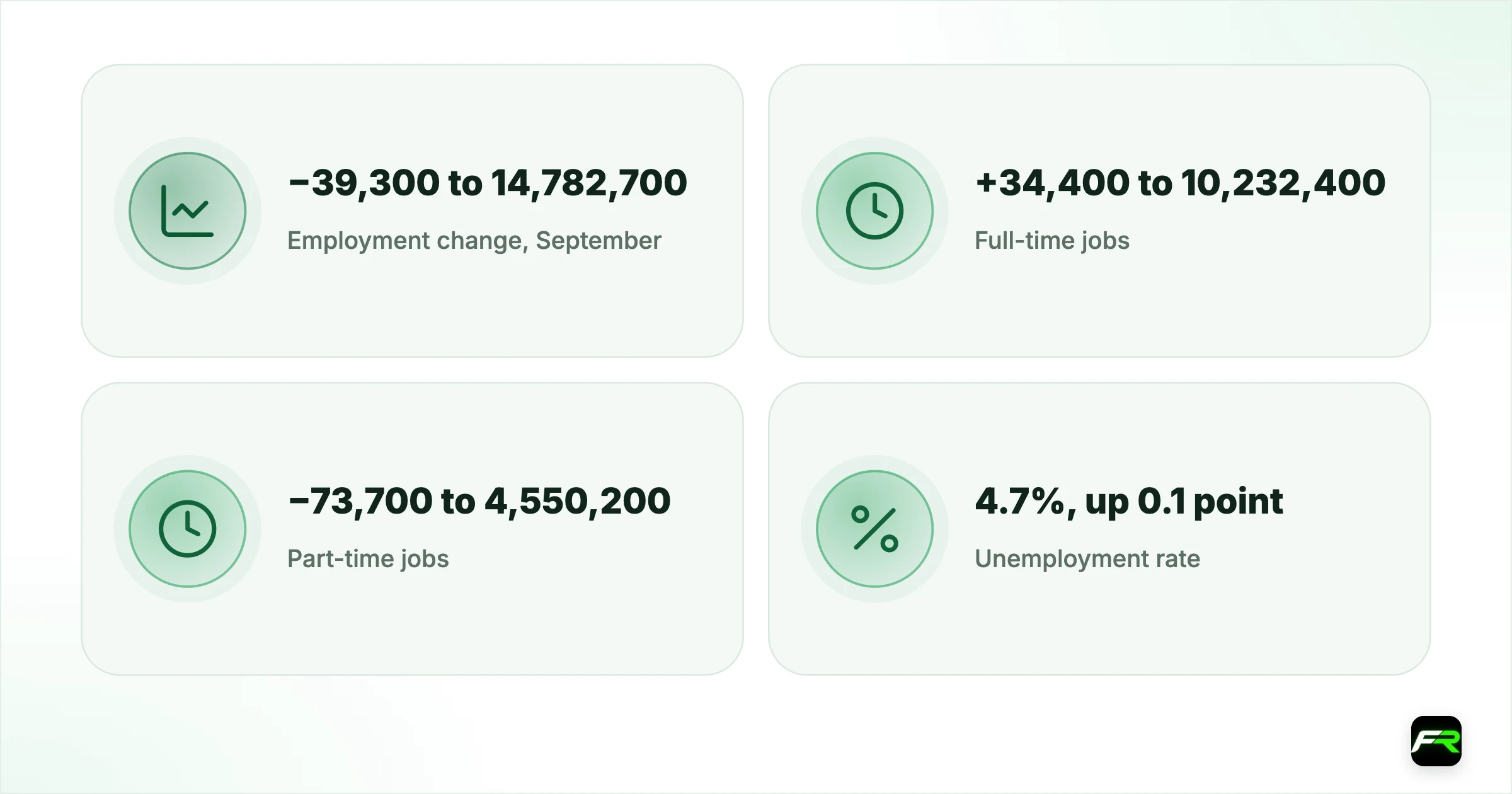
| Employment change, September | −39,300 to 14,782,700 (seasonally adjusted) |
|---|---|
| Full-time jobs | +34,400 to 10,232,400 |
| Part-time jobs | −73,700 to 4,550,200 |
| Unemployment rate | 4.7%, up 0.1 point |
| Participation rate | 66.8%, down 0.2 point |
| RBA cash rate | 4.60% after the 29 September hike |
| Next RBA decision | 3 November 2026 |
What the September jobs data showed
The headline drop hides a split. Full-time employment rose by 34,400, while part-time employment fell by 73,700, according to the ABS. Monthly hours worked, a measure that captures both, edged up by 1.3 million hours to 2,011 million. So the economy used slightly more labour in September even as the number of people in work fell, because the losses were concentrated in shorter-hours jobs.
Slack still rose. The number of unemployed people increased by 8,900 to 732,000. Underemployment, which counts workers who want more hours, rose 0.1 point to 6.3%, and the broader underutilisation rate climbed 0.2 point to 11.0%. Youth unemployment rose 0.3 point to 11.1%. The employment-to-population ratio fell 0.3 point to 63.6%.
Men and women saw different shifts. Unemployment for men held at 4.8%, while the rate for women rose 0.1 point to 4.6%, according to the ABS. Participation fell for both groups: by 0.3 point to 70.6% for men and by 0.1 point to 63.1% for women. Fewer people looking for work kept the jobless rate from rising further, which is worth remembering when you read the 4.7% headline.
Over the year, employment is still up by 168,300 people, or 1.2%. The ABS's trend series, which smooths out monthly noise, is steadier: trend employment rose 15,700 in September, and the trend unemployment rate held at 4.6%. Monthly labour figures are volatile, so a single weak month does not make a downturn. Still, slack has built over the year: the trend unemployment rate is 0.3 point higher than in September 2025.
| Measure (seasonally adjusted) | August 2026 | September 2026 | Change |
|---|---|---|---|
| Employed people | 14,822,000 | 14,782,700 | −39,300 |
| Unemployed people | 723,100 | 732,000 | +8,900 |
| Underemployment rate | 6.2% | 6.3% | +0.1 point |
| Participation rate | 67.0% | 66.8% | −0.2 point |
Source: ABS, Labour Force, Australia, September 2026. Changes are calculated from unrounded figures.
One note on the data. September's release marks the return of the ABS's full set of Labour Force products after its modernisation work, so some series and tables look different from recent months.
Monthly hours are worth a second look whenever headcount and hours disagree. A drop in part-time workers alongside a rise in full-time jobs and slightly higher total hours points to a reshuffle of work rather than a broad wave of layoffs. If next month's release shows hours falling as well, that would be a clearer sign of weakening demand for labour, and a stronger argument for the RBA to hold rates.
Why the RBA is watching closely
The Reserve Bank raised its cash rate target by 25 basis points to 4.60% on 29 September, its fourth increase of 2026 according to the board's statement, which refers to three earlier rises since the start of the year. The decision was unanimous, and the board said inflation remained elevated, that the Middle East conflict had broadened and that global energy prices were "much higher than had been assumed in the August forecasts".
The same statement said labour market conditions "have eased broadly as expected in recent months". September's figures fit that description: slightly higher unemployment and lower participation, without a collapse in hours. The board also said it will "continue to do what it considers necessary" to bring inflation back to target, "including increasing the cash rate target further if needed".
Inflation, not jobs, is the key number before the next meeting. The ABS publishes the September consumer price figures on Wednesday 28 October at 11:30 a.m. Australian Eastern Daylight Time. The RBA's Monetary Policy Board then meets on 2 and 3 November, with the decision on the 3rd. A softening labour market gives the board a reason to be patient, but a strong inflation reading could outweigh it.
What it means for AUD/USD
The Australian dollar has been resilient this month. It has traded between roughly 0.6915 and 0.7015 since the start of October, briefly rising above 0.70 on Wednesday before the US inflation report pulled it back. Today's dip took it to the lower half of that band. Two forces are pulling in opposite directions: a central bank that is still raising rates, which supports the currency, and a US dollar that remains strong against most majors.
For short-term traders, today's data slightly weakens the case for another RBA hike in November, which is mildly negative for the Aussie. Over longer horizons, the bigger drivers are commodity prices, China's demand and the gap between Australian and US interest rates. With the RBA at 4.60% and the Fed's range at 3.75% to 4.00%, Australian rates are higher than US rates, which helps the Aussie when global markets are calm.
The RBA's September statement also flagged forces beyond the jobs market. It said housing prices have fallen in most capital cities and new housing loans have declined noticeably, while growth in business investment and debt is strong. It added that weak productivity growth continues to constrain potential growth. Those cross-currents matter for the currency: a cooling housing market and softer hiring argue for a pause, but strong investment and high energy prices keep inflation risks alive. Traders should expect the board's 3 November statement to weigh all of them, not just today's employment figure.
- Mark 28 October (Australian CPI, 00:30 UTC) and 3 November (RBA decision) in your economic calendar.
- Watch the 0.6915 and 0.7015 extremes of October's range; a daily close outside either would signal the next direction.
- Remember that US data moves AUD/USD too: the Fed decides on 28 October, later on the same day as the Australian CPI release.
- Use the position size calculator so one trade risks no more than 1% to 2% of your account.
A trader in Sydney buys one mini lot (10,000 units) of AUD/USD at 0.6955 with a stop at 0.6910, below the October low, and a target at 0.7010. Each pip is worth $1, so the stop risks $45, about A$65 at current rates, and the target would make $55. If the Australian CPI release on 28 October gaps the pair through the stop, the loss could be larger, so the trader plans to close or reduce the position before that release.
Currency moves around jobs and inflation data can be sharp. Leverage magnifies losses as well as gains, so size each trade by the money you can afford to lose.
Labour figures are from the Australian Bureau of Statistics, Labour Force, Australia, September 2026. The rate decision and quotes are from the Reserve Bank of Australia's statement of 29 September 2026, and meeting and release dates are from the RBA and ABS calendars. AUD/USD levels are market data from hourly bars and differ slightly between providers. This is news, not investment advice.
Frequently asked
What was Australia's unemployment rate in September 2026?
The seasonally adjusted unemployment rate rose 0.1 percentage point to 4.7%, according to the ABS. In trend terms it held at 4.6%.
How many jobs did Australia lose in September 2026?
Employment fell by 39,300 people to 14,782,700. Full-time employment rose by 34,400, while part-time employment fell by 73,700.
What is the RBA cash rate now?
The Reserve Bank of Australia raised the cash rate target by 25 basis points to 4.60% on 29 September 2026. Its next decision is on 3 November 2026.
When is Australia's next CPI release?
The ABS publishes the September 2026 Consumer Price Index on Wednesday 28 October 2026 at 11:30 a.m. AEDT, which is 00:30 UTC.
Sources: Australian Bureau of Statistics: Labour Force, Australia, September 2026 · Reserve Bank of Australia: Monetary Policy Decision, 29 September 2026 · Reserve Bank of Australia: Board meeting schedules · Australian Bureau of Statistics: release calendar
The team behind this guide
Researched, checked and approved by five forex specialists
Every guide is written, fact-checked and edited before it goes live, and updated when the facts change. Spotted an error? Tell us.