 IC Markets




































What is Lot Size in Forex
Lot size sets how much you gain or lose per pip. How lot sizes work, how to calculate the right one, and the rules that protect your account.
 WriterAbir KhanWriterWrites the guides · checks every figure against primary sources View profileAbout Abir →
 Market analysisTanbir Habib RiyadForex & Crypto AnalystForex and crypto analyst · technical and fundamental analysis View profileAbout Tanbir →
 Fact-checking & riskJannatul FerdaushFact-Checker & Risk AnalystFact-checks every figure · risk analysis · Applied Statistics, University of Dhaka View profileAbout Jannatul →
 Trading reviewJowel RanaCo-Founder & Forex TraderCo-founder · forex trader · reviews guides from a trader's view View profileAbout Jowel →
 Final approvalRanjan NiskrityFounder, Owner & Forex TraderFounder and owner · forex trader · signs off every guide View profileAbout Ranjan →
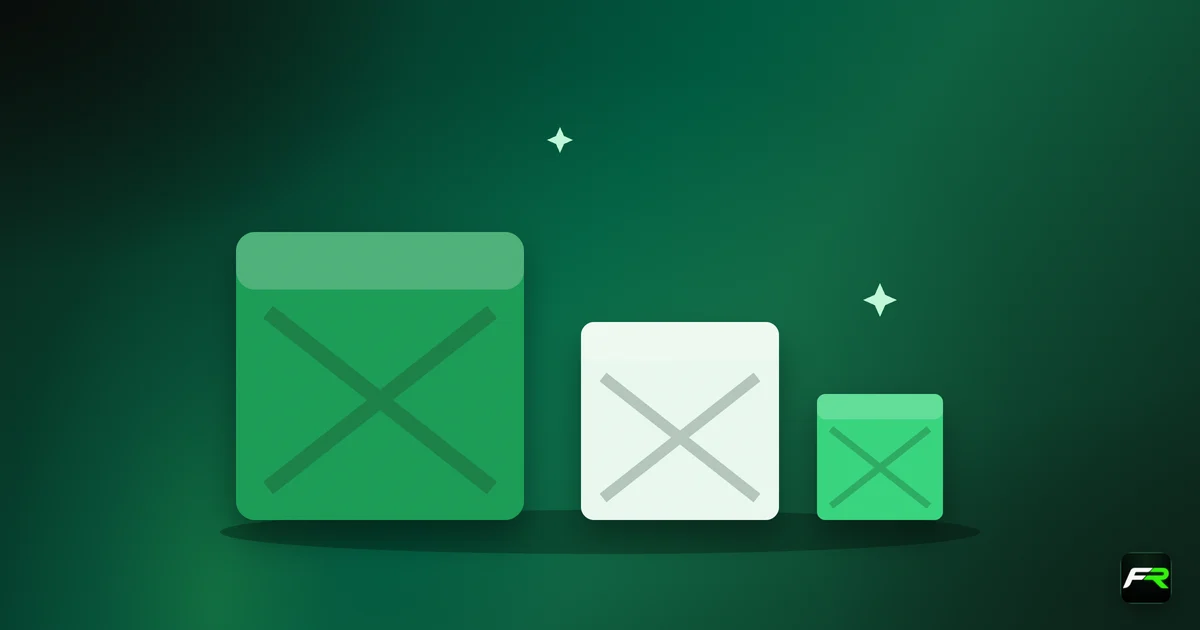
Lot size is one of the first real concepts that separates traders who last from those who blow up their accounts in the first few months. It sounds technical, but the idea is simple: every time you place a trade in forex, you choose how many units of currency you are buying or selling. That quantity is your lot size.
Get it right and your risk stays manageable. Get it wrong and a single bad trade can wipe out weeks of gains. This article walks you through the mechanics of lot size, shows you how to calculate the right size for any trade, and shares real examples of what happens when traders do and do not take it seriously.
What Is Lot Size in Forex?
A lot is a standardized unit of measurement for trade size. When you open a position, you are not trading random amounts; you are trading in specific lot sizes that the market and your broker recognize.
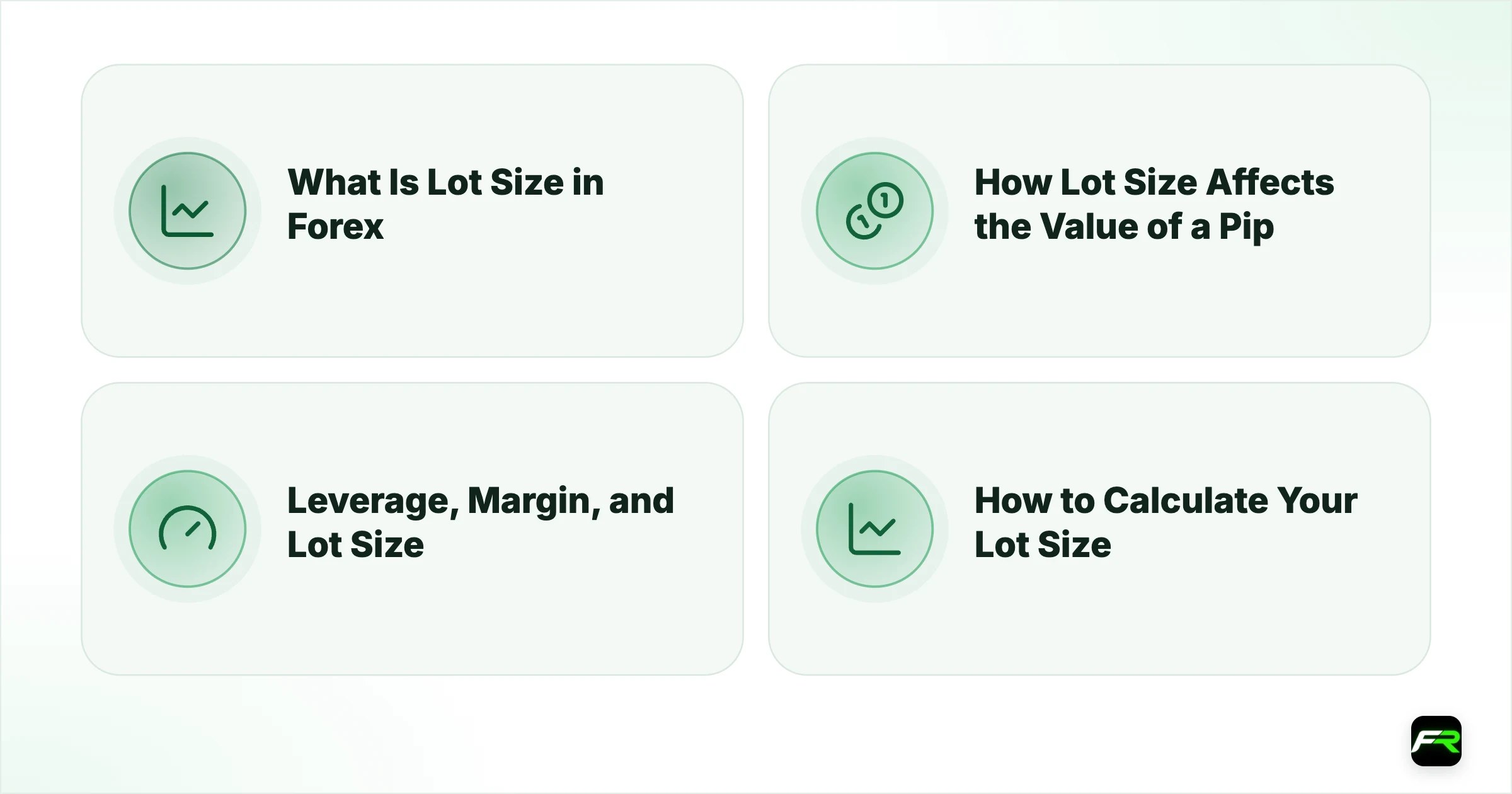
The four standard types are:
- Standard lot: 100,000 units of the base currency
- Mini lot: 10,000 units
- Micro lot: 1,000 units
- Nano lot: 100 units (offered by select brokers, not universal)
To put this in concrete terms: if you are trading EUR/USD, the base currency is the Euro. Buying one standard lot means you are buying 100,000 euros against US dollars. Buying one micro lot means you are buying 1,000 euros.
Most retail traders, especially those starting out, work with micro and mini lots. Standard lots require significant capital and tolerance for larger account swings. Nano lots suit complete beginners who want to trade live with minimal financial exposure while still learning.
What Lot Size Looks Like on a Trading Platform
When you open an order in MetaTrader 4 or MetaTrader 5, you will see a field called Volume, not lot size. The two mean the same thing. Volume 1.00 is one standard lot, 0.10 is a mini lot, and 0.01 is a micro lot. So if your calculation tells you to trade 0.04 lots, you simply enter 0.04 in the Volume field. Most brokers set the minimum at 0.01 and allow increments of 0.01, though this varies by broker.
How Lot Size Affects the Value of a Pip
Your lot size determines how much money each pip move is worth. If you are not yet familiar with pips, this breakdown of what a pip is in forex is worth reading first. For most major pairs quoted against the US dollar, like EUR/USD or GBP/USD, pip values work out like this:
- Standard lot (100,000 units): approximately $10 per pip
- Mini lot (10,000 units): approximately $1 per pip
- Micro lot (1,000 units): approximately $0.10 per pip
So a 50-pip move in your favor on a standard lot earns 50 x $10 = $500. The same move on a micro lot earns 50 x $0.10 = $5. The math scales exactly, which is what makes lot size such a direct lever on your profit and loss.
The JPY Exception
For pairs that include the Japanese Yen, such as USD/JPY or EUR/JPY, the pip sits at the second decimal place rather than the fourth. For a standard lot of USD/JPY, one pip is worth approximately $9.30, not $10, and the value shifts with the exchange rate. Many new traders apply the standard $10 figure to JPY pairs and end up with a slightly off lot size calculation. Always verify pip value with your broker’s tool when trading a pair you are less familiar with.
Leverage, Margin, and Lot Size
Forex brokers offer leverage, which lets you control a large position with a relatively small amount of capital. With 100:1 leverage, a $2,000 account can control up to $200,000 in currency. But controlling that much and using that much are very different decisions.
Consider two traders, both with a $2,000 account and 100:1 leverage. Trader A opens 0.02 lots. A 50-pip move against them costs $1, less than 0.1% of their account. Trader B opens 1.0 lots. The same 50-pip move costs them $500, which is 25% of their account gone on a single trade. Same market, same broker, completely different outcomes because of lot size choice.
Margin is the amount your broker sets aside as collateral while your trade is open. If your account equity falls too close to your used margin, you receive a margin call and your positions may be closed automatically. Understanding how forex margin works will help you avoid that situation before it happens.
How to Calculate Your Lot Size
Most experienced traders do not guess their lot size. They calculate it from three inputs before every trade: account balance, risk percentage, and stop-loss distance in pips.
The Formula
Lot size = (Account Balance x Risk %) / (Stop Loss in Pips x Pip Value per Standard Lot)
Here is a worked example. Account balance: $2,000. Risk per trade: 1% = $20. Stop loss: 50 pips. Pip value per standard lot on EUR/USD: $10.
Lot size = $20 / (50 x $10) = $20 / $500 = 0.04 standard lots
You enter 0.04 in the Volume field. Your maximum loss on the trade is $20, exactly 1% of your account. If the trade hits your stop-loss, that is all you lose.
Why Stop-Loss Distance Changes Your Lot Size
A wider stop-loss means you need a smaller lot size to keep the same dollar risk. A tighter stop-loss lets you use a larger lot size for the same dollar risk. Using the same $20 risk amount: a 10-pip stop gives you 0.20 lots, a 50-pip stop gives 0.04 lots, and a 100-pip stop gives 0.02 lots. The dollar risk is identical in all three cases. This is why you always set your stop-loss at a technically logical level first, then calculate lot size from it.
Lot Size as a Risk Management Tool
The most consistent traders follow a clear rule: never risk more than 1% to 2% of your account on any single trade. At 1% risk, you need 100 consecutive losing trades to wipe out your account. That is nearly impossible if your strategy has any real edge. At 10% risk, ten consecutive losers finish you, which is entirely possible during a rough stretch of markets.
Lot size is the variable you adjust to stay within that threshold regardless of where your stop sits. The dollar risk stays constant. Only the lot size changes. This is the foundation of forex risk management, and it is where long-term traders separate themselves from those who do not last.
One common mistake is scaling lot sizes up after a winning streak. That confidence is a psychological response to recent results, not information about what the market will do next. Increasing lot size should follow a deliberate plan, not a mood.
Adjusting Lot Size for Market Volatility
Most lot size explanations treat position sizing as a fixed formula. In practice, volatility should influence your decisions too.
During high-volatility periods, such as major economic data releases or central bank rate decisions, price can move sharply and unpredictably. In fast markets, orders sometimes fill at a worse price than requested, which is called slippage. Your stop-loss might be set at 30 pips, but if the market moves aggressively through it, you could exit at 45 pips of loss instead.
Experienced traders often reduce their lot size ahead of known high-impact events, not because they lack conviction in their trade, but because unpredictable conditions make stop placement less reliable. A smaller position absorbs that uncertainty without threatening the account. The currency pair matters too. Major pairs like EUR/USD are deeply liquid and tend to move in more measured ways than exotic pairs, which can spike aggressively on thin volume.
When and How to Scale Your Lot Size Up
Growing your lot size should be a structured decision, not a spontaneous one. The right conditions are: your account has grown enough that your current lot size now represents a smaller percentage of equity than intended; you have a track record of at least 50 to 100 trades showing consistent results across different market conditions; and your drawdown history shows your strategy can handle losing streaks without serious damage.
The wrong time to scale up is immediately after a winning streak. When you do increase, move in small steps. Going from 0.02 lots to 0.03 lots is already a 50% increase in exposure. Give each new size at least 30 to 50 trades before moving further. If the new size is causing anxiety or pushing you to exit trades early, it is too large for your current comfort level regardless of what your balance technically allows.
Real Stories: Discipline vs. Ambition
Maria: The Trader Who Kept Her Lots Small
Maria started with $5,000 and one rule: no single trade would risk more than $50, which was 1% of her account. That meant sticking to mini and micro lots almost entirely. There were stretches where she watched other traders post bigger short-term gains by sizing up aggressively. She stayed disciplined anyway. Over three years, she averaged an 8% annual return and only three times saw a drawdown exceed 5% of her account. The small lot sizes were not a limitation. They were what made it possible to stay calm, follow her plan, and survive the losing streaks that ended less disciplined traders around her.
John: Two Standard Lots and No Plan
John came to forex with a finance background and a $4,000 account. He was confident in his EUR/USD analysis and opened two standard lots with no stop-loss and no plan for how much he was willing to lose. A few days later, a news release moved the market 30 pips against him. Two standard lots at $10 per pip means $20 lost per pip across the position. That 30-pip move cost him $600. Had the move been 100 pips, he would have lost $2,000, half his account on a single unmanaged trade. The lesson was never about whether his analysis was right. It was about never having thought through what lot size was appropriate before pressing buy.
A Practical Pre-Trade Lot Size Checklist
Before entering any trade, work through these in order:
- What is my current account balance?
- What percentage am I risking on this trade? (Aim for 1% to 2%)
- Where is my stop-loss, and how many pips from my entry is it?
- What is the pip value per standard lot for this pair? (JPY pairs differ from USD-quoted majors)
- Using the formula: Risk Amount / (Stop Loss Pips x Pip Value), what is my lot size?
- Is there a high-impact event nearby that warrants reducing size further?
- Am I sizing based on the calculation, or on how confident I feel about this trade?
If you can honestly answer all of these before opening a position, you are treating lot sizing as a process rather than a guess. Practicing this on a demo account before going live is one of the most underrated habits you can build.
Summary
Lot size is not a detail you sort out after finding a good trade. It is one of three core inputs that structure every position from the start, alongside your entry price and your stop-loss level.
The traders who handle lot size well are not necessarily the ones with the sharpest analysis. They are the ones who understand that staying in the game long enough to compound gains requires keeping each trade’s risk small, consistent, and calculated rather than felt.
Start with micro or mini lots. Learn the formula and apply it before every trade. Factor in JPY pip value differences when trading yen pairs. Increase lot size only when your account growth and track record justify it. Those habits will not guarantee profitable trading, but they will guarantee that one bad trade does not end your forex journey before it has a real chance to develop.
The team behind this guide
Researched, checked and approved by five forex specialists
Every guide is written, fact-checked and edited before it goes live, and updated when the facts change. Spotted an error? Tell us.
Related Articles
 Education
9 min read
Education
9 min read

 Education
25 min read
Education
25 min read
 Education
9 min read
Education
9 min read
 Education
9 min read
Education
9 min read
 Education
9 min read
Education
9 min read
 Education
7 min read
Education
7 min read