IC Markets

 3:09
 2:39
 2:10
 2:18
 3:43
 8:42





































Bank of Canada Raises Its Rate to 2.5%, Its First Hike Since July 2023, as Oil Lifts Inflation
The bank now sees inflation near 3.5% by year end and says it may need to go further, though it will proceed carefully as US tariffs weigh.
 WriterAbir KhanWriterWrites the guides · checks every figure against primary sources View profileAbout Abir →

 Market analysisTanbir Habib RiyadForex & Crypto AnalystForex and crypto analyst · technical and fundamental analysis View profileAbout Tanbir →

 Fact-checking & riskJannatul FerdaushFact-Checker & Risk AnalystFact-checks every figure · risk analysis · Applied Statistics, University of Dhaka View profileAbout Jannatul →

 Trading reviewJowel RanaCo-Founder & Forex TraderCo-founder · forex trader · reviews guides from a trader's view View profileAbout Jowel →

 Final approvalRanjan NiskrityFounder, Owner & Forex TraderFounder and owner · forex trader · signs off every guide View profileAbout Ranjan →

The Bank of Canada raised its target for the overnight rate by 25 basis points to 2.5% on Wednesday 28 October. Its Bank Rate rose to 2.75% and the deposit rate to 2.45%. Governor Tiff Macklem told reporters it was “the first interest rate increase since July 2023.”
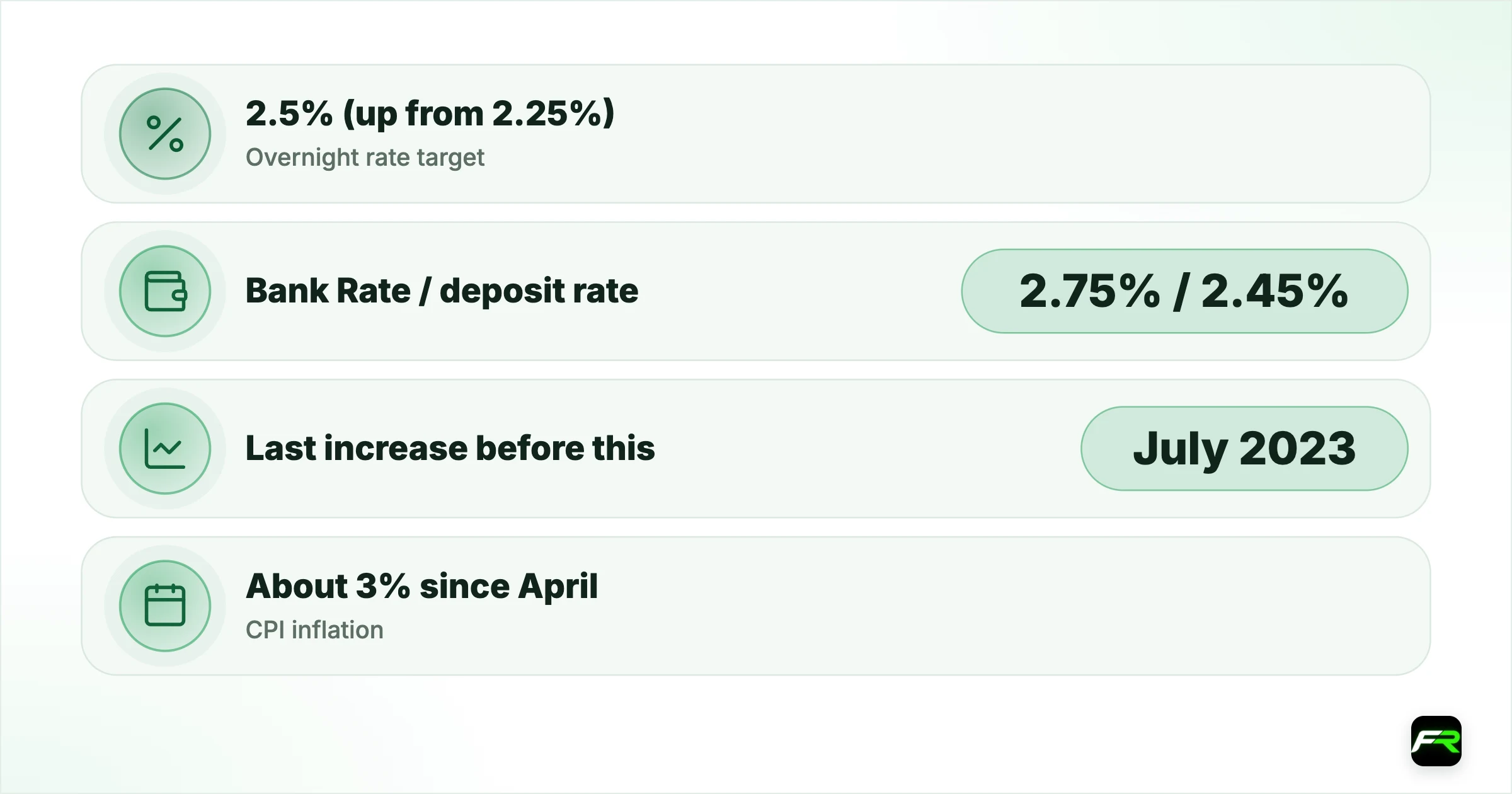
The reason is energy. In its press release, the bank said that with “persistently high oil prices,” consumer price inflation has been around 3% since April and is expected to reach about 3½% by the end of the year. It now sees inflation averaging 3% in 2027, a full percentage point above its July forecast. Governing Council raised rates “to reduce the risk that continuing high energy prices spread broadly to the prices of other goods and services.”
For the Canadian dollar, the most important line came at the end. “There could be a need to increase the policy rate further,” the bank wrote, “but given uncertainties, Governing Council agreed to proceed carefully.” That is a tightening bias with a brake attached, and it leaves the 9 December decision open.
| Overnight rate target | 2.5% (up from 2.25%) |
|---|---|
| Bank Rate / deposit rate | 2.75% / 2.45% |
| Last increase before this | July 2023 |
| CPI inflation | About 3% since April; about 3.5% by year end |
| CPI excluding gasoline, September | 2.2% |
| Inflation forecast, 2027 average | 3%, a point above July |
| GDP growth forecast | 1% in 2026, 2% in 2027 and 2028 |
| Next decision | 9 December 2026 |
What the Bank of Canada decided
Wednesday's move ends a long period of steady or falling rates. Before this meeting the overnight rate had stood at 2.25%, where the bank left it at its 2 September decision. The rise came with the October Monetary Policy Report, the quarterly forecast round, so the bank published new projections for growth and inflation alongside it.
Macklem pointed to two developments since July. “First, the outlook for inflation has deteriorated,” he said, as the war in the Middle East keeps oil prices higher for longer. Second, the growth outlook “has improved modestly, despite continued trade actions by the United States.” A higher inflation path together with a sturdier economy gave the bank room to act.
The Governor said Governing Council weighed two options, holding or hiking. Holding was justified, in this view, because the rise in inflation has so far been concentrated in energy and energy-heavy services such as airfares, with core measures still close to 2%. Those who backed a rise, the view that won, argued that energy prices are expected to stay high, cost pressures are building, and “the longer energy prices remain high, the more likely it is these costs will spill over to consumer prices more broadly.”
The inflation outlook behind the hike
Headline inflation has been around 3% since April, while inflation excluding gasoline was 2.2% in September. The bank's concern is what comes next. Fuel costs are raising the price of production and transport, and imported industrial and electronics inputs have become dearer. Businesses have mostly absorbed those costs so far, but “Bank surveys suggest cost pass-through will increase over the next year.”
Expectations are moving too. The release said near-term household and business inflation expectations have risen, while longer-term expectations “remain well anchored.” Central banks watch that split closely: once people expect higher prices for years, wage and price setting starts to build them in.
The new projection has CPI inflation averaging 3% in 2027 and returning to 2% only in the middle of 2028. It named the main risks to that path as developments in the Middle East, a conflict it said is “now in its eighth month” with “no clear path to resolution,” and how businesses respond to higher costs.
Growth, tariffs and the loonie
The economy has done better than the bank expected in July. GDP grew 3.3% in the second quarter, and recent indicators point to about 2% in the third. Consumer spending has been solid, business investment rebounded on oil and gas activity and machinery spending, and exports have strengthened on firm US demand and higher energy output. Unemployment has been around 6½% for several months, and the bank still sees some excess supply.
New US tariffs are expected to slow growth in the fourth quarter before a pickup in 2027 supported by business investment, exports and fiscal measures. The bank forecasts growth of 1% this year and 2% in both 2027 and 2028, slightly stronger than in July taken as a whole, with uncertainty over Canada-US trade relations flagged as the main caveat.
On the currency, the bank said the Canadian dollar “had weakened somewhat on US-dollar strength but has since recovered to around 71 cents,” the same level assumed in July. ECB reference rates tell a similar story. USD/CAD, derived as a cross, was 1.3925 on 2 September and 1.4246 on 1 October, then eased to 1.4023 on 27 October. Wednesday's rate of 1.4047 was set at about 13:15 UTC, half an hour before the decision, so it does not yet reflect the hike.
| USD/CAD, ECB reference rates | Rate | Note |
|---|---|---|
| 2 September 2026 | 1.3925 | Day of the last BoC hold |
| 1 October 2026 | 1.4246 | Weakest loonie of the period |
| 27 October 2026 | 1.4023 | Day before the decision |
| 28 October 2026 | 1.4047 | Set before the 13:45 UTC decision |
Rates are derived by FX Recap as EUR/CAD divided by EUR/USD from the European Central Bank's daily euro reference rates. They are one reading a day, not live prices.
How the world outlook fed into the decision
The bank's view of the world economy also moved up. It now expects global GDP to grow 3.1% in 2026, slightly more than in July, and 3.2% in both 2027 and 2028. In the United States, it said, growth continues “at a robust pace, supported by consumer spending and AI-related investment,” while euro area growth has been resilient and broad-based and Chinese growth rebounded in the third quarter on exports and fiscal spending.
Stronger world demand helps Canadian exporters, but it also keeps energy prices firm. The release noted that inflation has risen in most countries because of elevated oil prices and refinery margins, and that global financial conditions have tightened since July. Advanced economy bond yields are higher, and equity and credit markets have been volatile on uncertainty about the outlook for the AI sector. Canada is far from alone in tightening: central banks in several other advanced economies have also raised rates this autumn as energy costs feed through.
What it means for traders
A hike with a hint of more usually supports a currency, and the Bank of Canada now has a firmer stance than it did at the start of the autumn. The loonie's direction still depends a great deal on the US dollar and on oil. Within five hours of the Canadian decision the Fed held its own rate, with two officials voting for a rise, as our Fed story explains. If both central banks lean hawkish, the rate gap between them may change little.
- Oil is a double driver for the Canadian dollar: higher prices lift Canada's export earnings and now also raise the chance of further hikes.
- Watch Canadian CPI for October, which the bank expects to move towards 3½%. A faster rise would strengthen the case for 9 December.
- Trade headlines matter. The bank expects new US tariffs to slow growth in the fourth quarter, and any escalation could weigh on the currency.
- Compare USD/CAD with CAD crosses such as EUR/CAD to separate Canadian news from moves in the US dollar.
- Check upcoming Canadian and US releases in your own time zone on our economic calendar.
Suppose you sell USD/CAD at 1.4040, expecting the hawkish Bank of Canada to support the loonie, with a stop at 1.4100, 60 pips away. One pip on 10,000 units of USD/CAD is worth 1 Canadian dollar, about $0.71 at that rate, so the stop costs about $43 per 10,000 units. On a $5,000 account with a 1% risk limit of $50, a size of about 11,500 units keeps the loss near $49. Use the <a href="/position-size-calculator">position size calculator</a> to check your own numbers.
Background to this meeting is in our Bank of Canada preview and our Canadian CPI story. Convert amounts with the currency converter.
Central bank decisions can move currencies sharply in seconds, and prices can gap past stop orders. Leverage magnifies losses as well as gains, so trade only with money you can afford to lose.
The decision, rates, forecasts and quotations come from the Bank of Canada's press release and Governor Macklem's opening statement of 28 October 2026. Exchange rates are derived from ECB euro reference rates. The table is FX Recap's own summary. This is news, not investment advice.
Frequently asked
Did the Bank of Canada raise rates in October 2026?
Yes. On 28 October 2026 the Bank of Canada raised its overnight rate target by 25 basis points to 2.5%. The Bank Rate is now 2.75% and the deposit rate 2.45%.
Why did the Bank of Canada raise interest rates?
The bank said persistently high oil prices have pushed inflation to around 3% and it expects about 3.5% by year end. It raised rates to reduce the risk that energy costs spread to other prices.
Will the Bank of Canada raise rates again?
The bank said there could be a need to raise the policy rate further, but that it will proceed carefully and take decisions one meeting at a time. The next decision is on 9 December 2026.
When was the last Bank of Canada rate hike before October 2026?
Governor Tiff Macklem said the October 2026 move was the first interest rate increase since July 2023.
Sources: Bank of Canada: policy rate raised to 2½% (28 October 2026) · Bank of Canada: Governor Macklem opening statement, 28 October 2026 · Bank of Canada: Monetary Policy Report, October 2026 · European Central Bank: euro foreign exchange reference rates
The team behind this guide
Researched, checked and approved by five forex specialists
Every guide is written, fact-checked and edited before it goes live, and updated when the facts change. Spotted an error? Tell us.