IC Markets
































RBI Raises Repo Rate to 5.50%, Its First Hike Since February 2023
The Reserve Bank of India lifted its repo rate by 25 basis points to 5.50% on 7 October and moved to a stance of calibrated tightening, citing oil prices and the West Asia conflict. USD/INR traded near 96.8.
 WriterAbir KhanWriterWrites the guides · checks every figure against primary sources View profileAbout Abir →
 Market analysisTanbir Habib RiyadForex & Crypto AnalystForex and crypto analyst · technical and fundamental analysis View profileAbout Tanbir →
 Fact-checking & riskJannatul FerdaushFact-Checker & Risk AnalystFact-checks every figure · risk analysis · Applied Statistics, University of Dhaka View profileAbout Jannatul →
 Trading reviewJowel RanaCo-Founder & Forex TraderCo-founder · forex trader · reviews guides from a trader's view View profileAbout Jowel →
 Final approvalRanjan NiskrityFounder, Owner & Forex TraderFounder and owner · forex trader · signs off every guide View profileAbout Ranjan →
The Reserve Bank of India has started raising interest rates again. On Wednesday 7 October its Monetary Policy Committee lifted the policy repo rate by 25 basis points to 5.50%, the first increase since February 2023, and changed its stance from neutral to "calibrated tightening". The vote on the rate was unanimous, but two members, Dr. Nagesh Kumar and Prof. Ram Singh, preferred to keep the neutral stance.
The move reverses part of the 2025 easing cycle, when the RBI cut the repo rate by a total of 125 basis points, from 6.50% to 5.25%. Rates had stayed at 5.25% through four meetings before Wednesday's decision. The rupee got little relief: USD/INR rose to about 96.85 on the day, its highest level since late May according to market reports, and traded near 96.77 early on Thursday.
| Policy repo rate | 5.50%, up from 5.25% |
|---|---|
| Standing Deposit Facility | 5.25% |
| Marginal Standing Facility and Bank Rate | 5.75% |
| Stance | Calibrated tightening (was neutral) |
| CPI inflation forecast, 2026-27 | 5.2%, with 6.0% in Q3 |
| GDP growth forecast, 2026-27 | 7.1% |
| Forex reserves, 2 October | US$734.6 billion |
| Next policy meeting | 2–4 December 2026 |
Why the RBI raised rates
Oil is the main reason. In the Governor's statement, the Indian basket of crude oil averaged US$116.1 a barrel in September, up from US$90.2 in August and US$82.0 in July. India imports most of the oil it uses, so a jump of that size feeds quickly into fuel, transport and food prices, and widens the trade deficit.
Inflation has started to turn. CPI inflation rose to 4.8% in August from 4.5% in July, and core inflation climbed to 4.2%. The MPC now expects inflation to average 5.2% in 2026-27, peaking at 6.0% in the October to December quarter. That is well above the RBI's 4% target and at the top of its 2% to 6% tolerance band.
Supply risks feature heavily in the statement: the West Asia conflict, a deficient monsoon and El Niño conditions. On the demand side, the committee pointed to strong growth in money and credit. Growth is still forecast at 7.1% for the year, so the hike comes from a position of strength rather than a slowdown.
What it means for the rupee
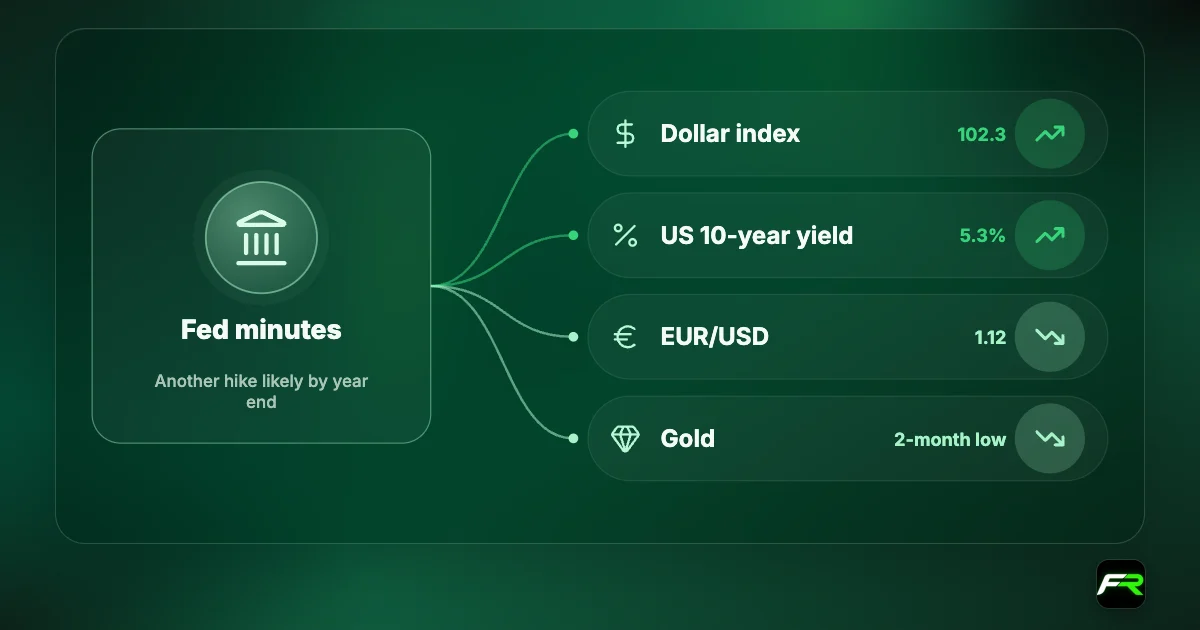
A rate hike usually supports a currency, because it raises the return on holding it. That effect has been weak so far. The dollar is strong across the board, with the US Dollar Index near its highest level since April 2025 and US 10-year yields near 5.3%, and a higher oil import bill adds to demand for dollars in India.
On the currency itself the RBI said little. The Governor said the bank remains "committed to ensuring orderly adjustments to the exchange rate that are in sync with the underlying macroeconomic fundamentals and curbing excessive volatility". With reserves at US$734.6 billion on 2 October, enough for about 11 months of imports, the central bank has room to smooth sharp moves, even if it does not defend a set level.
| USD/INR | Open | High | Low | Close |
|---|---|---|---|---|
| Thu 1 Oct | 95.82 | 96.33 | 95.82 | 96.31 |
| Mon 5 Oct | 96.30 | 96.32 | 96.21 | 96.30 |
| Tue 6 Oct | 96.30 | 96.45 | 96.28 | 96.36 |
| Wed 7 Oct (RBI decision) | 96.36 | 96.85 | 96.33 | 96.76 |
UTC daily candles built from hourly market data. 2 October is left out because Indian markets were closed for Gandhi Jayanti.
What it means for borrowers and savers
Home and business loans will feel the change first. Since October 2019, banks have had to link new floating-rate loans to retail customers and small firms to an external benchmark, and most use the repo rate, so the 25-point rise should reach many EMIs within one reset cycle. Fixed deposit rates tend to follow more slowly, as banks lift them only once they need more funding.
A quarter point sounds small, but it adds up. On a ₹50 lakh home loan over 20 years, it lifts the monthly instalment by roughly ₹800, depending on the bank's spread and the loan's terms.
What it means for traders in India
For Indian residents, the legal route to trade currencies is rupee pairs such as USD/INR, EUR/INR, GBP/INR and JPY/INR on NSE or BSE through a SEBI-registered broker. Those contracts react directly to RBI decisions, so policy days bring wider ranges than usual. Our guide on whether forex trading is legal in India sets out the rules.
- Expect bigger swings around the December meeting (2-4 December) and each monthly CPI release.
- Watch crude oil: a further jump would raise the odds of another hike.
- Keep an eye on the dollar index, which has done more to move USD/INR in this cycle than the RBI.
- Size every position so one bad day costs no more than 1% to 2% of your account.
Priya trades USD/INR futures on NSE. Her long position is 10 lots of US$1,000 each, so every 10-paise move is worth ₹1,000. When the pair climbed from 96.36 to 96.76 on 7 October, a 40-paise rise, the position gained about ₹4,000. A surprise that lifted the rupee instead would have cost her the same amount, which is why she cut her size before the announcement.
What comes next
The new stance tells markets the RBI is ready to do more if needed, without promising a series of hikes. Two members preferred to stay neutral, a sign that the committee is not united on how far to go. September CPI inflation, due in mid-October, is the next test: a reading close to the RBI's 6.0% forecast for the quarter would keep a December hike on the table.
Outside forces still matter more for the rupee. If the Fed raises rates again by year end, as most US officials expect, the dollar's yield advantage will stay large, and any rupee rally is likely to be limited.
Currency futures use margin, so losses can build quickly on a fast day. Trade only through SEBI-registered brokers on recognised exchanges.
Policy rates, votes, projections, oil prices and reserves are from the Reserve Bank of India's Monetary Policy Statement and the Governor's statement of 7 October 2026. USD/INR levels are market data and differ slightly between providers. This is news, not investment advice.
Frequently asked
What is the RBI repo rate now?
The repo rate is 5.50% after the Monetary Policy Committee raised it by 25 basis points on 7 October 2026. The Standing Deposit Facility rate is 5.25%, and the Marginal Standing Facility rate and Bank Rate are both 5.75%.
Why did the RBI raise rates in October 2026?
Higher crude oil prices, the West Asia conflict and a deficient monsoon pushed up the inflation outlook. The RBI now expects CPI inflation of 5.2% for 2026-27, peaking at 6.0% in the October to December quarter.
When was the last RBI rate hike before this?
In February 2023, when the repo rate went to 6.50%. The RBI later cut it by a total of 125 basis points during 2025, taking it down to 5.25% before this week's increase.
Does a rate hike make the rupee stronger?
It can help, since higher rates make rupee assets pay more, but bigger forces are at work right now. A strong US dollar and a costly oil import bill kept USD/INR near 96.8 after the decision.
When is the next RBI policy meeting?
The Monetary Policy Committee meets next on 2 to 4 December 2026, with the decision announced on the final day of the meeting.
Sources: Reserve Bank of India: Monetary Policy Statement, 7 October 2026 · Reserve Bank of India: Governor's Statement, 7 October 2026 · FXStreet: Forex Today, 7 Oct
The team behind this guide
Researched, checked and approved by five forex specialists
Every guide is written, fact-checked and edited before it goes live, and updated when the facts change. Spotted an error? Tell us.