IC Markets






































ECB Preview: Two Hikes Are Done. Does the ECB Pause or Push On at 2.50% on 29 October?
Inflation hit 3.8% in September, but the ECB promised no rate path and has no new forecasts this month. Here is what each outcome could mean for the euro.
 WriterAbir KhanWriterWrites the guides · checks every figure against primary sources View profileAbout Abir →

 Market analysisTanbir Habib RiyadForex & Crypto AnalystForex and crypto analyst · technical and fundamental analysis View profileAbout Tanbir →

 Fact-checking & riskJannatul FerdaushFact-Checker & Risk AnalystFact-checks every figure · risk analysis · Applied Statistics, University of Dhaka View profileAbout Jannatul →

 Trading reviewJowel RanaCo-Founder & Forex TraderCo-founder · forex trader · reviews guides from a trader's view View profileAbout Jowel →

 Final approvalRanjan NiskrityFounder, Owner & Forex TraderFounder and owner · forex trader · signs off every guide View profileAbout Ranjan →

The European Central Bank announces its next decision on Thursday 29 October at 14:15 Frankfurt time, which is 13:15 UTC now that European clocks have gone back. Its deposit facility rate stands at 2.50% after quarter-point rises in June and September. Thursday's call comes the day after the Federal Reserve and 45 minutes after the first estimate of US third-quarter growth, so the euro faces two big tests within an hour.
Euro area inflation has moved the wrong way since the last meeting. Eurostat confirmed that consumer prices rose 3.8% in the year to September, up from 3.2% in August, and energy alone added 1.71 percentage points to that rate. Core inflation, which strips out energy, food, alcohol and tobacco, was 2.5%. Those figures sit well above the 2% target, yet the bank's own record of its September meeting shows officials were careful not to promise a third hike.
EUR/USD has fallen hard in the meantime. The ECB's own euro reference rate was 1.1616 on the day of the September hike and 1.1193 on Friday 23 October, a drop of about 3.6%. Earlier this month the rate touched 1.1177 on 7 October, the lowest reference rate of 2026 so far.
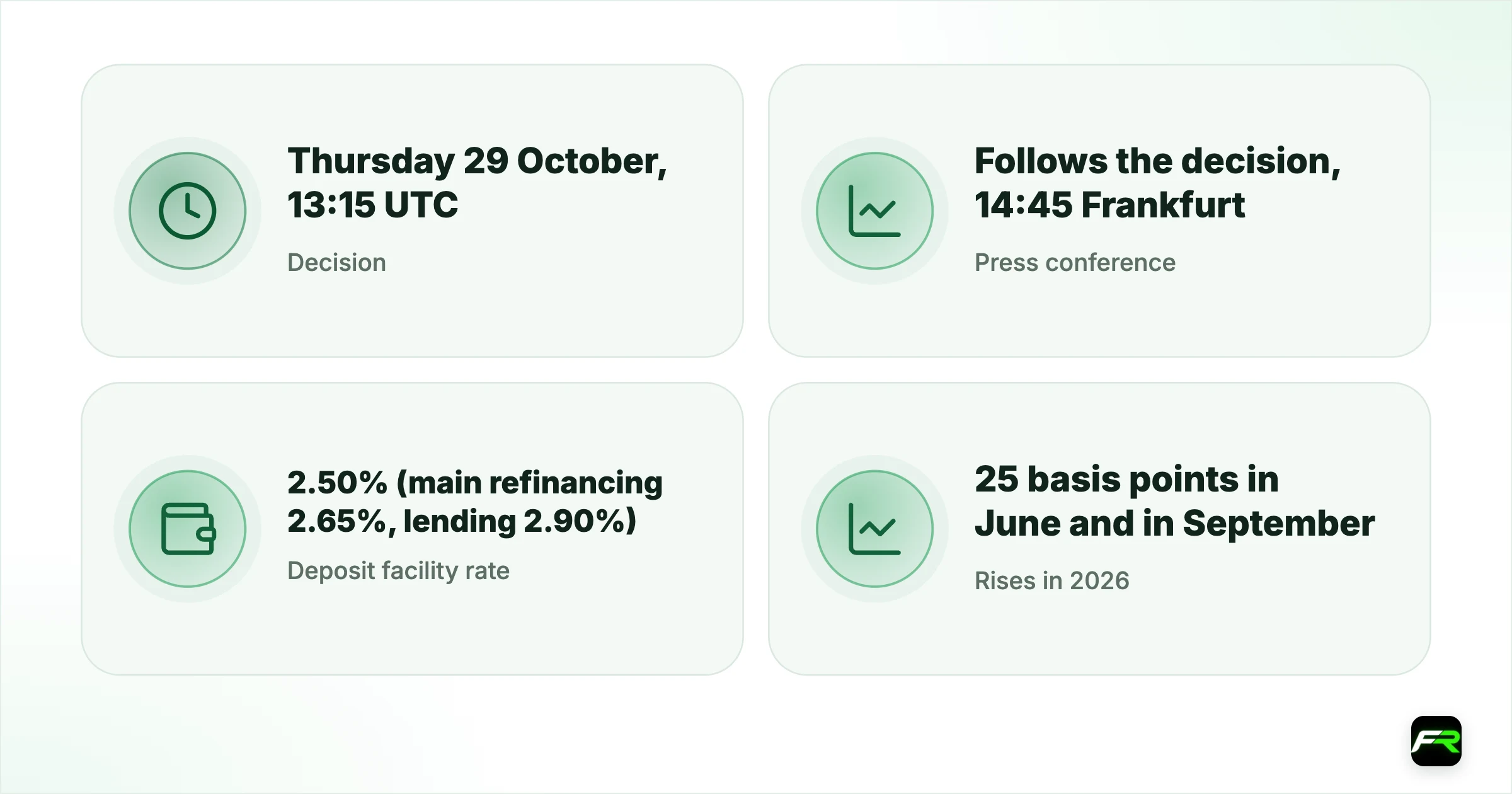
| Decision | Thursday 29 October, 13:15 UTC (14:15 Frankfurt) |
|---|---|
| Press conference | Follows the decision, 14:45 Frankfurt |
| Deposit facility rate | 2.50% (main refinancing 2.65%, lending 2.90%) |
| Rises in 2026 | 25 basis points in June and in September |
| Euro area inflation, September | 3.8% (August 3.2%), core 2.5% |
| Energy contribution | 1.71 percentage points |
| New staff projections | Not at this meeting; next set due 17 December |
| EUR/USD reference rate | 1.1193 on 23 October (1.1616 on 10 September) |
What the ECB said when it raised rates in September
On 10 September the Governing Council lifted all three key rates by 25 basis points. Its statement said that “the conflict in the Middle East continues to generate inflation pressures, and inflation is set to remain well above target for an extended period.” The deposit rate rose to 2.50%, the main refinancing rate to 2.65% and the marginal lending rate to 2.90%, effective from 16 September.
New staff projections came with that decision. Headline inflation was seen averaging 3.0% in 2026, 2.5% in 2027 and 2.1% in 2028, while inflation excluding energy and food was put at 2.5%, 2.6% and 2.3% over the same years. Growth was revised up to 0.9% for 2026 and 1.4% for 2027, which the bank linked to the economy's “greater than expected resilience”.
Most important for traders was the guidance on future moves, or rather the lack of it. The council said it would follow “a data-dependent and meeting-by-meeting approach” and that it “is not pre-committing to a particular rate path.” That sentence leaves every option open on Thursday: a hold, another quarter point, or a hold with a firm warning.
What the account of the September meeting tells us
The ECB published its account of the 9 and 10 September meeting on 8 October. It shows that all members supported the proposal from chief economist Philip Lane to raise rates. Members also noted that a deposit rate of 2.50% “remained in the range of neutral interest rates estimated by staff”, a hint that policy is not yet clearly restrictive.
On communication, the account is unusually direct. It says the message “should remain neutral, neither suggesting that the current decision was another step in a predetermined tightening cycle nor that it was the last rate hike.” For a currency trader, that line matters more than any forecast. The council deliberately refused to signal its next step, so Thursday's statement and press conference will be read word by word for any shift.
Markets and economists disagreed in September. According to the account, financial markets had priced in 84 basis points of hikes by the end of 2027, while surveys of analysts, including the ECB's own Survey of Monetary Analysts, pointed to the deposit rate plateauing at 2.50% after the September move. Members said the gap partly reflected risk premia in market prices and the earlier timing of the surveys.
Wages were the reassuring part. Compensation per employee grew at an annual rate of 3.3% in the second quarter, down from 3.5%, and negotiated wage growth eased to 2.4%. The ECB wage tracker pointed to only a modest rise, to 2.7%, in the first half of 2027. Officials wrote that there had been no second-round effects on wages so far, though they warned against complacency because wages react with a lag.
What has changed since September
Two things moved after the September meeting: inflation and the tone of the ECB President. September's 3.8% inflation rate was a big step up from 3.2%, driven by energy. Core inflation at 2.5% was only slightly higher than the 2.4% recorded for August in the account, which supports the view that the shock has not yet spread widely through other prices.
Christine Lagarde gave her latest view in a written statement to the International Monetary and Financial Committee, published on 17 October. She said the energy shock is “too large to ‘look through’ but a measured response remains appropriate to keep inflation in check”. Our story on that statement covers the full text. The phrase “measured response” is the key: it fits either a pause or a slow pace of further rises, but it does not suggest urgency.
This meeting also lacks fresh staff projections. The ECB updates its forecasts four times a year, and the next set comes with the 17 December decision. Central banks often prefer to move when new forecasts can explain the step, so many observers see December as the more natural moment for any further rise. That is a reading of the calendar, not something the ECB has said.
Three outcomes and how the euro could react
The ECB has not given guidance, so the outcomes below are our own framework for thinking about Thursday, not a forecast. Each one depends on the statement and on what Lagarde says at the press conference.
| Outcome | What it would look like | Possible euro reaction |
|---|---|---|
| Hold, neutral tone | Rates unchanged, same meeting-by-meeting wording | Limited; focus moves to US data and December |
| Hold, firm warning | Rates unchanged, stress on upside inflation risks | Supportive; markets keep a December rise in view |
| Third rise of 25 bp | Deposit rate to 2.75% | Likely euro strength, unless paired with a clear signal of a pause |
| Hold, softer tone | Focus on weaker growth, wages and the milder scenario | Euro could extend its fall towards the 2026 low |
A hold with a firm warning looks closest to the language officials have used, given Lagarde's “measured response” and the neutral stance in the account. A surprise third rise would test EUR/USD sellers who have pushed the pair down 3.6% since September. A softer tone, with stress on the downside risks to growth that the bank already flags, would add to the pressure on the euro, because the Fed's own path is still open.
Where EUR/USD stands before the decision
The ECB's reference rates give a clean, official record of the pair's slide. The rate was 1.1616 on 10 September, 1.1253 on 16 October and 1.1193 on 23 October. Over the last 20 reference days the range ran from 1.1177 to 1.1378, and the 20-day average was 1.1237, so the pair sits just under its short-term mean and close to its yearly low.
Those are daily reference rates, set around 14:15 CET, not intraday highs or lows, and the live price on the day will differ. Our daily EUR/USD analysis turns these rates into support and resistance levels and shows the live chart.
What it means for traders
Thursday is crowded. US GDP and PCE inflation land at 12:30 UTC, the ECB at 13:15 and the press conference at 13:45 UTC. Spreads usually widen across that window, and a move after the US data can be reversed by the ECB less than an hour later.
- Read the statement for changes to “not pre-committing” or “well above target”. A new reference to further tightening would matter more than the rate itself if the bank holds.
- Watch Lagarde's answers on wages and second-round effects. The account says these are the signals the council is waiting for.
- Remember the Fed decides the night before. A firm Fed on Wednesday can leave the euro weaker going into the ECB, whatever Frankfurt does.
- Reduce position size or step aside between 12:30 and 14:30 UTC if you cannot watch the screen. Gaps can jump past a stop.
- Check every time in your own zone on our economic calendar, because US clocks change only on 1 November.
Suppose you plan to buy EUR/USD at 1.1195 if the ECB sounds firm, with a stop at 1.1135, 60 pips away. On a $4,000 account with a 1% risk limit you can lose $40, so the position should be about 6,600 units, because each pip on that size is worth about 66 cents. If the spread widens to 3 pips at 13:15 UTC, your real risk grows, so either widen the stop and cut the size or wait until the press conference is over. Work the numbers with the <a href="/position-size-calculator">position size calculator</a> before the event.
For the US side of the week, read our Fed preview. Convert euro amounts with the currency converter.
Central bank decisions can move currencies by large amounts in seconds, and prices can gap past stop orders. Leverage magnifies losses as well as gains, so trade only with money you can afford to lose.
Rates, projections and quotations come from the ECB's 10 September press release, the account of the 9-10 September meeting published on 8 October, and Christine Lagarde's IMFC statement of 17 October. Inflation figures are from Eurostat's release of 16 October. EUR/USD levels are ECB euro reference rates. The scenario table is FX Recap's own framework, not an ECB statement. This is news, not investment advice.
Frequently asked
When is the ECB's October 2026 decision?
The European Central Bank announces its decision on Thursday 29 October 2026 at 14:15 Frankfurt time, which is 13:15 UTC. President Christine Lagarde holds a press conference at 14:45 Frankfurt time.
What is the ECB deposit rate now?
The deposit facility rate is 2.50%, effective from 16 September 2026 after the ECB raised rates by 25 basis points on 10 September. The main refinancing rate is 2.65% and the marginal lending rate 2.90%.
Will the ECB raise rates again in October?
The ECB has not said. Its September statement said it is not pre-committing to a particular rate path, and the meeting account says communication should suggest neither more hikes nor the last one. No new staff projections are due until 17 December.
How could the ECB decision affect EUR/USD?
A third rise or a firm warning on inflation could support the euro, while a softer tone could push EUR/USD towards its 2026 low near 1.1177 on the ECB reference rate. US GDP data 45 minutes earlier can also move the pair.
Sources: European Central Bank: account of the monetary policy meeting of 9-10 September 2026 · Eurostat: Annual inflation up to 3.8% in the euro area (16 October 2026) · European Central Bank: IMFC Statement by Christine Lagarde (17 October 2026) · European Central Bank: Key ECB interest rates · European Central Bank: Governing Council meeting calendar · European Central Bank: euro foreign exchange reference rates
The team behind this guide
Researched, checked and approved by five forex specialists
Every guide is written, fact-checked and edited before it goes live, and updated when the facts change. Spotted an error? Tell us.