IC Markets

 3:09
 2:39
 2:10
 2:18
 3:43
 8:42





































RBA Preview: What the September Minutes Say About a Fifth Rate Rise on Tuesday
The Board gave three reasons to hike in September and found little to say for waiting. Hotter prices since then put 4.60% on the table again.
 WriterAbir KhanWriterWrites the guides · checks every figure against primary sources View profileAbout Abir →

 Market analysisTanbir Habib RiyadForex & Crypto AnalystForex and crypto analyst · technical and fundamental analysis View profileAbout Tanbir →

 Fact-checking & riskJannatul FerdaushFact-Checker & Risk AnalystFact-checks every figure · risk analysis · Applied Statistics, University of Dhaka View profileAbout Jannatul →

 Trading reviewJowel RanaCo-Founder & Forex TraderCo-founder · forex trader · reviews guides from a trader's view View profileAbout Jowel →

 Final approvalRanjan NiskrityFounder, Owner & Forex TraderFounder and owner · forex trader · signs off every guide View profileAbout Ranjan →

The Reserve Bank of Australia's Monetary Policy Board meets on Monday and Tuesday and publishes its decision at 14:30 Sydney time on Tuesday 3 November, which is 03:30 UTC. Fresh forecasts arrive at the same moment in the new Statement on Monetary Policy, and Governor Michele Bullock holds her media conference an hour later.
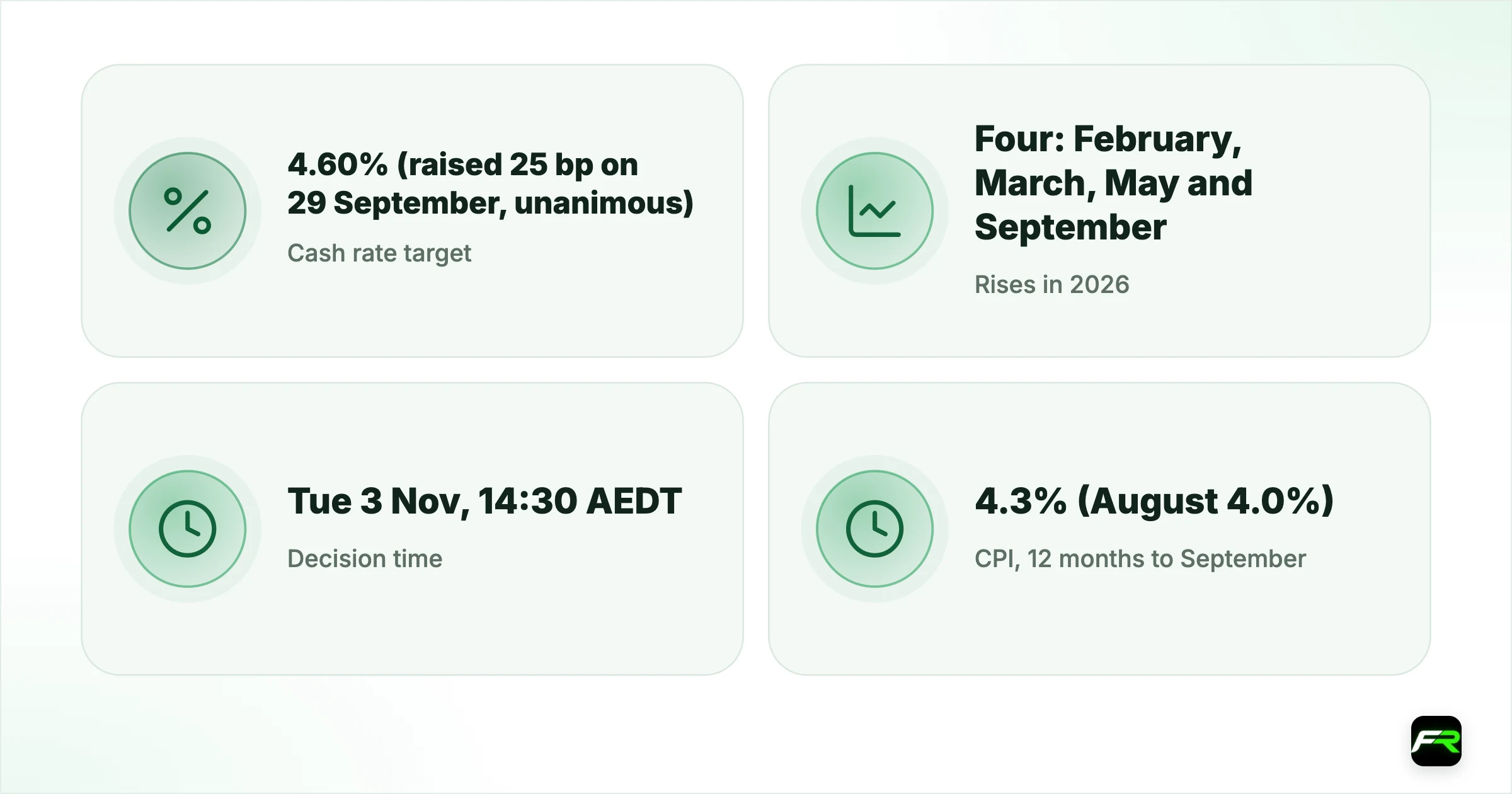
At present the cash rate target is 4.60%. Since January the Board has raised it four times, each by a quarter point, from 3.60% at the end of 2025. Its last move came on 29 September, and the minutes of that meeting, published two weeks later, are the best guide to how members think. They show a Board that weighed three arguments for a rise and spent little time on the case for waiting.
We do not forecast the decision. This preview sets out what the RBA itself has said, what the data have done since, and how AUD/USD stands going into the announcement.
| Cash rate target | 4.60% (raised 25 bp on 29 September, unanimous) |
|---|---|
| Rises in 2026 | Four: February, March, May and September |
| Decision time | Tue 3 Nov, 14:30 AEDT (03:30 UTC) |
| CPI, 12 months to September | 4.3% (August 4.0%) |
| Quarterly trimmed mean, Sep quarter | +1.0%, 3.7% a year |
| Unemployment, September | 4.7% |
| AUD/USD reference rate | 0.7025 on 30 October (derived from ECB rates) |
| Following meeting | 7-8 December |
Three reasons the Board gave for hiking in September
The minutes list the arguments in order. “The strongest argument for raising the cash rate target at this meeting was that several of the upside risks identified in August had since materialised or were building,” they say. Members pointed to signs that domestic capacity pressures were wider than assumed, to liaison reports of broad cost pressures, and to oil prices substantially above the level built into the August forecasts. Demand for AI-related products and farm commodity prices added to global cost pressures.
A second argument was timing. Members “acknowledged that waiting for further confirmation of the outlook for inflation could be costly, given that inflation had already been above target for an extended period.” Surveys and liaison, they added, gave concerning signs that medium-term inflation expectations in the business community may be rising.
Their third point is the one currency traders should note. If markets were right that the global neutral interest rate had risen, members said, the cash rate of 4.35% at the time was less restrictive than it had been two years earlier. And if Australian policy stayed put while other central banks tightened, financial conditions at home “could loosen via a depreciation of the exchange rate.” In plain terms, the Board sees a weak Australian dollar as a source of extra inflation, and it is watching rates abroad.
The case for holding, and why it lost
Members “briefly considered” leaving the rate unchanged. That case rested on three possibilities: that falling house prices could hit household spending harder than expected, that uncertainty around the Middle East conflict could weigh on demand, and that earlier rate rises might bite more than forecast. Scenario analysis, the minutes note, suggested that even large falls in house prices would have only modest direct effects on spending.
All members then backed the rise. They said the August forecasts needed a number of favourable developments for inflation to return to target on time, and that it no longer appeared likely all of them would happen. Those forecasts had inflation back at the middle of the 2% to 3% band by around late 2027.
Members also admitted the trade-off had worsened. Fighting persistent supply shocks, they wrote, “would require accepting slower growth in demand and employment than would otherwise be the case.” The statement closed with the same commitment the Board has repeated all year: it will do what is necessary, “including increasing the cash rate target further if needed.”
What has changed since 29 September
Most of the data released since the meeting point the same way as the minutes. The Australian Bureau of Statistics reported on 28 October that consumer prices rose 4.3% in the 12 months to September, up from 4.0% in August, with transport 8.7% higher on fuel. On the quarterly basis the RBA used before October 2025, the trimmed mean rose 1.0% in the September quarter and 3.7% over the year. A 1.0% quarterly rise is close to a 4% annual pace.
Officials did little to talk down expectations before the CPI release. Deputy Governor Andrew Hauser said on 21 October that “the inflation outlook looks materially worse than we projected in the August report,” and that oil was about a third higher than assumed in those forecasts. Our Australian CPI story and report on Hauser's remarks cover both in detail.
Jobs are the main argument the other way. Employment fell by 39,300 in September and unemployment rose to 4.7%, according to the ABS. The minutes had described leading indicators of the labour market as broadly stable, so a run of weaker hiring would test that view. Abroad, several central banks have moved in the RBA's direction: the Bank of Canada raised its rate on 28 October, and two members of the US Federal Reserve voted for a rise the same day.
| Indicator | At the September meeting | Latest |
|---|---|---|
| Cash rate target | 4.35% before the rise | 4.60% |
| CPI, annual | 4.0% (August) | 4.3% (September) |
| Quarterly trimmed mean, annual | 3.6% (June quarter) | 3.7% (September quarter) |
| Unemployment rate | 4.6% (August) | 4.7% (September) |
What to read in Tuesday's release
The rate is only the first line. Three parts of the release will tell you more about what comes next.
- The forecast table in the Statement on Monetary Policy. Look at when trimmed mean inflation returns to 2.5%. If the date moves out beyond late 2027, the Board is signalling that policy is still not tight enough.
- The last paragraph of the decision statement. Each statement this year has kept the promise to raise the rate further “if needed”. Its removal would be a strong hint that tightening has paused; a firmer version would point the other way.
- The vote. September's rise was unanimous. The RBA now publishes whether a decision was unanimous, so a split would show members starting to disagree on how much more is required.
Hauser speaks again on Thursday 5 November, and Assistant Governor Sarah Hunter appears at a conference on Monday 9 November, Sydney time. Both appearances give the bank a chance to explain the new forecasts, so the message from Tuesday may be fine-tuned within days.
Where AUD/USD stands before the decision
Using the ECB's euro reference rates, AUD/USD worked out at 0.7025 on Friday 30 October, almost unchanged from 0.7022 a week earlier. The pair has drifted sideways since the September rise, from 0.7005 on the day of the decision. Over the past 20 working days it ranged from 0.6911 on 15 October to 0.7034 on 21 October, and Friday's rate sat a little above its 20-day average of 0.6991 but below the 50-day average of 0.7069.
That calm hides a slower decline. On 12 August, when the Board held at 4.35%, the pair was at 0.7071, and the 60-day high on reference rates is 0.7225. Higher Australian rates have not lifted the currency much, partly because rates and yields have risen elsewhere too. A rise on Tuesday that was already widely expected may not move the pair far. By contrast, a hold, especially with softer wording, could have a larger effect because it would change what the market expects for December.
- Mark 03:30 UTC on Tuesday on our economic calendar. Liquidity in the Asian morning is thinner than in London or New York, so spreads can widen sharply for a few minutes.
- Watch the US side as well. US job openings follow at 15:00 UTC the same day, and the October jobs report arrives on Friday.
- Check the daily levels in our AUD/USD analysis, which is built on official reference rates and updates on Monday.
Say you plan to sell AUD/USD at 0.7020 if the Board holds and drops its tightening bias, with a stop at 0.7060, 40 pips away. On a $4,000 account risking 1%, you can lose $40, so each pip can be worth $1, which is a position of 10,000 units. If the spread widens to 5 pips at 03:30 UTC, your real risk grows, so either wait for it to settle or cut the size. Our <a href="/position-size-calculator">position size calculator</a> runs this sum for any pair.
Central bank decisions can move currencies sharply within seconds, and prices can gap past stop orders. Leverage magnifies losses as well as gains, so trade only with money you can afford to lose.
Quotations come from the RBA's 29 September 2026 decision statement and the minutes of that meeting, and from Andrew Hauser's 21 October fireside chat as published by the RBA. Cash rate history and meeting dates are from the RBA website. Inflation and jobs figures are from the Australian Bureau of Statistics. AUD/USD rates are derived from ECB euro reference rates (EUR/USD ÷ EUR/AUD). This is news, not investment advice.
Cite this guide
FX Recap, "RBA Preview: What the September Minutes Say About a Fifth Rate Rise on Tuesday", updated 1 November 2026, https://fxrecap.com/forex-news/top-stories/rba-november-2026-decision-preview
Free to quote with a link. Journalists: data and comment in our press room.
Frequently asked
When is the RBA's November 2026 decision?
The Reserve Bank of Australia announces it on Tuesday 3 November 2026 at 14:30 Sydney time, which is 03:30 UTC, together with the Statement on Monetary Policy. The Governor's media conference follows at 15:30 Sydney time.
What is the RBA cash rate now?
The cash rate target is 4.60%. The Board raised it by 25 basis points on 29 September 2026, the fourth rise of the year after increases in February, March and May.
Why did the RBA raise rates in September 2026?
The minutes say upside risks to inflation had materialised, including higher oil prices and wider capacity pressures, that waiting could be costly after a long period of above-target inflation, and that the rate might not have been high enough to rebalance the economy in a reasonable time.
When does the RBA meet after November?
The Monetary Policy Board's last meeting of 2026 is on 7 and 8 December, with the decision on the second day.
Sources: Reserve Bank of Australia: Minutes of the Monetary Policy Meeting, 29 September 2026 · Reserve Bank of Australia: Monetary Policy Decision, 29 September 2026 · Reserve Bank of Australia: Cash rate target · Australian Bureau of Statistics: Consumer Price Index, Australia · Reserve Bank of Australia: Board meeting schedules · Australian Bureau of Statistics: Labour Force, Australia, September 2026 · ECB: euro foreign exchange reference rates
The team behind this guide
Researched, checked and approved by five forex specialists
Every guide is written, fact-checked and edited before it goes live, and updated when the facts change. Spotted an error? Tell us.