 IC Markets





























Best Forex Brokers for Beginners in 2026
Our picks: AvaTrade for structured education, Pepperstone for clear costs and platform choice, XTB for the simplest interface, Exness for small deposits and fast withdrawals, and eToro if copy trading is why you are starting. Whichever you choose, practise on a demo first and risk no more than 2% of your balance per trade.
 WriterAbir KhanWriterWrites the guides · checks every figure against primary sources View profileAbout Abir →
 Market analysisTanbir Habib RiyadForex & Crypto AnalystForex and crypto analyst · technical and fundamental analysis View profileAbout Tanbir →
 Fact-checking & riskJannatul FerdaushFact-Checker & Risk AnalystFact-checks every figure · risk analysis · Applied Statistics, University of Dhaka View profileAbout Jannatul →
 Trading reviewJowel RanaCo-Founder & Forex TraderCo-founder · forex trader · reviews guides from a trader's view View profileAbout Jowel →
 Final approvalRanjan NiskrityFounder, Owner & Forex TraderFounder and owner · forex trader · signs off every guide View profileAbout Ranjan →


Exness

XM

IC Markets

LiteFinance

FP Markets

AvaTrade

Octa

RoboForex
Disclosure: "Visit Broker" links are partner (affiliate) links. FX Recap may earn a commission at no cost to you. Trading involves significant risk of loss. T&Cs apply.
Based on our editorial assessment, AvaTrade is our top beginner-friendly broker, multi-platform access, and copy trading support within a regulated trading environment Pepperstone is a strong option for traders looking for competitive pricing. and want the freedom to run any serious platform: MT4, MT5, cTrader, or TradingView. If copy trading is the primary draw, eToro is widely known for its Copy Trader social investing platform. Exness offers one of the lowest minimum deposits among the brokers , Eligible payment methods support instant withdrawals. Availability depends on payment provider and region and an FSCA licence that gives South African traders local regulatory oversight. XTB designed xStation 5 with a beginner-friendly interface and integrated educational tools.
Whatever broker you choose, practising on a demo account before trading with real money is strongly recommended.
The 5-Broker Comparison
| Broker | Regulation | Min Deposit | EUR/USD Spread | Commission | Platform | Copy Trading | Best For |
| AvaTrade | CBI, ASIC, FSCA | $100 | ~0.9 pips | None | MT4, MT5, AvaTradeGO | Yes | Education & beginners |
| Pepperstone | FCA, ASIC, FSCA | $0 | From 0.1 | $3.50/side Razor | MT4, MT5, cTrader, TV | Yes | Low cost, platform range |
| eToro | FCA, CySEC, ASIC | $50 | ~1.0 pip | None | Proprietary only | Excellent | Social copy trading |
| Exness | FCA, CySEC, FSCA | $50 | From 0.2 | None (Std) | MT4, MT5 | Limited | Small deposits, fast out |
| XTB | FCA, KNF, CySEC | $0 | ~0.9 pips | None | xStation 5 only | No | Ease of use |
How to Pick the Right Broker for Your Situation
No single broker fits every beginner. Three variables do most of the sorting: where you live and trade, how much you can put in initially, and what you actually intend to do once the account is open.
Regulation Comes Before Everything Else
The most important filter is not the spread width or the platform colour scheme. It is whether the broker holds a licence from a regulator that enforces the rules. The Financial Conduct Authority in the UK, Australia’s ASIC, and CySEC in the EU represent Tier-1 oversight the tier where client fund segregation, negative balance protection, and compensation schemes are mandatory rather than optional. FCA-regulated brokers, for instance, must segregate client funds and carry compensation cover of up to £50,000 per client if the firm fails.
Offshore licences from Seychelles, Vanuatu, or St. Vincent carry none of those protections. A broker can operate legitimately under an offshore licence, but your deposit sits in a higher level of risk Always verify the licence directly on the regulator’s public register not by reading the logo on the broker’s homepage.
South African traders may prefer brokers authorised by the FSCA because they operate under local regulatory oversight, which provides local regulatory cover and clearer recourse channels. Exness, Pepperstone, and AvaTrade each operate an FSCA-regulated entity.
Match the Deposit to Your Risk Reality
Several brokers here accept $0 as a formal minimum, but a more honest question is: what amount lets you trade with sensible position sizing while absorbing the inevitable early losses? Independent research consistently points to $200–$500 as a sensible starting balance for a micro or standard account with proper risk management where each trade’s exposure stays below 2% of account equity.
Starting at $10 or $50 is not wrong. At those sizes, proper position sizing get very tight very fast. A $50 account risking 2% per trade has $1 to work with. That works on micro lots, but every spread or overnight swap takes a disproportionate bite. Think of a very small account as an extended demo with real-market psychology attached, not a route to meaningful returns in the near term.
Demo Accounts Are Not a Shortcut to Skip
Every broker on this list offers a free demo. Many trading educators recommend gaining consistent experience on a demo account before moving to a live account. The goal is not simply learning how to click the buy button. It is developing a repeatable routine, testing a strategy across 30 to 50 trades, and verifying that the approach delivers consistent results before real money amplifies the emotional pressure.
Platform Fit Matters More Than Brand Recognition
MetaTrader 4 remains the most widely supported platform globally, carrying the largest community of indicators and expert advisors. MT5 adds more timeframes, order types, and cleaner multi-asset support. XTB’s xStation 5 and eToro’s proprietary environment prioritise accessibility faster to navigate on day one than any MetaTrader installation. The practical test: can you find your watchlist, place a trade, attach a stop loss, and close the position within five minutes of first logging in? If the platform demands a tutorial before those four basic actions, it is not the right starting point.
1. AvaTrade: Best Overall for Beginners
AvaTrade picked up Best in Class for Beginners and Copy Trading from ForexBrokers.com in 2026, and the award reflects something specific rather than just general competence. The AvaAcademy runs over 100 structured courses sorted by experience level, with quizzes and progress tracking built in the kind of scaffolding most beginners do not know they need until they have wasted months clicking through YouTube at random. The AvaProtect feature lets traders pay a small premium to shield an open position from loss for a defined window of time, which is a genuinely useful safety net when confidence in your own analysis is still being calibrated. Spreads at roughly 0.9 pips on EUR/USD sit slightly above the industry average for a commission-free account, but at the learning stage, the quality of education and the breadth of platform access justify that margin.
| Regulation & Safety | CBI (Ireland, Tier-1), ASIC (Australia, Tier-1), FSCA (South Africa). Client funds segregated. Negative balance protection on all retail accounts. |
| Trust Score | 8.9/10 four Tier-1 licences plus three Tier-2, one of the widest regulatory footprints among retail-focused brokers. |
| Minimum Deposit | $100 (approximately R1,840 ZAR at current rates). No minimum on demo. |
| Fees & Spreads | EUR/USD average 0.9 pips on Standard trading account. No commission on most instruments. Inactivity fee of $50 per quarter after three months with no trades. Overnight swap fees apply on non-Islamic accounts. |
| Platforms | MT4, MT5, AvaTrade WebTrader, AvaTradeGO mobile. Guardian Angel plugin for MT4 adds risk management overlays. AvaOptions for vanilla options trading. |
| Copy Trading | Yes through DupliTrade and ZuluTrade integrations. wide range of strategy providers with verified track records. |
| Tradable Markets | 1,260+ instruments: 55 forex pairs, commodities, indices, share CFDs, ETF CFDs, bonds, crypto CFDs, vanilla options. |
| SA Payment Support | FSCA-regulated entity. ZAR deposits accepted. EFT available. No Ozow or SnapScan at time of review. Conversion fee applies on non-USD deposits. |
| Withdrawals | Typically 24–48 hours for e-wallets. Bank transfers 3–5 business days. No withdrawal fees charged by AvaTrade directly. $100 minimum withdrawal. |
| Education | AvaAcademy: 100+ articles and video courses sorted by asset class and experience level. Webinars uploaded to YouTube and Vimeo. One of the strongest free education suites available to retail traders. |
| Islamic Account | Available. Swap-free from trading account opening. Verify current terms with AvaTrade support conditions vary by entity. |
| FX Recap NoteAvaTrade charges a $50 quarterly inactivity fee after three months without a trade. If you open an trading account and step away from the market, put a calendar reminder in before that deadline arrives. |
2. Pepperstone: Best for Platform Variety and Transparent Costs
No minimum deposit, no inactivity fee, and a choice of four serious trading environments: MT4, MT5, cTrader, and TradingView. That combination is unusual and genuinely valuable. The Standard account is commission-free with spreads averaging 1.0 pip on EUR/USD. Traders who step up to the Razor account get raw spreads from 0.1 pip with a $3.50 per-side commission the all-in cost works out cheaper for anyone regularly trading more than a few lots a month. FCA and ASIC licences place Pepperstone among the most tightly overseen brokers in retail forex, and the FSCA licence means South African traders access a regulated entity without routing deposits through an offshore structure.
| Regulation & Safety | FCA (UK, Tier-1), ASIC (Australia, Tier-1), CySEC (Cyprus, Tier-1), DFSA (Dubai), CMA (Kenya), FSCA (South Africa). Client funds segregated. Negative balance protection on retail accounts. |
| Trust Score | 9.4/10 three Tier-1 licences. Highly trusted. FSCA licence provides direct South African regulatory cover. |
| Minimum Deposit | $0 formal minimum. Most payment methods carry a €10 practical minimum. Minimum trade size 0.01 lot. |
| Fees & Spreads | Standard: EUR/USD ~1.0 pip. Razor: ~0.1 pip + $3.50/side (~0.80 pips all-in). No deposit fees, no withdrawal fees, no inactivity fee. |
| Platforms | MT4, MT5, cTrader, TradingView, Pepperstone proprietary app. Widest platform selection among regulated brokers at this deposit level. |
| Copy Trading | Yes through Pepperstone’s social trading hub. Strategy providers ranked by performance metrics with adjustable allocation. |
| Tradable Markets | 1,726 instruments: 65+ forex pairs, indices, commodities, share CFDs, crypto CFDs, ETFs, currency indices. |
| SA Payment Support | FSCA-regulated entity. ZAR deposits accepted. EFT available. No significant local payment friction reported. Withdrawal to SA bank accounts straightforward. |
| Withdrawals | No fees. Most methods process within 1–2 business days. International bank transfers 3–5 days. Consistently strong withdrawal reliability ratings. |
| Education | Webinars, trading guides, and video content. Functional but not as structured as AvaTrade’s academy. AutoChartist integration for pattern recognition on all platforms. |
| Islamic Account | Available across all account types. Swap-free structure. Entity-specific terms apply verify before opening. |
| FX Recap NoteEducational content at Pepperstone is solid but comparatively thin for absolute beginners who need structured coursework. Plan to supplement with independent resources. The copy trading infrastructure is strong; the formal education library is not. |
3. eToro: Best for Copy Trading and Social Learning
eToro built its entire identity around social trading and has not drifted from it. CopyTrader lets you replicate the live positions of investors whose complete performance history is publicly visible on their profiles. For a beginner without a personal strategy, that is a practical way to stay in the market while absorbing how decisions get made in real conditions a form of apprenticeship through observation. The Learning Academy covers forex fundamentals through video content and weekly webinars. Spreads are wider than the cheapest options on this list, and the proprietary platform does not run MetaTrader, but those trade-offs are reasonable for the specific type of trader eToro serves well.
| Regulation & Safety | FCA (UK, Tier-1), CySEC (Cyprus, Tier-1), ASIC (Australia, Tier-1), FSA Seychelles. South African traders access via FCA entity. Client funds segregated. Negative balance protection. |
| Trust Score | 8.8/10 four Tier-1 licences. Founded 2007 with 35M+ registered users globally. |
| Minimum Deposit | $50 general / $500 for certain regions (R880–R9,100 ZAR approximately). |
| Fees & Spreads | EUR/USD ~1.0 pip. No commission on standard trades. Overnight fee on leveraged positions. $5 withdrawal fee. $10 monthly inactivity fee after 12 months. |
| Platforms | Proprietary eToro web and mobile only. No MT4, MT5, or cTrader. CopyTrader, Smart Portfolios, and social feed integrated directly into the interface. |
| Copy Trading | Best in class. CopyTrader provides full performance history, risk scores, and proportional allocation across 35M+ accounts. |
| Tradable Markets | 3,000+ symbols: 50+ forex pairs, stocks (real and CFD), ETFs, indices, commodities, 76 cryptocurrencies. |
| SA Payment Support | Available in South Africa through FCA entity. No ZAR account. Currency conversion fee on all rand deposits. No confirmed local EFT integration. |
| Withdrawals | $5 flat fee per withdrawal. $30 minimum. Processing 1–3 business days for e-wallets, 3–5 for bank transfers. No same-day option. |
| Education | Learning Academy covers video courses, articles, and weekly webinars. Less structured than AvaTrade for systematic forex study. CopyTrader itself functions as an ongoing practical lesson. |
| Islamic Account | Available in select regions. Confirm availability for South African FCA-entity accounts at sign-up access varies by jurisdiction. |
| FX Recap NoteeToro charges a $5 withdrawal fee on every transaction and a $10 monthly inactivity fee after 12 months. All balances are held in USD, so non-USD deposits incur a currency conversion charge. South African traders are onboarded via the FCA entity, which caps forex leverage at 1:30. |
4. Exness: Best for Small Deposits and Instant Withdrawals
Exness has developed a serious following in emerging markets for two reasons that outweigh most feature comparisons: the Standard account starts at $10 with no commission, and withdrawals process instantly to most e-wallets and cards around the clock. In markets where banking turnaround creates real friction, that withdrawal speed is not a marketing line it is a practical advantage that compounds daily. The EUR/USD spread from 0.2 pips on a no-commission standard account is exceptional by any market standard. Exness also offers cent accounts, which run trades in smaller denomination units and serve as a useful bridge between the zero-pressure of demo trading and the full psychological weight of a standard live account.
| Regulation & Safety | FCA (UK, Tier-1), CySEC (Cyprus, Tier-1), FSCA (South Africa), FSA Seychelles, CBCS (Curaçao), CMA (Kenya). Select a Tier-1 entity carefully at account opening entity choice determines your level of protection. |
| Trust Score | 9.0/10 FCA and CySEC entities provide strong client protections. Offshore entities offer materially less cover. |
| Minimum Deposit | $10 on Standard and Standard Cent accounts. Pro and Raw Spread accounts require $200. |
| Fees & Spreads | Standard: EUR/USD from 0.2 pips, zero commission. Raw Spread: from 0.0 pips plus commission. No deposit fees, no withdrawal fees, no inactivity fee. |
| Platforms | MT4, MT5, Exness Terminal (web), Exness Trade app. All platforms available on Standard account. |
| Copy Trading | Limited. Basic strategy provider functionality not a social trading focus. |
| Tradable Markets | 200+ instruments: 100+ forex pairs, metals, energies, indices, crypto CFDs, stocks (limited). Broader forex pair selection than most competitors. |
| SA Payment Support | FSCA licence held. ZAR account supported. EFT available. Among the strongest local payment infrastructure on this list for South African traders. |
| Withdrawals | Instant to most e-wallets and cards, 24/7. Bank transfers 3–5 days. No fees. Same-day processing consistently reported by South African traders. |
| Education | Help centre, video tutorials, and webinars. Adequate rather than detailed. Suited to traders who learn primarily by doing rather than structured study. |
| Islamic Account | Available on Standard and Standard Cent accounts. Swap-free from account type selection. Confirm terms for the specific entity you register with. |
| FX Recap NoteThe very high leverage options on Exness’s offshore entities marketed as ‘Unlimited’ for balances under $5,000 are not appropriate for beginners. Register with the FCA or CySEC entity and stay within the leverage limits that apply there. The entity selection screen at sign-up is where this decision happens. |
5. XTB: Best for Ease of Use
XTB swept Best in Class for Beginners, Ease of Use, and Overall at the ForexBrokers.com 2026 Annual Awards, and the clean sweep traces back to one thing more than any other: xStation 5. The platform is built for the person opening a trading account for the first time. Onboarding is intuitive, charting tools are accessible without being stripped back, and the education section sits naturally within the interface rather than buried in a forgotten tab. No minimum deposit removes one barrier entirely. The limitation worth knowing from the start: XTB runs exclusively on xStation 5. Traders who specifically need MetaTrader for expert advisors or third-party indicators will need to look elsewhere.
| Regulation & Safety | FCA (UK, Tier-1), KNF (Poland, Tier-1), CySEC (Tier-1), CNMV (Spain), BaFin (Germany). Publicly listed on Warsaw Stock Exchange (WSE: XTB.PL). Market cap over PLN 8.44 billion (~$2.06B) as of Q3 2025. |
| Trust Score | 9.6/10 two Tier-1 and two Tier-2 licences. Public listing adds additional transparency obligation beyond regulatory requirements. |
| Minimum Deposit | $0. No minimum required to open a live account. Minimum trade size 0.01 lot. |
| Fees & Spreads | EUR/USD ~0.9 pips on Standard account. No commission on standard forex and CFD trades. $10 monthly inactivity fee after 12 months. No deposit or withdrawal fees. |
| Platforms | xStation 5 only (web and mobile). No MetaTrader, no cTrader. Award-winning proprietary platform with integrated sentiment analysis, market scanner, and advanced charting. |
| Copy Trading | No dedicated copy trading functionality. |
| Tradable Markets | 10,000+ instruments: 70+ forex pairs, indices, commodities, stocks (real and CFD), ETFs, crypto CFDs. |
| SA Payment Support | No FSCA licence. No ZAR-denominated account. EFT deposits available through FCA entity. ZAR converts to USD at deposit with applicable conversion fee. |
| Withdrawals | Typically within 24 hours for e-wallets. No fees charged by XTB. Bank transfers 2–3 business days internationally. |
| Education | Structured video library, written guides, live webinars, and daily in-house analysis. One of the strongest free education offerings available alongside AvaTrade. |
| Islamic Account | Available. Swap-free. An additional $10 per round-turn commission applies on the Islamic account for forex. Verify current terms at account opening. |
| FX Recap NoteXTB’s $10 monthly inactivity fee kicks in after 12 months with no trade. Manageable for most active traders, but worth tracking if you trade irregularly. ZAR is not a supported account currency, so deposits in rands carry a conversion fee. |
How to Read a Forex Chart
The chart is where every trading decision eventually lives. Before you can act on any analysis, place a sensible stop loss, or judge whether a trade idea makes sense, you need to read what the chart is actually telling you. Most beginners skip this and pay for it later.
The Three Chart Types
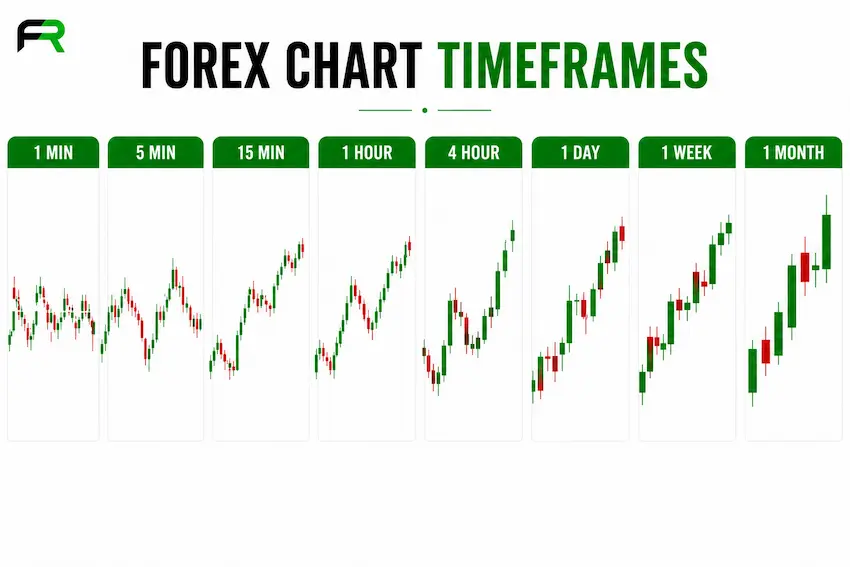
Forex platforms offer three main ways to display price over time. The differences matter more than most newcomers realise.
Line Chart
A line chart connects the closing price of each period with a straight line. Clean, simple, and useful for getting a high-level sense of direction. The limitation: it discards everything that happened between the open and the close of each candle. You see where price ended up, not the journey it took to get there.
Bar Chart (OHLC)
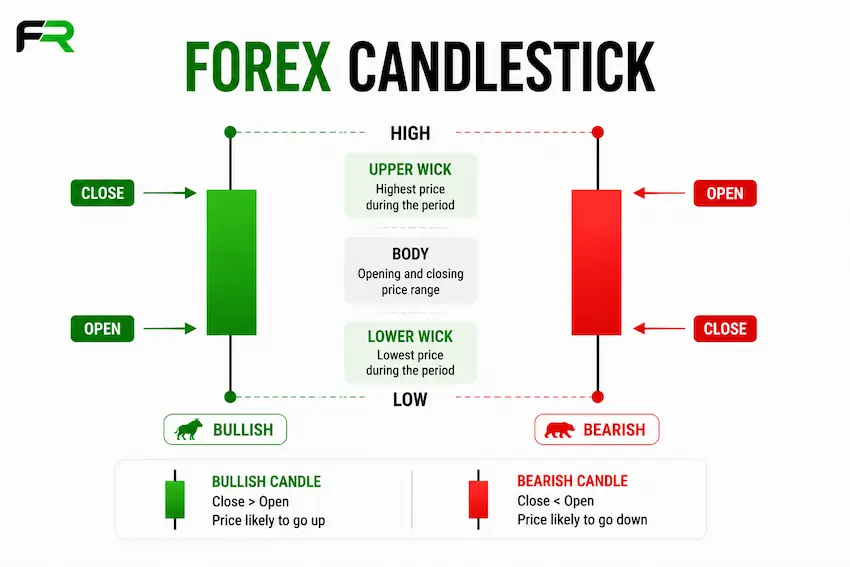
Each vertical bar shows four pieces of information: the Open, High, Low, and Close of the period. A small horizontal tick on the left marks the open; a small tick on the right marks the close. More information than a line chart, less visually intuitive than candlesticks.
Candlestick Chart
Candlesticks carry the same four data points as a bar chart but display them in a way the human eye reads faster. This is the format used by the vast majority of traders globally, and the one this guide focuses on.
| BULLISH CANDLE BEARISH CANDLE | | | ← Upper shadow | ← Upper shadow [███████] [░░░░░░░] [███████] ← Body (Open→Close) [░░░░░░░] ← Body (Close→Open) [███████] [░░░░░░░] | | | ← Lower shadow | ← Lower shadow Filled/green = price rose Hollow/red = price fell |
A bullish candle closes higher than it opened. A bearish candle closes lower. The wicks show the full price range of the period.
The filled body of the candle shows the range between open and close. The thin lines extending above and below called wicks or shadows show the highest and lowest prices reached during the period. A long upper wick on an otherwise bullish candle tells you buyers pushed price up, but sellers pushed it back down before the period closed. That is meaningful information a line chart simply erases.
Timeframes
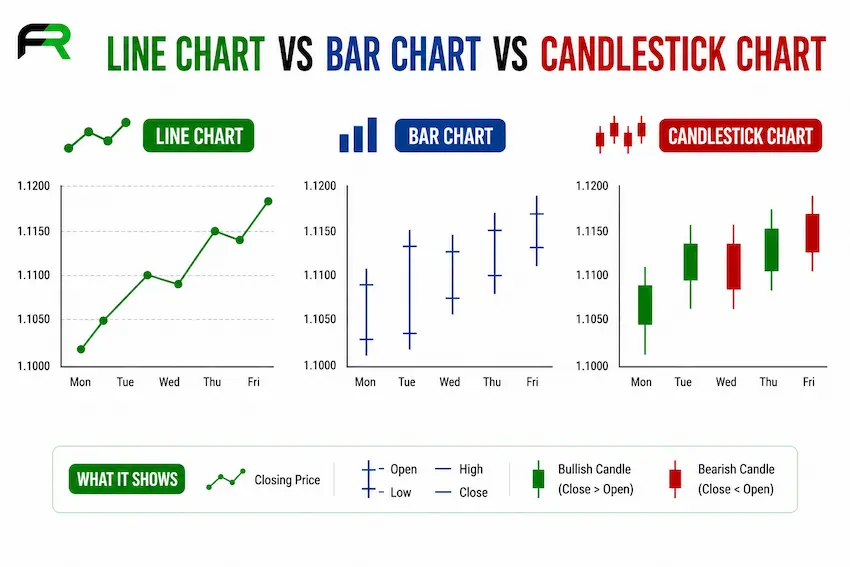
Every chart operates on a timeframe the period each candle or bar represents. A 1-hour chart means each candle covers one hour of trading activity. A daily chart means each candle covers a full trading day. Choosing the right timeframe depends on your trading style, not on what looks busiest.
| Timeframe | Each Candle Covers | Typical Use |
| M1 (1-minute) | 1 minute | Scalping very short trades, high noise |
| M5 (5-minute) | 5 minutes | Short-term intraday entries |
| M15 / M30 | 15–30 minutes | Intraday trading with slightly more context |
| H1 (1-hour) | 1 hour | Most popular for beginners enough signal, manageable noise |
| H4 (4-hour) | 4 hours | Swing trading entries with cleaner structure |
| D1 (Daily) | 1 full day | Position trading, trend identification |
| W1 (Weekly) | 1 full week | Long-term bias and major level identification |
For a beginner, the H1 (1-hour) and H4 (4-hour) charts are the most practical starting point. They move slowly enough to give you time to think through decisions, but frequently enough to offer regular trading opportunities. The M1 and M5 charts are a fast track to impulsive, reactive trading the opposite of what builds good habits.
The Three Indicators Every Beginner Should Know
Indicators are mathematical calculations applied to price data and displayed on the chart. There are hundreds of them. Most beginners overload their screen with indicators and end up paralysed by contradictory signals. Three are enough to start.
Moving Average (MA)
A moving average smooths price data over a set number of periods and draws a single line on the chart. A 20-period moving average, for example, averages the last 20 closing prices. When price is consistently above the moving average, the trend is broadly upward. When it is consistently below, the trend is downward. The moving average does not predict; it describes what has already happened in a tidier visual form.
Relative Strength Index (RSI)
The RSI measures the speed and magnitude of recent price changes and outputs a number between 0 and 100. Readings above 70 are conventionally described as overbought meaning the recent upward move has been aggressive and a pullback may follow. Readings below 30 are described as oversold. The RSI is best used as a supporting signal, not as a standalone buy or sell trigger. Price can remain overbought or oversold for extended periods in a strong trend.
Bollinger Bands
Bollinger Bands place two lines above and below a moving average, set at a distance based on recent price volatility. When price approaches the upper band, the move is extended relative to recent history. When it approaches the lower band, the opposite is true. The bands also contract and expand: narrow bands signal low volatility and often precede a significant price move; wide bands signal high volatility already in motion.
| Beginner Rule of ThumbOne trend indicator (moving average) plus one momentum indicator (RSI) is enough for a starter setup. Adding more creates noise, not clarity. Remove every indicator from your chart and add them back one at a time, only when you understand exactly what each one is measuring. |
Understanding Leverage and Margin
Leverage is the concept most often cited when retail traders discuss their losses, and also the concept most poorly explained in beginner resources. This section covers it with real numbers, because the mathematics are the only thing that makes the risk genuinely tangible.
What Leverage Actually Is
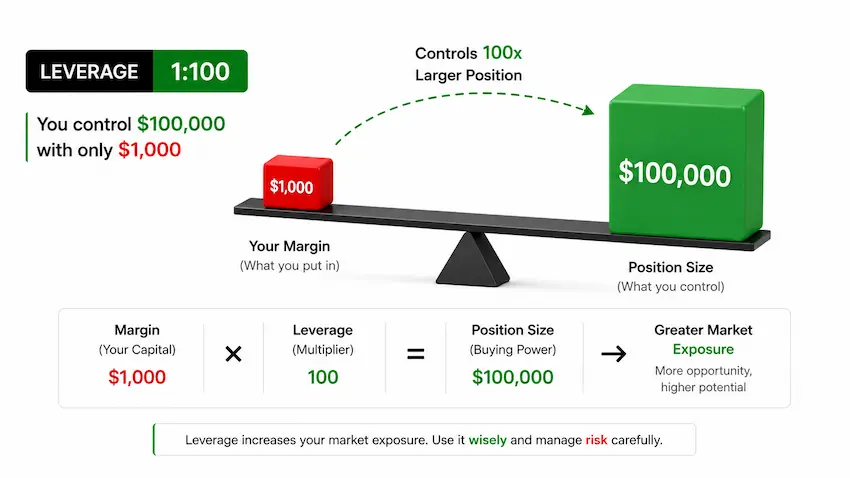
Leverage allows you to control a position larger than your account balance. At 10:1 leverage, a $1,000 account can control a $10,000 position. At 100:1, that same $1,000 controls $100,000. The broker is extending you temporary credit to hold the full position size, with your deposited funds serving as the collateral.
The important thing to understand: leverage amplifies both gains and losses by the same factor. A 1% move in your favour at 100:1 leverage produces a 100% gain on your margin. A 1% move against you at 100:1 leverage wipes the margin entirely. The market does not care which direction you are pointing.
Margin: What Gets Held and Why
When you open a leveraged trade, your broker holds a portion of your account balance as collateral. This held amount is called margin. The rest of your account balance remains as free margin available to absorb losses or open additional positions.
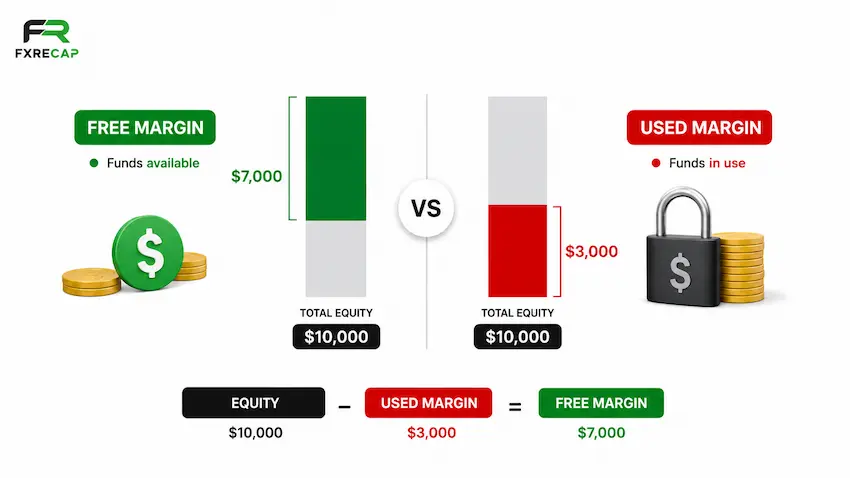
| The Margin FormulaRequired Margin = Trade Size ÷ Leverage Ratio Example: Opening 1 standard lot (100,000 units) of EUR/USD at 30:1 leverage requires $3,333 in margin. $100,000 ÷ 30 = $3,333 |
Real Number Examples
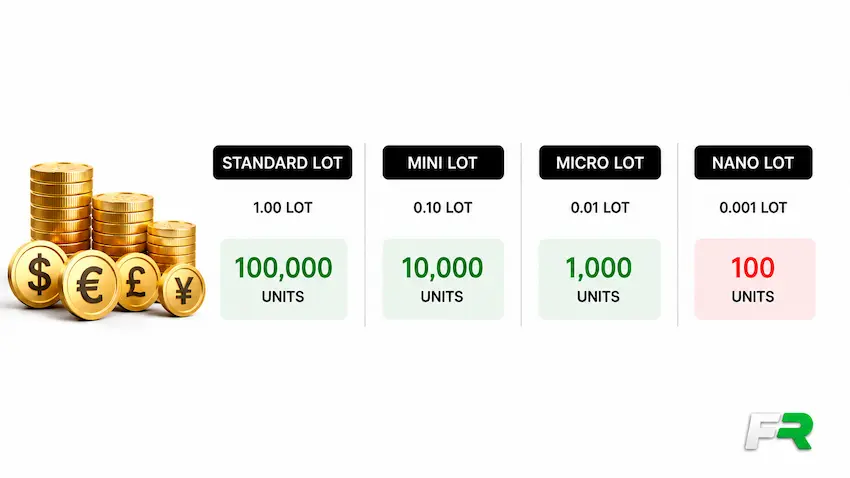
These examples use EUR/USD at a price of 1.0850. One pip on a standard lot (100,000 units) equals $10. One pip on a mini lot (10,000 units) equals $1. One pip on a micro lot (1,000 units) equals $0.10.
| Account Size | Leverage | Position Size | Margin Used | Value of 1 Pip | To Wipe Account |
| $500 | 1:30 | Micro lot (1,000) | $33 | $0.10 | 5,000 pips adverse |
| $500 | 1:100 | Mini lot (10,000) | $100 | $1.00 | 500 pips adverse |
| $500 | 1:100 | Standard (100,000) | $1,000 | $10.00 | 50 pips adverse account gone |
| $1,000 | 1:30 | Mini lot (10,000) | $333 | $1.00 | 1,000 pips adverse |
| $1,000 | 1:30 | Standard (100,000) | $3,333 | $10.00 | 100 pips adverse |
The third row is the one worth staring at for a moment. A $500 account, trading a full standard lot at 100:1 leverage, needs only a 50-pip move against it to hit zero. EUR/USD routinely moves 50 pips in a single trading session. This is not a hypothetical worst case. It is a Tuesday morning in the forex market.
Margin Call and Stop Out
Two terms appear in every broker’s terms and conditions and deserve specific attention before any live trade is placed.
A margin call occurs when your account equity drops to a set percentage of the margin being used typically 100% at most regulated brokers. At this point the broker alerts you to deposit more funds or close positions. Some brokers issue a notification; others move directly to automatic closure.
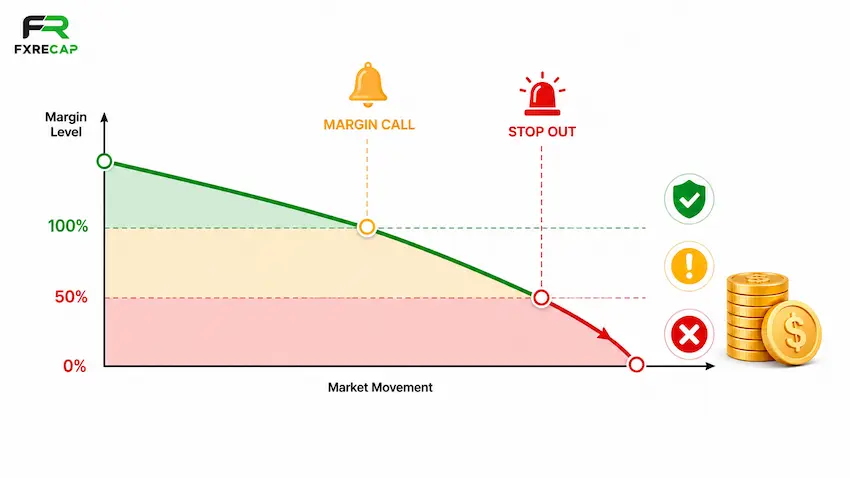
Stop out is the level at which the broker begins automatically closing your open positions, starting with the largest losing trade. This is the mechanism that prevents your account from going below zero. The stop out level is typically set at 50% of margin at regulated brokers, meaning positions close automatically when your equity reaches half the required margin.
| The Rule That Changes EverythingNever use leverage because it is available. Use the minimum leverage that allows you to trade your intended position size with proper risk management applied. Most professional traders operate at effective leverage of 3:1 to 5:1, regardless of the maximum their broker permits. |
Negative Balance Protection
All FCA, ASIC, and CySEC-regulated brokers are required to offer negative balance protection on retail accounts. This means your losses are capped at your account balance the broker cannot pursue you for additional funds if a sharp market move pushes a position into negative territory. Verify this is in place before depositing, particularly if accessing a broker through an offshore entity where the requirement does not apply.
How to Place Your First Trade
Knowing what to trade and knowing how to execute the trade are two separate skills. Most beginners spend weeks absorbing market theory and then fumble the mechanical part because they have never actually walked through the execution process before money is on the line. This guide fixes that.
The steps below apply to MetaTrader 4 and MT5, the platforms used by AvaTrade, Pepperstone, Exness, and most regulated brokers on the FX Recap list. xStation 5 (XTB) and eToro’s platform follow the same logical sequence with slightly different screen layouts.
The Order Types You Need to Know
Before placing any trade, understand what kind of order you are using and what it commits you to.
| Market Order | Executes immediately at the current market price. You get filled right now, at whatever price the market is offering. Fast, but in volatile conditions the fill price may differ slightly from what you saw on screen (this is called slippage). |
| Limit Order | Sets a specific price at which you want to enter. The order only executes if the market reaches that price. Useful when you want to buy a pullback rather than chasing price upward. Your fill is guaranteed at your price or better but the trade may never fill if the market does not return to your level. |
| Stop Order | An entry order that triggers when price moves through a specified level, in the direction of the move. Used to enter breakouts: you place a buy stop above current price, and the order triggers if price moves up and hits your level. |
| Stop Loss | An order attached to an open position that closes the trade automatically if price moves against you to a set level. Non-negotiable for every single trade. Set it when you open the position, not later. |
| Take Profit | An order attached to an open position that closes the trade automatically when price reaches your target. Optional but strongly recommended removes the emotional element from closing a winning trade. |
Step-by-Step: Opening a Trade in MetaTrader
This walkthrough uses a buy (long) trade on EUR/USD as the example. The same process applies to any currency pair and to sell (short) trades.
- Open the order window In MT4 or MT5, right-click the chart and select ‘New Order’, or press F9. The order window appears.
- Select the instrument Confirm EUR/USD is selected in the Symbol field at the top of the order window.
- Set the lot size Enter your position size in the Volume field. For a first live trade, use 0.01 lots (one micro lot). This is the smallest available size on most platforms and keeps your per-pip value at $0.10.
- Set the Stop Loss level In the Stop Loss field, enter the price level where you want the trade to close automatically if it moves against you. If EUR/USD is currently at 1.0850 and you are buying, a stop loss at 1.0800 means the position closes if price falls 50 pips.
- Set the Take Profit level In the Take Profit field, enter your target exit price. If your stop loss is 50 pips below entry, a take profit at 1.0950 gives you a 1:2 risk-to-reward ratio risking 50 pips to target 100 pips.
- Select order type and execute Choose ‘Market Execution’ for an immediate fill. Click ‘Buy’ (or ‘Sell’ for a short trade). The order executes and appears in your Terminal at the bottom of the screen under the Trade tab.
- Confirm the trade is live Check the Trade tab in the Terminal window. You should see the open position showing the entry price, lot size, stop loss level, and current profit or loss. If the stop loss field is empty, close the trade immediately and re-enter with the stop loss set correctly.
Reading the Terminal Window
Once a trade is open, the Terminal window at the bottom of the MetaTrader screen becomes your primary monitoring panel. Understanding what each column shows prevents misreading your account status.
| Symbol | The currency pair you are trading. EUR/USD, GBP/USD, etc. |
| Type | Buy or Sell the direction of your trade. |
| Volume | The lot size of the position (e.g. 0.01, 0.10, 1.00). |
| Open Price | The price at which the trade was executed. |
| S / L | Your stop loss level. If this is blank, the position has no protection. Fix it. |
| T / P | Your take profit level. Blank means the trade has no automatic exit target. |
| Current Price | The live market price. Updates in real time. |
| Profit | Your unrealised profit or loss in account currency. Negative does not mean the stop has triggered it means price has moved against you but the position is still open. |
| Balance | Your account balance excluding open positions. |
| Equity | Your account balance including the current unrealised P&L of all open positions. This is the live value of your account. |
| Margin | The total collateral held by the broker for all open positions. |
| Free Margin | What remains available after margin is deducted. If this approaches zero, you are close to a margin call. |
| The Most Common First-Trade MistakePlacing a trade without a stop loss because you intend to monitor it manually and close it yourself if it goes wrong. You will not be there. The market moves while you are sleeping, distracted, or emotionally unable to close a losing position. The stop loss is the rule that overrides all of that. Set it before you click Buy. |
Risk Management: Lot Sizing, Stop Loss, and the 2% Rule
Risk management is not the cautious, boring part of trading that serious traders eventually get to. It is the entire foundation. Every trader who survives longer than six months has a risk management framework they follow consistently. Every trader who blew their account in the early stages did not.
This guide covers three interlocking concepts: the 2% rule, how to size positions correctly based on it, and how to place a stop loss that reflects actual market structure rather than an arbitrary number.
The 2% Rule Explained
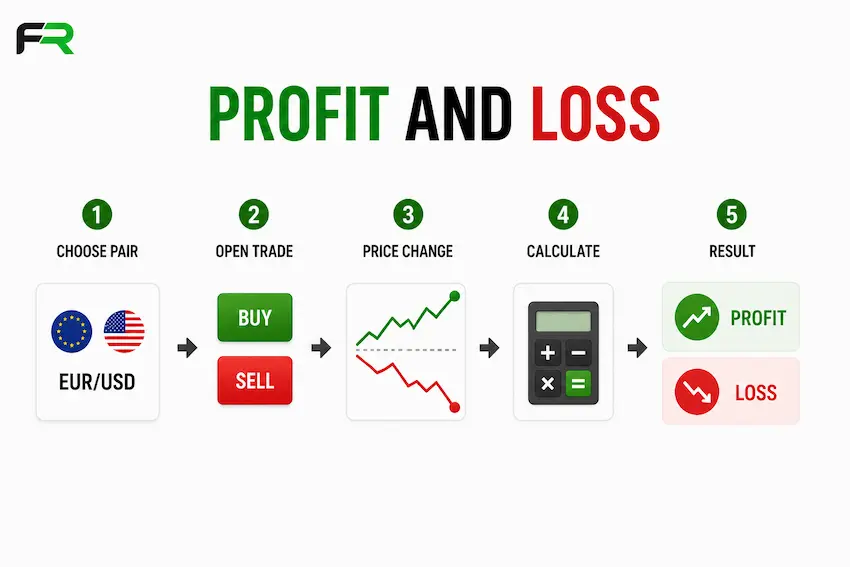
The 2% rule states that no single trade should put more than 2% of your account balance at risk. At a $1,000 account, that is $20 per trade. At $500, it is $10. The rule is not about limiting your profit potential it is about ensuring that a losing streak, which every trader experiences, cannot eliminate the account.
| Why 2% Survives a Losing StreakAt 2% risk per trade: 10 consecutive losses = account reduced to approximately $817 from $1,000 (an 18.3% drawdown) 20 consecutive losses = account reduced to approximately $668 (a 33.2% drawdown) At 10% risk per trade: 10 consecutive losses = account reduced to approximately $349 from $1,000 (a 65.1% drawdown) 20 consecutive losses = account reduced to approximately $122 (an 87.8% drawdown) A ten-trade losing streak is not unusual for a developing strategy. The 2% framework keeps it survivable. The 10% framework makes it catastrophic. |
Position Sizing: The Calculation
The position size calculation connects your risk percentage, your account size, and the distance to your stop loss. It tells you the exact lot size to trade so that if your stop loss triggers, you lose precisely your chosen risk amount and no more.
| POSITION SIZE FORMULA Risk Amount ($) = Account Balance × Risk % = $1,000 × 2% = $20 Pip Value = Risk Amount ÷ Stop Loss Distance (pips) = $20 ÷ 40 pips = $0.50 per pip Lot Size = Pip Value ÷ $10 (pip value per standard lot) = $0.50 ÷ $10 = 0.05 lots (5 micro lots) Summary: $1,000 account | 2% risk | 40-pip stop = 0.05 lot size |
Running this calculation before every trade is non-negotiable at the learning stage. It takes less than thirty seconds and ensures the position size matches the risk you have decided to accept, rather than a round number you chose because it felt about right.
Position Size Reference Table
These figures assume a $10 pip value per standard lot on EUR/USD. Adjust for other pairs where pip values differ.
| Account | Risk (2%) | Stop Loss | Correct Lot Size | Loss if Stopped Out |
| $500 | $10 | 20 pips | 0.05 lots | $10 |
| $500 | $10 | 40 pips | 0.025 lots | $10 |
| $500 | $10 | 60 pips | 0.017 lots | $10 |
| $1,000 | $20 | 20 pips | 0.10 lots | $20 |
| $1,000 | $20 | 40 pips | 0.05 lots | $20 |
| $1,000 | $20 | 60 pips | 0.033 lots | $20 |
| $2,500 | $50 | 30 pips | 0.17 lots | $50 |
| $5,000 | $100 | 50 pips | 0.20 lots | $100 |
Where to Place a Stop Loss
The stop loss level should be determined by the chart, not by how much you are willing to lose in dollar terms. Setting a stop 30 pips below entry because 30 pips equals $30 and $30 feels manageable is backwards thinking. The correct approach is to identify where the market would need to go to tell you your trade idea was wrong, and place the stop there. Then calculate the lot size that makes that distance equal to your 2% risk amount.
Common Stop Loss Placement Methods
Behind a swing low or high: if you are buying, the most logical stop sits just below the most recent significant low. If price breaks below that level, the bullish structure you were trading no longer holds. The trade was wrong; the stop exits it cleanly.
Beyond a key support or resistance level: price often reacts strongly at previous highs and lows, round numbers, and moving average crossings. A stop placed just beyond one of these levels accounts for normal market noise without being so tight that a routine oscillation triggers it.
Below or above an indicator reading: some traders use the ATR (Average True Range) indicator to set stop distances proportional to current volatility. An ATR reading of 40 pips on the H1 chart suggests placing a stop at least 40 pips from entry any tighter and the normal daily range will trigger it without the trade actually being wrong.
| The Stop Loss Trap to AvoidWidening a stop loss after the trade moves against you to avoid taking the loss. This converts a calculated, defined-risk trade into an undefined-risk position. The original stop was set where the idea was wrong. Moving it means continuing to hold a trade that the market is telling you is wrong. Close it, log the loss, and move on. |
Daily Loss Limits
Beyond the per-trade 2% rule, experienced traders impose a daily loss limit after which trading stops entirely for the day. A common setting is 6% of account equity the equivalent of three losing trades at 2% each. Once that limit is reached, the platform closes. The reasoning is straightforward: a losing day often becomes a worse losing day when you trade through it emotionally. The daily loss limit is the mechanism that prevents one bad session from becoming an account-threatening event.
Reading an Economic Calendar and Trading News Events
The forex market does not move in a vacuum. Behind every significant price movement is a fundamental trigger a central bank decision, an employment report, an inflation reading. Understanding how news events drive currency prices separates traders who are constantly surprised by the market from those who anticipate its major turning points.
What the Economic Calendar Is
An economic calendar is a scheduled list of upcoming data releases and events that have the potential to move currency prices. Every regulated broker provides one, and dedicated resources like Investing.com, Forex Factory, and Myfxbook maintain free, real-time versions. Most beginners open one once and close it again. Experienced traders check it before every trading session.
How to Read a Calendar Entry
Each event on the calendar carries several pieces of information that collectively tell you how significant the release is and what to expect from it.
| Time | The exact time the data releases, in your local timezone. The market can move sharply in the seconds around this timestamp. Know it before you have positions open. |
| Currency | The currency most directly affected. A US Non-Farm Payrolls release primarily moves USD pairs. A Bank of England rate decision moves GBP pairs. |
| Impact | Typically flagged as Low, Medium, or High (often shown as one, two, or three coloured bars). High-impact events carry the most price-moving potential. Beginners should treat High-impact releases as a reason to either step aside or cut position size. |
| Previous | The figure from the last release of this same data. This is the baseline the market is comparing the new number against. |
| Forecast | The consensus estimate from economists surveyed before the release. The market prices in this expectation in the days leading up to the event. The actual price move depends on how far the released number deviates from the forecast, not just whether the number is good or bad in absolute terms. |
| Actual | The released figure. Published at the exact scheduled time. The market’s reaction depends on the gap between Actual and Forecast. |
The Key High-Impact Events
Not all calendar entries carry equal weight. These are the events with the highest consistent price-moving potential across major currency pairs.
| Event | Currency | Why It Moves the Market |
| Non-Farm Payrolls (NFP) | USD | Monthly US employment figure. Released the first Friday of each month. One of the highest-impact regular releases globally EUR/USD can move 50–150 pips in minutes. |
| Central Bank Rate Decisions | All major | The Federal Reserve, ECB, Bank of England, RBA, and others set interest rates at scheduled meetings. Rate changes, or even the language around future changes, drive sustained multi-day moves. |
| Consumer Price Index (CPI) | USD, EUR, GBP, AUD | Inflation data. Central banks use CPI to justify rate decisions. A CPI reading above expectations signals potential rate hikes, strengthening the currency. Below expectations signals the opposite. |
| Gross Domestic Product (GDP) | USD, EUR, GBP | Measures economic growth. Strong GDP supports the currency; weak GDP weakens it. Released quarterly with significant advance, preliminary, and final revisions. |
| Purchasing Managers Index (PMI) | USD, EUR, GBP | A business activity survey. Above 50 signals expansion; below 50 signals contraction. Released monthly. Affects currencies tied to manufacturing and services output. |
| Unemployment Rate | USD, EUR, GBP, AUD | Closely watched alongside NFP. High unemployment weakens a currency; declining unemployment strengthens it. |
The Volatility Trap Around News Events
High-impact news events create the most dangerous conditions for beginners, and understanding why requires understanding how the market processes information at the moment of release.
In the seconds before a major release, spreads widen. Liquidity providers pull their quotes because they do not know what the number will be, and they are not willing to be on the wrong side of a sudden 80-pip move. The platform still shows a price, but the ability to execute at that price is temporarily compromised. Slippage the difference between the price you see and the price you get can be severe.
The immediate post-release move is often violent and in one direction, followed by a reversal as the market reassesses and repositions. This two-directional whipsaw catches traders on both sides. Experienced traders either stay out entirely during the release or take positions with clearly defined stops and reduced size.
| A Practical Rule for BeginnersFor the first three months of live trading, close or significantly reduce any positions in pairs directly affected by a High-impact event at least 15 minutes before the scheduled release time. Missing the occasional large move costs far less than being on the wrong side of one with a full-size position. |
Using the Calendar Proactively
The economic calendar is not just a hazard warning system. Traders who understand the fundamental backdrop use it to identify higher-probability trade setups. A currency that has consistently printed weaker-than-expected economic data for several months is fundamentally weak. That context supports short trades in that currency when technical setups align. A country with rising inflation and a central bank that has signalled upcoming rate hikes has a fundamentally strengthening currency. The calendar helps you understand which direction the fundamental wind is blowing technical analysis tells you the best moment to put up the sail.
Where to Access the Calendar
Investing.com and Forex Factory both offer free, highly detailed economic calendars with timezone adjustment, impact filtering, and historical comparison data. All five brokers in the FX Recap review include a calendar within their platforms or via integrated tools Pepperstone and AvaTrade both integrate Trading Central, which flags events automatically on charts. XTB’s xStation 5 has a built-in economic calendar with direct chart annotations. These in-platform versions are convenient; the dedicated sites give you more filtering control when you need to plan ahead across a full trading week.
Mistakes That Cost Beginners the Most
Every broker on this list is regulated and legitimate. Early account losses come almost entirely from how you trade, not from which broker holds the account. Four patterns account for most of the damage.
Using Excessive Leverage from the Start
A 30:1 leverage ratio the EU and UK retail cap means a 3.3% adverse price move wipes the account. Offshore entities offering 100:1 or above shrink that threshold to 1%. Start at the lowest leverage your account permits and move upward only when risk management is genuinely consistent across weeks of trading.
Skipping the Demo Stage
Traders who move directly from research to live accounts bypass the most important part of the process. The mechanics of entering trades, setting stops, and managing open positions against real prices are not intuitive on first contact. Two to three months of disciplined demo trading is not a delay it is the foundation the live account depends on.
Trading Without a Stop Loss
A stop loss is not pessimism. It is the mechanism that keeps a single trade from becoming an account-ending event. Every position placed without one is an open invitation for the market to run until the balance reaches zero. Set it at order entry, every time, without exception.
Chasing Losses
The pattern where a losing trade immediately prompts a larger position to recover the deficit is the most reliably destructive habit in retail forex. Experienced traders maintain a strict daily loss limit after which they close the platform entirely. The market reopens tomorrow. Your account needs to survive long enough to be there for it.
Frequently Asked Questions
How much money do I realistically need to start?
The technical floor at some brokers is $5 or $10, but a practical starting point is $200 to $500. That range provides enough room to trade micro lots with 2% risk management applied while absorbing early losses without immediately depleting the account. Anything below $100 functions more as an extended demo with minor financial exposure than a viable trading account with room to breathe.
Is forex trading legal in South Africa?
Yes. Forex trading is fully legal in South Africa. The Financial Sector Conduct Authority is the primary regulator for forex brokers operating locally, and South African traders should prioritise brokers holding an FSCA licence it provides local regulatory cover and clearer recourse channels. Exness, Pepperstone, and AvaTrade all maintain active FSCA-regulated entities.
What is the difference between MT4 and MT5?
MetaTrader 4 is the most widely used retail forex platform globally. It supports four order types, nine timeframes, and a large ecosystem of expert advisors and custom indicators. MetaTrader 5 adds 21 timeframes, six order types, a built-in economic calendar, and broader multi-asset support. For pure forex beginners, MT4 is simpler and carries more community resources. MT5 is the stronger long-term platform for traders who plan to expand across multiple asset classes.
What is a pip and why does it matter?
A pip is the fourth decimal place in most currency pair prices. On EUR/USD, a move from 1.0850 to 1.0851 is one pip. A broker quoting a 1.0 pip spread adds that cost to every trade, regardless of outcome. On a standard lot (100,000 units), one pip equals $10. On a micro lot (1,000 units), it equals $0.10. Spreads are one of the primary ongoing trading costs, which is why comparing them across brokers remains relevant even at the beginner stage.
Should I start with a demo or a live account?
A demo account no exceptions. Real capital creates emotional pressure that paper trading cannot replicate, but platform mechanics, strategy testing, and position sizing discipline are best developed without that pressure first. Spend at least two months on a demo, treat it with the same seriousness as a funded account, and only then make the transition.
Which broker is best for South African beginners specifically?
Exness offers the strongest combination: FSCA licence, ZAR account support, EFT deposits, instant withdrawals, and a $10 entry point with spreads from 0.2 pips on EUR/USD. Pepperstone is the better choice for traders who want a broader platform selection and slightly deeper educational resources. AvaTrade leads for structured learning with an FSCA-regulated entity. For the highest trust score in the sector, IG Markets holds both FSCA and FCA licences with a 9.7/10 rating from ForexBrokers.com though it was not included in this five-broker shortlist, it remains worth considering for serious beginners who want the deepest infrastructure available.
FX Recap’s Final Take
The retail forex market in 2026 offers genuine quality at the entry level, and the five brokers in this guide represent that quality across different priorities. AvaTrade’s education library is the most structured available to retail traders. Pepperstone’s platform range and transparent fee model make it the strongest all-round option for traders who care about cost from day one. XTB delivers the most accessible interface a first-timer will encounter. Exness solves the entry-cost and withdrawal friction problem and for South African traders specifically, it leads on local payment support.
eToro sits in its own category. If social copy trading is the reason you are starting, there is no better-built environment for it. If it is not the reason, the proprietary platform and wider spreads represent a real trade-off.
None of those distinctions matter if the foundational habits are missing: start on a demo, risk no more than 2% per trade, apply a stop loss on every position, and spend more time inside the education library than on the trading screen for the first three months. The brokers provide the infrastructure. Everything after that depends entirely on the discipline you bring to it.
- 1
 IC MarketsTop pick★★★★★★★★★★4.7/5
 - 2
 Exness★★★★★★★★★★4.7/5
 - 3
 XM★★★★★★★★★★4.7/5
 - 4
 RoboForex★★★★★★★★★★4.6/5
 - 5
 FP Markets★★★★★★★★★★4.6/5
Your capital is at risk. FX Recap rates brokers available in each country on regulation, trading conditions and user trust. How we rank
 Unlimited cashback on your XM tradesUnlimited XM cashbackAdT&Cs apply. Your capital is at risk.T&Cs apply · Capital at riskStart earning