IC Markets






































Week Ahead: Five Central Bank Decisions in Three Days, Plus US GDP and Australian CPI
The RBNZ, Bank of Canada, Fed, ECB and Bank of Japan all decide between Wednesday and Friday, with US growth and inflation data in the middle.
 WriterAbir KhanWriterWrites the guides · checks every figure against primary sources View profileAbout Abir →

 Market analysisTanbir Habib RiyadForex & Crypto AnalystForex and crypto analyst · technical and fundamental analysis View profileAbout Tanbir →

 Fact-checking & riskJannatul FerdaushFact-Checker & Risk AnalystFact-checks every figure · risk analysis · Applied Statistics, University of Dhaka View profileAbout Jannatul →

 Trading reviewJowel RanaCo-Founder & Forex TraderCo-founder · forex trader · reviews guides from a trader's view View profileAbout Jowel →

 Final approvalRanjan NiskrityFounder, Owner & Forex TraderFounder and owner · forex trader · signs off every guide View profileAbout Ranjan →

Next week is the busiest stretch for central banks this autumn. Between Wednesday 28 and Friday 30 October, the Reserve Bank of New Zealand, the Bank of Canada, the Federal Reserve, the European Central Bank and the Bank of Japan all announce rate decisions. From the first announcement to the last is only about 50 hours, so almost every major currency has a scheduled policy event. Only sterling and the Swiss franc sit this one out.
Data fills the gaps between them. Australia publishes September consumer prices half an hour before the RBNZ speaks. The US Bureau of Economic Analysis releases its first estimate of third-quarter growth and the September inflation measure the Fed prefers on Thursday, the morning after the Fed decides and 45 minutes before the ECB. Tokyo's October prices land on the morning of the Bank of Japan decision, and euro area growth figures follow a few hours later.
A clock change adds one more trap. Summer time ends in the UK and the European Union on Sunday 25 October, while the United States keeps daylight saving time until 1 November. For one week, New York is only four hours behind London instead of five, so US releases and the Fed decision arrive an hour earlier than usual for anyone in Europe, Africa or the Middle East.
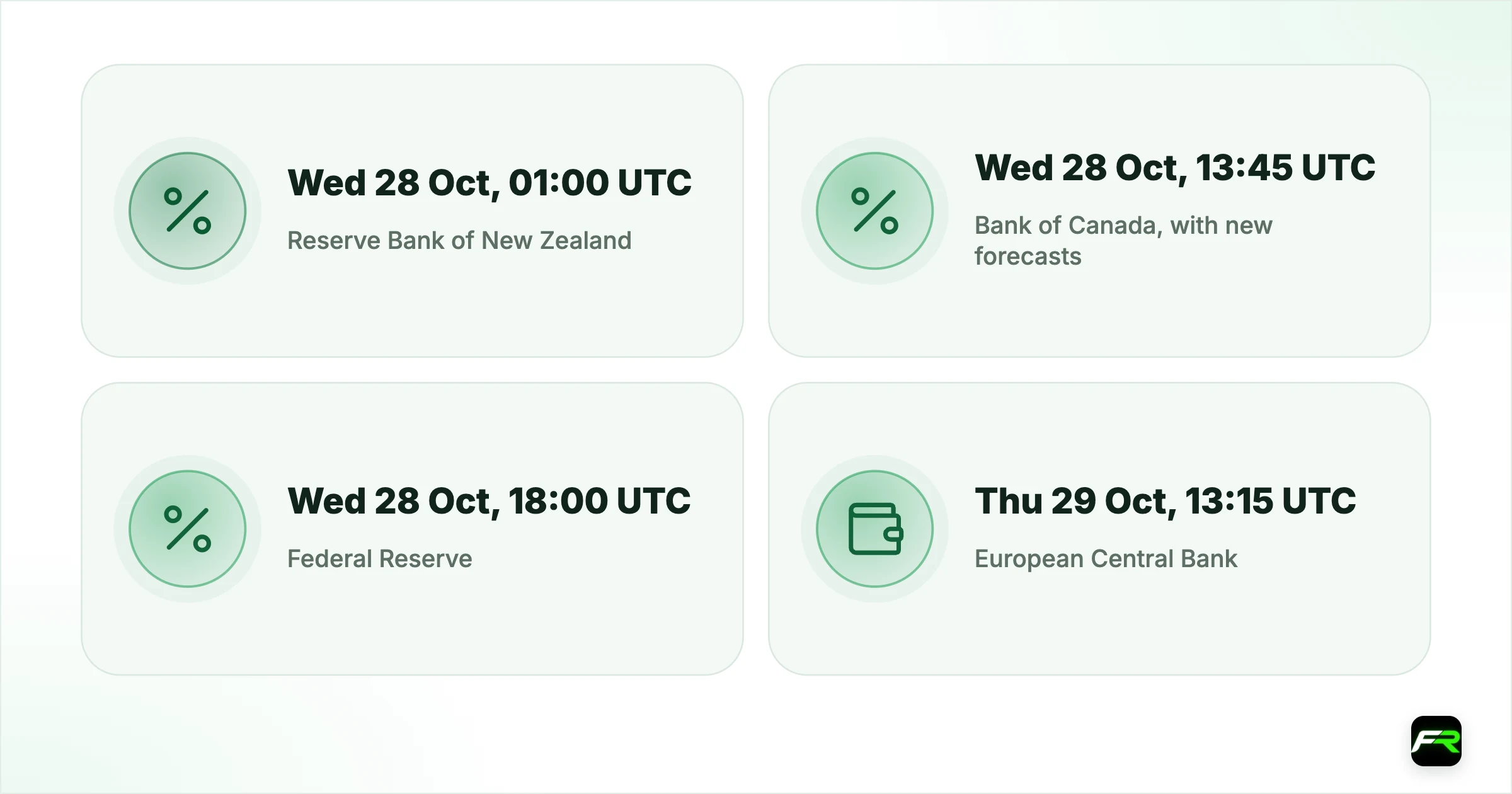
| Reserve Bank of New Zealand | Wed 28 Oct, 01:00 UTC (OCR 2.75%) |
|---|---|
| Bank of Canada, with new forecasts | Wed 28 Oct, 13:45 UTC (2.25%) |
| Federal Reserve | Wed 28 Oct, 18:00 UTC (3.75% to 4.00%) |
| European Central Bank | Thu 29 Oct, 13:15 UTC (deposit rate 2.50%) |
| Bank of Japan | Fri 30 Oct, no fixed time (1.25%) |
| US GDP, Q3 advance, and September PCE (BEA) | Thu 29 Oct, 12:30 UTC |
| Australia CPI, September (ABS) | Wed 28 Oct, 00:30 UTC |
| Euro area flash GDP, Q3 (Eurostat) | Fri 30 Oct |
Monday and Tuesday: a quiet start with US orders
The first two days are light, which gives you time to prepare. Statistics Canada publishes its advance wholesale trade indicator on Monday. On Tuesday 27 October, the US Census Bureau releases September durable goods orders at 08:30 New York time (12:30 UTC) and new home sales at 10:00 (14:00 UTC). Durable goods orders swing widely because of aircraft, so the figure excluding transportation is the one to read for business demand.
Both US reports land in the Fed's blackout period, when policy makers do not give speeches, so markets will read them without official comment. Weak orders would add to the case that high fuel costs are slowing the economy, which has been the message from the bond market this month. The 10-year Treasury yield ended Friday at 5.00%, according to the US Treasury, down from 5.09% a week earlier and 5.24% two weeks ago.
Wednesday: Australian inflation, the RBNZ, the Bank of Canada and the Fed
Wednesday begins in the Pacific. At 11:30 Canberra time (00:30 UTC), the Australian Bureau of Statistics publishes the Consumer Price Index for September 2026. In August, prices were 4.0% higher than a year earlier, up from 3.5% in July, and trimmed mean inflation, the underlying gauge the Reserve Bank of Australia watches, held at 3.6%. The ABS notes that quarterly data, including a quarterly trimmed mean, now come with the monthly release, so September's figures complete the third-quarter reading the RBA weighs before its 3 November meeting.
Thirty minutes later, at 14:00 Wellington time (01:00 UTC), the Reserve Bank of New Zealand announces its official cash rate. The bank lifted the rate to 2.75% on 2 September. This is a Monetary Policy Review rather than a full Monetary Policy Statement, which comes next on 9 December. New Zealand inflation eased to 3.7% in the September quarter but stayed above the 1% to 3% target band, as our NZ CPI story explained.
Ottawa follows at 09:45 local time (13:45 UTC). The Bank of Canada held its policy rate at 2.25% on 2 September and publishes a new Monetary Policy Report with this decision, which means fresh forecasts for growth and inflation. September CPI rose to 3.1% on gasoline, but the bank's preferred core measures, CPI-trim and CPI-median, eased to 1.8% and 1.9%. USD/CAD fell 0.95% this week to 1.4002, so the loonie arrives strong.
The Federal Reserve closes the day at 14:00 New York time, which is 18:00 UTC and, after the clock change, 18:00 in London too. Its target range has been 3.75% to 4.00% since 16 September. Consumer prices rose 3.7% in the year to September, according to the Bureau of Labor Statistics, and the BEA's PCE price index rose 3.4% in the year to August. The Chair's press conference normally starts 30 minutes after the statement, and the reaction often turns there.
Thursday: US growth and inflation, then the ECB
Thursday is the crowded middle of the week. At 08:30 New York time (12:30 UTC), the BEA publishes its advance estimate of third-quarter GDP together with Personal Income and Outlays for September, which includes the PCE price index. Second-quarter growth was 2.2% at an annual rate, according to the BEA's third estimate, after 2.5% in the first quarter. Because these numbers come out the morning after the Fed, they can either confirm its message or undercut it within hours.
The European Central Bank announces its decision at 14:15 Frankfurt time, which is 13:15 UTC, after a two-day meeting in Frankfurt, and holds a press conference afterwards. Its last move, on 10 September, lifted the deposit rate to 2.50%. Eurostat confirmed euro area inflation at 3.8% for September, up from 3.2% in August, with energy adding 1.71 percentage points to the annual rate. EUR/USD slipped 0.35% this week to 1.1205.
Only 45 minutes separate the US data from the ECB announcement. A strong US reading followed by a cautious ECB would be a heavy mix for the euro; the reverse could lift it fast. The European Commission's economic sentiment survey for October is also due on Thursday, an early read on how businesses and households in Europe are coping with energy costs.
Friday: Tokyo prices, the Bank of Japan and euro area growth
Japan's Statistics Bureau releases Tokyo's October consumer prices on Friday 30 October at 08:30 Tokyo time, which is 23:30 UTC on Thursday. National figures published this week showed core inflation, excluding fresh food, rising to 2.1% in September from 1.7%, and the measure that also strips out energy climbing to 2.4%. Our Japan CPI story covers the details, including the gasoline tax effect that keeps the headline lower.
The Bank of Japan ends its two-day meeting on Friday and announces its decision with no fixed time, usually around midday in Tokyo. It raised its policy rate to 1.25% on 18 September and publishes its quarterly Outlook for Economic Activity and Prices with this meeting. USD/JPY ended the week at 156.81, down 0.74%, after a sharp drop on Thursday when US yields fell.
Later on Friday, Eurostat publishes its preliminary flash estimate of third-quarter GDP for the euro area and the EU, plus September unemployment. At 08:30 Ottawa time (12:30 UTC), Statistics Canada releases GDP by industry for August. After five rate decisions in three days, those growth numbers will show whether higher rates are already biting.
Rates and latest inflation side by side
The table puts each bank's current rate next to the latest inflation figure it will have in front of it. Four of the five raised rates at their last move; only the Bank of Canada held.
| Central bank | Current rate | Last decision | Latest inflation | Decision (UTC) |
|---|---|---|---|---|
| Reserve Bank of New Zealand | 2.75% | Raised 2 Sep | 3.7% (Q3) | Wed 28 Oct, 01:00 |
| Bank of Canada | 2.25% | Held 2 Sep | 3.1% (Sep) | Wed 28 Oct, 13:45 |
| Federal Reserve | 3.75% to 4.00% | Raised 16 Sep | 3.7% CPI (Sep) | Wed 28 Oct, 18:00 |
| European Central Bank | 2.50% deposit | Raised 10 Sep | 3.8% (Sep) | Thu 29 Oct, 13:15 |
| Bank of Japan | 1.25% | Raised 18 Sep | 2.1% core (Sep) | Fri 30 Oct, no fixed time |
Sources: the five central banks' own calendars and statements; Stats NZ, Statistics Canada, the US Bureau of Labor Statistics, Eurostat and Japan's Statistics Bureau for inflation.
Where the markets start the week
Friday's closes set the scene. The dollar index finished almost unchanged at 101.75, but that flat number hides big moves underneath. Against it, the Australian dollar gained 1.27% to 0.7038 and the New Zealand dollar 0.83% to 0.5701, while sterling added 0.34% to 1.3375. Gold had a rough week, with COMEX futures falling 4.1% to $4,010, the lowest close since mid-July; our gold story looks at why. US crude futures closed near $103 a barrel after a 4% jump on Friday.
Those moves matter for next week because they show where positions are crowded. A currency that has already rallied, such as the Australian dollar, has more room to fall if the data disappoint. One that has been sold, such as the euro this week, can bounce sharply if its central bank sounds firmer than expected.
How to trade a week with five decisions
A week like this rewards preparation more than speed. Spreads widen around every announcement, and moves after one decision can be reversed by the next.
- Convert every time on this page into your own time zone before Monday, and remember the clock change. Our economic calendar does the conversion, and the market hours page shows which session is open.
- Hold fewer positions at once. Five decisions in 50 hours means a trade in one pair can be hit by news from two or three central banks.
- Read the statements and press conferences, not only the rate. A hold with a firm warning about inflation can move a currency more than a hike that was fully expected.
- Be careful with the yen on Friday. The Bank of Japan has no fixed announcement time, so set alerts rather than waiting at the screen.
- Avoid placing tight stops right before the 12:30 UTC US data on Thursday or the 13:15 UTC ECB decision, when the spread alone can trigger them.
Say you want to sell EUR/USD at 1.1205 before the ECB, with a stop at 1.1275, 70 pips away. A mini lot of 10,000 units is worth about $1 a pip, so the stop risks about $70 per mini lot. On a $5,000 account with a 1% limit of $50, the right size is about 7,000 units. If the spread widens to 3 pips at 13:15 UTC, count that too, and consider waiting until after the press conference instead.
For levels on the main pairs, see our daily EUR/USD analysis, USD/JPY analysis and AUD/USD analysis, which carry Friday's close over the weekend. Size each trade with the position size calculator.
Rate decisions can move currencies by a large amount within seconds, and prices can gap between quotes. Leverage magnifies losses as well as gains, so trade only with money you can afford to lose.
Meeting dates and announcement times come from the Reserve Bank of New Zealand, the Bank of Canada, the Federal Reserve, the European Central Bank and the Bank of Japan. Release dates come from the official calendars of the US Bureau of Economic Analysis, the US Census Bureau, the Australian Bureau of Statistics, Eurostat, Statistics Canada and Japan's Statistics Bureau. Previous readings are from each agency's latest release. Currency, gold and oil levels are market data built from hourly bars at the Friday close (about 21:00 UTC) and differ slightly between providers. Calendars can change, so check the official site on the day. This is news, not investment advice.
Frequently asked
Which central banks decide on rates in the week of 26 October 2026?
The Reserve Bank of New Zealand, the Bank of Canada and the Federal Reserve on Wednesday 28 October, the European Central Bank on Thursday 29 October and the Bank of Japan on Friday 30 October.
What time is the Fed decision on 28 October 2026?
The Federal Reserve publishes its statement at 14:00 New York time, which is 18:00 UTC. Because the UK clocks go back on 25 October and US clocks on 1 November, that is also 18:00 in London.
When is US third-quarter GDP released?
The Bureau of Economic Analysis publishes the advance estimate on Thursday 29 October 2026 at 08:30 New York time (12:30 UTC), together with September personal income and the PCE price index.
When is Australia's September CPI released?
The Australian Bureau of Statistics publishes it on Wednesday 28 October 2026 at 11:30 Canberra time, which is 00:30 UTC. In August, CPI inflation was 4.0% and trimmed mean inflation 3.6%.
Sources: Federal Reserve: FOMC meeting calendar · European Central Bank: Governing Council meeting calendar · Bank of Japan: Monetary Policy Meetings schedule · US Bureau of Economic Analysis: release schedule · Reserve Bank of New Zealand: Official Cash Rate · Bank of Canada: upcoming events · Australian Bureau of Statistics: future releases · Australian Bureau of Statistics: Consumer Price Index, August 2026 · Eurostat: release calendar · US Census Bureau: 2026 economic indicator calendar · Statistics Bureau of Japan: CPI schedule of release · Statistics Canada: upcoming releases
The team behind this guide
Researched, checked and approved by five forex specialists
Every guide is written, fact-checked and edited before it goes live, and updated when the facts change. Spotted an error? Tell us.