IC Markets






































BoJ Preview: Two Rate Rises This Year, Yet the Yen Still Trades Near 157 per Dollar
The Bank of Japan decides on 30 October after hikes in June and September, with new forecasts due and underlying inflation now close to 2%.
 WriterAbir KhanWriterWrites the guides · checks every figure against primary sources View profileAbout Abir →

 Market analysisTanbir Habib RiyadForex & Crypto AnalystForex and crypto analyst · technical and fundamental analysis View profileAbout Tanbir →

 Fact-checking & riskJannatul FerdaushFact-Checker & Risk AnalystFact-checks every figure · risk analysis · Applied Statistics, University of Dhaka View profileAbout Jannatul →

 Trading reviewJowel RanaCo-Founder & Forex TraderCo-founder · forex trader · reviews guides from a trader's view View profileAbout Jowel →

 Final approvalRanjan NiskrityFounder, Owner & Forex TraderFounder and owner · forex trader · signs off every guide View profileAbout Ranjan →

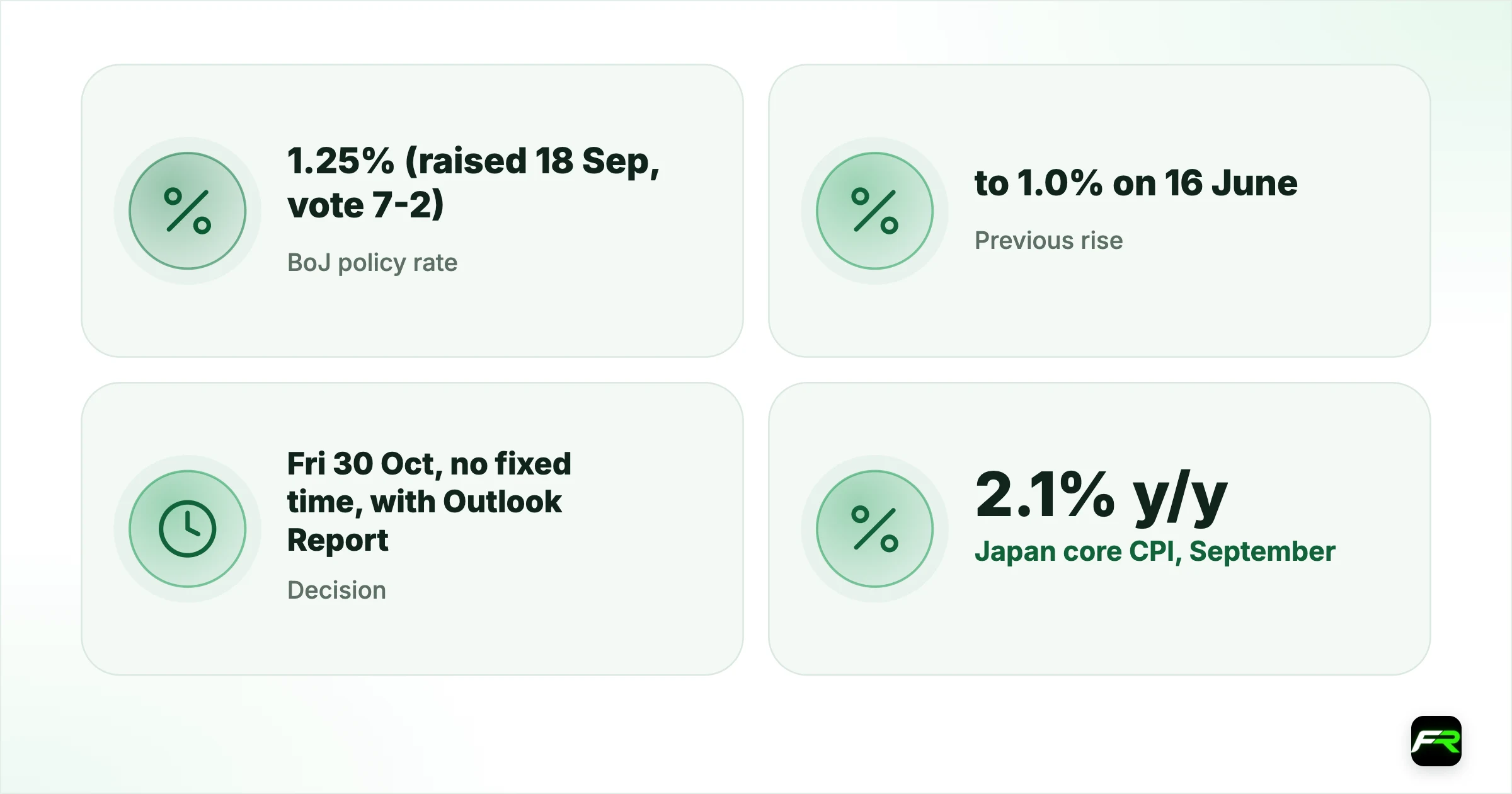
The Bank of Japan ends its next two-day policy meeting on Friday 30 October and, as usual, gives no fixed time for the announcement. It has raised its short-term policy rate twice this year: to 1.0% on 16 June and to 1.25% on 18 September, the second step coming only three months after the first. October's meeting also brings the quarterly Outlook for Economic Activity and Prices, which carries the bank's new forecasts.
For currency traders, the puzzle is the yen. Two rate rises have not lifted it much. USD/JPY closed Friday at 156.81, almost exactly where it ended the day of the September hike, at 156.86. It spent most of October between about 157.5 and 158.9, before a sharp drop on Thursday 22 October when US yields fell. A gap of roughly 2.5 to 2.75 percentage points still separates US and Japanese short-term rates, which keeps the dollar attractive to hold.
Japan's Ministry of Finance has already stepped in once this year. Its monthly figures show ¥15,399.3 billion of foreign exchange intervention between 30 July and 26 August, and none from 27 August to 28 September. The ministry publishes the daily breakdown only in its quarterly report, so it has not yet said on which days it acted. Market data show USD/JPY fell from a high of 163.74 to a low of 157.92 on 30 July, the first day of that period.
| BoJ policy rate | 1.25% (raised 18 Sep, vote 7-2) |
|---|---|
| Previous rise | to 1.0% on 16 June (vote 7-1) |
| Decision | Fri 30 Oct, no fixed time, with Outlook Report |
| Japan core CPI, September | 2.1% y/y (excl. fresh food) |
| Core excluding energy, September | 2.4% y/y |
| Intervention, 30 Jul to 26 Aug (MoF) | ¥15,399.3 billion |
| Intervention, 27 Aug to 28 Sep (MoF) | None |
| USD/JPY, Friday close | 156.81 (about 21:00 UTC) |
What the BoJ said in September
September's statement left little doubt about direction. With underlying inflation “approaching 2 percent” and financial conditions still accommodative, the bank said it “will continue to raise the policy interest rate and adjust the degree of monetary accommodation”, while weighing “the timing and pace of adjustment”. It named three things to watch: the situation in the Middle East, the expansion in AI-related demand and developments in foreign exchange rates.
A new kind of risk was flagged as well. Underlying inflation, the board said, could “deviate upward to a level above the price stability target”, because firms are shifting toward raising wages and prices and medium- to long-term inflation expectations are rising. For a central bank that spent years trying to lift inflation, that is a notable change of emphasis.
Not everyone agreed. Two of the nine board members, Asada Toichiro and Sato Ayano, voted against the rise. Asada argued that with core inflation below 2% recently, the economy could not necessarily be called strong. Sato said economic and price developments had not substantially accelerated, so a rise was not appropriate at that time.
The Summary of Opinions: a shift in phase
The Summary of Opinions, published on 1 October, lists comments from board members without names. One said that with underlying inflation now “getting closer to 2 percent”, keeping it stable there becomes important, adding: “In that sense, it is considered that there has been a shift in the phase of monetary policy.”
Another member went further: “If signs of an upward deviation in prices are observed, the Bank will need to accelerate the pace of rate hikes.” A third wanted to bring the rate “closer to the approximate goal relatively soon”, leaving room to move in either direction if the economy surprises.
Others urged care. One opinion said underlying inflation “does not seem to be accelerating at a speed that could lead the Bank to fall behind the curve, so there is no need to take hasty action”. The summary also noted that the September rise came sooner after June than earlier steps had, because the economy had been “more resilient than expected”.
Taken together, the board looks set on more rises but divided on speed. That split matters for Friday: a move only six weeks after the last would shorten the gap between hikes again, so most of the debate is about whether October is too soon rather than whether rates go higher.
What has changed since September
Inflation data have moved the hawks' way. Japan's Statistics Bureau reported that core consumer prices, which exclude fresh food, rose 2.1% in the year to September, up from 1.7% in August. A narrower gauge that also leaves out energy climbed to 2.4% from 1.9%. Government fuel measures, including the gasoline tax change, held the headline down by about 0.82 percentage point, so the underlying trend is firmer than the headline suggests. Our Japan CPI story has the breakdown.
Tokyo's October prices, an early guide to the national figure, arrive at 08:30 Tokyo time on Friday, which is 23:30 UTC on Thursday, only hours before the decision. A further rise in the core reading there would strengthen the case for acting now.
Abroad, the backdrop is mixed. US Treasury yields fell sharply on 22 October, and the 10-year closed the week at 5.00% against 5.13% on Wednesday, according to the US Treasury. Lower US yields narrow the gap with Japan and tend to help the yen, which is one reason USD/JPY fell from about 158.1 to 156.5 that day. The Fed's own decision, two days before the BoJ's, will shape that gap again.
| BoJ decision | Policy rate | Vote | USD/JPY close that day |
|---|---|---|---|
| 16 June 2026 | Raised to 1.0% | 7-1 | 160.42 |
| 18 September 2026 | Raised to 1.25% | 7-2 | 156.86 |
| 30 October 2026 | To be decided | 156.81 (Friday 23 Oct) |
Rates and votes from the Bank of Japan's statements. Currency closes are UTC days built from hourly market data and differ slightly between providers.
Three ways Friday could go
These are our scenarios, not forecasts from the bank, and the market reactions are typical patterns rather than predictions.
- Raise to 1.5%. A quarter-point step like June and September would surprise on timing rather than direction. The yen would likely gain at first, though September showed such gains can fade within hours: on the day of that hike, USD/JPY swung between 156.11 and 158.05.
- Hold, with a firm message. If the Outlook Report raises the inflation forecasts and the statement repeats that rates will keep rising, traders would look to the 18 December meeting. That could support the yen without a move.
- Hold, with a cautious message. Stress on Middle East risks or slower growth would push expectations of the next rise into 2027. The yen could weaken, and attention would turn to whether the Ministry of Finance steps in again.
Governor Ueda's press conference, held later in the day in Tokyo, often moves the yen as much as the decision itself. Listen for how he describes the pace of future rises and whether he mentions the exchange rate.
What it means for yen traders
- Set alerts rather than watching the clock. The BoJ has no fixed release time; decisions usually come around midday Tokyo time, roughly 03:00 UTC.
- Watch the vote. Two members opposed the September rise; if a hold comes with members voting for an immediate hike, that points to December.
- Read the Outlook Report's core inflation forecasts. Higher numbers for the coming years would back further rises.
- Remember that the Fed speaks first. A Fed rise on Wednesday would widen the rate gap before the BoJ decides.
- Respect intervention risk. The Ministry of Finance spent more than ¥15 trillion in a single month this summer, and moves of several yen in a day are possible when it acts, so trade smaller and accept that stops may fill at a gap.
Say you sell USD/JPY at 156.80 before the decision, with a stop at 157.80, 100 pips away. Each pip on 10,000 units is 100 yen, about $0.64, so the stop risks about $64 per 10,000 units. On a $5,000 account with a 1% limit of $50, the right size is about 7,800 units. When the pair swings almost 2 yen in a day, as it did on 18 September, even a 100-pip stop can be hit, so size for that range.
Levels and a trade plan are in our daily USD/JPY analysis, which carries Friday's close over the weekend. Our Fed preview covers Wednesday, the week-ahead guide lists every release, and the position size calculator sets your size.
The yen can move several big figures in minutes around a Bank of Japan decision or an intervention, and spreads often widen in thin Asian trading. Leverage magnifies losses as well as gains, so trade only with money you can afford to lose.
Policy rates, votes, dissents and quoted wording come from the Bank of Japan's statements of 16 June and 18 September 2026 and its Summary of Opinions released on 1 October 2026. Intervention totals are from Japan's Ministry of Finance monthly releases. Inflation figures are from Japan's Statistics Bureau and yields from the US Treasury. USD/JPY levels are market data built from hourly bars and differ slightly between providers. Scenarios are FX Recap's reading, not a forecast. This is news, not investment advice.
Frequently asked
When does the Bank of Japan announce its October 2026 decision?
The meeting runs on 29 and 30 October, and the decision comes on Friday 30 October with no fixed time, usually around midday Tokyo time (about 03:00 UTC). The Outlook Report is published with it.
What is the Bank of Japan's interest rate now?
The bank guides the overnight call rate to around 1.25%. It decided the rise on 18 September 2026 by a 7-2 vote, effective from 24 September, after an earlier rise to 1.0% in June.
Has Japan intervened in the yen in 2026?
Yes. The Ministry of Finance reports ¥15,399.3 billion of intervention between 30 July and 26 August 2026 and none between 27 August and 28 September. The daily breakdown comes in its quarterly release.
Why hasn't the yen strengthened after the BoJ's rate rises?
Even at 1.25%, Japan's policy rate is about 2.5 to 2.75 percentage points below the Fed's 3.75% to 4.00% range, so holding dollars still pays more. US yields and Fed decisions often matter as much for USD/JPY as the BoJ itself.
Sources: Bank of Japan: Change in the Guideline for Money Market Operations, 18 September 2026 · Bank of Japan: Summary of Opinions, 17-18 September 2026 meeting · Ministry of Finance Japan: foreign exchange intervention operations · Bank of Japan: Monetary Policy Meetings schedule · Bank of Japan: Change in the Guideline for Money Market Operations, 16 June 2026 · Statistics Bureau of Japan: Consumer Price Index · US Treasury: daily par yield curve rates
The team behind this guide
Researched, checked and approved by five forex specialists
Every guide is written, fact-checked and edited before it goes live, and updated when the facts change. Spotted an error? Tell us.