IC Markets




































Why USD/JPY Moves Every Time the Bank of Japan Meets
The Bank of Japan meets eight times a year, and USD/JPY reacts to almost every one. Here is what the meeting decides, why the statement matters more than the rate, and how to be positioned for it.
 WriterAbir KhanWriterWrites the guides · checks every figure against primary sources View profileAbout Abir →
 Market analysisTanbir Habib RiyadForex & Crypto AnalystForex and crypto analyst · technical and fundamental analysis View profileAbout Tanbir →
 Fact-checking & riskJannatul FerdaushFact-Checker & Risk AnalystFact-checks every figure · risk analysis · Applied Statistics, University of Dhaka View profileAbout Jannatul →
 Trading reviewJowel RanaCo-Founder & Forex TraderCo-founder · forex trader · reviews guides from a trader's view View profileAbout Jowel →
 Final approvalRanjan NiskrityFounder, Owner & Forex TraderFounder and owner · forex trader · signs off every guide View profileAbout Ranjan →
USD/JPY is the pair most sensitive to a single institution: the Bank of Japan. Eight scheduled meetings a year, plus the press conference and the outlook report that come with four of them, and each is capable of moving the pair 100 to 300 pips in a session. If you trade USD/JPY, AUD/JPY or any yen cross, the BoJ calendar is not optional reading.
What the meeting decides
The BoJ sets Japan’s short-term policy rate and, historically, the framework around it: yield curve control, asset purchases, and forward guidance on what comes next. For most of the last decade the rate itself barely moved, which is why the market learned to trade the language rather than the number. A hold with a hawkish statement can strengthen the yen sharply; a hike with a dovish statement can weaken it. The rate is the headline; the tone is the trade.
Why the statement matters more than the rate
The market prices in the expected rate decision well before the meeting. What it cannot fully price is the wording: whether the BoJ signals more tightening ahead, whether it flags concern about the weak yen, whether the inflation forecast is revised. Traders and algorithms parse the statement within seconds, and USD/JPY moves on the gap between what was said and what was expected. This is why the pair can spike in both directions within minutes of the release as the initial read gets corrected.
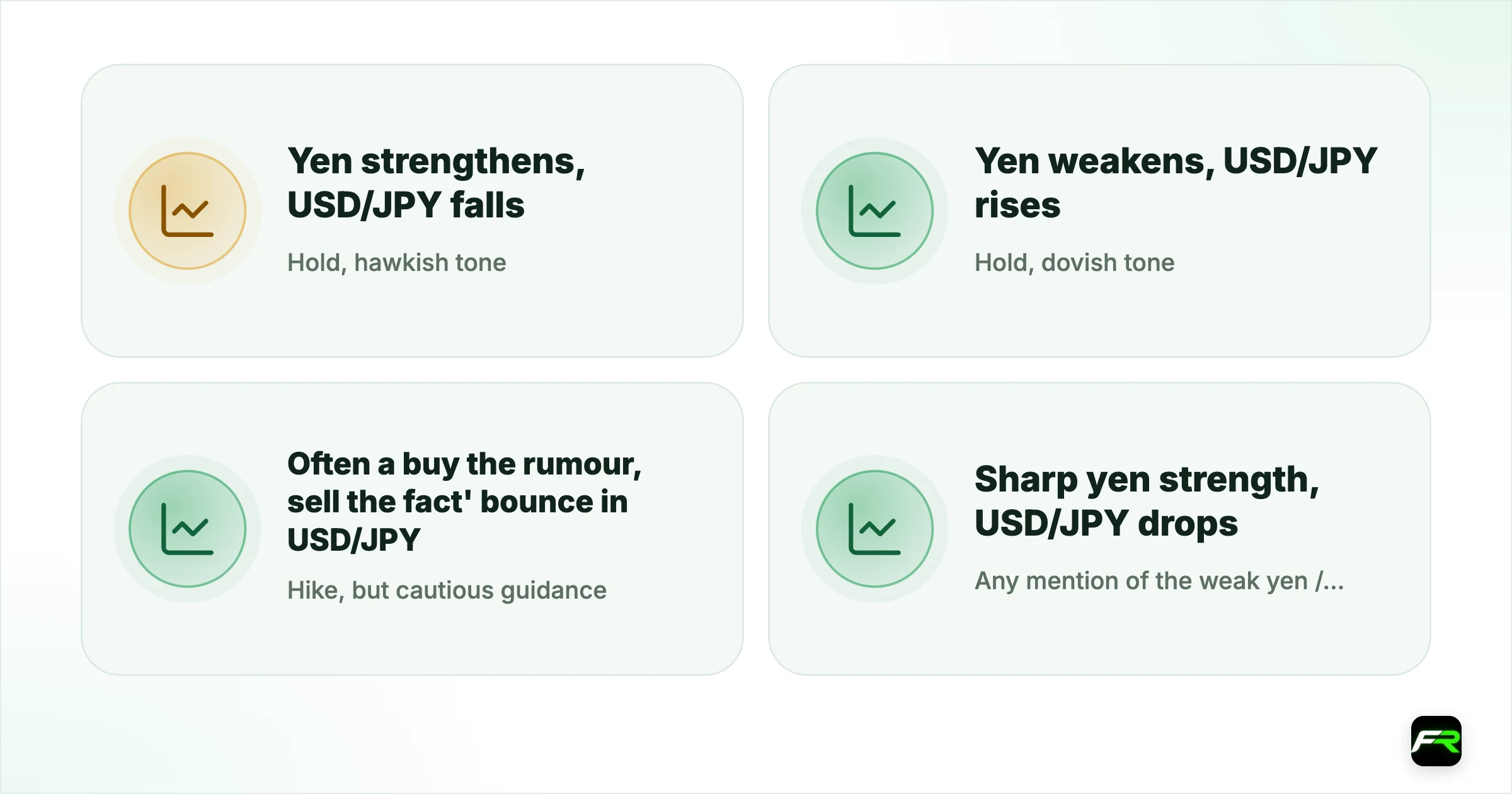
| Outcome | Typical USD/JPY reaction |
|---|---|
| Hold, hawkish tone (hints at future hikes) | Yen strengthens, USD/JPY falls |
| Hold, dovish tone (no urgency to tighten) | Yen weakens, USD/JPY rises |
| Hike, but cautious guidance | Often a ‘buy the rumour, sell the fact’ bounce in USD/JPY |
| Any mention of the weak yen / intervention | Sharp yen strength, USD/JPY drops |
The Fed-BoJ rate gap
The bigger driver of USD/JPY over months is the difference between US and Japanese interest rates. When the Federal Reserve holds rates high and the BoJ keeps rates near zero, holding dollars pays far more than holding yen, so money flows into USD/JPY and the pair trends up. As that gap narrows, through the Fed cutting or the BoJ hiking, the pressure reverses. Most of the large multi-month moves in USD/JPY are this story. The BoJ meeting is where the market updates its view on which way the gap is heading.
Kenta stopped trading USD/JPY on BoJ days after being whipsawed twice: once caught long as the pair spiked up then dropped 180 pips, once stopped out on the initial move before the trade he wanted came good. His rule now is flat by the day before the meeting, no new position until the press conference is over and the dust has settled, usually the next morning Tokyo time. He says the moves after a BoJ meeting are tradeable, but the moment of the release is a coin flip he does not need to be in.
How to be positioned
- Know the meeting dates. The BoJ publishes its schedule a year ahead.
- Be flat, or holding only a small defined-risk position, into the decision if you are still building consistency.
- Expect a two-way spike in the first minutes. The tradeable move often comes after the initial reaction is corrected.
- Watch the press conference, not just the statement. The governor’s answers frequently move the pair more than the release did.
A USD/JPY position with no stop, held through a BoJ meeting, is how retail accounts take 40% losses in a session. If you must hold, size it so the worst plausible move is one or two per cent of the account.
For the rules and brokers that apply where you live, see our guide to forex brokers in Japan.
Frequently asked
How often does the Bank of Japan meet?
Eight times a year on a published schedule. Four of those meetings come with an Outlook Report containing updated growth and inflation forecasts, and those tend to produce the larger reactions.
Why does USD/JPY spike both ways after the announcement?
The first move is an algorithmic reaction to headline keywords. As traders read the full statement and the nuance becomes clear, the initial move is often reversed. Being in a position during those first minutes is close to gambling.
What is the Tokyo fix and is it related?
The Tokyo fix is a daily benchmark rate set around 09:55 Tokyo time for settlement purposes, separate from BoJ meetings. It can cause a burst of flow in USD/JPY near that time but is a much smaller event than a policy decision.
Should I trade the BoJ meeting?
Experienced traders sometimes trade the move after the release, once direction is established. Trading the moment of the release, or holding through it without a plan, is not advisable while you are still learning.
How is this different from a Fed meeting for USD/JPY?
Both move the pair because USD/JPY is driven by the US-Japan rate gap. A Fed meeting moves the US side of that gap; a BoJ meeting moves the Japan side. Weeks with both are especially volatile.
Related reading
The team behind this guide
Researched, checked and approved by five forex specialists
Every guide is written, fact-checked and edited before it goes live, and updated when the facts change. Spotted an error? Tell us.