 IC Markets




































 WriterAbir KhanWriterWrites the guides · checks every figure against primary sources View profileAbout Abir →
 Written byAbir KhanWriter
 Market analysisTanbir Habib RiyadForex & Crypto AnalystForex and crypto analyst · technical and fundamental analysis View profileAbout Tanbir →
 Market analysis byTanbir Habib RiyadForex & Crypto Analyst
 Fact-checking & riskJannatul FerdaushFact-Checker & Risk AnalystFact-checks every figure · risk analysis · Applied Statistics, University of Dhaka View profileAbout Jannatul →
 Fact-checked byJannatul FerdaushFact-Checker & Risk Analyst
 Trading reviewJowel RanaCo-Founder & Forex TraderCo-founder · forex trader · reviews guides from a trader's view View profileAbout Jowel →
 Reviewed byJowel RanaCo-Founder & Forex Trader
 Final approvalRanjan NiskrityFounder, Owner & Forex TraderFounder and owner · forex trader · signs off every guide View profileAbout Ranjan →
 Approved byRanjan NiskrityFounder, Owner & Forex Trader
Last verified Against each broker's own terms
CFDs are complex instruments and carry a high risk of losing money rapidly due to leverage. Offers and account rules change often, so confirm the live terms on the broker's site before you sign up. Some links are affiliate links; they never change which brokers we list or how we rate them.
Forex cashback programmes checked this month
Each programme below is run by a broker we review, and each figure comes from the broker's own rules page or terms. The cards show the condition most likely to cut what reaches your account.
| Broker | Rate | Paid | Minimum | Paid as |
|---|---|---|---|---|
 RoboForex RoboForex | 5–10% | Monthly | 10 lots/month | Cash, no conditions |
 IUX IUX | $0.25–$0.75/lot | On redemption | None | Balance |
 XM XM | Coins per trade | On redemption | None | Cash or bonus |
 HFM HFM | $2/lot gold | Daily | $5 a day | Balance |
RoboForex Cashback (Rebates) Programme
RoboForex's international entity
- Minimum volume
- 10 lots a month
- ECN tiers
- 5%, 7%, then 10% of commission
- Pro and ProCent
- Fixed rebate per instrument
- Paid
- 1st of each month, as balance
The catch: Only currency pairs and metals count; CFD volume is ignored. The ECN rate climbs at 1,000 and 3,000 lots a month, which only very active traders reach.
IUX LotBack Programme
IUX's international entity
- Points per lot
- 0.5 rising to 1.5
- Point value
- 1 point = $0.50
- Minimum hold
- 5 minutes per trade
- Tier upgrades
- After 10, 30, 90, 180 trading days
The catch: Trades held under five minutes earn nothing, and index, stock and crypto CFDs are excluded. Thirty days without trading drops you a tier.
XM Traders Club (XM Coins)
XM Global, the group's international entity
- Currency
- XM Coins (XMC) per trade
- Status tiers
- 5
- Redeem for
- Cash, trading bonus or tools
- Members
- 1.5 million+, per XM
The catch: Coin earnings rise with status, and status rises with time and activity, so new traders earn the lowest rate. Only some redemption options pay withdrawable cash.
HFM Supercharged Rebate
HFM regional entities, as part of the 100% Supercharged Bonus
- Paid
- Daily, 02:00 server time
- Minimum daily payout
- $5
- Cap
- $8,000 in total
- Hold time
- Under 1 min: none; 1 to 2 min: half
The catch: The rebate comes bundled with HFM's deposit bonus, whose credit shrinks dollar for dollar on every withdrawal. Weigh the two together, not the rebate alone.
Reward programmes from brokers we list
Cashback is one of several ways the brokers we cover reward activity. Loyalty coins, rebates, referral cash and competitions all appear below, each with a link to its full terms.
IUXCashbackIUX LotBack Rebate Program
0.5 to 1.5 points per standard lot, each worth $0.50, on trades held at least five minutes; tiers rise with trading days.
XMLoyaltyXM Traders Club: Earn XM Coins
Earn XM Coins on every real-account trade across five statuses, then redeem them for cash, tradable bonuses or tools.
HFMDeposit bonusHFM 100% Supercharged Bonus up to $50,000
100% of each $50+ deposit as credit, up to $50,000, plus cash rebates of 0.2 pips per forex lot or $2 per gold lot, up to $8,000.
 EightcapTrade credit
Eightcap Trading Credit Bonus up to $1,000
Up to $1,000 of credit for selected new clients, converted to real money at $1 per standard FX lot traded.
XMCompetitionXM Trading Competitions
Free demo contests, including a $25,000 weekly pool for 100 winners and a Daily Arena of up to $5,000, plus a $5 paid daily contest.
 LiteFinanceCash reward
LiteFinance 50% Cash Reward (Trade Smart)
A cash reward of 50% of your deposit if you make 50% profit in 30 days while staying inside four risk limits.
How forex cashback works
Forex cashback, also called a rebate, returns part of what you pay to trade. Every position costs a spread, a commission or both; a cashback programme hands a slice of that back after the trade closes, whether it made or lost money. If a round-turn lot costs you $7 in commission and the rebate is $2, the trade really cost $5.
The money comes from one of two places. Broker-run programmes, like RoboForex's rebates or IUX LotBack, pay straight into your account. Independent rebate services work as introducing brokers: the broker pays them a share of your costs and they pass part of it back to you, usually monthly and sometimes to an e-wallet.
Because the payout depends on volume, cashback rewards activity. Ten lots a month at $2 a lot is $20; two hundred lots is $400. That makes it valuable for active day traders and almost irrelevant for someone placing a handful of swing trades.
You will see it called a forex rebate, cashback bonus, lot rebate, IB rebate or loyalty reward. The one number that matters is the net cost per lot once the rebate is paid.
Forex cashback calculator
Enter your usual monthly volume and costs. The calculator shows the rebate you would earn and what each lot really costs after it is paid.
Types of forex rebate
Programmes pay in five main ways. The format decides who gains most: fixed per-lot rebates suit high-volume traders, while commission shares grow with the account type you use.
| Type | How it pays | Example |
|---|---|---|
| Fixed per lot | A set dollar amount per standard lot | IUX LotBack, HFM's gold rebate |
| Share of commission | A percentage of the commission you pay | RoboForex ECN: 5% to 10% |
| Share of spread | A fraction of a pip returned per lot | Common with independent rebate services |
| Loyalty points | Points per trade, swapped for cash or perks | XM Traders Club, IUX points |
| Tiered volume | The rate rises as monthly lots climb | RoboForex tiers at 1,000 and 3,000 lots |
Rebate terms that decide what you receive
Headline rates assume every lot counts. These clauses decide how many of yours do.
Minimum hold time
IUX ignores trades closed inside five minutes, and HFM halves the rebate on trades held one to two minutes. Scalpers should check this first.
Eligible instruments
RoboForex counts forex and metals only. IUX excludes indices, shares and crypto. Your favourite market may earn nothing.
Minimum monthly volume
RoboForex pays nothing below 10 lots a month. Tiered rates only improve at volumes most retail traders never reach.
Payout timing
Payouts range from daily at HFM to the first of the month at RoboForex. Points programmes pay only when you redeem.
Verification
Rebates usually need a fully verified account. Unverified volume is often lost, not held back.
Status and downgrades
IUX drops you a tier after 30 inactive days, and XM's coin rate depends on status. A break in trading cuts your rate.
Bonus-funded trades
Some programmes ignore volume traded on bonus credit. IUX counts only trades on real balance.
How it is paid
Rebates may arrive as balance, trading credit or an external wallet payment. Balance is best: it is withdrawable and never tied to a volume target.
Worked example: a year of rebates
- Her trading
Mei day-trades EUR/USD and gold on a raw-spread account, averaging 60 standard lots a month at $7 round-turn commission.
- Her costs
Commission alone is 60 x $7 = $420 a month, before spread.
- The rebate
A $2 per lot rebate returns 60 x $2 = $120 a month, about $1,440 over a year.
- What it means
Her effective commission drops from $7 to $5 a lot, a 29% cut in one of her largest trading costs.
The rebate paid off because Mei's volume came from her normal strategy. Had she added trades to chase it, a single extra losing day could have wiped out a month of cashback.
Cashback vs deposit bonus
Both are sold as promotions, but they behave in opposite ways once you start trading and withdrawing.
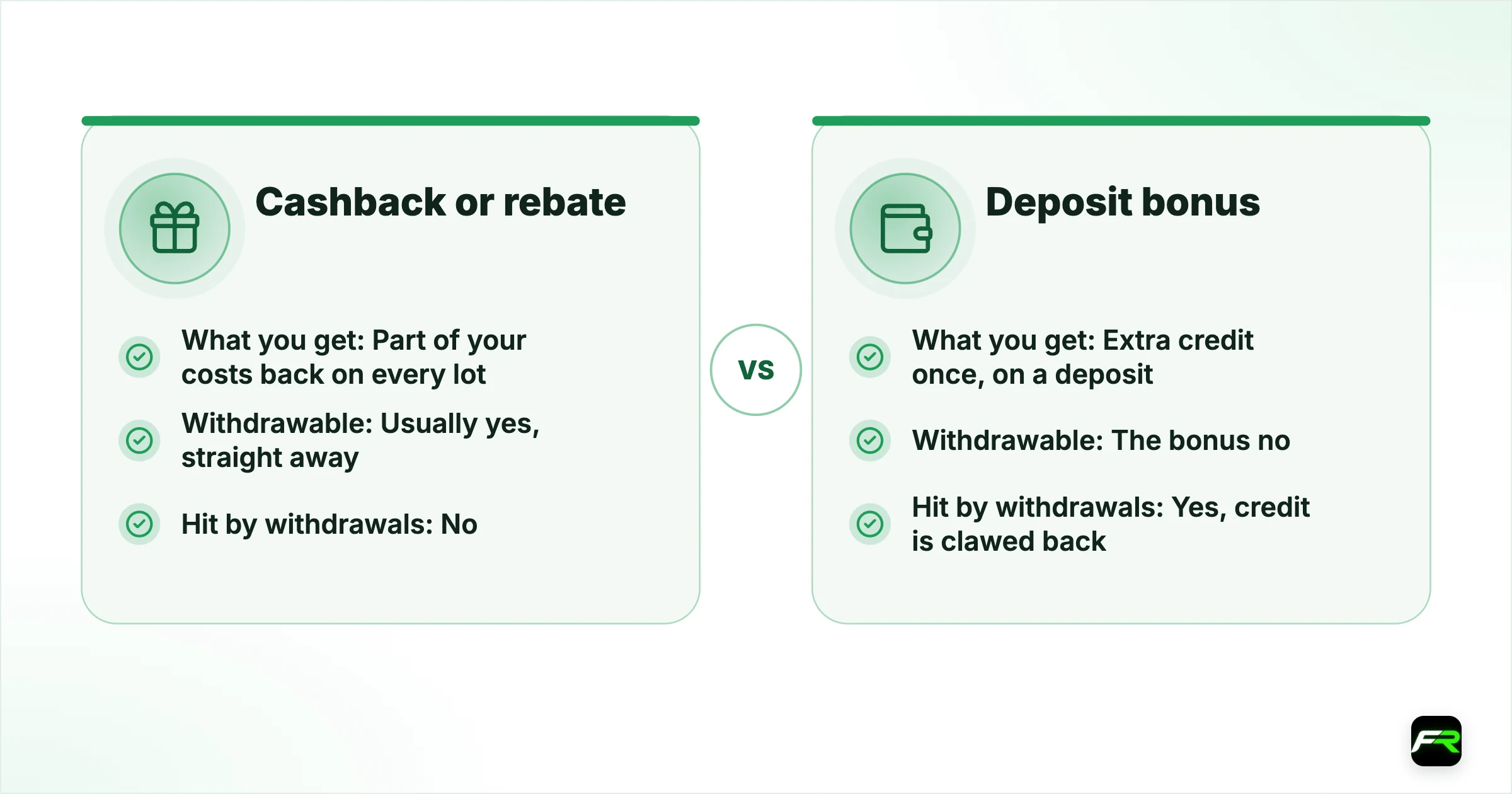
| Cashback or rebate | Deposit bonus | |
|---|---|---|
| What you get | Part of your costs back on every lot | Extra credit once, on a deposit |
| Withdrawable? | Usually yes, straight away | The bonus no; profits after conditions |
| Volume target | Rarely | Common |
| Hit by withdrawals? | No | Yes, credit is clawed back |
| Allowed in UK, EU, Australia? | Some volume rebates are, with limits | No, banned for retail clients |
| Best for | Active traders | Traders adding margin to one deposit |
Forex cashback trends in 2026
Rebates have become the promotion brokers lean on most. Four shifts shape what you can earn this year.
Loyalty schemes are replacing one-off bonuses
Brokers now lean on points and per-lot rewards such as XM Traders Club and IUX LotBack, which reward steady activity rather than a single deposit.
Minimum hold times to deter scalp farming
IUX's five-minute rule and HFM's one-minute cut-off stop traders opening and closing positions only to farm rebates.
Rebates on gold and metals first
Metals now feature in most programmes, from HFM's gold rebate to RoboForex counting metals volume, reflecting how much retail trading has moved to XAU/USD.
Regulated volume rebates
Where bonuses are banned, some regulated brokers still offer volume-based rebates to active clients under stricter conditions, so check what your own entity allows.
Cashback red flags
A good rebate lowers your costs. These signs suggest a programme is doing the opposite.
A service promising more back than the spread and commission you pay is paying you with someone else's money, or not at all.
A rebate that only works if you change your strategy is costing you, not paying you.
Independent services sit between you and the broker. Check how long they have operated and how they pay before linking your account.
Compare your all-in cost before and after. A rebate paired with a worse account type can leave you behind.
Forex cashback FAQs
What is a forex cashback bonus?
A forex cashback bonus, or rebate, pays back part of the spread or commission on every trade you close, whether it wins or loses. It is paid per lot, usually as withdrawable balance, and reduces your all-in trading cost rather than adding credit you cannot touch.
How is forex cashback calculated?
Most programmes pay a fixed amount per standard lot, a percentage of the commission, or a fraction of a pip per lot. Multiply your monthly lots by the rate: 40 lots at $2 a lot returns $80. Our calculator on this page does the sum and shows your net cost per lot.
Is forex cashback withdrawable?
Usually yes. RoboForex states its rebates are not bonus funds and can be used without conditions, and IUX LotBack points convert to balance. Loyalty points like XM Coins can be swapped for cash or for a trading bonus, and only the cash option is freely withdrawable.
What is the difference between cashback and a rebate?
In practice they are the same thing: money returned based on your trading volume. "Cashback" is often used for broker-run programmes and "rebate" for independent services acting as introducing brokers, which pay a share of the broker's revenue back to you.
Are forex rebates worth it for beginners?
Rarely. At ten lots a month a $2 rebate pays $20, which matters far less than choosing a low-cost account and managing risk. Rebates become meaningful at dozens of lots a month, which usually means an experienced, active trader.
Do scalpers earn cashback?
Often not in full. IUX ignores trades held under five minutes and HFM pays nothing on trades under one minute and half on trades held one to two minutes. Check the minimum hold time before you count on rebates from a scalping strategy.
Is forex cashback allowed in the UK?
Deposit bonuses are banned for UK retail clients, but some FCA-authorised firms offer volume-based rebates to active clients under their own rules. Offshore rebate schemes aimed at UK residents by unauthorised firms are not covered by UK protections.
Sources: RoboForex cashback (rebates) programme, IUX LotBack terms, XM Traders Club terms, HFM Supercharged Bonus terms (HF Markets SA).