 IC Markets





























Forex Trading in the UK
Forex is legal in the UK and tightly regulated. What decides your outcome is the entity you sign with, whether you spread bet or trade CFDs, and how you size trades around sterling's big days.
 WriterAbir KhanWriterWrites the guides · checks every figure against primary sources View profileAbout Abir →
 Market analysisTanbir Habib RiyadForex & Crypto AnalystForex and crypto analyst · technical and fundamental analysis View profileAbout Tanbir →
 Fact-checking & riskJannatul FerdaushFact-Checker & Risk AnalystFact-checks every figure · risk analysis · Applied Statistics, University of Dhaka View profileAbout Jannatul →
 Trading reviewJowel RanaCo-Founder & Forex TraderCo-founder · forex trader · reviews guides from a trader's view View profileAbout Jowel →
 Final approvalRanjan NiskrityFounder, Owner & Forex TraderFounder and owner · forex trader · signs off every guide View profileAbout Ranjan →
Forex trading is legal in the UK, and the Financial Conduct Authority (FCA) runs one of the strictest retail regimes anywhere. Leverage is capped at 30:1 on major pairs, bonuses are banned, and a retail client cannot lose more than the money in their account. Those rules only protect you if the company holding your money is the UK-authorised one. Three questions decide how UK traders fare in practice: which legal entity you sign with, whether you spread bet or trade CFDs, and how you handle sterling on the handful of days each year when it moves hardest.
FX Recap built this section from the questions UK traders ask on forums, in broker complaints and in search, then checked every rule against the FCA Handbook, HMRC's own manuals and the brokers' published terms. If you are new, start with the step-by-step plan, which walks from how spread betting works to practising on a demo and your first live trade. The section also includes a full cluster on IC Markets, which is popular with UK traders and is also the subject of an FCA warning, because the gap between those two facts is where most of the confusion lives.
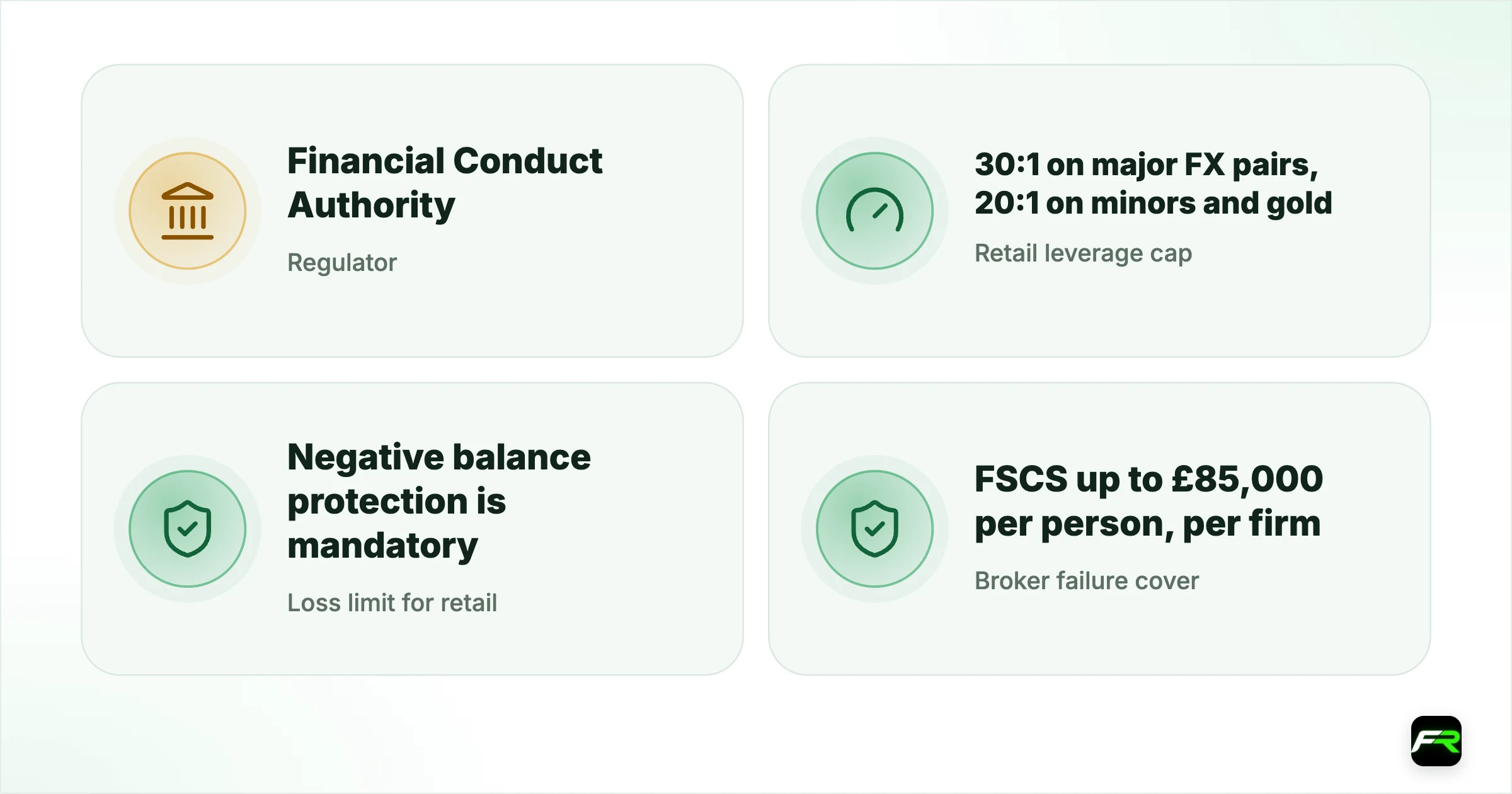
| Regulator | Financial Conduct Authority (FCA) |
|---|---|
| Retail leverage cap | 30:1 on major FX pairs, 20:1 on minors and gold |
| Loss limit for retail | Negative balance protection is mandatory |
| Broker failure cover | FSCS up to £85,000 per person, per firm |
| Complaints | Financial Ombudsman, awards up to £455,000 |
| Spread betting tax | Outside CGT and income tax for most individuals |
| CFD tax | Capital Gains Tax at 18% or 24%, £3,000 allowance |
| Bank Rate | 3.75% (held 17 September 2026) |
What the FCA rules give a retail trader
Since August 2019 the FCA's permanent rules for contracts for difference have applied to CFDs, financial spread bets and rolling spot forex alike. A retail client gets four protections that are not optional for the broker. Initial margin is at least 3.33% on major currency pairs (30:1 leverage), 5% on minor pairs, gold and major indices (20:1), 10% on other commodities and minor indices (10:1) and 20% on shares (5:1). If your account equity falls below half the margin you are using, the broker must start closing positions. Your losses are limited to the funds in the account. And the firm cannot tempt you with deposit bonuses or trading rebates.
Each broker also has to publish the share of its retail accounts that lose money, recalculated every quarter. In September 2026 the published figures for large UK firms sit roughly between 61% and 74%. Treat that number as the honest base rate, not as a slogan. The leverage limits guide walks through the margin maths in pounds, and the close-out and negative balance explainer shows what happens on a gap.
Clients who meet the FCA's elective professional test can give up those protections for higher leverage. To qualify you need a qualitative assessment plus two of three things: frequent trading of significant size, a portfolio above EUR 500,000, or a year of relevant work in finance. The FCA warned in October 2025 that some firms push people to opt up, and it has consulted on tightening the route. Our professional status guide covers what you lose and what you keep.
Checking a broker before you send money
Search the firm on the FCA's Firm Checker or the full Financial Services Register, note its firm reference number (FRN), then confirm that the website, phone number and email you are dealing with match the ones on the Register. Clone firms copy real names, addresses and FRNs; the contact details are where they slip. After that, read the first page of the client agreement you are asked to sign. Many global brands run a UK-authorised company alongside offshore ones, and the name on that agreement, not the logo on the website, decides which rules apply to you.
That second check matters more than ever. On 25 September 2026 the FCA said 24 CFD firms had closed or were closing after it challenged firms that used a UK licence as a badge to make linked overseas companies look more trustworthy. The crackdown explainer covers what that means for your account, and the step-by-step Register guide shows each screen. If you are weighing an overseas firm for higher leverage, read what a UK resident gives up offshore first, and the legal position for what the law does and does not stop you doing.
When a UK-authorised firm fails and your money is missing, the Financial Services Compensation Scheme covers up to £85,000 per person, per firm. The £120,000 limit introduced in December 2025 applies to bank deposits, not to brokers, a mix-up repeated on several well-known review sites. Trading losses are never covered. Complaints about how a firm treated you go first to the firm, then to the Financial Ombudsman, which can award up to £455,000. See the FSCS guide and the Ombudsman guide.
Picking a UK broker for your kind of trading
No single firm suits everyone, so we rank UK brokers by use rather than naming one winner. Our FCA-regulated broker shortlist lists each firm's FRN, published loss rate, platforms and whether it offers spread betting. A first account has different needs again: negative balance protection, a small minimum, a decent demo and a clear app, which is what the beginners' guide weighs up. If you already know you want MetaTrader, cTrader or TradingView, the platform-by-platform table shows which firms let you spread bet on each one, and the best spread betting brokers ranks those firms by what you trade.
Two practical details save money over time. A GBP base account avoids conversion charges on every deposit and withdrawal, and the funding guide covers Faster Payments, cards, PayPal and why some banks block payments to trading platforms.
IC Markets and UK traders
IC Markets, which rebranded to IC and moved to ic.com in July 2026, is one of the most searched brokers among UK traders. Its raw-spread pricing, cTrader and MetaTrader support and fast execution have a strong following. It also has no FCA authorisation and no UK entity. The FCA's Warning List carries an entry against IC Markets Global, first published in October 2024 and updated in August 2026 to include ic.com, saying the firm is not authorised and may be targeting people in the UK, and that UK customers will not have access to the Financial Ombudsman or the FSCS.
IC Markets' EU company states that the information on its site is not intended for UK residents, so in practice a UK resident who opens an account today is onboarded by Raw Trading Ltd in the Seychelles. That entity offers leverage far above the UK caps, a deposit bonus the FCA would not allow, and no guaranteed negative balance protection. It does not offer spread betting, so UK profits there fall under Capital Gains Tax. None of this makes it illegal for you to hold an account. It does mean you are relying on a Seychelles licence and Seychelles courts rather than UK ones.
FX Recap has a commercial relationship with IC Markets and reviews it in full on our IC Markets review. For UK residents we set the facts out plainly across twelve guides, starting with whether IC Markets is FCA regulated and which entity UK residents sign with, what the FCA warning means for existing clients, why neither the FSCS nor the Ombudsman covers you there, how IC profits are taxed and how to spot IC clone sites. Four head-to-heads compare it with FCA brokers, including IC Markets vs Pepperstone, and the alternatives guide lists UK firms with similar raw pricing.
Tax: spread bets, CFDs and HMRC
The UK is unusual in giving traders a legal choice between two products with very different tax treatment. HMRC's Capital Gains Manual says no chargeable gains or allowable losses arise from spread betting, and its Business Income Manual treats betting profits as outside income tax for individuals. Being systematic, skilled or even making a living from it does not by itself create a taxable trade. CFDs are different: HMRC treats retail CFDs as financial futures, so gains are charged to Capital Gains Tax at 18% within the basic rate band and 24% above it, after a £3,000 annual exempt amount.
The trade-off is losses. A CFD loss can be set against other gains; a spread betting loss cannot. For a trader who expects to profit, spread betting usually wins. Someone with large gains elsewhere and a losing trading year may find CFDs the better tool. The spread betting vs CFD guide works through the numbers, is spread betting tax free? quotes HMRC's own wording, and forex tax in the UK covers spot FX, self assessment deadlines and currency conversion. When you need to file, the self assessment walkthrough goes box by box. Separate guides cover ISAs, prop firm payouts and when HMRC treats trading as a business. A Budget is due on 28 October 2026, and press speculation about changes to CGT is exactly that until the Chancellor speaks.
Sterling: the days that move the pound
Most UK traders trade their own currency, and sterling reacts to a short list of events. Bank of England decisions land at 12:00 UK time; the Monetary Policy Committee held Bank Rate at 3.75% on 17 September 2026 by six votes to three, with all three dissenters wanting a rise, and the next decisions are on 5 November and 17 December. Inflation data from the ONS arrives at 07:00, with CPI at 3.1% in the year to August 2026. Gilt yields and the Budget round out the list, with long-dated yields reported at their highest since 1998 in early September.
Those events widen spreads and can gap prices through stops, which matters more at high leverage. Our market guides cover GBP/USD, EUR/GBP and GBP/JPY, plus how to handle rate decisions, CPI mornings and Budget day.
When to trade from the UK
London is the largest forex centre in the world, and UK traders sit in the busiest time zone. The London session runs roughly 08:00 to 17:00 UK time, and the overlap with New York, from about 13:00, is when most majors are liquid and most US data lands. Clocks matter twice a year: UK clocks go back on 25 October 2026 and US clocks a week later, so for that week the overlap shifts by an hour. If you work a nine-to-five, the early London open, the 13:30 US releases and swing trading with pending orders are the realistic options, covered in the trading around a job guide and best time to trade.
Scams aimed at UK traders
The FCA published 2,329 warnings about unauthorised firms in 2025. Most follow a few patterns: clone firms borrowing a real broker's FRN, an "account manager" on WhatsApp or Telegram who trades for you, signal groups run by social media personalities, and recovery firms that contact victims offering to get their money back for a fee. In February 2026 seven social media influencers, several known from reality TV, were sentenced after pleading guilty to promoting an unauthorised trading scheme. If something goes wrong, call your bank first, then report it to Report Fraud, which replaced Action Fraud: reportfraud.police.uk or 0300 123 2040. The scams guide and finfluencer guide set out the red flags, and the copy trading guide explains where following another trader stops being legal.
What realistic results look like
The published loss rates are the most reliable guide to outcomes. A trader who treats forex as a skill to build, risks around 1% of the account per trade, keeps records for HMRC and stays with an FCA-authorised firm will usually lose slowly while learning, which is the point: slow losses leave time to improve. A trader who chases 1:500 leverage offshore, follows a signal group or lets an account manager trade usually loses quickly. The five UK case studies show both paths with the numbers.
Frequently asked
Is forex trading legal in the UK?
Yes. Individuals can trade their own money without a licence. The firms that offer forex, CFDs and spread betting to UK retail clients must be authorised by the FCA, and promoting investments without FCA authorisation or an authorised firm's approval is a criminal offence.
Is IC Markets regulated in the UK?
No. IC Markets holds licences in Australia, Cyprus, the Seychelles, the Bahamas and Kenya, but has no FCA authorisation or UK entity. The FCA has a Warning List entry against IC Markets Global, updated in August 2026 to include ic.com.
What leverage can UK retail traders use?
Up to 30:1 on major currency pairs, 20:1 on minor pairs, gold and major indices, 10:1 on other commodities and 5:1 on shares. Crypto derivatives are banned for UK retail clients.
Is spread betting tax free?
For most individuals, yes. HMRC treats spread betting profits as outside both Capital Gains Tax and income tax, and losses cannot be offset. CFD profits are subject to CGT at 18% or 24% above the £3,000 allowance.
How much does the FSCS cover if my broker fails?
Up to £85,000 per person, per firm, for money a failed FCA-authorised firm should have held for you. The £120,000 limit applies to bank deposits. Trading losses and offshore brokers are outside the scheme.
Where do I report a forex scam in the UK?
Contact your bank straight away, then report it to Report Fraud at reportfraud.police.uk or 0300 123 2040, the service that replaced Action Fraud. You can also report an unauthorised firm to the FCA.
What is the best time to trade forex from the UK?
The London session, about 08:00 to 17:00 UK time, and especially the overlap with New York from around 13:00, when liquidity is deepest and most US data is released. Avoid thin periods late in the evening.
Every UK Forex Guide
All 53 guides in this section, grouped by the question you are working on.
The team behind this guide
Researched, checked and approved by five forex specialists
Every guide is written, fact-checked and edited before it goes live, and updated when the facts change. Spotted an error? Tell us.