IC Markets






































Australian CPI Preview: August Hit 4.0%. What Wednesday's September and Quarterly Data Mean for the RBA
The ABS publishes September prices and the quarterly figures at 00:30 UTC on 28 October, five days before an RBA meeting that already raised rates four times.
 WriterAbir KhanWriterWrites the guides · checks every figure against primary sources View profileAbout Abir →

 Market analysisTanbir Habib RiyadForex & Crypto AnalystForex and crypto analyst · technical and fundamental analysis View profileAbout Tanbir →

 Fact-checking & riskJannatul FerdaushFact-Checker & Risk AnalystFact-checks every figure · risk analysis · Applied Statistics, University of Dhaka View profileAbout Jannatul →

 Trading reviewJowel RanaCo-Founder & Forex TraderCo-founder · forex trader · reviews guides from a trader's view View profileAbout Jowel →

 Final approvalRanjan NiskrityFounder, Owner & Forex TraderFounder and owner · forex trader · signs off every guide View profileAbout Ranjan →

Australia's consumer price index for September comes out at 11:30am Sydney time on Wednesday 28 October, which is 00:30 UTC, or 20:30 in New York on Tuesday evening. Because September closes a quarter, the Australian Bureau of Statistics will also add the September quarter figures to its quarterly tables, including the quarterly trimmed mean that the Reserve Bank of Australia has long watched.
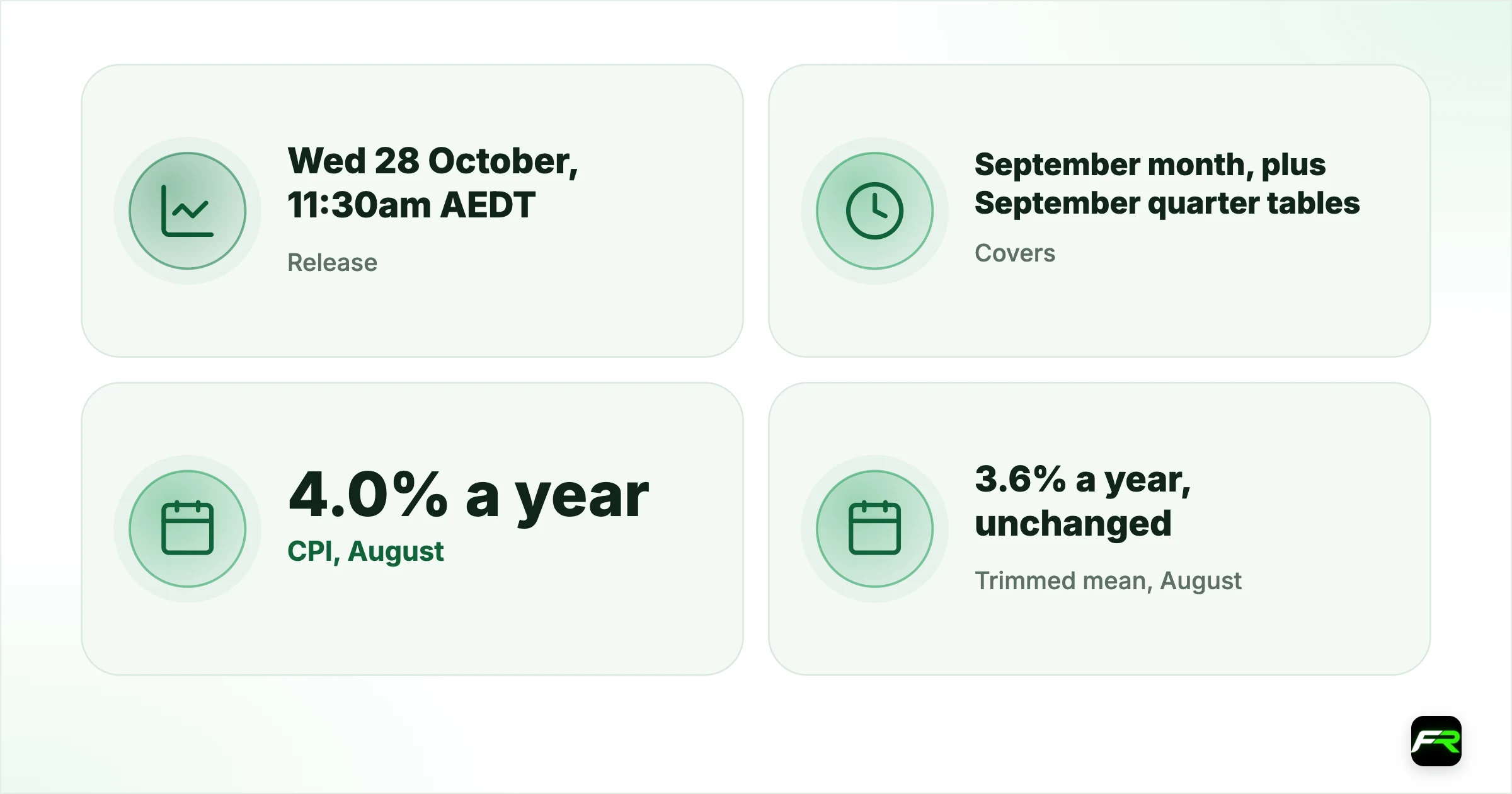
The release lands five days before the RBA's next decision on Tuesday 3 November. The cash rate is 4.60% after a fourth rise this year on 29 September, and August's annual inflation rate jumped back to 4.0% from 3.5% in July. Wednesday's numbers are the last major inflation data the board will see before it meets.
The Australian dollar has held up into the event. AUD/USD, derived from the ECB's daily euro reference rates, was 0.7025 on Monday 26 October, up from 0.7005 on the day of the September rise and from a 20-day low of 0.6911 on 15 October.
| Release | Wed 28 October, 11:30am AEDT (00:30 UTC) |
|---|---|
| Covers | September month, plus September quarter tables |
| CPI, August | 4.0% a year (July 3.5%) |
| Trimmed mean, August | 3.6% a year, unchanged |
| CPI, month of August | +0.4% original, +0.7% seasonally adjusted |
| RBA cash rate | 4.60%, raised on 29 September |
| Next RBA decision | Tue 3 November, 2:30pm AEDT (03:30 UTC) |
| AUD/USD reference rate | 0.7025 on 26 October |
What the August figures showed
The ABS reported on 30 September that prices rose 4.0% in the 12 months to August, up from 3.5% in July. Prices rose 0.4% in the month in original terms and 0.7% after seasonal adjustment. Transport did most of the work: it rose 4.2% in the month and 5.6% over the year, which fits the jump in fuel costs linked to the Middle East conflict.
Underlying measures were steadier. The trimmed mean, which drops the biggest rises and falls each month, held at 3.6% a year and rose only 0.2% in August. The weighted median was also 3.6%. Housing costs were up 5.7% on the year, food 3.0%, and clothing just 2.6%.
The annual rate has swung a lot in 2026. It peaked at 4.6% in March, then eased each month to 3.5% in July before August's rebound. That pattern is what makes Wednesday hard to call: fuel has driven the headline up and down, while the trimmed mean has stayed well above the RBA's 2% to 3% target band throughout.
Which parts of the basket to watch
Transport is the obvious one. Its 4.2% jump in August came mostly from fuel, so any change in pump prices during September will show up in the headline first. A smaller rise, or a fall, would pull the annual rate down even if nothing else changed.
Housing is the second big item. At 5.7% a year in August it was the fastest-rising major group, and it covers rents, new dwellings and utilities, which tend to move slowly and are harder for the RBA to ignore. Services prices like these are the part of the basket the board watches for signs that inflation is settling in.
Food rose 3.0% over the year, and a few groups are already soft: clothing and footwear were up 2.6%, and furnishings and household equipment just 1.0%. If the September data show the rise spreading from fuel into food, services and housing, that would match the RBA's warning that higher fuel prices are being passed on to other goods and services.
How the quarterly numbers fit in
Since the October 2025 reference month, the monthly CPI has been Australia's main inflation measure. The ABS still publishes quarterly series: its release notes say data for the latest quarter are added to tables 17 and 18 when the monthly CPI for March, June, September or December comes out. A quarterly trimmed mean built on the methods used before October 2025 sits in an appendix.
For traders this means two headlines may compete on Wednesday: the September monthly rate and the September quarter rate. Markets usually react first to the annual monthly figure and the monthly trimmed mean, but analysts who compare against the RBA's own forecasts often focus on the quarterly trimmed mean. A gap between the two can produce a first move that reverses within minutes.
Base effects matter as well. Prices rose 0.5% in September 2025, so, roughly speaking, a September 2026 rise larger than that would push the annual rate above 4.0%, and a smaller one would pull it back. That is simple arithmetic on the ABS series, not a forecast of the result.
Seasonal adjustment adds one more twist. In August the original index rose 0.4% while the seasonally adjusted index rose 0.7%, because August is usually a quieter month for prices. Monthly headlines in the media normally quote the original annual rate, so check which series a figure comes from before you compare it with earlier months or with forecasts.
One schedule change is coming. From February 2027 the CPI will be published on the fourth Wednesday of each month instead of the last one, after an ABS review found an earlier release would not hurt the quality of the data.
What the RBA said in September
The RBA's board raised the cash rate by 25 basis points to 4.60% on 29 September, a unanimous decision. Its statement said that “inflation remains elevated and some of the upside risks flagged in August are materialising,” and that “recent inflation outcomes in Australia were stronger than expected at the previous meeting.”
It also noted that “higher fuel prices have partially been passed through to prices of other goods and services,” which is the second-round effect central banks fear most. The board said it “will continue to do what it considers necessary to bring inflation sustainably back to target, including increasing the cash rate target further if needed.”
Senior RBA officials have spoken since then; our story on Deputy Governor Andrew Hauser's remarks covers what they said. The labour market is the counterweight: the unemployment rate rose to 4.7% in September, which argues for patience if inflation cools.
Scenarios for the Australian dollar
The table is our own framework for reading Wednesday's numbers. It is not a forecast and not an RBA statement.
| Result | What it could signal | Possible AUD reaction |
|---|---|---|
| Headline above 4.0%, trimmed mean up | Inflation broadening beyond fuel | AUD likely firmer as a fifth rise on 3 November looks more likely |
| Headline steady, trimmed mean steady at 3.6% | No clear change since August | Limited; RBNZ at 01:00 UTC and the Fed take over |
| Headline lower, trimmed mean lower | Fuel effect fading, core cooling | AUD could slip as pressure for another hike eases |
What it means for traders
Wednesday's Asian session is packed. The CPI comes out at 00:30 UTC, New Zealand's rate decision follows at 01:00 UTC, and the Fed and the Bank of Canada decide later the same day.
- Check the trimmed mean before you react to the headline. A fuel-driven headline with a steady core is a weaker signal for the RBA.
- Compare the monthly and quarterly figures. If they point in different directions, the first move may not last.
- Watch AUD/NZD as well as AUD/USD. It isolates Australian news from the US dollar, but the RBNZ can move it 30 minutes later.
- Spreads widen at 00:30 UTC. Avoid market orders in the first minute if you can.
- Our economic calendar shows every release in your own time zone.
Suppose you plan to buy AUD/USD at 0.7030 if the trimmed mean rises, with a stop 35 pips lower at 0.6995. On a $5,000 account with a 1% risk limit you can lose $50, so the position should be about 14,000 units, since each pip on that size is worth about $1.40. If the spread is 3 pips at the release, your real risk is closer to 38 pips, so trim the size. The <a href="/position-size-calculator">position size calculator</a> does the sums.
See our RBNZ preview for the New Zealand side, and the AUD/USD analysis for today's levels.
Inflation releases can move currencies sharply, and prices can gap past stop orders in the thin Asian session. Leverage magnifies losses as well as gains, so trade only with money you can afford to lose.
CPI figures, release notes and the release time come from the Australian Bureau of Statistics. Quotations come from the RBA's statement of 29 September 2026. AUD/USD is derived from ECB euro reference rates. The scenario table is FX Recap's own framework. This is news, not investment advice.
Frequently asked
When is Australia's September 2026 CPI released?
The Australian Bureau of Statistics publishes the September 2026 CPI at 11:30am AEDT on Wednesday 28 October 2026, which is 00:30 UTC. The release also adds the September quarter figures to the quarterly tables.
What was Australia's inflation rate in August 2026?
Consumer prices rose 4.0% in the 12 months to August 2026, up from 3.5% in July. The trimmed mean was 3.6%, unchanged from July, according to the ABS.
Will the RBA raise rates on 3 November?
The RBA has not said. Its September statement said the board will do what it considers necessary, including raising the cash rate further if needed. The September CPI is the last major inflation release before the meeting.
How can the CPI affect the Australian dollar?
A higher headline and trimmed mean would make a fifth rate rise more likely, which tends to support the Australian dollar. Softer numbers could weaken it. New Zealand's rate decision 30 minutes later can also move AUD/NZD.
Sources: Australian Bureau of Statistics: Consumer Price Index, Australia, August 2026 · Reserve Bank of Australia: Monetary Policy Decision, 29 September 2026 · Australian Bureau of Statistics: Consumer Price Index, Australia (release dates) · Reserve Bank of Australia: Board meeting schedules · Australian Bureau of Statistics: Labour Force, Australia, September 2026 · European Central Bank: euro foreign exchange reference rates
The team behind this guide
Researched, checked and approved by five forex specialists
Every guide is written, fact-checked and edited before it goes live, and updated when the facts change. Spotted an error? Tell us.