IC Markets




































Dollar Holds Near 18-Month High as Markets Brace for US Inflation Data
The dollar index held near 102.2 on Monday, close to last week's 18-month peak, as oil-supply attacks in the Gulf and Wednesday's US CPI report kept traders cautious. The euro has fallen for five straight weeks.
 WriterAbir KhanWriterWrites the guides · checks every figure against primary sources View profileAbout Abir →
 Market analysisTanbir Habib RiyadForex & Crypto AnalystForex and crypto analyst · technical and fundamental analysis View profileAbout Tanbir →
 Fact-checking & riskJannatul FerdaushFact-Checker & Risk AnalystFact-checks every figure · risk analysis · Applied Statistics, University of Dhaka View profileAbout Jannatul →
 Trading reviewJowel RanaCo-Founder & Forex TraderCo-founder · forex trader · reviews guides from a trader's view View profileAbout Jowel →
 Final approvalRanjan NiskrityFounder, Owner & Forex TraderFounder and owner · forex trader · signs off every guide View profileAbout Ranjan →
The US dollar starts the week close to its strongest level in about 18 months. The dollar index, which measures the greenback against six major currencies, was slightly lower at about 102.16 in Asian trading on Monday, according to Reuters, not far from the peak it set last week. Trading was thin: Tokyo is closed for a public holiday, and the US bond market is shut for Columbus Day.
Two things are keeping traders cautious. The first is Wednesday's US consumer price report, one of the last big data releases before the Federal Reserve meets on 27 and 28 October. The second is the Middle East. Reuters reported that Yemen's Iran-backed Houthis stepped up strikes on Saudi Arabian energy assets and that two tankers were attacked over the weekend. Brent crude was volatile, trading near $103 a barrel.
| Dollar index, 12 October (reported) | About 102.16, near last week's 18-month high |
|---|---|
| EUR/USD, 05:00 UTC | 1.1210, after a fifth straight weekly loss |
| US CPI, August (BLS) | +0.4% on the month, 3.4% over the year |
| Core CPI, August (BLS) | +0.3% on the month, 2.4% over the year |
| US CPI for September | Wednesday 14 October, 8:30 a.m. ET (12:30 UTC) |
| Fed funds rate | 3.75%–4.00% after the 16 September hike |
| Next FOMC decision | 28 October 2026 |
Why Wednesday's inflation report matters
The Bureau of Labor Statistics publishes September consumer prices on Wednesday 14 October at 8:30 a.m. Eastern time, 12:30 UTC. In August, the all-items index rose 0.4% on the month and 3.4% over the year. Gasoline did much of the work: it rose 3.9% in August and accounted for over a third of the monthly increase, and the energy index was up 16.3% from a year earlier.
Underlying inflation looks calmer. The index excluding food and energy rose 0.3% in August and 2.4% over the year, down from 2.5% in July. That split matters for the Fed: an oil-driven rise in headline inflation is harder to fight with interest rates than broad price pressure, but officials have made clear they do not want higher energy costs to feed into wages and other prices.
Producer prices follow on Thursday, also at 8:30 a.m. Eastern time. Together, the two reports will show whether the energy shock is spreading further down the supply chain.
What markets expect from the Fed
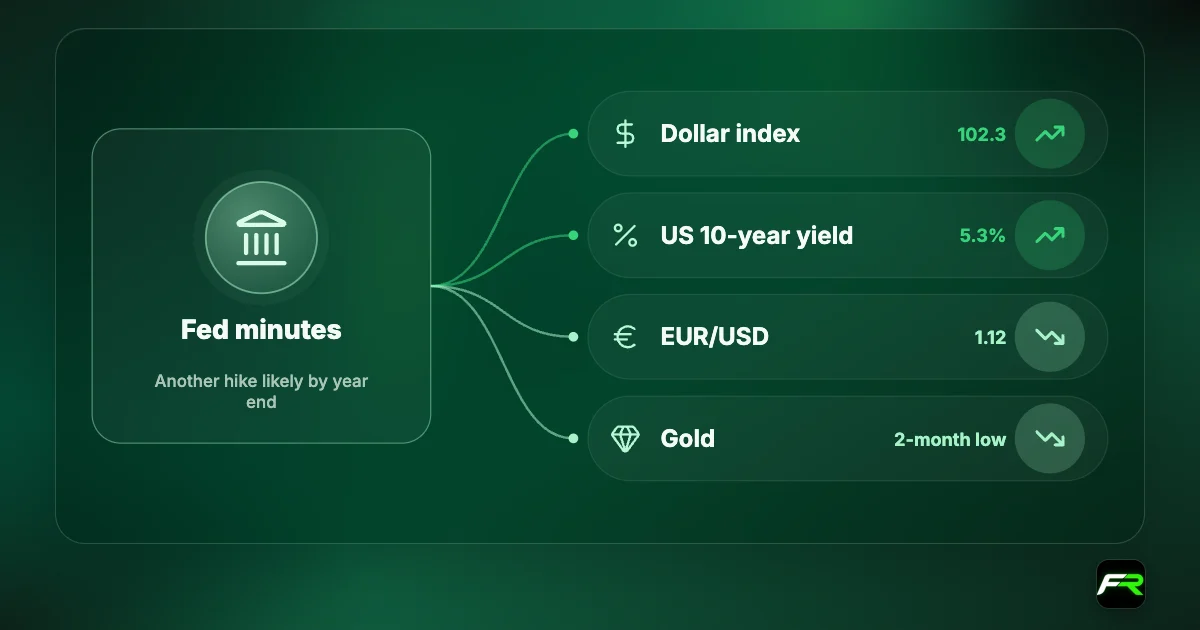
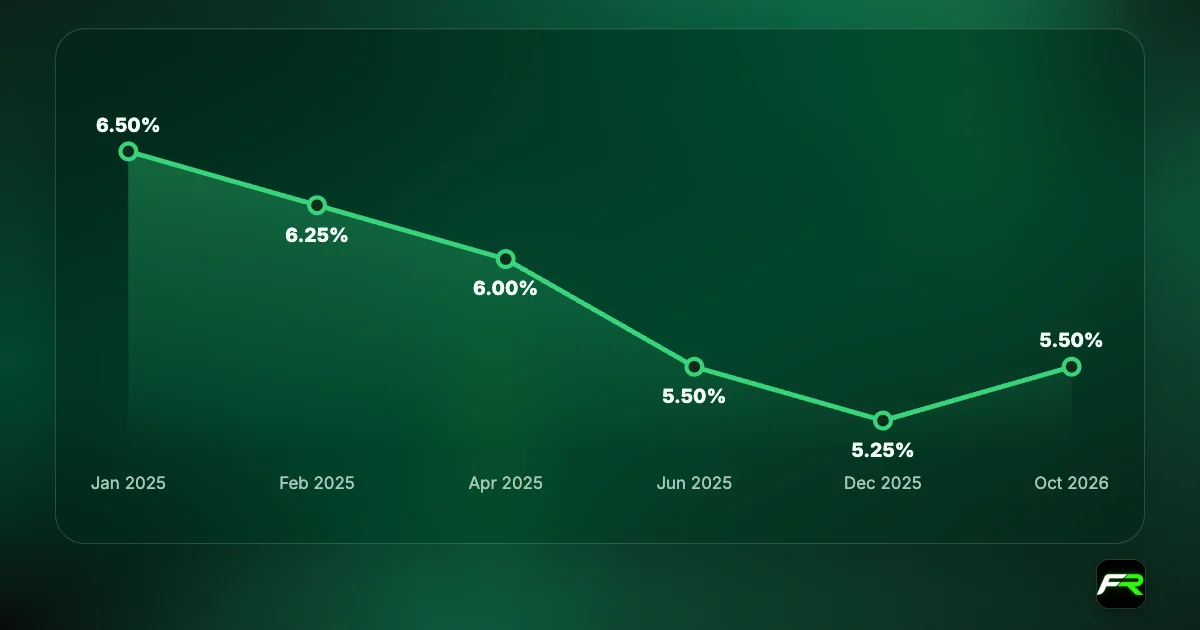
The Fed raised its target range by a quarter point to 3.75% to 4.00% on 16 September, and minutes of that meeting showed most officials expect another increase by year end. Markets do not expect it this month. Reuters reported that CME FedWatch put the chance of the Fed holding rates in October at 81%, up from 51% a month earlier.
That leaves CPI as the swing factor. Chris Weston, head of research at Pepperstone, told Reuters it is "a very high bar for the Fed to raise rates in October", but said a hot number could bring forward bets on a December hike and possibly another in January. A soft reading would do the opposite, and the dollar's recent gains would be exposed.
How the major currencies are trading
| Market | Close 2 Oct | Close 9 Oct | 12 Oct, 05:00 UTC |
|---|---|---|---|
| EUR/USD | 1.1257 | 1.1206 | 1.1210 |
| GBP/USD | 1.3240 | 1.3233 | 1.3244 |
| USD/JPY | 157.83 | 158.25 | 158.33 |
| Gold futures (COMEX) | $4,162.3 | $4,216.3 | $4,220.3 |
UTC daily closes built from hourly market data; levels differ slightly between providers.
The euro is the weakest of the majors. It lost 51 pips last week, its fifth weekly loss in a row, and it trades close to the 1.1166 low it touched last Monday. Worries over French public finances are part of the reason: Reuters reported that the gap between French and German 10-year yields had widened to 137 basis points, near its widest since 2012. Sterling has held up better, ending last week almost unchanged at 1.3233, while USD/JPY hovers just below 158.50 as warnings from Tokyo limit the upside.
Outside the majors, the Indian rupee rose about 1% to around 95.8 per dollar on Monday, Reuters reported, after the Reserve Bank of India moved state oil companies' dollar purchases away from the open market. South Korea's won reached a two-year high.
Treasury yields and oil
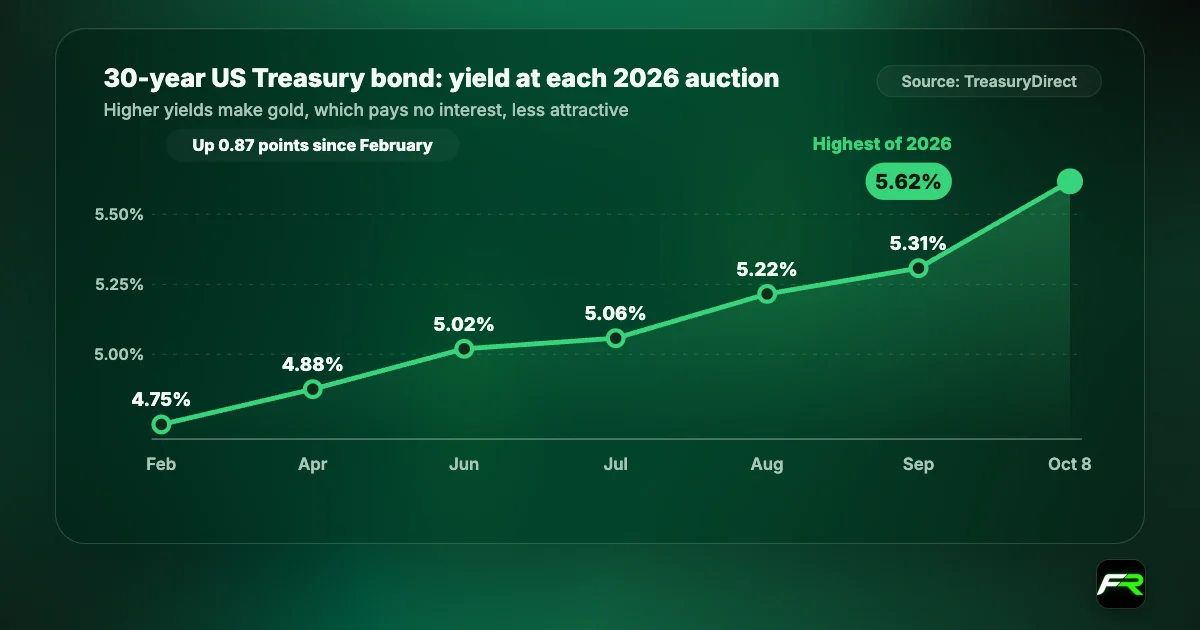
Long-dated US yields remain the dollar's main support. Treasury data show the 10-year yield at 5.24% on Friday 9 October and the 30-year at 5.60%, down from 5.67% on 7 October, which was the 30-year's highest close this year. Higher yields make dollar assets more attractive to foreign investors, which helps explain why the currency has held up even as some US data has softened.
Oil adds to the pressure. Each new attack on Gulf energy facilities lifts the inflation outlook, and with it the chance that the Fed keeps raising rates. Commonwealth Bank of Australia analysts told Reuters they expect the Houthi attacks to continue, "supporting gains in the oil price and the USD".
How to trade the week
- Mark Wednesday 12:30 UTC and Thursday 12:30 UTC in your economic calendar; spreads can widen sharply in the minutes around each release.
- Cut position size before CPI, or close trades that sit close to their stops.
- Watch Brent crude and the 10-year yield next to EUR/USD; this month they have often moved first.
- Expect thin, uneven trading today while Tokyo and the US bond market are closed.
- Use the position size calculator so one trade risks no more than 1% to 2% of your account.
Say you plan to hold one standard lot of EUR/USD through the CPI release, with a 40-pip stop. That is about $400 at risk. If the release moves the pair 60 pips against you in a few seconds, the stop may fill 5 to 10 pips worse, so the real loss could be $450 to $500. Trading half a lot instead caps the loss near $250 and leaves room to add once the price settles.
Our daily EUR/USD analysis, GBP/USD analysis and USD/JPY analysis carry today's levels and trade plans.
Leverage magnifies data-day swings. Size each trade by the money you can afford to lose, not by the margin your account allows.
Inflation figures and release times are from the US Bureau of Labor Statistics. The rate decision is from the Federal Reserve, and yields are from the US Treasury's daily par yield curve. The dollar index, Brent crude, the Gulf attacks, the rupee move and FedWatch odds are as reported by Reuters on 12 October. Currency levels are market data and differ slightly between providers. This is news, not investment advice.
Frequently asked
Why is the US dollar so strong in October 2026?
US yields are high, the Fed raised rates in September and signalled another hike by year end, and oil-supply attacks in the Gulf have pushed investors towards safe assets. The dollar index reached its highest level in about 18 months last week.
When is the US CPI report for September 2026?
The Bureau of Labor Statistics releases it on Wednesday 14 October 2026 at 8:30 a.m. Eastern time, which is 12:30 UTC. Producer prices follow on Thursday 15 October at the same time.
What was US inflation in August 2026?
Consumer prices rose 0.4% in August and 3.4% over the 12 months, according to the BLS. Excluding food and energy, prices rose 0.3% on the month and 2.4% over the year.
Will the Fed raise rates in October 2026?
Markets think it is unlikely. Reuters reported that CME FedWatch put the chance of a hold at the 27-28 October meeting at 81%. A hot CPI reading would raise the odds of a hike in December.
How does a hot CPI print affect EUR/USD?
Higher-than-expected US inflation usually lifts Treasury yields and bets on Fed hikes, which strengthens the dollar and pushes EUR/USD lower. A soft reading tends to have the opposite effect.
Sources: US Bureau of Labor Statistics: Consumer Price Index, August 2026 · BLS release schedule, October 2026 · US Treasury: daily par yield curve rates · Reuters via Investing.com: Dollar stays near 18-month high, 12 Oct
The team behind this guide
Researched, checked and approved by five forex specialists
Every guide is written, fact-checked and edited before it goes live, and updated when the facts change. Spotted an error? Tell us.