 IC Markets























Best High Leverage Forex Brokers (2026)
Leverage lets traders control a larger position with a relatively small amount of capital, making it one of the most influential features in forex trading. This guide reviews eight of the best high leverage forex brokers for 2026, comparing leverage limits, regulation, trading platforms, and account features.
From Exness with up to 1:Unlimited on qualifying accounts to OANDA and FOREX.com at the legal 1:50 ceiling for US traders, with honest breakdowns of which regulatory structure sits behind each leverage figure.
Real limits by country, position sizing math, and what to check before depositing a cent.






Exness
XM

IC Markets

LiteFinance

FP Markets

AvaTrade

Octa

RoboForex
Disclosure: "Visit Broker" links are partner (affiliate) links. FX Recap may earn a commission at no cost to you. Trading involves significant risk of loss. T&Cs apply.
Leverage lets you control a position larger than your account balance. At 1:100, a $500 account can open a $50,000 position. At 1:500, that same $500 controls $250,000 worth of currency. Higher leverage can increase both potential profits and potential losses, making proper risk management essential.
Many traders choose high leverage to improve capital efficiency, although it also increases trading risk. They want more flexibility with small accounts, tighter stop-losses relative to position size, or the ability to run multiple positions simultaneously without parking all their capital in margin. Those are common reasons. The problem is that high leverage and poor risk management can quickly lead to significant losses faster than almost anything else in trading.
The brokers reviewed below provide high leverage through different regulated entities, with investor protections varying by jurisdiction. Exness offers Unlimited Leverage only for eligible trading accounts that meet its qualification requirements. Availability depends on account type, trading history, equity, and instrument. FBS and FXTM offer up to 1:3000 through offshore entities. Pepperstone and IC Markets cap at 1:500 outside of EU and UK regulatory zones. For traders in the US, OANDA and FOREX.com provide the maximum legally permitted 1:50 under CFTC rules.
| Risk Warning: High leverage increases both potential profits and potential losses at the same rate. With very high leverage, relatively small market movements can quickly reduce available margin. The actual impact depends on position size, account equity, margin requirements and the broker’s stop-out policy. Between 51% and 89% of retail CFD accounts lose money. Always use leverage in combination with strict position sizing and stop-loss orders, and never risk more than you can afford to lose on any single trade. |
How Leverage Actually Works?
Leverage does not increase your capital. It allows you to control a larger position with borrowed buying power from your broker. You remain responsible for any losses on the total position, not just the margin you put up.
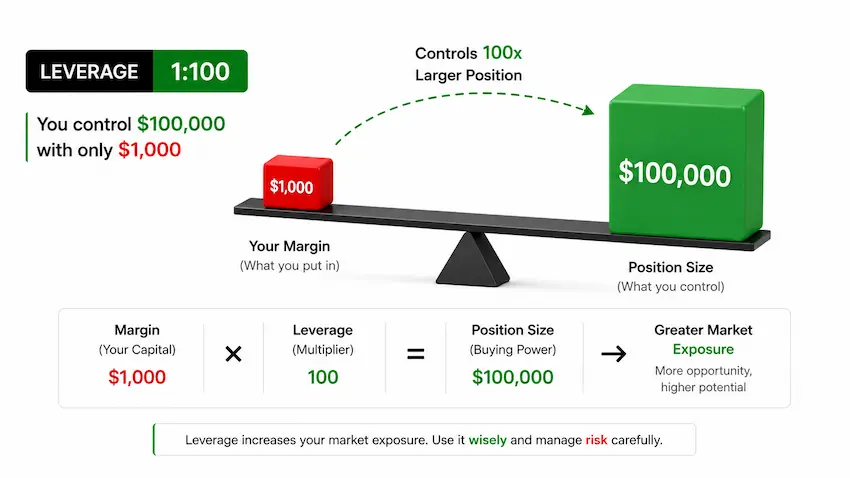
| Example: You open a 1 standard lot EUR/USD position worth $100,000 using 1:100 leverage ratio. Your required margin is $1,000. The market moves 50 pips in your favor. You make $500, a 50% return on your $1,000 margin. Now the market moves 100 pips against you instead. You lose $1,000, your entire margin, and the position is closed. If negative balance protection is in place, you cannot lose more than your deposit. Without it, you could owe more than your account balance. |
Negative balance protection is an important safeguard because it helps prevent retail investors from owing more than their account balance where applicable. Most brokers provide negative balance protection for eligible retail clients under certain regulated entities, but availability depends on the regulator and account type. It means the worst outcome is losing your deposit, not going into debt to your broker. Always confirm this feature is active for your specific account and entity before trading with high leverage.
Maximum Leverage Limits by Region
Leverage availability is determined by regulation, not broker generosity. Where a broker is authorized to serve you determines the cap you face. Below are the standard retail limits imposed by major regulators.
| Regulator / Region | Max Retail Leverage (Forex Majors) |
| ESMA / EU | 1:30 |
| FCA (UK) | 1:30 |
| ASIC (Australia) | 1:30 |
| MAS (Singapore) | 1:20 |
| CFTC / NFA (USA) | 1:50 |
| IIROC (Canada) | 1:50 |
| CySEC (Cyprus — offshore clients) | 1:30 retail / higher for pro |
| FSCA (South Africa) | 1:500 |
| IFSC (Belize) | 1:1000+ |
| FSA (Seychelles) | 1:1000+ |
| VFSC (Vanuatu) | 1:500 to 1:1000+ |
Most multi-jurisdiction brokers operate several entities under different regulators. An investor in the EU gets capped at 1:30 under their ESMA-compliant entity. The same broker’s offshore entity in Seychelles or Belize can serve clients from less regulated regions at 1:500 or higher. Some experienced retail clients choose offshore entities to access higher leverage, accepting reduced regulatory protections. This page will flag which entity applies to each broker’s high-leverage offering.
The 8 Best High Leverage Forex Brokers Reviewed
Broker information has been reviewed using official broker documentation, regulator registers, and publicly available product information. Leverage figures are verified per entity as of 2025.
1. Exness — Highest Available Leverage for Qualifying Accounts
Founded in 2008, Exness reports one of the highest monthly retail trading volumes in the industry according to its published statistics. It holds authorizations from the FCA, CySEC, FSCA, FSA, and several other bodies. For investors outside EU and UK regulatory zones, Exness offers leverage ratio up to 1:Unlimited on select account types including Standard, Raw Spread, and Zero accounts, subject to specific conditions.
| Founded | 2008, Limassol, Cyprus |
| Regulated by | FCA (UK), CySEC, FSCA, FSA (BVI), FSA (Seychelles) |
| Max Leverage (Retail) | 1:2000 (select non-EU/UK regions) |
| Max Leverage (Pro / Offshore) | 1:Unlimited (qualifying accounts, conditions apply) |
| Min. Deposit | $10 (Standard Cent) / $200 (professional accounts) |
| Platforms | MT4, MT5, Exness Terminal (proprietary) |
| Best for | Experienced traders wanting maximum leverage flexibility, high-volume scalpers |
The 1:Unlimited option is available only for eligible accounts that meet Exness’s qualification requirements, and dynamic margin rules continue to apply. In practice, the broker applies dynamic margin requirements, meaning as your account equity rises or you hold positions through the weekend, the required margin increases. It is not literally unlimited in all conditions, but it gives experienced investors a greater flexibility when managing position sizes no other major regulated broker currently matches.
Exness processes withdrawals instantly in most cases, which is practically useful for high-leverage retail clients who may need to move funds quickly after closing positions. The broker supports over 90 currency pairs alongside commodities, indices, and crypto. MT4 and MT5 are both fully supported. Exness also provides its proprietary Exness Terminal alongside MT4 and MT5 for web-based trading. Exness does refuse traders from the US, Canada, or Japan.
2. FBS — Up to 1:3000 with Beginner-Friendly Account Options
FBS was founded in 2009 and has expanded to serve over 27 million investors across 150 jurisdictions. FBS operates through regulated entities including the Cyprus Securities and Exchange Commission (CySEC) and the Financial Services Commission (FSC) Belize. The top leverage level of up to 1:3000 is available through FBS’s FSC Belize regulated entity for eligible clients. Within the CySEC-regulated entity, standard retail limits of 1:30 apply.
| Founded | 2009, Belize |
| Regulated by | CySEC (Cyprus), IFSC (Belize) |
| Max Leverage (Retail) | 1:3000 (IFSC entity, non-EU clients) |
| Max Leverage (Pro / Offshore) | 1:3000 |
| Min. Deposit | $1 (Cent account) / $100 (standard) |
| Platforms | MT4, MT5 |
| Best for | Traders in Asia, Africa, and Latin America wanting maximum leverage; beginners starting with micro accounts |
FBS is one of only a handful of brokers globally offering 1:3000 leverage to retail clients through a regulated entity. The Cent account allows trading with micro positions starting from a $1 deposit, which makes high leverage accessible at minimal absolute risk for traders still learning position sizing. A $10 account at 1:3000 controls $30,000 in currency exposure, which is significant but the dollar loss on a 1-pip adverse move on a micro lot is still just $0.01.
The regulatory trade-off is important to understand. The IFSC in Belize is a lighter-touch regulator than the FCA or ASIC. Fund segregation, negative balance protection, and conduct obligations are less stringent than under Tier-1 oversight. FBS is a legitimate, long-running broker, but traders accepting 1:3000 leverage through the IFSC entity are accepting a lower level of investor protection than they would receive through the CySEC entity. This is the honest trade-off that applies to almost every broker offering extreme leverage.
3. Pepperstone — Best High Leverage Broker with Top-Tier Regulation
Founded in Melbourne in 2010, Pepperstone operates through multiple regulated entities including ASIC, FCA, CySEC, BaFin, DFSA, CMA and SCB (Bahamas), depending on client location. Outside the EU and UK where ESMA caps apply, retail clients can access leverage ratios up to 1:500. Eligible wholesale or professional clients may qualify for higher leverage where permitted under local regulatory oversight and Pepperstone’s eligibility requirements. Pepperstone does not serve US or Canadian investors.
| Founded | 2010, Melbourne, Australia |
| Regulated by | ASIC, FCA, CySEC, BaFin, DFSA, CMA |
| Max Leverage (Retail) | 1:500 (outside EU/UK) / 1:30 (EU/UK retail) |
| Max Leverage (Pro / Offshore) | Higher available to professional clients (ASIC entity) |
| Min. Deposit | $0 |
| Platforms | MT4, MT5, cTrader, TradingView, Proprietary app |
| Best for | Active traders wanting high leverage with strong regulatory coverage; scalpers and algorithmic traders |
Pepperstone combines strong regulatory oversight with leverage ratio of up to 1:500 for eligible clients outside restricted jurisdictions. The seven licenses across four continents mean investors can access up to 1:500 in most of Asia, Africa, the Middle East, and Latin America while staying within a Tier-1 regulated environment. This combination is less common among globally regulated brokers. Most brokers offering 1:500 or above do so only through offshore entities with lighter oversight.
For scalpers and algorithmic traders, the combination of 1:500 leverage with Pepperstone’s raw spread pricing and sub-100ms execution creates an attractive option. The Active investor rebate program further reduces per-trade costs for high-volume accounts. Islamic swap-free accounts are available alongside the high leverage structure in applicable regions.
4. IC Markets — Up to 1:500 with ECN-Grade Execution
Founded in Sydney in 2007, IC Markets operates through several regulated entities, including ASIC (Australia), CySEC (Cyprus), and the Seychelles Financial Services Authority (FSA), depending on client location. The top leverage level of 1:500 is available through the offshore entity for market participants outside EU and Australian retail regulatory zones. The ASIC entity caps retail leverage ratio at 1:30 in line with Australian regulatory requirements.
| Founded | 2007, Sydney, Australia |
| Regulated by | ASIC, CySEC, FSA (Seychelles) |
| Max Leverage (Retail) | 1:500 (FSA Seychelles entity) / 1:30 (ASIC retail) |
| Max Leverage (Pro / Offshore) | 1:500 |
| Min. Deposit | $0 |
| Platforms | MT4, MT5, cTrader, TradingView |
| Best for | High-leverage traders who also want tight ECN spreads; scalpers and algorithmic traders outside EU/AU |
IC Markets combines the 1:500 leverage ceiling with some of the tightest raw spreads available at the retail level. The cTrader Raw account averages 0.02 pips on EUR/USD, which means a high-leverage investor is not paying inflated spreads for the privilege of using more margin. That combination matters. Trading costs should always be evaluated alongside leverage, execution quality, and licensing. IC Markets does neither. See the full spread breakdown in our best low spread broker guide.
Negative balance protection is available for eligible retail clients under applicable IC Markets entities. Clients should confirm coverage for their specific trading account. Execution averages under 40 milliseconds and the zero requote policy on raw accounts makes it a reliable setup for high-leverage strategies where fill quality affects outcome. US and Canadian investors cannot open client accounts with IC Markets.
5. AvaTrade — Up to 1:400 with Strong Multi-Jurisdiction Regulation
Founded in Dublin in 2006, AvaTrade holds authorizations from CySEC, ASIC, FSA Japan, FSCA South Africa, and ADGM, among others. Eligible clients opening accounts under AvaTrade entities that offer higher leverage may access up to 1:400 on major forex pairs, subject to local regulatory oversight and account eligibility.
| Founded | 2006, Dublin, Ireland |
| Regulated by | CySEC, ASIC, FSA (Japan), FSCA, ADGM |
| Max Leverage (Retail) | 1:400 (non-EU/AU clients) / 1:30 (EU/AU retail) |
| Max Leverage (Pro / Offshore) | 1:400 |
| Min. Deposit | $100 |
| Platforms | AvaTradeGO, AvaOptions, AvaSocial, MT4, MT5 |
| Best for | Traders wanting 1:400 leverage with multi-jurisdiction regulation; options traders; copy traders |
AvaTrade combines trading leverage of up to 1:400 in eligible regions with regulatory oversight across several well-established jurisdictions. FSCA and FSC Belize operate under different regulatory frameworks with different investor protection requirements. Retail clients should review the protections available under their specific profile entity. ADGM in Abu Dhabi operates under a strict framework designed for professional markets. For traders in MENA and African regions, AvaTrade is one of the few brokers offering meaningful leverage under locally respected oversight.
The AvaOptions app for forex vanilla options is a distinctive feature for high-leverage investors who want to define their highest available possible loss on a trade rather than relying on stop-loss orders alone. For copy traders wanting leverage ratio, AvaSocial integrates the copy-trading model. See our best copy trading broker guide for more on how AvaTrade’s copy structure compares.
6. XM — Up to 1:1000 with Wide Global Availability
XM, founded in 2009, serves clients across more than 190 countries. Use the latest client statistics published by XM before publication. It holds authorizations from ASIC, CySEC, and IFSC Belize. Leverage of up to 1:1000 is available for eligible clients through XM’s FSC Belize regulated entity, subject to jurisdiction and account conditions. CySEC-regulated accounts are capped at 1:30 for retail clients.
| Founded | 2009, Limassol, Cyprus |
| Regulated by | ASIC, CySEC, IFSC (Belize), FSC (Belize) |
| Max Leverage (Retail) | 1:1000 (IFSC entity) / 1:30 (CySEC/ASIC retail) |
| Max Leverage (Pro / Offshore) | 1:1000 |
| Min. Deposit | $5 |
| Platforms | MT4, MT5 |
| Best for | Traders in developing regions wanting high leverage; beginners with micro accounts |
XM serves clients across more than 190 countries and is widely available in many international markets. The $5 minimum deposit and micro-lot trading from 0.01 lot combined with 1:1000 leverage ratio gives new market participants in regions with limited capital access an entry point that would otherwise require much larger deposits. No commissions are applied to standard trading accounts, with trading costs built into spreads.
The spread structure on standard accounts is competitive across most major pairs. XM states that the majority of trades are executed quickly with no requotes under normal market conditions, but it does not guarantee a fixed average execution speed. For traders whose strategy requires volume rather than tight raw spreads, XM’s setup may suit. The main limitation for traders who also scalp is that XM does not offer cTrader, which removes one platform option that benefits manual high-frequency strategies. US and Canadian market participants cannot access XM’s accounts.
7. FXTM — Up to 1:3000 Through Offshore Entity
FXTM, which stands for ForexTime, was founded in 2011 in Cyprus and now serves over 1 million client accounts across 180 countries. It holds CySEC, FCA, and FSCA authorizations. Eligible clients trading under FXTM’s offshore entity may access leverage of up to 1:3000, subject to jurisdiction, trading account type and instrument. Under CySEC and FCA-regulated entities, standard retail limits of 1:30 apply.
| Founded | 2011, Limassol, Cyprus |
| Regulated by | CySEC (Cyprus), FCA (UK), FSCA (South Africa) |
| Max Leverage (Retail) | 1:3000 (offshore entity) / 1:30 (FCA/CySEC retail) |
| Max Leverage (Pro / Offshore) | 1:3000 |
| Min. Deposit | $10 (Cent account) / $200 (Advantage account) |
| Platforms | MT4, MT5, FXTM Mobile |
| Best for | Traders wanting extreme leverage through a long-established broker; cent account beginners |
FXTM has operated since 2011 and offers both standard and cent account options through different entities. The Cent account lets traders start with $10 and trade in cent lots, which allows practicing with high trading leverage ratios at very low absolute risk. A 1:3000 account with $10 controls $30,000 in exposure, but at cent lot size the pip value is around $0.01, making it a realistic learning environment.
FXTM’s FCA and CySEC entities provide the strongest investor protection. Traders who want 1:3000 leverage will be using an offshore entity rather than these regulated arms, so the same protection trade-off applies here as with FBS. The broker has a solid reputation, transparent fee structures, and strong educational resources, making it a more well-rounded offering than purely leverage-focused brokers.
8. OANDA and FOREX.com — Best for US Traders at Maximum Legal Leverage
US market participants face a hard regulatory ceiling of 1:50 on major forex pairs and 1:20 on minors under CFTC and NFA rules. There is no offshore workaround for US residents. Any broker claiming to offer US traders leverage ratio above 1:50 is operating illegally in the United States. OANDA and FOREX.com are the most established regulated options for American market participants who want to offer the highest permitted leverage.
| Founded | OANDA: 1996, New York / FOREX.com: 2001, GAIN Capital / StoneX (NASDAQ) |
| Regulated by | CFTC/NFA (US), FCA (UK), ASIC (AU), IIROC (Canada), MAS |
| Max Leverage (Retail) | 1:50 (US major pairs) / 1:20 (US minors) |
| Max Leverage (Pro / Offshore) | 1:50 (US ceiling, no higher permitted) |
| Min. Deposit | OANDA: $0 / FOREX.com: varies |
| Platforms | OANDA Trade, MT4, MT5 / FOREX.com proprietary, MT4, MT5, TradingView |
| Best for | US and Canadian traders needing maximum legally permitted leverage with full CFTC regulation |
Both brokers operate under CFTC and NFA oversight for U.S. clients. Client fund segregation is required, but negative balance protection is not a standard regulatory requirement in the United States. OANDA allows investors to open positions in individual currency units, providing greater flexibility than fixed micro-lot increments.
FOREX.com, as a subsidiary of the NASDAQ-listed StoneX Group, carries institutional accountability alongside its NFA registration. For US traders, these two remain the widely recognized choice for regulated forex access.
Side-by-Side Leverage Comparison
All leverage figures reflect the maximum available to retail traders through the stated entity. Reg. = Tier-1 regulator for each broker’s primary entity.
| Broker | Max Retail Leverage | Max Pro/Offshore | Regulator (Tier-1) | Neg. Balance Protection | US Traders |
| Exness | 1:2000 (select regions) | 1:Unlimited (conditions apply) | FCA, CySEC | Yes | No |
| FBS | 1:3000 (offshore entity) | 1:3000 | CySEC, IFSC | Yes (regulated entity) | No |
| Pepperstone | 1:500 (outside EU/UK/AU) | 1:500 (pro clients AU: higher) | ASIC, FCA, CySEC | Yes | No |
| IC Markets | 1:500 (offshore entity) | 1:500 | ASIC, CySEC | Yes | No |
| AvaTrade | 1:400 | 1:400 | CySEC, ASIC, FSCA | Yes | No |
| XM | 1:1000 (offshore entity) | 1:1000 | ASIC, CySEC, IFSC | Yes | No |
| FXTM | 1:3000 (offshore entity) | 1:3000 | CySEC, FCA, FSCA | Yes (regulated entity) | No |
| OANDA / FOREX.com | 1:50 (US majors) | 1:50 (US cap) | CFTC/NFA, FCA, ASIC | Yes | Yes |
How to Use High Leverage Without Destroying Your Account?
Most market participants who blow client accounts on high leverage do not fail because they used leverage. They fail because they sized positions based on what the leverage allowed rather than what their account could absorb. The leverage ratio is not a suggestion about how large to trade. It is a ceiling on what the broker will permit.
A simple rule that works: never risk more than 1% to 2% of your trading account balance on a single trade, regardless of trading leverage. At 1:500 with a $1,000 account, you can technically open $500,000 in positions. That is not a reason to do so. Your maximum risk per trade should still be $10 to $20, which means your stop-loss must be tight enough to close the position before the loss exceeds that amount.
| Position sizing example: Account: $1,000. Risk per trade: 1% = $10. Trading EUR/USD with a 20-pip stop-loss. At 1 pip = $1 per 0.1 lot: position size = $10 / 20 pips = 0.5 pips per $1 risk = 0.05 lot. Leverage used: 0.05 lot x 100,000 = $5,000 / $1,000 account = 5:1 effective leverage. Even with 1:500 available, sensible risk management means using closer to 5:1 in practice. |
Maintaining consistent position sizing is one of the core principles of long-term capital management. The available leverage ratio at your broker changes what your account allows. Your risk management rules should determine how you choose to trade.
Margin Calls and Stop-Out Levels
Margin call and stop-out policies vary between brokers and account types. Always review the official profile specifications before trading. The margin call level is the point at which the broker notifies you that your account equity is approaching the minimum required to hold your open positions. The stop-out level is where positions start getting automatically closed.
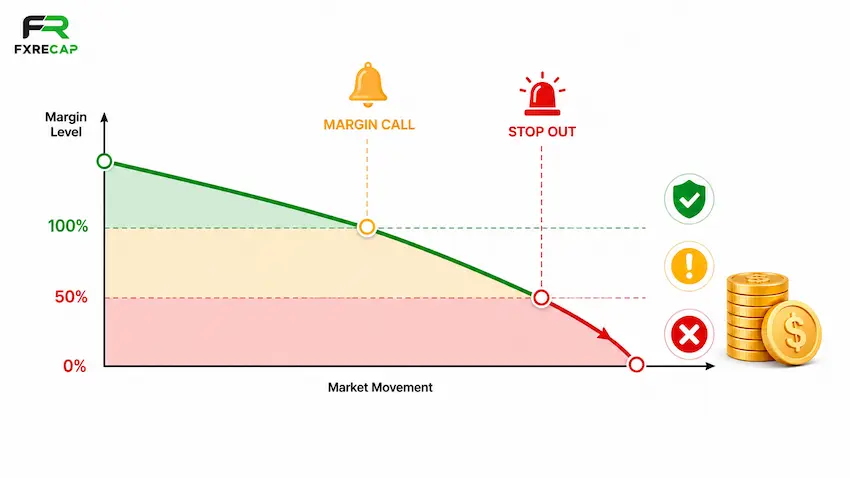
A broker with a margin call at 100% and stop-out at 50% will contact you when your equity equals your used margin, and start closing positions when equity falls to half of used margin. A broker with a stop-out at 20% allows greater flexibility to hold through drawdowns before forced closure. For investors using very high trading leverage with tight positions, knowing this threshold is important because forced closures can lock in losses at the worst possible price.
| FX Recap note: Always review the margin call and stop-out policies listed in your broker’s official account specifications before trading. Some brokers apply different trading conditions to demo and live accounts. Check the broker’s official documentation for any differences. |
Professional Client Status: How to Access Higher Leverage in the EU and UK
Retail clients based in the EU and UK face the 1:30 retail cap under ESMA and FCA rules. There is a legal route to higher leverage within these regions: applying for professional client status with your broker. To qualify, you generally need to meet at least two of three criteria: a financial portfolio exceeding 500,000 euros or equivalent, relevant professional experience in the financial sector, or a track record of significant trading activity across the past four quarters.
Professional clients may qualify for higher leverage where permitted by their broker and local regulatory oversight. The maximum available leverage varies by broker and regulated entity. Professional clients may lose certain retail protections, including some compensation rights and conduct safeguards, depending on the broker and applicable licensing. Several brokers, including Pepperstone, IG and others, offer professional client classification for eligible applicants under applicable regulations. Eligibility requirements differ by broker.
How to Pick the Right High-Leverage Broker
You Want Maximum Leverage with Institutional Volume
Exness is the only major regulated broker offering 1:Unlimited leverage on qualifying accounts. Its monthly trading volume exceeding $4 to $5 trillion provides the liquidity scale to support large leveraged positions. For market participants who also want tight spreads alongside the trading leverage, Exness’s Zero trading account offers 0.0 pip spreads with a small commission. See our best ECN broker guide for how execution models affect fill quality on large trading leveraged positions.
You Want High Leverage and the Best Raw Spreads
Pepperstone at 1:500 with Razor account pricing or IC Markets at 1:500 with cTrader Raw are the two options that combine high leverage options with ECN-grade execution and tight spreads. Both brokers are built for the investors who understand leverage and want to deploy it efficiently. Our best scalping broker guide covers these two in depth from an execution perspective.
You Are New to Trading and Want to Practice with High Leverage
XM’s micro accounts and FBS Cent accounts are the most accessible entry points. A $5 to $10 deposit with micro-lot sizing and 1:500 to 1:1000 leverage gives you real market exposure at absolute risk levels that are suitable for learning with smaller position sizes. Use this setup to understand how leverage amplifies both direction and speed of trading account movement before scaling up. Our best broker for beginners guide covers brokers that combine accessible trading leverage with quality education.
You Are Based in the US
OANDA and FOREX.com are your options. Both are CFTC and NFA regulated. Both offer 1:50 on majors and 1:20 on minors, which is the legal ceiling for American retail traders. Any broker claiming to offer a US resident more than 1:50 is either operating illegally or routing you through an entity that is not authorized to serve US clients. Do not use those brokers.
You Are in Asia, Africa, or Latin America
Most of the brokers on this list are available to you with trading leverage between 1:500 and 1:1000 or higher. The key check is which specific entity your profile would be opened under. Pepperstone’s DFSA and CMA licenses cover MENA and Kenyan clients with 1:500. FBS, XM, and FXTM offshore entities serve South and Southeast Asia, Africa, and Latin America. Country-specific guidance is in our regional broker guides: India, Malaysia, Philippines, Vietnam, Thailand, Bangladesh, Pakistan, South Africa, Brazil, and Japan.
High Leverage Broker Red Flags
The leverage topic attracts a disproportionate number of bad actors. Certain patterns are worth considering specifically in this space.
Unregulated brokers advertising extreme leverage as a selling point are the common risk. Leverage of 1:1000 or 1:2000 from a broker with no verifiable regulatory license is not a good deal. It is a warning sign. If the broker goes insolvent or disputes your withdrawal, there is no regulatory body to escalate to and no compensation scheme to rely on.
Bonuses tied to high leverage are another pattern. Brokers offering deposit bonuses alongside 1:500 or higher leverage typically attach trading volume requirements. These requirements mean you cannot withdraw your deposit until you have generated a set number of traded lots, which keeps your money locked regardless of how your trading goes. Read every bonus term before accepting.
Brokers that do not publish their margin call and stop-out levels clearly in their profile specifications deserve closer attention. Any broker committed to transparency makes these figures visible before you deposit. If you cannot find them in the terms, ask support directly and get a written answer.
People’s Most Asked Queries
What is the highest leverage a regulated broker can offer?
Exness offers 1:Unlimited leverage on qualifying accounts under certain conditions, making it the highest among regulated brokers in 2025. FBS and FXTM both offer up to 1:3000 through offshore entities. The key phrase is regulated: leverage claims from unverifiable or unregulated sources should be disregarded entirely.
Is high leverage dangerous?
Leverage itself is not dangerous. Using leverage without proper position sizing and stop-loss management is dangerous. At 1:500 with 2% risk per trade and sensible position sizing, your effective leverage on any single trade is far lower than 500:1. The margin ratio the broker offers is a ceiling, not a prescription for how large to trade.
Can US traders access high leverage forex brokers?
US traders are capped at 1:50 on major currency pairs and 1:20 on minor pairs under CFTC and NFA regulations. This cap applies to all forex brokers legally serving US clients. OANDA and FOREX.com are the principal regulated options. Any broker offering a US resident higher leverage is doing so outside the law.
What is the difference between retail and professional leverage?
Retail clients in the EU and UK face leverage caps of 1:30 on major pairs under ESMA and FCA rules. Professional clients can access higher leverage by meeting specific criteria: a portfolio over 500,000 euros, professional financial sector experience, or a history of large frequent trades. Professional status comes with reduced investor protections, including potential loss of FSCS compensation coverage.
Does negative balance protection apply on high-leverage accounts?
All brokers regulated under Tier-1 jurisdictions including FCA, ASIC, CySEC, and CFTC/NFA are required to provide negative balance protection for retail clients. This means the worst outcome on a leveraged position is losing your deposit. You cannot owe money to the broker. Brokers operating through offshore entities may also offer it voluntarily, but it is not always mandated. Confirm this in the account terms before depositing.
Which platforms support high leverage trading best?
MT4 and MT5 are the most widely used platforms for leveraged trading and support the full range of order types, automated strategies, and risk management tools that high-leverage trading requires. cTrader adds depth-of-market visibility useful for manual high-leverage scalping. See our best MT4 brokers and best MT5 brokers guides for which brokers deliver the best execution on each platform.
FX Recap Final Take
High trading leverage can be useful when combined with disciplined risk management, but it also increases exposure to market volatility.
At the time of writing, Exness is among the few major regulated brokers offering Unlimited trading leverage for eligible accounts under specific conditions. FBS and FXTM match it at 1:3000 through offshore entities, with FBS being particularly accessible for new market participants in developing regions through its Cent account structure.
Pepperstone and IC Markets combine leverage of up to 1:500 in eligible jurisdictions with regulatory oversight under multiple recognized financial authorities. AvaTrade at 1:400 brings multi-jurisdiction regulated trading leverage for investors in MENA and African markets. XM accepts clients from many countries across Asia, Africa and Latin America through different regulated entities, subject to local restrictions. For US traders, OANDA and FOREX.com operate at the 1:50 legal maximum with CFTC backing.
Choose trading leverage based on your trading plan rather than the maximum available, and always confirm the regulatory entity and account protections before opening an account.