Best Forex Brokers in Malaysia 2026
Forex trading is legal in Malaysia. While Malaysia has a licensing framework under the Securities Commission Malaysia (SC Malaysia), most retail traders use internationally regulated offshore brokers because very few brokers operate locally under this framework. Many Malaysian traders use internationally regulated brokers licensed by regulators such as the FCA, ASIC, CySEC, LFSA, FSCA or other recognised authorities, depending on the broker entity serving their account.
Each broker was evaluated using FX Recap’s internal research framework, covering regulation, trading costs, platforms, withdrawals, and overall reliability.
This guide compares several well-known forex brokers available to Malaysian traders in 2026, including Islamic account options, MYR deposit support, leverage rules, and tax guidance.
Exness
XM
IC Markets

LiteFinance
FP Markets
AvaTrade
Octa
RoboForex
Disclosure: "Visit Broker" links are partner (affiliate) links. FX Recap may earn a commission at no cost to you. Trading involves significant risk of loss. T&Cs apply.
Choosing a reliable forex broker is one of the most important decisions for traders in Malaysia. With so many international brokers promising low fees, high payouts, and easy deposit methods, choosing the right broker can quickly become overwhelming.
In practice, the situation is more straightforward than many comparison websites suggest. No retail forex broker is officially licensed in Malaysia to accept individual forex traders under local regulation. That said, Malaysian traders are completely free to open accounts with brokers authorized by strong overseas bodies like the FCA, ASIC, CySEC, or FSCA.
Each broker was independently assessed based on regulation, trading conditions, platform quality, and withdrawal experience. Here’s what our research shows for Malaysian traders specifically, including how legality works, what fees to watch, how the tax rules apply, and which brokers offer the tightest spreads.
Forex Trading in Malaysia: A Fast-Growing Market
Malaysia has one of Southeast Asia’s most trade-driven economies, and retail forex participation reflects that. Retail participation in online trading has grown steadily in Malaysia, although precise participation figures vary across studies. A 2024 study projected the number of active retail forex traders would reach 280,000 in 2025.
The available studies suggest Malaysia has an active and growing retail forex community. Growth has been supported by wider smartphone adoption and easier access to international trading platforms. Partly by the wider availability of offshore brokers that accept ringgit deposits and offer swap-free accounts for Muslim traders.
Quick Comparison: Top Forex Brokers for Malaysian Traders
Each broker included in this guide met our minimum evaluation criteria for regulation, trading costs, platform quality, and withdrawal reliability. Regulation received the highest weighting during our evaluation. Any broker that could not verify tier-1 or strong tier-2 regulatory status was excluded before other criteria were assessed.
| Broker | Regulation | Platforms | Max Leverage | Spread (Approx) | Islamic Account |
| XM | ASIC, CySEC, FSC Belize | MT4, MT5 | Up to 1000:1 | 0.6 pips | Yes |
| Exness | FSCA, CySEC | MT4, MT5 | Unlimited | 0.0 pips | Yes |
| TickMill | LFSA + FCA, CySEC | MT4, MT5 | Up to 500:1 | 0.0 pips (Pro) | Yes |
| FXTM | FCA, CySEC, FSCA | MT4, MT5 | Up to 2000:1 | 0.1 pips | Yes |
| Pepperstone | FCA, ASIC, CySEC | MT4, MT5, cTrader | Up to 500:1 | 0.0 pips | Yes |
Is Forex Trading Legal in Malaysia?
Malaysia’s Regulatory Framework
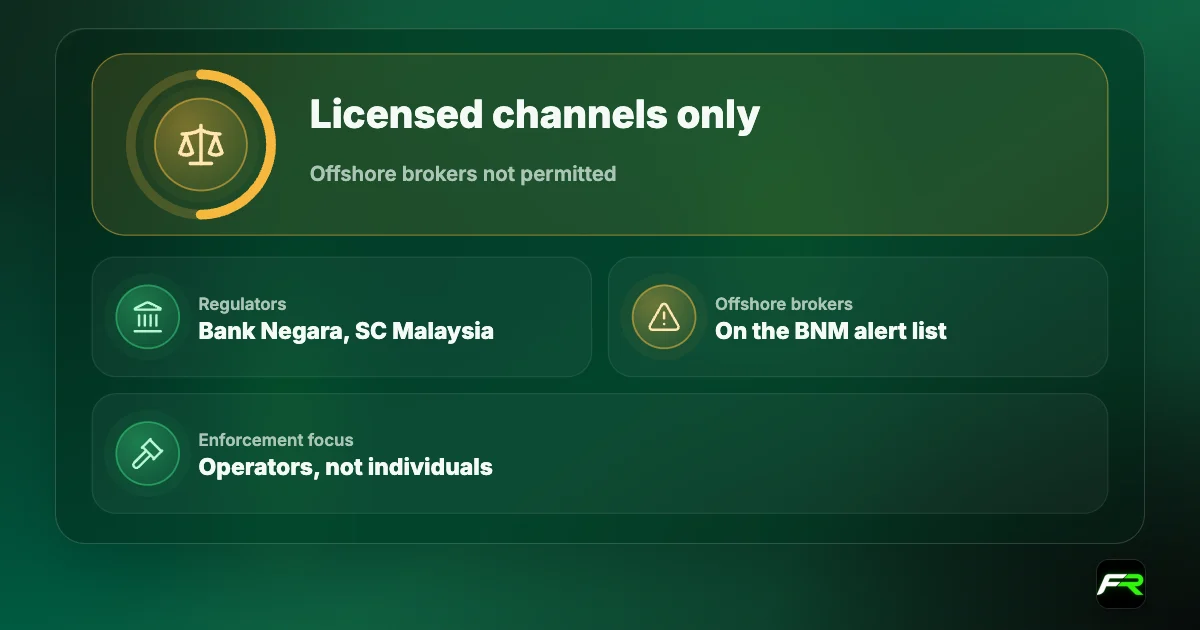
Yes, forex trading is legal in Malaysia, but it comes with conditions. Both the Securities Commission Malaysia (SCM) and Bank Negara Malaysia (BNM) have strict rules around who can offer forex services inside the country. Certain regulated capital market activities require a Capital Markets Services Licence (CMSL) issued by the Securities Commission Malaysia.
The minimum capital requirement for this license sits at MYR 5 million, directors must meet experience and qualification standards, and brokers are expected to maintain anti-money laundering systems. Most Malaysian retail traders continue to use internationally regulated brokers, as locally licensed retail CFD forex providers remain very limited.
Practical Implications for Malaysian Traders
Most Malaysian traders open accounts with offshore, licensed brokers. Those accounts are not covered under Malaysian financial protection laws, so conducting your own due diligence before funding an account is an essential step before opening a trading account.
One additional rule from Bank Negara Malaysia worth noting: Bank Negara Malaysia regulates MYR transactions under the Foreign Exchange Policy. Residents should ensure their trading activities comply with applicable foreign exchange regulations. Non-MYR currency pairs, however, are generally fine with properly authorized offshore brokers.
How Broker Regulation Works for Malaysian Traders
Local Regulators: SCM, BNM, and LFSA
The SCM oversees Malaysian capital markets under the Capital Markets and Securities Act 2007 but does not currently issue licenses to forex brokers for serving individual Malaysian clients. Bank Negara Malaysia, established in 1959, regulates the broader foreign exchange market, protects the ringgit, and manages the country’s international reserves.
A third local body useful to understand is the Labuan Financial Services Authority (LFSA), based in the Labuan island territory. As an offshore financial center, Labuan attracts foreign brokers with lower tax rates and a reduced initial capital threshold of around MYR 500,000, compared to the SCM’s MYR 5 million requirement.
Since Labuan is a federal territory of Malaysia, LFSA-licensed brokers can legally serve mainland Malaysian traders. Tickmill serves regional clients through Tickmill Asia Ltd, which is regulated by the Labuan Financial Services Authority (LFSA).
Key International Regulators
Since local retail licensing is limited, Malaysian traders rely on international regulation for protection. Our scoring weights tier-1 regulators most heavily because they impose the strictest segregation, compensation, and reporting standards. The FCA in the UK requires segregated client funds and access to financial compensation schemes.
ASIC requires licensed CFD providers to provide negative balance protection for eligible retail clients under its product intervention measures. CySEC-regulated investment firms participate in the Investor Compensation Fund (ICF), which may compensate eligible retail clients up to €20,000, subject to the scheme’s conditions. The FSCA in South Africa is increasingly rigorous for brokers serving emerging market clients.
Always verify a broker’s license number directly on the regulator’s official website. The SCM also maintains a public investor alert list of companies targeting Malaysian residents without authorization, before opening an account with any broker.
How to Verify a Broker is Authorized in Malaysia?
Using the SCM Public Register
Broking firms domiciled in Malaysia are listed in the SCM’s public licensee register. If the broker you are considering is locally regulated, it will appear in this database along with its registration number. Confirm the license status shows as active, since the database also contains firms with revoked, suspended, or expired permits.
Contacting the SCM Directly
You can contact the SCM through the inquiry form on their official website or by emailing [email protected]. A dedicated phone line (+603-6204 8000) is available on weekdays from 9am to 5pm. For complaints, use [email protected]. For offshore brokers, check the public register of whichever authority issued their license, whether FCA, ASIC, CySEC, or another recognized body.
Trading Platforms: What the Top Brokers Offer
Platform performance often differs from the specifications listed in marketing materials. Our evaluation covers execution speed on both market and limit orders, mobile stability, and how each platform holds up during high-volatility periods like central bank announcements. Our evaluation identified the following differences across the main options available to Malaysian traders.
MetaTrader 4 (MT4)
MT4 remains the most widely used forex platform worldwide and every broker on our list supports it. It handles automated trading through Expert Advisors (EAs), carries a large library of custom indicators, and runs stably on both desktop and mobile. For Malaysian traders who want reliability and a familiar interface, MT4 is still a practical platform for beginners.
MetaTrader 5 (MT5)
MT5 offers more timeframes, additional order types, and access to more asset classes including stocks and futures. Active traders who want to diversify beyond currency pairs will find MT5 the may be more suitable for long-term traders. Based on our execution testing, IC Markets and Pepperstone are widely recognised for fast execution, although execution quality varies by account type, server location and market conditions.
cTrader
Pepperstone and IC Markets both offer cTrader alongside MT4 and MT5. Live account tests showed consistently fast execution and transparent depth-of-market pricing, making it commonly preferred by scalpers and traders running algorithmic strategies.
Proprietary Platforms and TradingView
Tickmill offers the Tickmill Trader app, XTB has xStation 5, and AvaTrade provides WebTrader with its AvaProtect risk management feature. TradingView is increasingly supported by brokers serving Malaysian clients. However, platform availability depends on broker entity and region. TradingView offers a browser-based experience with one of the world’s largest charting platforms and advanced charting tools. If you prefer not to install desktop software, TradingView support is a practical thing to confirm before you sign up.
Trading Fees: What to Watch Before You Deposit
Trading costs often appear straightforward but can vary significantly depending on account type. Across our live account tests, the same EUR/USD round trip cost anywhere between $0.80 and $12 depending on the account type and broker. Here is where those differences actually come from.
Spreads
The spread is the gap between the buy and sell price. On raw or ECN accounts, brokers like Exness, IC Markets, and Pepperstone offer EUR/USD spreads starting near 0.0 pips, but these are paired with a per-trade commission. Standard accounts show a wider spread with no separate commission. Neither model is always cheaper; it depends on your average trade size.
Commissions
Raw or Pro accounts typically charge USD 3 to USD 6 per lot round trip. At Fusion Markets, that figure is USD 4.50 round turn on Zero accounts. Pepperstone charges USD 7 round turn on Razor accounts. If you trade frequently in smaller sizes, a commission account often works out cheaper. If you hold larger positions less often, standard spreads may be more cost-effective.
Overnight Swap Fees
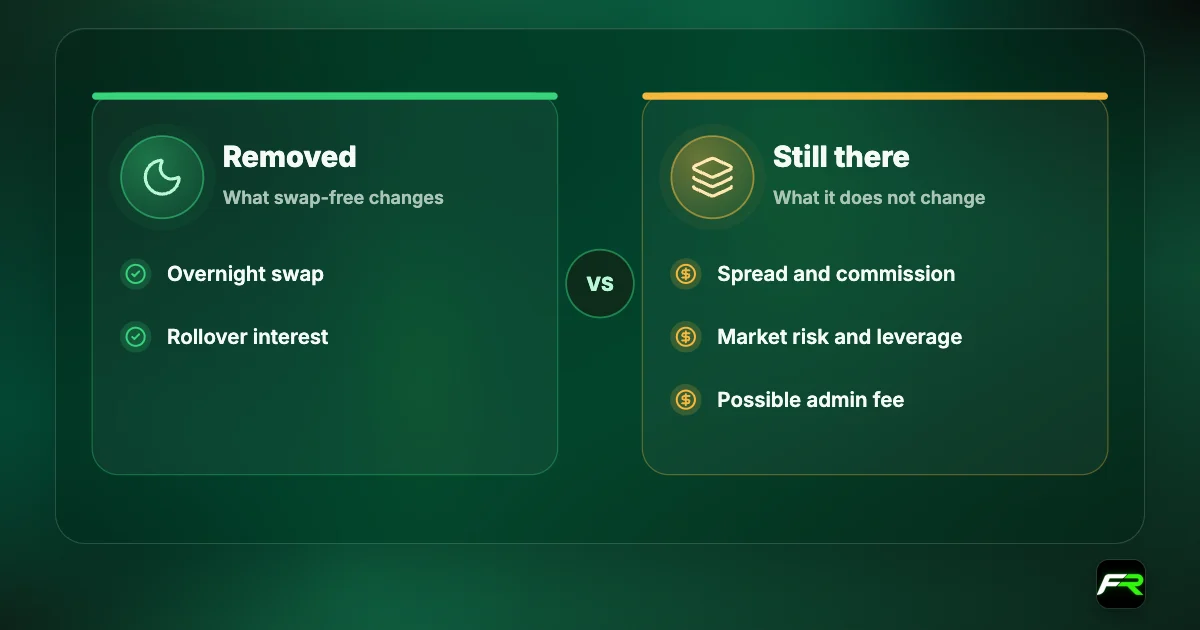
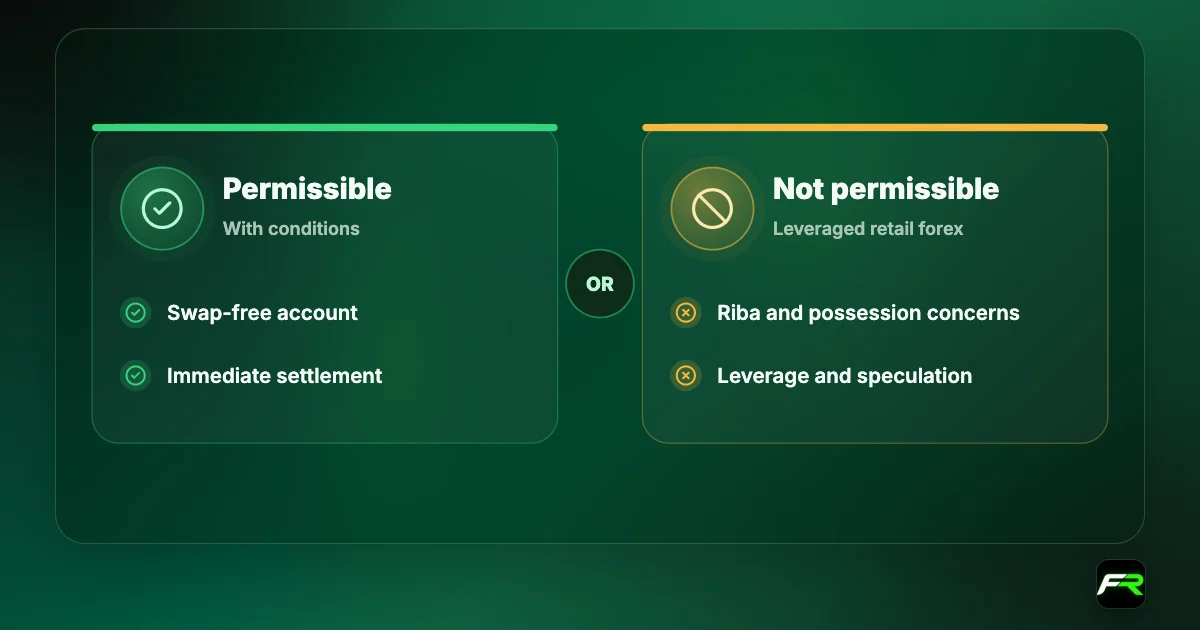
Holding a position past the daily rollover time triggers a swap charge based on the interest rate differential between the two currencies in the pair. For Malaysian traders observing Islamic finance principles, all five brokers in our comparison table offer swap-free accounts that remove this charge.
Deposit and Withdrawal Costs
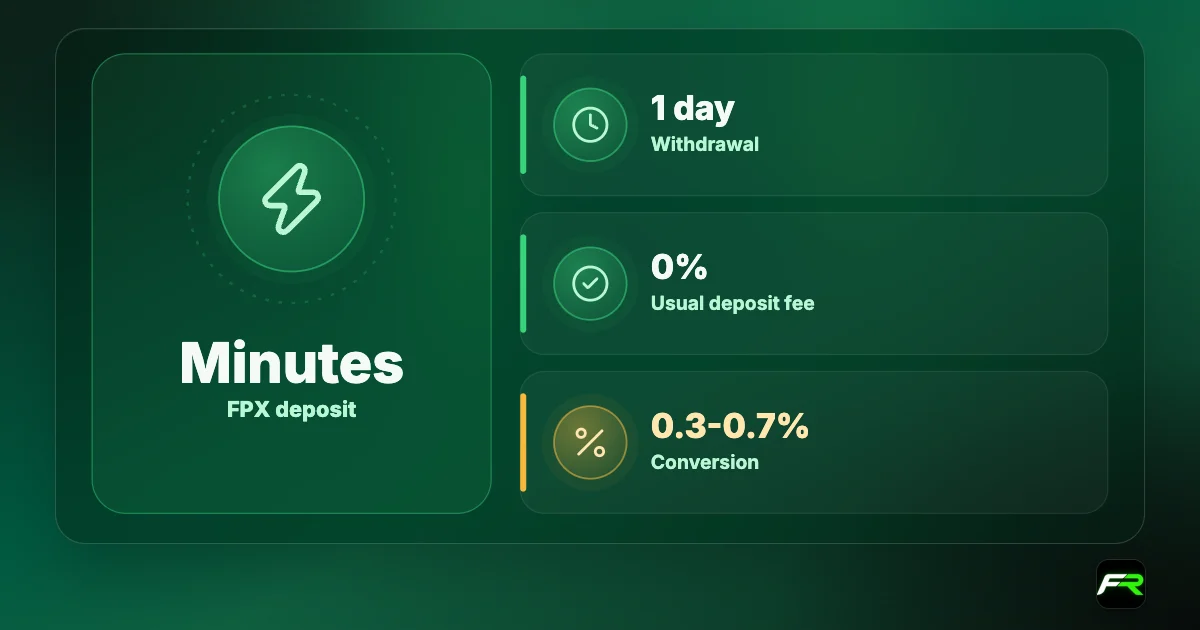
Withdrawal processing is one of the most practical ways to assess a broker’s operational reliability. Pepperstone states that withdrawal processing times depend on the payment method and banking system used. Exness states that many electronic payment withdrawals are processed instantly, although actual processing times may vary depending on the payment provider. Some brokers absorb local transfer fees; others pass them on. Always review the funding page before committing, since costs can vary by payment method and region even within the same broker.
Leverage Caps for Malaysian Forex Traders
Regulatory Leverage Limits in Malaysia
The Securities Commission Malaysia does not specify hard leverage caps in its CFD provider guidelines. The LFSA mandates a maximum of 1:100 for retail traders across all contracts for difference. This is more generous than the 1:30 cap that ASIC-regulated brokers impose on major forex pairs, or the 1:25 cap enforced in Japan.
Brokers regulated in Belize or Vanuatu sometimes offer leverage as high as 1:1000 to retail clients. While that advertised leverage may appear appealing, a single 0.1% adverse price move wipes the entire margin on a 1000:1 position. Although some brokers advertise very high leverage, many experienced traders use substantially lower leverage to manage risk more effectively.
| Broker | Maximum Leverage |
| XM | Up to 1000:1 |
| FXTM | Up to 2000:1 |
| Exness | Unlimited (subject to conditions) |
| TickMill | Up to 500:1 |
Brokers with the Tightest Spreads for Malaysian Traders
For active traders, spread costs can have a significant impact on overall trading expenses. The figures below are based on published broker specifications and independent testing where available.
| Broker | Average Spread EUR/USD |
| IC Markets | 0.0 to 0.8 pips |
| FP Markets | 1.0 to 1.4 pips |
| IG | 0.8 pips |
| Fusion Markets | 1.0 pips |
Islamic (Swap-Free) Accounts for Malaysian Traders
Who Should Consider an Islamic Account
Malaysia is a predominantly Muslim country with over 63% of its 34-million population following the Islamic faith. Islam prohibits interest, or riba, which makes standard overnight swap charges incompatible with Shariah principles. The brokers included in this comparison offer Islamic account options, subject to eligibility and regional availability. For many Muslim traders, access to a swap-free account is an important consideration.
How Islamic Accounts Work
Swap-free accounts replace overnight interest charges with fixed administrative fees, wider spreads on certain pairs, or a grace period after which holding fees apply. For example, if a broker charges a fixed fee of $20 per standard lot on EUR/USD with a 7-day grace period, holding that position for 10 days means paying the $20 administrative charge once, not nightly interest.
Some brokers automatically enable Islamic accounts for eligible clients, while others require a request and approval. Others require a manual request, sometimes with documentation confirming religion if it is not stated on your government-issued ID. Conditions and eligible pairs vary, so confirm the specific terms directly with the broker before opening an account.
Funding in Malaysian Ringgit (MYR)
Benefits of MYR Funding Support
Not every international broker accepts MYR. Using MYR-supported funding methods may reduce currency conversion costs, depending on your payment provider.
Brokers Offering MYR Funding Options
Brokers with known MYR deposit support include Exness, Tickmill (through its Malaysian LFSA entity), and JustMarkets. Fusion Markets also supports DuitNow, a Malaysia-specific payment method that makes funding straightforward. FP Markets and IC Markets support a wide range of options including bank transfers and e-wallets commonly used by Malaysian traders. Before transferring any funds, confirm whether the broker lists MYR as a supported base or funding currency on their official website.
Taxes on Forex Trading Profits in Malaysia
Malaysia’s Tax Treatment of Forex Trading
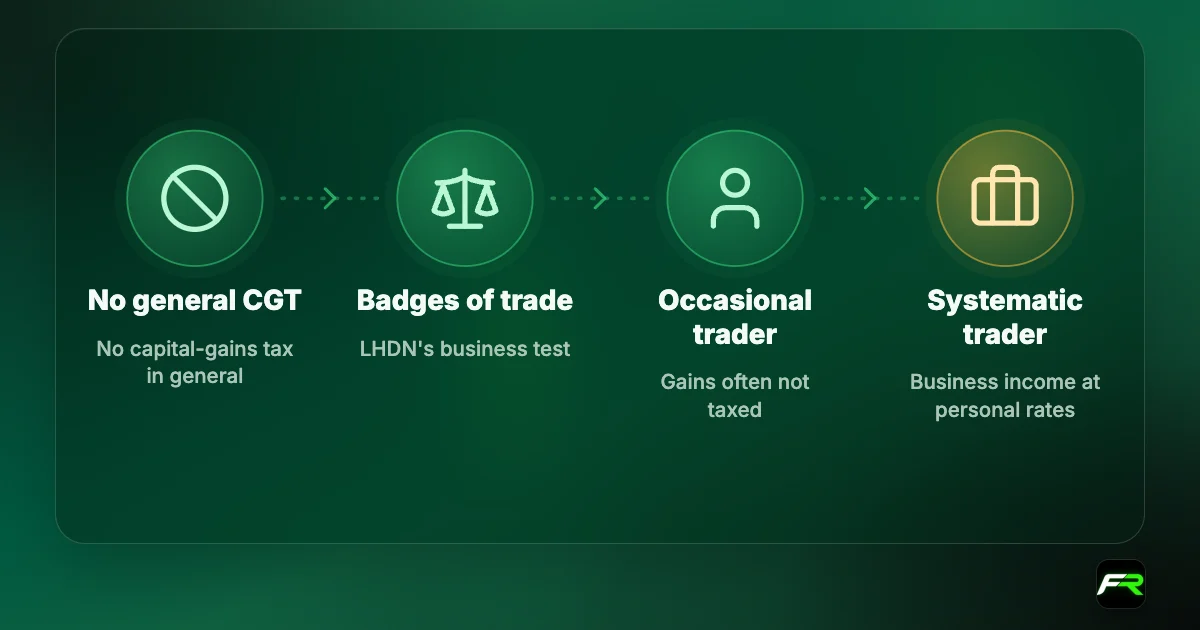
The tax treatment of forex trading depends on whether the activity is regarded as income or capital in nature. Traders should seek advice from a qualified Malaysian tax professional. Traders are generally exempt from capital gains tax. Income from forex trading is subject to personal income tax once it crosses the relevant threshold. Whether your trading income is treated as ‘other income’ or ‘business income’ depends on how frequently and consistently you trade. If the Inland Revenue Board (LHDN) determines trading is your primary income activity, it may be classified as business income with different tax treatment and loss carry-forward rules.
Residents who spend 182 days or more in Malaysia per calendar year are taxed under the tiered system below. Non-residents are taxed at a flat rate of 30%. Malaysia’s tax treatment depends on individual circumstances and trading activity. A qualified Malaysian tax advisor is the best source of professional guidance if you trade actively.
Malaysia Income Tax Brackets
| Annual Income (MYR) | Tax Rate |
| 0 to 5,000 | 0% |
| 5,001 to 20,000 | 1% |
| 20,001 to 35,000 | 3% |
| 35,001 to 50,000 | 6% |
| 50,001 to 70,000 | 11% |
| 70,001 to 100,000 | 19% |
| 100,001 to 400,000 | 25% |
| 400,001 to 600,000 | 26% |
| 600,001 to 2,000,000 | 28% |
| Above 2,000,000 | 30% |
Best Time to Trade Forex in Malaysia
Understanding Forex Trading Sessions in Malaysian Time
The forex market runs 24 hours a day, five days a week, cycling through the Sydney, Tokyo, London, and New York sessions. Malaysia Standard Time (MST) is UTC+8, which puts Malaysian traders in a useful position relative to both the Asian and European sessions.
Most Active Trading Sessions
The Tokyo session runs from roughly 7am to 4pm MST, making it the most accessible session for Malaysian day traders. Asian pairs like USD/JPY and AUD/USD tend to see their typically experience higher trading activity during this window. The London session opens around 3pm to 4pm MST and overlaps with the tail end of Tokyo, which is typically when EUR/USD and GBP/USD volatility picks up.
One of the most active trading periods for Malaysian traders falls between roughly 3pm and 7pm MST, when London and New York are both active. This overlap produces the tightest spreads and the most reliable price movement for short-term trading. Traders seeking lower volatility often focus purely on the Tokyo session and avoid the European overlap entirely.
Fund Security and Trader Protection
Segregated Client Funds
Reputable brokers keep client funds in accounts entirely separate from the broker’s own operating capital. This means that if a broker faces financial difficulties or files for bankruptcy, client deposits are protected. In our evaluation criteria, fund segregation is a non-negotiable requirement. Any broker that cannot demonstrate this practice clearly in their documentation does not pass our regulatory check.
Negative Balance Protection
Negative balance protection prevents your account from dropping below zero, even during extreme market moves. Without it, leveraged positions in fast-moving markets could theoretically cost you more than your original deposit. ASIC-regulated and FCA-regulated brokers are required to offer this to retail clients. For brokers operating under more permissive offshore jurisdictions, check whether this protection is offered voluntarily. This is one of the specific items we verify during our live account testing.
Margin Closeout Explained
When using leverage, traders maintain a minimum balance threshold to keep open positions running. If the market moves sharply against your positions and your balance drops below this threshold, the broker automatically begins closing losing positions to prevent further loss. This is called an automatic margin closeout. It is a safety mechanism, not a penalty, and all properly regulated brokers implement it. Knowing your broker’s specific margin closeout level before opening leveraged positions is basic risk hygiene.
Getting Started with Forex Trading in Malaysia
How Much Do You Need to Start?
Minimum deposits vary significantly. Some brokers on this list accept accounts from USD 0 with no minimum. Most experienced traders suggest putting in at least USD 200 to USD 500 before trading live. At that level, keeping risk to 1% to 2% per trade gives you enough cushion to absorb a losing streak without wiping the account. If you are just starting out, XM currently offers a deposit bonus that can extend your initial capital while you find your footing. Opening with less than USD 100 tends to push new traders into oversizing positions, which is one of the most common causes of early account losses.
Using a Demo Account First
Every broker on this list provides a free demo account loaded with virtual funds. Use one before going live. It lets you test how the platform handles orders during volatile moments, practice your risk management, and verify that the broker’s actual spreads match what they advertise. Two to four weeks on a demo is a reasonable minimum before committing real money.
Risk Management When Trading with Offshore Brokers
Make Risk Management Your Priority
Successful trading depends on balancing profitable opportunities with disciplined risk management. Preserving trading capital is essential for long-term consistency. Since Malaysian traders typically operate through offshore platforms without local regulatory safety nets, risk discipline becomes even more important. Never risk more than 1% to 2% of your account on a single trade. This one rule does more to preserve capital during losing streaks than almost anything else.
Position Sizing and Leverage Discipline
Always place a stop-loss on every position, regardless of your market outlook about the setup. Markets move on news and events that no analysis fully anticipates. Keep your actual working leverage well below the broker maximum. Experienced traders often operate at effective leverage of 5:1 to 20:1, even when a broker offers 500:1 or higher. Many experienced traders use far less leverage than the maximum available to reduce risk.
Trading Frequency and Withdrawals
Avoid overtrading. Three to five well-planned trading opportunities per week tends to outperform twenty average ones when you account for spread costs and mental fatigue. Review your withdrawal strategy regularly based on your trading plan and risk tolerance. Regular withdrawals may help reduce counterparty exposure. It also forces a regular review of what is actually working in your trading.
How to Evaluate a Broker Before Opening an Account?
Verify the Broker’s Regulation First
With no local regulator vetting retail forex brokers in Malaysia, the responsibility for due diligence sits with you. Find the broker’s license number and verify it directly on the regulator’s official site, whether that is the FCA register, ASIC connect, or the CySEC register. Always verify the broker’s licence directly through the regulator’s official register. From there, look at the actual spread and commission structure on the account type you plan to use, not just the headline number on the homepage.
Evaluate Customer Support and Read Withdrawal Reviews
Test customer support before funding your account. Send a genuine question and see how fast and clearly they respond. Then read independent reviews specifically about withdrawal experiences, since that is where issues most often surface. Trustpilot reviews filtered to withdrawal-specific comments are a useful indicator of customer experience. Confirm whether MYR is accepted and what payment methods are available for Malaysian banks.
Check Negative Balance Protection
Finally, review the negative balance protection policy. A broker serious about retail client protection will not allow your account to go into debt beyond your deposit. This is especially worth confirming when trading with high leverage on offshore platforms. FX Recap treats this as a pass-fail criterion during our broker evaluation.
Frequently Asked Questions
Is forex trading halal in Malaysia?
Forex trading can be conducted in a Shariah-compliant way through swap-free Islamic accounts, which remove the interest-based overnight charges that conflict with Islamic finance principles. Each broker we reviewed for this page supports swap-free trading. Whether a specific trading activity is considered halal is ultimately a matter for qualified Islamic scholars and your own religious guidance, not a broker or a review site.
Which forex broker is best for beginners in Malaysia?
For beginners, the priority should be a broker with a strong demo account, clear educational resources, responsive customer support, and no pressure to deposit large amounts quickly. Based on our testing, XM and Pepperstone both perform well on these criteria for Malaysian beginners. XM’s minimum deposit is low, its educational content is genuinely useful, and support is available in multiple languages. Pepperstone’s execution is among the fastest we tested, which builds good trading habits from the start. If you are considering IC Markets, they also run a welcome deposit bonus for new accounts that is worth checking before you sign up.
Can I trade forex with Malaysian ringgit?
Yes, several internationally regulated brokers accept MYR deposits and support local Malaysian payment methods. Exness and Tickmill are the most frequently cited for ringgit deposit support among Malaysian traders. Fusion Markets supports DuitNow. Not all brokers support MYR as a base account currency, so confirm this specifically on the broker’s funding page before opening an account.
Do I need to pay tax on forex profits in Malaysia?
Forex trading income is generally subject to personal income tax in Malaysia, though capital gains tax does not apply. How your earnings are classified, whether as supplementary income or as a primary business activity, depends on how frequently and extensively you trade. Malaysia uses a tiered tax system with rates from 0% to 30% for residents. Non-residents pay a flat 30%. Consulting a qualified Malaysian tax advisor is the most reliable way to handle this correctly.
What is the minimum amount needed to start forex trading in Malaysia?
Some brokers on this list accept accounts with no minimum deposit. For practical trading with proper risk management, USD 200 to USD 500 is a reasonable starting point. With that range, you can apply the 1% to 2% risk-per-trade rule without your position sizes becoming so small they are impractical. Opening with less is technically possible but tends to create bad habits around position sizing.
Is XM or Pepperstone better for Malaysian traders?
They serve different needs. XM is better for traders who want a low-barrier entry, a wide range of account types including cent accounts, and strong educational support. Pepperstone is better for traders who prioritize execution speed, tighter spreads on raw accounts, and a wider selection of platforms including cTrader. Both are regulated by multiple top-tier authorities and both offer Islamic accounts. The right choice depends on your trading style and experience level.
Final Thoughts
Malaysian traders have access to a wide range of internationally regulated forex brokers, making careful broker selection especially important. The challenge is separating the credible ones from those that simply appear credible.
The brokers on this page were selected and ordered based on FX Recap’s 75-point evaluation, live account testing, and verified regulatory status. Safety and licensing carried the most weight in our scoring because they are the single factors that protect your capital should a dispute or operational issue arise. Every other feature, platform quality, spread size, educational content, is secondary to whether your money is actually safe.
Cross-check any broker you seriously consider by verifying their license on the relevant regulator’s site and reading independent withdrawal reviews. That combination, more than any marketing claim, tells you what you can reasonably expect as a client.