 IC Markets

 3:09
 2:39
 2:10
 2:18
 3:43
 8:42






































What is a Pip in Forex? Full Guide to Forex Basics
A pip is the smallest standard price move in a currency pair. How pip values differ across pairs, and how pips measure profit, loss and risk.
 WriterAbir KhanWriterWrites the guides · checks every figure against primary sources View profileAbout Abir →

 Market analysisTanbir Habib RiyadForex & Crypto AnalystForex and crypto analyst · technical and fundamental analysis View profileAbout Tanbir →

 Fact-checking & riskJannatul FerdaushFact-Checker & Risk AnalystFact-checks every figure · risk analysis · Applied Statistics, University of Dhaka View profileAbout Jannatul →

 Trading reviewJowel RanaForex TraderForex trader · reviews guides from a trader's view View profileAbout Jowel →

 Final approvalRanjan N. MondolForex TraderForex trader · signs off every guide View profileAbout Ranjan →

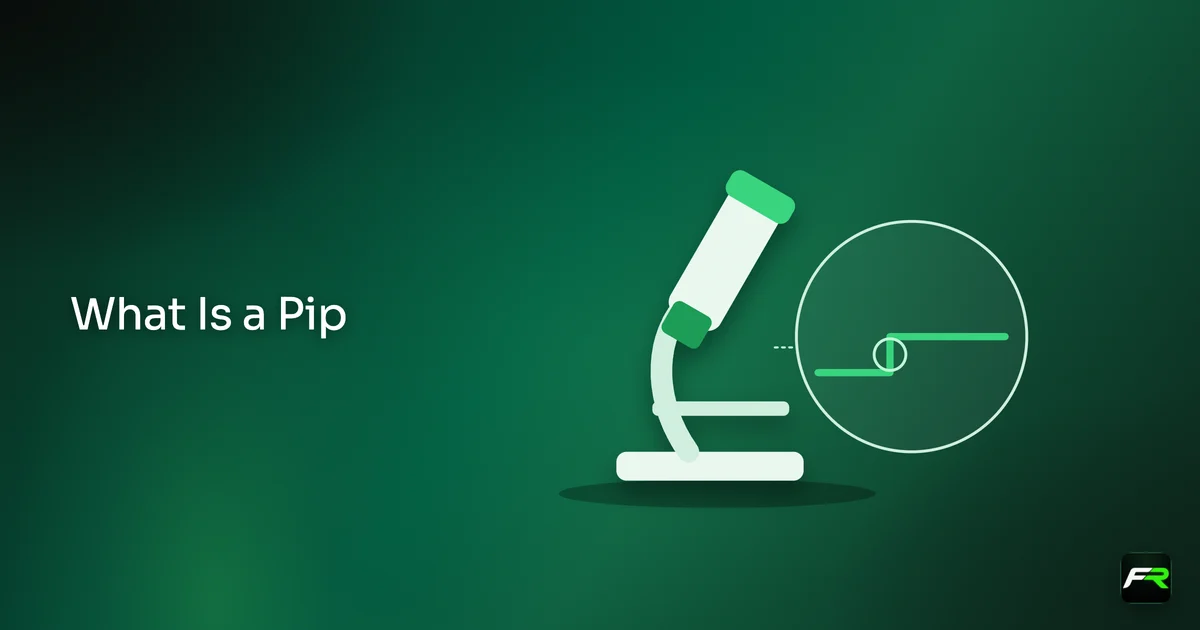
A pip is the standard unit for measuring how far a currency price has moved. On most pairs it is the fourth decimal place, 0.0001. If EUR/USD moves from 1.1050 to 1.1051, it has moved one pip.
Traders count in pips because it works the same way on every account size. Once you know what a pip is worth on your trade, you can turn any price move into money, set a stop-loss in money terms and compare costs between brokers.
What a pip is
The word pip is usually read as short for “percentage in point” or “price interest point”. Whatever the name, the meaning is fixed by convention:
- Most pairs (EUR/USD, GBP/USD, AUD/USD and others): one pip is 0.0001, the fourth decimal place.
- Yen pairs (USD/JPY, EUR/JPY, GBP/JPY): one pip is 0.01, the second decimal place, because one yen is worth far less than one dollar or euro.
Most platforms show one more digit than the pip. That last digit is a fractional pip, often called a pipette, worth one tenth of a pip. A EUR/USD price of 1.10503 is 1.1050 plus half a pip. When a broker advertises a spread of 0.6 pips, it is counting in those tenths.
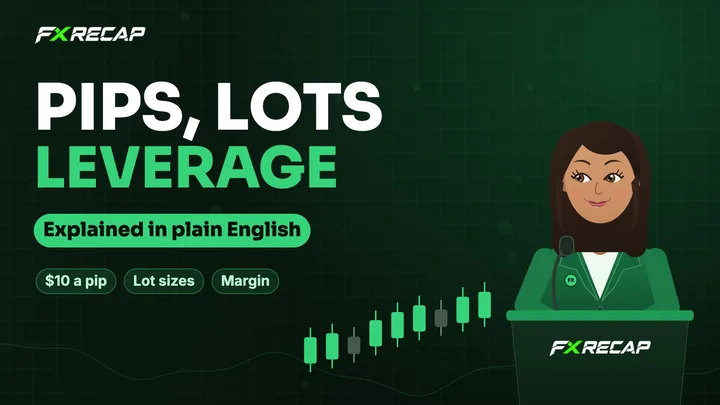
Watch this on video
What is a pip?
From our lesson "Pips, Lots and Leverage" (Forex basics, part 2). This part starts at 0:17 of the 2:39 video and plays in a large player.
How to count pips on a trade
To count pips, take the difference between two prices and divide it by the pip size.
- EUR/USD from 1.1050 to 1.1080: 0.0030 ÷ 0.0001 = 30 pips.
- GBP/USD from 1.2700 to 1.2655: 0.0045 ÷ 0.0001 = 45 pips lower.
- USD/JPY from 150.20 to 150.95: 0.75 ÷ 0.01 = 75 pips.
The direction tells you whether those pips are a gain or a loss. A buyer gains when the price rises and loses when it falls. A seller gains when it falls.
Work it out
Our free pip calculator shows what one pip is worth in your account currency for any pair and lot size.
Our free forex profit calculator shows a trade's profit or loss in pips and money, and how it compares with the loss to your stop.
What one pip is worth
The money value of a pip depends on two things: the size of your trade and the currency the pair is quoted in. Trade size is measured in lots. For EUR/USD and other pairs where the US dollar is the quote currency, the numbers are round:
| Lot size | Units of base currency | Value of 1 pip on EUR/USD |
|---|---|---|
| Standard lot (1.00) | 100,000 | $10 |
| Mini lot (0.10) | 10,000 | $1 |
| Micro lot (0.01) | 1,000 | $0.10 |
When the US dollar is not the quote currency, the pip value is worked out in the quote currency first and then converted. One pip on a standard lot of USD/JPY is 1,000 yen. At 150.00 that is about $6.67; at 158.00 it is about $6.33. One pip on a standard lot of USD/CHF is 10 Swiss francs, which is $12.50 when USD/CHF is at 0.8000.
So the pip value moves a little as exchange rates change. Your platform shows it for you, and the pip calculator works it out for any pair, lot size and account currency.
Turning pips into profit and loss
Profit or loss is simply the number of pips multiplied by the value of one pip on your trade size:
Profit or loss = pips moved × pip value
The same 30-pip move is worth $3 on a micro lot, $30 on a mini lot and $300 on a standard lot of EUR/USD. That is why the lot size you choose matters far more than the number of pips you hope to catch.
Pips, leverage and risk
Leverage does not change what a pip is worth. One pip on one standard lot of EUR/USD is $10 whether your account runs at 30:1 or 500:1. Leverage only changes how much margin the broker holds while the trade is open. A trader who uses high leverage to open a bigger position does get bigger pip values, but that is because of the bigger position, not the leverage itself.
Pips are also how most traders set risk. Suppose you have a $1,000 account and decide to risk no more than 1%, which is $10, on a trade with a 25-pip stop-loss. You can afford $10 ÷ 25 = $0.40 a pip, which is 0.04 lot on EUR/USD. The position size calculator does this sum for any pair, and the guide to position sizing explains the method step by step.
Spreads and slippage in pips
Trading costs are measured in pips too. The spread is the gap between the buy and sell price. A 1.2-pip spread on one standard lot of EUR/USD costs $12 the moment the trade opens, because you buy at the higher price and could only sell at the lower one.
Slippage is the difference between the price you asked for and the price you got. It happens when the price moves between the moment you send the order and the moment it is filled, which is most likely around big news. Slippage can be in your favour or against you, and it is counted in pips. Our guide to requotes, slippage and off quotes explains how each one happens.
Questions about pips
Do all currency pairs have the same pip value?
No. The pip size is the same on most pairs (0.0001) but the money value depends on the quote currency and the exchange rate. Only pairs quoted in your account currency have a fixed pip value, such as $10 a standard lot on EUR/USD for a US dollar account.
Does leverage change the value of a pip?
No. The pip value comes from the trade size. Leverage changes the margin needed to open that trade, not what each pip is worth.
What is a pipette?
A pipette is a tenth of a pip: the fifth decimal on most pairs and the third on yen pairs.
Is a pip the same as a point?
Not always. Some platforms call the smallest price step a point, which is a pipette on a five-digit quote. On those platforms, 10 points make one pip, so check which unit a stop-loss or spread is shown in.
Leveraged forex and contract for difference (CFD) trading carries a high risk of losing money, and most retail accounts lose. This lesson explains how the products work; it is not advice to trade.
The team behind this guide
Researched, checked and approved by five forex specialists
Every guide is written, fact-checked and edited before it goes live, and updated when the facts change. Spotted an error? Tell us.
Related Articles
 Education
20 min read

 Education
13 min read
 Education
16 min read
 Education
7 min read
 Education
9 min read
 Education
7 min read