IC Markets






































RBNZ Holds the OCR at 2.75% in a 4-3 Vote, but Says Tighter Policy Is Likely to Be Needed
Three of seven members wanted a third rise to 3%. The bank now sees inflation at 4.4% by December, so the kiwi heads into 9 December with a hike still possible.
 WriterAbir KhanWriterWrites the guides · checks every figure against primary sources View profileAbout Abir →

 Market analysisTanbir Habib RiyadForex & Crypto AnalystForex and crypto analyst · technical and fundamental analysis View profileAbout Tanbir →

 Fact-checking & riskJannatul FerdaushFact-Checker & Risk AnalystFact-checks every figure · risk analysis · Applied Statistics, University of Dhaka View profileAbout Jannatul →

 Trading reviewJowel RanaCo-Founder & Forex TraderCo-founder · forex trader · reviews guides from a trader's view View profileAbout Jowel →

 Final approvalRanjan NiskrityFounder, Owner & Forex TraderFounder and owner · forex trader · signs off every guide View profileAbout Ranjan →

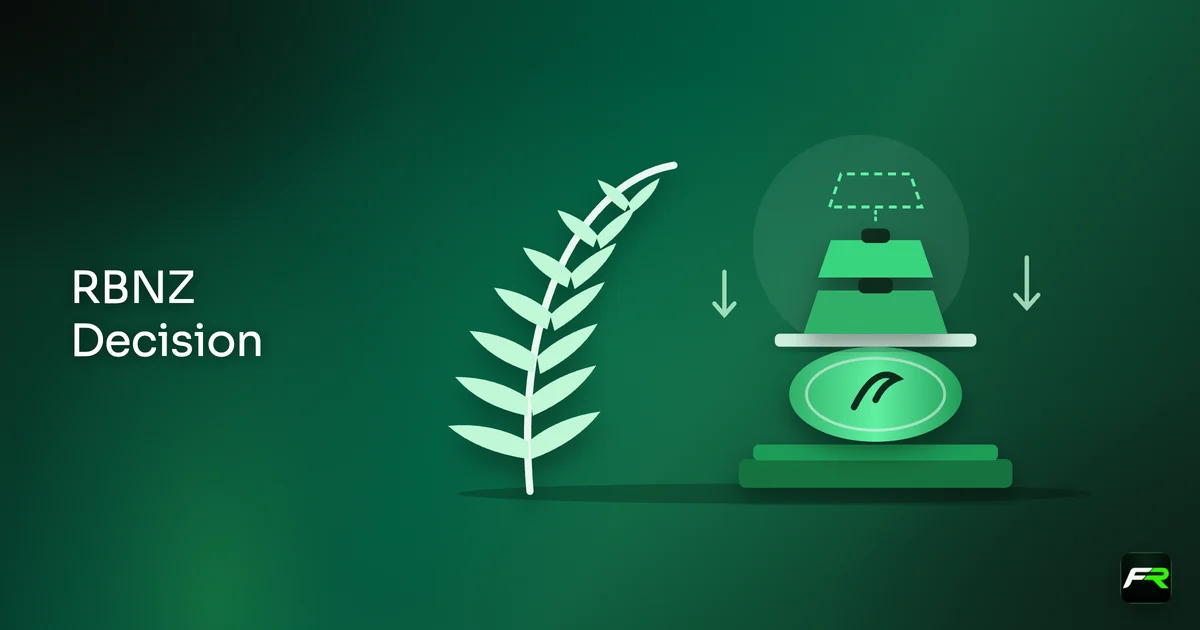
The Reserve Bank of New Zealand left its Official Cash Rate at 2.75% on Wednesday 28 October, but only just. Its Monetary Policy Committee “voted 4 - 3 to hold the OCR at 2.75 percent,” according to the bank's media release, and the three dissenting members wanted a 25 basis point rise to 3%. In September, by contrast, the committee had reached a consensus on its rise.
The message for currency traders is that the pause is not the end of tightening. The committee wrote that it “agreed that tighter monetary policy is likely to be required but remains conditional on the economic outlook.” Higher fuel prices and a weaker New Zealand dollar are expected to push annual inflation up again, to 4.4% in the December quarter, before the effect fades.
Wednesday's decision was a Monetary Policy Review, the shorter format without a full forecast round. It came out at 2pm New Zealand time, 01:00 UTC, half an hour after Australia's September inflation figures, and it puts the next move on 9 December, when the bank publishes a full Monetary Policy Statement.
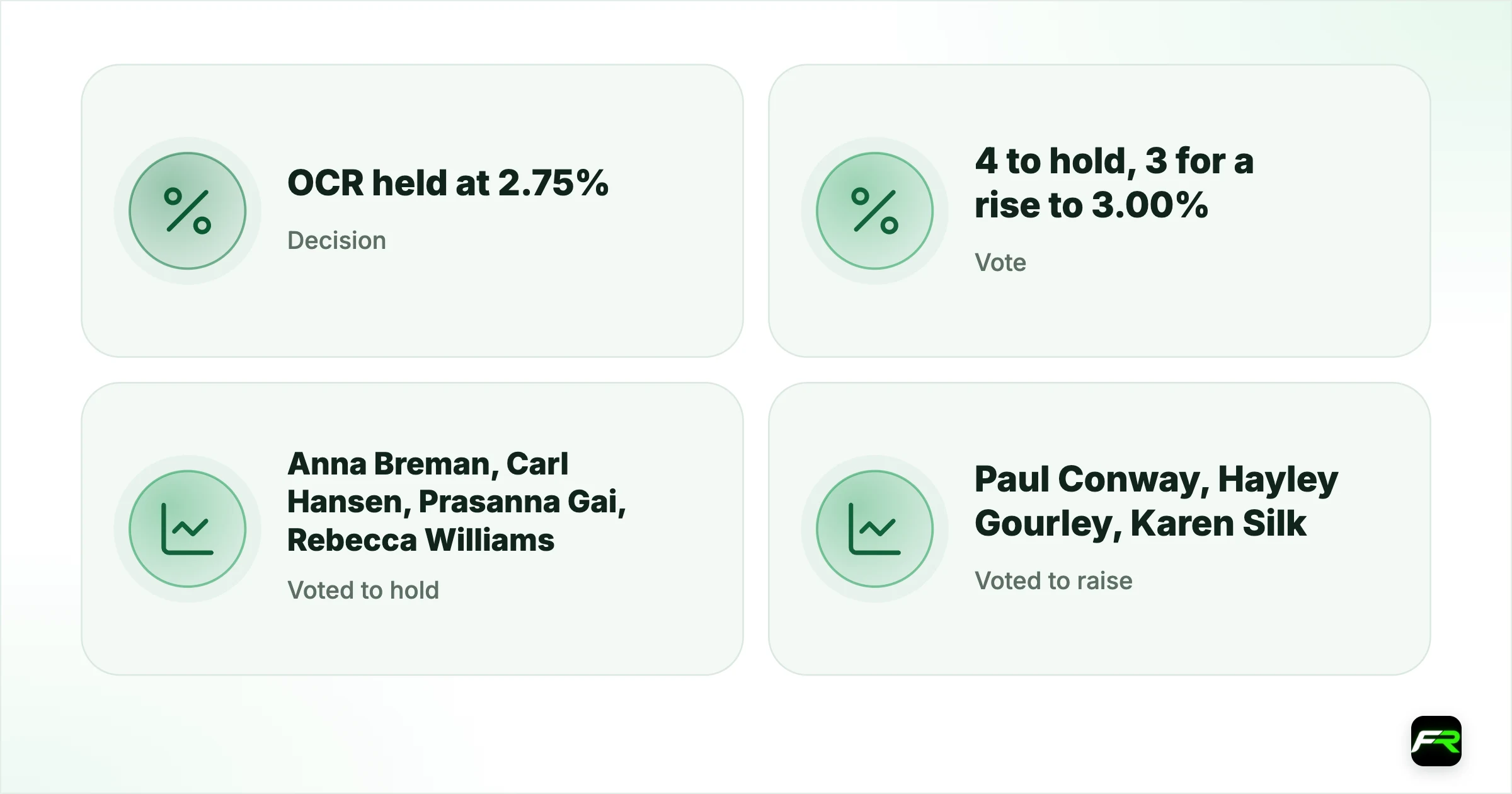
| Decision | OCR held at 2.75% |
|---|---|
| Vote | 4 to hold, 3 for a rise to 3.00% |
| Voted to hold | Anna Breman, Carl Hansen, Prasanna Gai, Rebecca Williams |
| Voted to raise | Paul Conway, Hayley Gourley, Karen Silk |
| CPI, September quarter | 3.7% a year (June quarter 4.1%) |
| Bank's December quarter forecast | 4.4% a year |
| Trade-weighted kiwi | Down about 3% since the September statement |
| Next decision | 9 December, with a Monetary Policy Statement |
What the RBNZ decided and why
Four members voted to keep the rate where it is. In the bank's words, they judged that “two recent OCR increases allow the Committee to take further time to assess their effects and economic developments.” Inflation came in lower than the bank had expected, wage growth has been subdued, and medium-term inflation expectations have stayed stable, so they saw room to wait.
Those four also stressed the weakness at home. Household consumption has been soft, employment growth is slow and house prices are still falling. According to the release, the aggregate saving rate is estimated at 3.7%, well above its 10-year average of 1%, a sign that families are holding back rather than spending. A further rise now, in their view, risked an even weaker recovery in spending and investment.
The release named the members on each side. Governor Anna Breman chaired the meeting and voted with Carl Hansen, Prasanna Gai and Rebecca Williams, who was appointed to the committee by the Minister of Finance on 24 September. Paul Conway, Hayley Gourley and Karen Silk voted for an increase to 3%.
Why three members wanted a third hike
The minority's case rested on core inflation. These members noted that core measures “have been above levels consistent with headline inflation at the target mid-point for some time,” which raises the risk that higher prices become built into how firms set prices and wages. They also gave more weight to the fact that overall growth has held up despite tough conditions for many households.
Their conclusion was blunt. “Acting now would guard against sustained inflation pressures and potentially reduce the risk of needing to do more with interest rates later,” the record says. They wanted the OCR raised to around the mid-point of the bank's estimated range for the neutral rate, the level that neither stimulates nor restrains the economy.
A 4-3 split is a sharp change from September's consensus. A narrow majority for holding, with all seven agreeing that more tightening is likely, leaves the December decision wide open.
The inflation outlook behind the split
Headline inflation fell to 3.7% in the September quarter from 4.1% in June, lower than the bank expected. Tradables inflation, the part of the basket driven by world prices, eased to 4.3% from 4.9%, while non-tradables inflation, which reflects domestic costs, was 3.3%. Excluding vehicle fuels, annual inflation rose to 3%.
The worrying detail for the hawks was breadth. On a weighted basis, 56% of items in the consumer price basket rose by more than 3% in the year to September, and the release says price increases have become more broad-based since the June quarter. Core inflation measures are around the top of the 1% to 3% target band.
Fuel is the main reason the bank expects a rebound. It forecasts annual inflation of 4.4% in the December quarter, “largely reflecting current futures prices for fuel,” and warned that near-term forecasts are uncertain because oil and refined fuel prices are so volatile. If fuel prices stabilise or fall, the direct effects would drop out of the annual figure in late 2027.
The bank also flagged risks on the other side. It warned that a global downturn “could occur abruptly” because of high debt, rising long-term yields and opaque financing of some AI investments. All members agreed that if the world economy turns sharply down, “this could alter the desired stance, including leading to monetary easing.” That two-way language is why the decision reads as cautious rather than simply hawkish.
What it means for the New Zealand dollar
The exchange rate is part of the story. The bank said the trade-weighted New Zealand dollar has fallen by about 3% since the September statement, which makes imports dearer and adds to inflation risk. A weaker currency was one of the reasons the RBNZ gave for raising rates earlier this year.
On the ECB's daily euro reference rates, NZD/USD, derived as a cross, was 0.5827 on the day of the September rise and 0.5703 on Tuesday 27 October, close to 2% lower. It had dropped as far as 0.5589 on 8 October before recovering. AUD/NZD, which compares the two antipodean currencies directly, rose from 1.2265 on 2 September to 1.2331 on 27 October.
Wednesday's reference rates are set around 14:15 CET, well after the decision, so the official record of the market's reaction will only appear later today. Live prices react straight away, and they can differ sharply from these daily rates, especially in thin Asian trading.
| What to watch | Hawkish sign | Dovish sign |
|---|---|---|
| December quarter CPI | Above the bank's 4.4% forecast | Below it, with core easing |
| Core inflation | Stays near the top of the 1% to 3% band | Falls back towards 2% |
| Kiwi exchange rate | Further fall adds to import prices | Stable or recovering currency |
| Global economy | Resilient growth, high energy costs | Sharp downturn, as the bank warned |
The table is our own summary of the risks the bank set out, not a forecast and not an RBNZ statement.
What it means for traders
A split vote with a tightening bias usually supports a currency more than a plain hold would, because markets keep pricing a chance of a rise at the next meeting. The weak domestic economy and the bank's talk of an abrupt global downturn pull the other way, so the kiwi may struggle to rally far on this decision alone.
- Watch how the market prices 9 December. The closer the three dissenters are to a majority, the more each data release matters.
- Compare the kiwi with the Aussie. Australian CPI rose to 4.3% in September, released 30 minutes before the RBNZ, so AUD/NZD carries both stories; see our Australian CPI story.
- Keep the Fed in view. The US decision at 18:00 UTC today can move NZD/USD more than the RBNZ did.
- Allow for wide spreads around New Zealand releases, which land in the quiet Asian session.
- Check upcoming New Zealand data and decisions in your own time zone on our economic calendar.
Suppose you want to buy NZD/USD at 0.5700, betting that the split vote keeps a December hike alive, with a stop 40 pips lower at 0.5660. On a $4,000 account with a 1% risk limit you can lose $40, so the position should be about 10,000 units, because each pip on that size is worth $1. If the Fed surprises later today and the spread widens to 4 pips, your real risk is closer to 44 pips, so trim the size or wait until after 18:00 UTC. The <a href="/position-size-calculator">position size calculator</a> works it out for you.
Our RBNZ preview sets out the background to this meeting, and the New Zealand CPI story covers the inflation data. Convert amounts with the currency converter.
Central bank decisions can move currencies sharply in seconds, and prices can gap past stop orders, especially in thin Asian trading. Leverage magnifies losses as well as gains, so trade only with money you can afford to lose.
The decision, the vote, the forecasts and every quotation come from the Reserve Bank of New Zealand's media release and summary record of meeting published on 28 October 2026. The appointment date is from the RBNZ's news page. Exchange rates are derived from ECB euro reference rates. The watch table is FX Recap's own summary. This is news, not investment advice.
Frequently asked
Did the RBNZ change interest rates in October 2026?
No. On 28 October 2026 the Reserve Bank of New Zealand held the Official Cash Rate at 2.75%. The Monetary Policy Committee voted 4 to 3, with three members wanting a rise to 3%.
Who voted for an RBNZ rate rise?
Paul Conway, Hayley Gourley and Karen Silk voted for a 25 basis point increase to 3%. Anna Breman, Carl Hansen, Prasanna Gai and Rebecca Williams voted to hold, according to the bank's record of the meeting.
Will the RBNZ raise rates in December?
The bank has not committed. All members agreed that tighter monetary policy is likely to be required, but said it remains conditional on the outlook. The next decision is on 9 December with a full Monetary Policy Statement.
What does the RBNZ decision mean for the New Zealand dollar?
A narrow hold with a tightening bias keeps a December rise in play, which can support the kiwi. Weak household spending and the bank's warning about a possible global downturn limit that support.
Sources: Reserve Bank of New Zealand: OCR held at 2.75% (28 October 2026) · Reserve Bank of New Zealand: The official cash rate (OCR) · Reserve Bank of New Zealand: New Monetary Policy Committee member appointed · European Central Bank: euro foreign exchange reference rates · Reserve Bank of New Zealand: Past monetary policy decisions
The team behind this guide
Researched, checked and approved by five forex specialists
Every guide is written, fact-checked and edited before it goes live, and updated when the facts change. Spotted an error? Tell us.