IC Markets

 3:09
 2:39
 2:10
 2:18
 3:43
 8:42



































Fed Holds Rates at 3.75% to 4.00% as Two Officials Vote for Another Hike
Lisa Cook and Beth Hammack wanted a quarter-point rise. Chair Warsh called inflation too high, so December stays live for the dollar.
 WriterAbir KhanWriterWrites the guides · checks every figure against primary sources View profileAbout Abir →

 Market analysisTanbir Habib RiyadForex & Crypto AnalystForex and crypto analyst · technical and fundamental analysis View profileAbout Tanbir →

 Fact-checking & riskJannatul FerdaushFact-Checker & Risk AnalystFact-checks every figure · risk analysis · Applied Statistics, University of Dhaka View profileAbout Jannatul →

 Trading reviewJowel RanaCo-Founder & Forex TraderCo-founder · forex trader · reviews guides from a trader's view View profileAbout Jowel →

 Final approvalRanjan NiskrityFounder, Owner & Forex TraderFounder and owner · forex trader · signs off every guide View profileAbout Ranjan →

The Federal Reserve kept its policy rate unchanged on Wednesday 28 October, leaving the target range for the federal funds rate at 3.75% to 4.00%. It was not a unanimous decision. Two of the twelve voters, Governor Lisa D. Cook and Cleveland Fed President Beth M. Hammack, “preferred to raise the target range for the federal funds rate by 1/4 percentage point at this meeting,” according to the statement released at 14:00 New York time, 18:00 UTC.
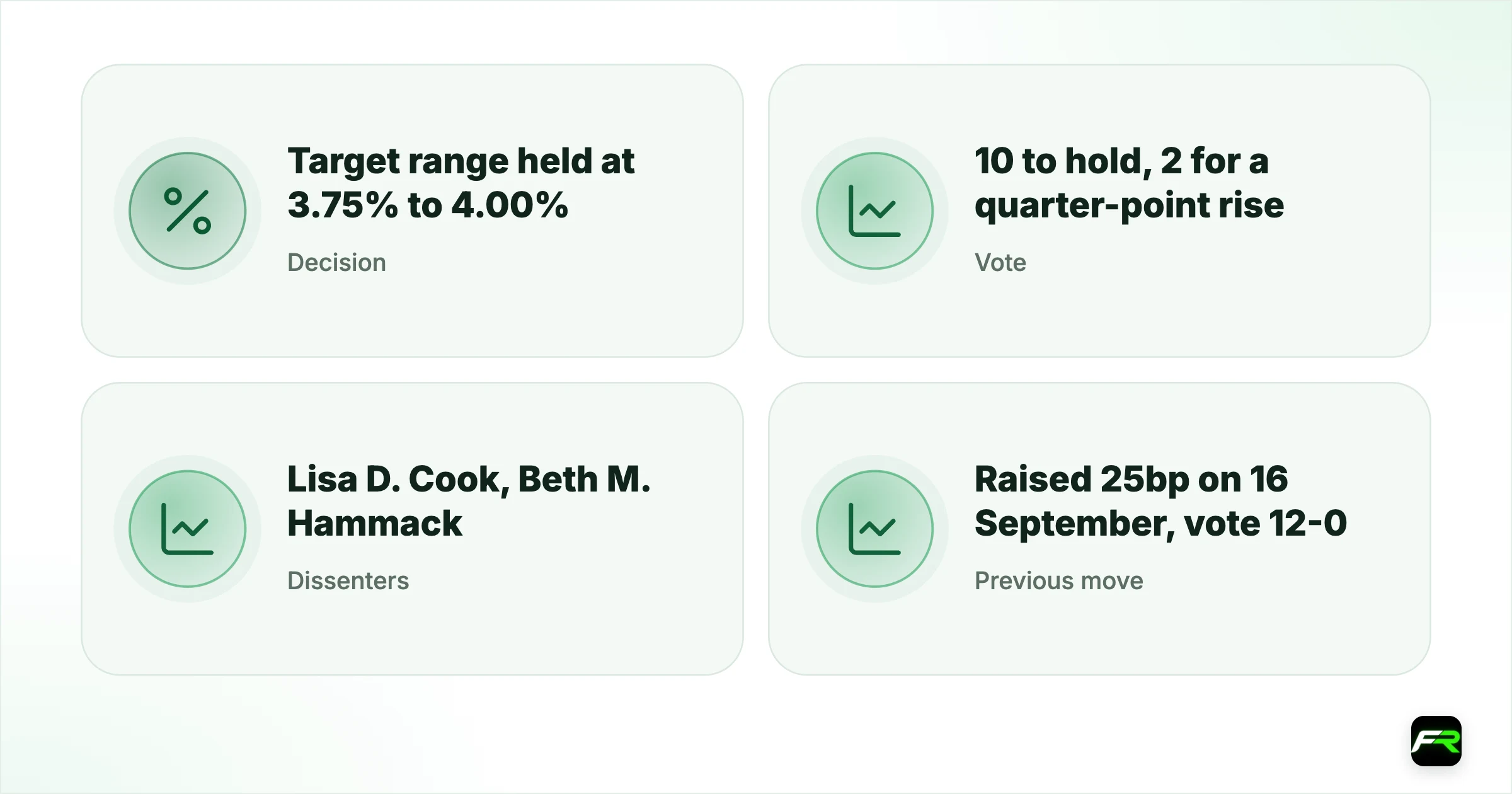
Six weeks earlier, all twelve members had backed a quarter-point rise. A 10-2 split in favour of waiting, with both dissenters asking for more tightening, tells currency traders that the next move is still more likely to be up than down. Chair Kevin Warsh kept that message in his press conference: “inflation is too high,” he said, and the committee will “deliver price stability.”
The pause came with a change in the statement's forward-looking sentence. In September the Fed said its rise “will support a timelier return” to 2% inflation. This time it wrote that “the accumulation of more information will help the Committee determine the policy stance appropriate” to get there, which leaves the 9 December meeting open.
| Decision | Target range held at 3.75% to 4.00% |
|---|---|
| Vote | 10 to hold, 2 for a quarter-point rise |
| Dissenters | Lisa D. Cook, Beth M. Hammack |
| Previous move | Raised 25bp on 16 September, vote 12-0 |
| Interest on reserve balances | 3.90%, effective 29 October |
| Overnight reverse repo rate | 3.75% |
| Standing repo and primary credit rate | 4.0% |
| Next decision | 9 December, with new projections |
What the Fed decided and how the statement changed
Most of the statement repeats September's structure, but several words moved. Economic activity is now described as “expanding at a strong pace”, an upgrade from “a solid pace” last month. The committee added that “productivity growth is strong, and capital investment is robust,” and said uncertainty “remains elevated owing, in part, to geopolitical developments.” Job gains “have kept pace with the workforce” and unemployment “has changed little.”
Inflation got a single short line: “Inflation remains elevated.” Paired with the stronger description of growth, that wording gives little sign that officials think their tightening is complete. A central bank that sees fast growth and high inflation, and still pauses, is usually buying time to check the data rather than ending a cycle.
Operational settings were left in line with the target range. The Implementation Note keeps the interest paid on reserve balances at 3.90% from 29 October, the overnight reverse repo offering rate at 3.75% and the standing repo rate at 4.0%. Meanwhile, the New York Fed's desk will keep buying Treasury bills, and if needed other Treasuries with up to three years to maturity, to maintain an ample level of reserves.
Why two officials wanted a rise
The statement does not explain the dissents beyond saying what Cook and Hammack preferred, and Fed officials usually set out their reasons in later speeches or statements. What can be said is that a dissent in favour of a hike, one meeting after a rise, is a clear signal. It shows that part of the committee thinks the September step was not enough with inflation still well above target.
Warsh's opening remarks give the background. He said Americans are “still dealing with inflation that has been running above the Committee's objective for close to 6 years,” and that the meeting “focused mainly on the price stability side of our remit.” He added that “energy and related prices have moved higher again in recent weeks,” and that the Fed's task is to stop those increases from spreading across the economy and to keep inflation expectations anchored.
The minutes of this meeting, due in about three weeks, should show how many non-voting officials shared the dissenters' view. Hawkish minutes would add to the case for a December rise even before the next round of data.
What Warsh said about growth and financial conditions
The Chair painted a strong economy. He said growth in the first half of the year had been revised up to 2.4% from an earlier estimate of 1.8%, and that the third quarter “appears to have brought an even more rapid advance,” led by consumer spending and business investment. High-tech investment is leading, he said, but other categories are broadening too.
He called the labour market “quite positive.” The jobless rate is lower than a year ago, he said, payroll growth is above last year's pace, and the four-week average of unemployment insurance claims is running at “the lowest level in generations.”
On markets, his comments were measured. Since September, financial and credit conditions have tightened for some businesses and households, “much as we would expect.” Even so, he said: “while overall financial conditions are tighter, I'm unwilling and unable to call them tight.” For traders that line matters, because it suggests the recent rise in bond yields has not done the Fed's work for it.
Warsh also announced a change to the meeting format. The committee will keep eight meetings a year, but in 2027 one of them “will focus exclusively on broad monetary policy strategy,” with no rate vote or statement expected. He said he expects two such strategy meetings in 2028 and six policy meetings. Traders should mark that 2027 will have only seven scheduled rate decisions once the Fed confirms which meeting is affected.
How the dollar and yields stood
The ECB's euro reference rate for EUR/USD was 1.1133 on Wednesday, set at about 13:15 UTC, almost five hours before the Fed spoke. That compares with 1.1150 on Tuesday and 1.1537 on 16 September, the day of the last Fed rise, so the dollar had already firmed by more than 3% against the euro in the run-up. USD/JPY, derived from the same rates, was 157.96.
Treasury yields moved in two directions on the day, according to the US Treasury's daily par yield curve. The 2-year yield, the maturity most closely tied to Fed expectations, slipped to 4.67% from 4.70%, while the 10-year rose to 5.05% from 4.99%. Our separate Treasury curve story looks at that steepening in detail.
Thursday's reference rates, published around 14:15 CET, will be the first official daily record that includes the Fed's decision. Live prices on our analysis pages update in real time and will differ from these daily figures.
What it means for traders
A hold with two hawkish dissents is close to the middle scenario in our Fed preview: no move now, but a clear signal that December is live. That tends to support the dollar on dips, while leaving it exposed to soft data. Four big events follow within days, so positions taken on the Fed alone can be overtaken quickly.
- Thursday 29 October, 12:30 UTC: the Bureau of Economic Analysis publishes the first estimate of third-quarter GDP and the September PCE price index, the Fed's preferred inflation gauge. Strong figures would add weight to the dissenters.
- Thursday 29 October, 13:15 UTC: the ECB decides, 45 minutes later. EUR/USD can swing on both events within an hour; see our ECB preview.
- Friday 30 October: the Bank of Japan ends its meeting with no fixed announcement time; our BoJ preview covers the yen risk.
- Watch Fed speeches in the next two weeks, especially from Cook and Hammack, for the reasons behind their votes.
- Keep stops wider than usual around 12:30 and 13:15 UTC, when spreads widen and prices can gap.
Suppose you sell EUR/USD at 1.1130 ahead of Thursday's data, expecting the hawkish Fed tone to keep the dollar firm, with a stop at 1.1190, 60 pips away. On a $6,000 account with a 1% risk limit you can lose $60, so the trade size is 10,000 units, where one pip is worth $1. Two events within 45 minutes can each move the pair by more than that, so you might halve the size or wait until after 13:15 UTC. The <a href="/position-size-calculator">position size calculator</a> does the maths.
Daily levels for the main dollar pairs are on our EUR/USD analysis and USD/JPY analysis pages. Times for every release, in your own time zone, are on the economic calendar.
Rate decisions and the data around them can move currencies sharply in seconds, and prices can gap past stop orders. Leverage magnifies losses as well as gains, so trade only with money you can afford to lose.
The decision, the vote and the statement wording come from the Federal Reserve's statement of 28 October 2026 and its Implementation Note. Quotes from Chair Warsh come from the Fed's preliminary transcript of his opening statement. September wording is from the 16 September statement. Exchange rates are ECB euro reference rates; yields are from the US Treasury's daily par yield curve. This is news, not investment advice.
Frequently asked
Did the Fed raise rates in October 2026?
No. On 28 October 2026 the Federal Reserve held the federal funds target range at 3.75% to 4.00%. The vote was 10 to 2, and both dissenters wanted a quarter-point rise.
Who dissented at the October 2026 Fed meeting?
Governor Lisa D. Cook and Cleveland Fed President Beth M. Hammack voted against the decision. They preferred to raise the target range by a quarter of a percentage point.
When is the next Fed decision?
The next FOMC decision is on 9 December 2026. It comes with a new Summary of Economic Projections, including the officials' rate forecasts.
What did the Fed change about its meetings?
Chair Warsh said the Fed keeps eight meetings a year, but in 2027 one will be devoted to monetary policy strategy, with no rate vote or statement expected. He expects two such meetings in 2028.
Sources: Federal Reserve: FOMC statement, 28 October 2026 · Federal Reserve: Implementation Note, 28 October 2026 · Federal Reserve: Chair's press conference, 28 October 2026 · US Treasury: daily par yield curve rates · Federal Reserve: FOMC statement, 16 September 2026 · European Central Bank: euro foreign exchange reference rates
The team behind this guide
Researched, checked and approved by five forex specialists
Every guide is written, fact-checked and edited before it goes live, and updated when the facts change. Spotted an error? Tell us.