IC Markets

 3:09
 2:39
 2:10
 2:18
 3:43
 8:42





































Bank of England Preview: Three Voted for a Rise in September and Four More Said One Could Come
Six members held Bank Rate at 3.75% in September, yet most of them warned that a longer energy shock would make tightening likely. Thursday tests it.
 WriterAbir KhanWriterWrites the guides · checks every figure against primary sources View profileAbout Abir →

 Market analysisTanbir Habib RiyadForex & Crypto AnalystForex and crypto analyst · technical and fundamental analysis View profileAbout Tanbir →

 Fact-checking & riskJannatul FerdaushFact-Checker & Risk AnalystFact-checks every figure · risk analysis · Applied Statistics, University of Dhaka View profileAbout Jannatul →

 Trading reviewJowel RanaCo-Founder & Forex TraderCo-founder · forex trader · reviews guides from a trader's view View profileAbout Jowel →

 Final approvalRanjan NiskrityFounder, Owner & Forex TraderFounder and owner · forex trader · signs off every guide View profileAbout Ranjan →

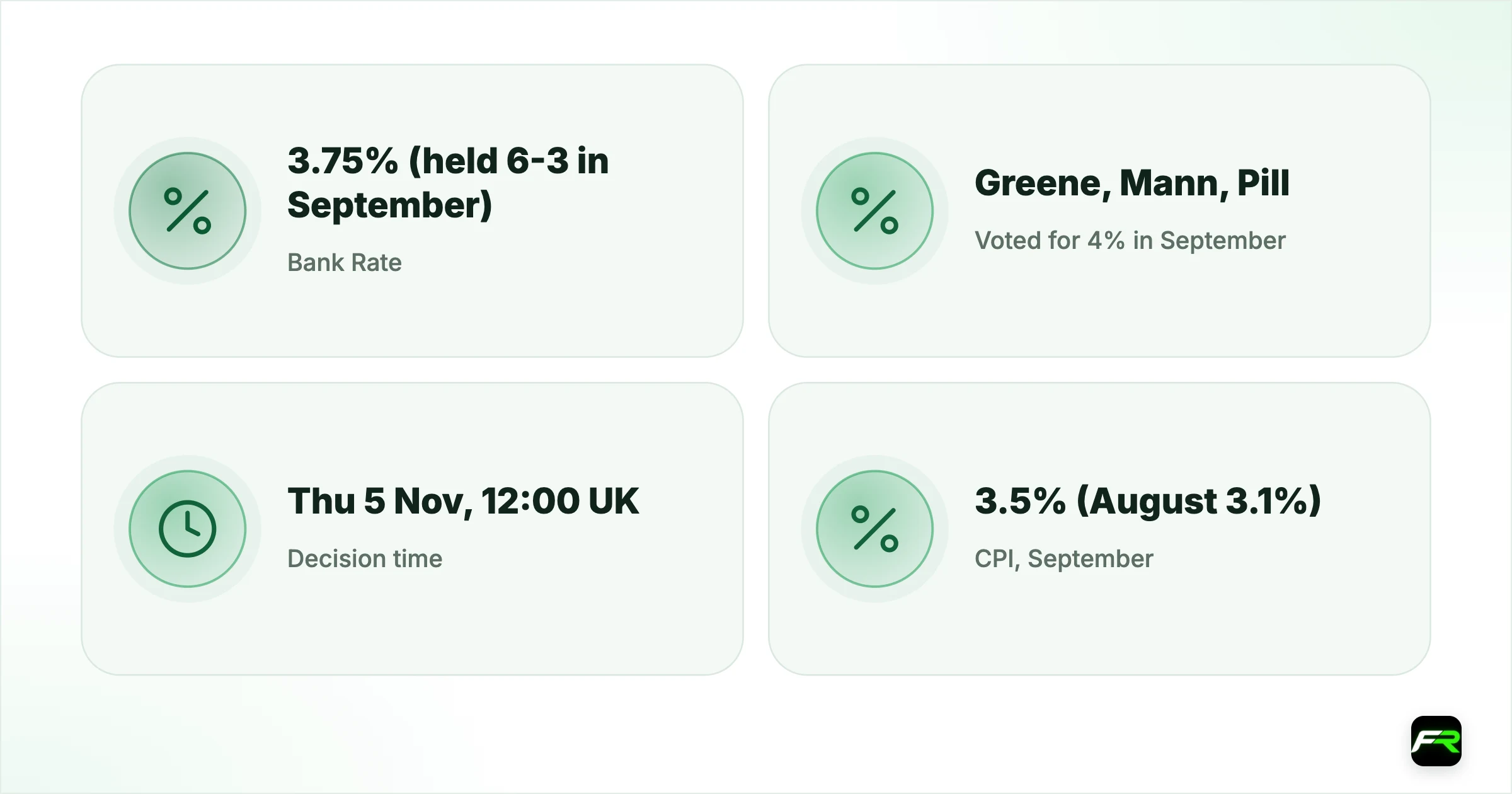
The Bank of England announces its next decision at 12:00 UK time on Thursday 5 November, which is also 12:00 UTC, together with the November Monetary Policy Report and its new forecasts. Bank Rate is 3.75%. At the previous meeting, which ended on 16 September, the Monetary Policy Committee held by six votes to three, with Megan Greene, Catherine Mann and Huw Pill voting to raise it to 4%.
The split only tells half the story. In the minutes, each of the nine members explains their vote, and four of the six who held wrote that a rise could become necessary if energy prices stayed high. That makes the individual statements more useful than the headline vote for anyone trying to judge how close the committee is to a move.
We do not forecast the outcome. Below we set out what each member said in September, the data published since, and where sterling stands before Thursday.
| Bank Rate | 3.75% (held 6-3 in September) |
|---|---|
| Voted for 4% in September | Greene, Mann, Pill |
| Decision time | Thu 5 Nov, 12:00 UK (12:00 UTC) |
| CPI, September | 3.5% (August 3.1%) |
| Services CPI, September | 3.7% (August 3.4%) |
| Unemployment, June to August | 4.7% |
| GBP/USD reference rate | 1.3399 on 30 October (derived from ECB rates) |
| Following decision | Thu 17 December |
How the nine members lined up in September
The official summary said risks to the inflation outlook were “tilted to the upside, and more so than at the time of the July Monetary Policy Report,” and that the committee “stands ready to act as necessary.” Behind that shared line, the members' own words show a committee spread across three groups.
Three wanted a rise straight away. Mann argued that “raising Bank Rate is a better risk-management strategy when faced with uncertainty about inflation dynamics and second-round effects.” Greene warned that “waiting for definitive evidence of second-round effects before acting would leave policy behind the curve.” Pill said an increase “sends a clear signal of the MPC's commitment to achieving its price stability mandate amidst the fog of geopolitical conflict and data noise.”
Four of the six who held left the door open. Governor Andrew Bailey wrote that if the Middle East conflict persists for an extended period, “as appears to be the case,” and the risk of second-round effects grows, “it is likely that policy may have to tighten.” Clare Lombardelli said “the case for raising Bank Rate is building the longer the conflict continues without lasting resolution.” Sarah Breeden wrote that if those risks crystallise, “it becomes increasingly appropriate for Bank Rate to respond,” and Dave Ramsden said there “could be a case for increasing Bank Rate” if upside pressures kept building.
Two members argued for patience. Swati Dhingra saw “value in waiting for a clearer read on the durable scale of the shock over the coming months.” Alan Taylor said further tightening “is not warranted at present,” put his estimate of the neutral rate at 3%, and added that if tensions ease, “an easing of policy should be in sight.”
| Member | September vote | Stated view |
|---|---|---|
| Greene, Mann, Pill | Raise to 4% | Act now as risk management |
| Bailey, Lombardelli | Hold | A rise likely or building if the shock lasts |
| Breeden, Ramsden | Hold | A rise could be needed if risks build |
| Dhingra, Taylor | Hold | Wait for evidence of second-round effects |
The groupings are our reading of each member's published statement, not labels the Bank uses.
What the Bank expected inflation to do
Based on energy prices at the close on 14 September, Bank staff expected CPI inflation to rise to around 3¾% in the fourth quarter of 2026 and to slightly above 4% in the first quarter of 2027. Ofgem's energy price cap for October to December was set at £1,723, higher than the Bank had assumed in July. Those numbers matter because Mann and Greene both warned that high, visible energy and food inflation makes households and firms pay closer attention to prices.
Wage signals were mixed. Private sector regular pay growth was 2.9% in the three months to July, but the Bank judged underlying private pay growth at around 3½% once pay settlements and tax data were included. Firms in the Decision Maker Panel expected one-year-ahead wage growth of 3.4%, unchanged since before the conflict began. Food was a pleasant surprise: the Bank's Agents now expected food inflation of around 4% at the end of 2026, against 6% to 7% expected in April.
The committee also settled its bond sales plan in September. It voted unanimously to run the stock of gilts held for monetary policy down to zero by the end of 2034, at an average pace of £46 billion a year, with £20 billion of sales a year alongside maturing bonds. That plan is meant to stay in place, so Thursday's decision is about Bank Rate alone.
What the data have said since
Inflation came in above the Bank's September path. The Office for National Statistics reported on 21 October that CPI rose 3.5% in the 12 months to September, up from 3.1%, with petrol and diesel at their highest since 2022. Core inflation rose to 2.8% from 2.6%, and services inflation, the figure many members watch for domestic pressure, climbed to 3.7% from 3.4%. Our UK inflation story has the breakdown.
Jobs gave both camps something. Unemployment fell to 4.7% in the three months to August from 4.9% a month earlier, which fits Greene's view that slack “may have already peaked.” Vacancies, though, dropped by 21,000 to 691,000, and growth in total pay slowed to 3.7%, the weakest since late 2020. The details are in our UK jobs report.
Abroad, the Federal Reserve held on 28 October with two votes for a rise, the Bank of Canada raised its rate the same day, and the ECB held on 29 October after debating an increase. Several central banks are now weighing the same energy shock, which is one reason markets watch the Bank of England's vote count so closely.
What to read on Thursday
- The vote first. Any member moving from hold to raise would show the four conditional voices turning into votes. A five-four vote for a hold, or a rise itself, would change expectations for 17 December.
- The inflation projections in the Monetary Policy Report, especially the peak early in 2027 and how far above 2% inflation sits two years out.
- Wording on second-round effects. September's summary said there was “little evidence so far” of them. A change to that phrase would matter more than most other edits.
- Individual statements in the minutes. Bailey's wording carries the most weight, given that his September view already called a rise likely if the conflict persisted.
Where sterling stands
Sterling has gained ground since the September meeting, mostly against the euro. Using ECB reference rates, EUR/GBP fell from 0.8583 on 17 September to 0.8338 on 30 October, a drop of almost 3% that leaves the pound worth more in euros. GBP/USD moved far less, from 1.3376 to 1.3399, because the dollar also gained against the euro over the same weeks.
Over the past 20 working days GBP/USD has ranged between 1.3205 on 7 October and 1.3402 on 21 October on reference rates, and Friday's 1.3399 sits at the top of that range and above both its 20-day average of 1.3298 and its 50-day average of 1.3383. The 60-day high is 1.3656. Our GBP/USD analysis turns those figures into levels and updates on Monday.
Sterling near recent highs into a meeting can cut both ways. A rise, or a vote that shifts towards one, may already be partly reflected. If the Bank holds with an unchanged split, buyers could be disappointed. The US productivity release arrives at 13:30 UTC, ninety minutes after the Bank, so dollar moves can follow quickly.
Suppose you buy GBP/USD at 1.3400 after the decision, with a stop at 1.3340, 60 pips away, on a $6,000 account risking 1%. You can lose $60, so each pip can be worth $1, which is about 10,000 units. If prices jump and your stop fills 30 pips late, the loss is about $90 instead. Our <a href="/position-size-calculator">position size calculator</a> handles the sizing, and the <a href="/forex-economic-calendar">economic calendar</a> shows 12:00 UTC in your own time zone.
Rate decisions can move sterling sharply and prices can gap past stop orders. Leverage magnifies losses as well as gains, so trade only with money you can afford to lose.
Quotations and forecasts come from the Bank of England's Monetary Policy Summary and minutes for the meeting ending 16 September 2026. Inflation and labour market figures are from the Office for National Statistics. GBP/USD and EUR/GBP are ECB euro reference rates or derived from them (EUR/USD ÷ EUR/GBP). This is news, not investment advice.
Cite this guide
FX Recap, "Bank of England Preview: Three Voted for a Rise in September and Four More Said One Could Come", updated 1 November 2026, https://fxrecap.com/forex-news/top-stories/bank-of-england-november-2026-decision-preview
Free to quote with a link. Journalists: data and comment in our press room.
Frequently asked
When is the Bank of England's November 2026 decision?
On Thursday 5 November 2026 at 12:00 UK time, which is 12:00 UTC, with the November Monetary Policy Report. The next decision after that is on 17 December.
How did the Bank of England vote in September 2026?
The Monetary Policy Committee held Bank Rate at 3.75% by six votes to three. Megan Greene, Catherine Mann and Huw Pill voted to raise it to 4%.
Did Andrew Bailey say rates could rise?
In the September minutes Bailey wrote that if the Middle East conflict persists for an extended period and the risk of second-round effects increases, it is likely that policy may have to tighten. He voted to hold at that meeting.
What inflation did the Bank of England expect?
Based on energy prices on 14 September, it expected CPI inflation of around 3¾% in the fourth quarter of 2026 and slightly above 4% in early 2027. September CPI came in at 3.5%.
Sources: Bank of England: Monetary Policy Summary and minutes, September 2026 · Bank of England: upcoming MPC dates · Office for National Statistics: Consumer price inflation, UK, September 2026 · Office for National Statistics: Labour market overview, UK, October 2026 · ECB: euro foreign exchange reference rates
The team behind this guide
Researched, checked and approved by five forex specialists
Every guide is written, fact-checked and edited before it goes live, and updated when the facts change. Spotted an error? Tell us.