IC Markets





































Position Sizing on a $5,000 Account: The Exact Math
The 1% risk rule with real numbers: how to turn a stop distance in pips into a lot size, worked through for USD/JPY, EUR/USD and gold on a $5,000 account.
 WriterAbir KhanWriterWrites the guides · checks every figure against primary sources View profileAbout Abir →
 Market analysisTanbir Habib RiyadForex & Crypto AnalystForex and crypto analyst · technical and fundamental analysis View profileAbout Tanbir →
 Fact-checking & riskJannatul FerdaushFact-Checker & Risk AnalystFact-checks every figure · risk analysis · Applied Statistics, University of Dhaka View profileAbout Jannatul →
 Trading reviewJowel RanaCo-Founder & Forex TraderCo-founder · forex trader · reviews guides from a trader's view View profileAbout Jowel →
 Final approvalRanjan NiskrityFounder, Owner & Forex TraderFounder and owner · forex trader · signs off every guide View profileAbout Ranjan →
Position sizing is the one calculation that separates traders who last from traders who do not, and it takes 30 seconds once you know the steps. The goal is simple: no matter what the trade is, if the stop gets hit you lose the same small, planned amount. On a $5,000 account that amount should be $50 to $100 per trade, one to two per cent. Everything else follows from that.
The order of operations matters. Beginners decide the position size first and let the risk fall out of it, which is how a trade ends up costing 20 per cent of the account. Do it the other way: risk first, stop second, size last.
The three steps
- Risk amount. One per cent of $5,000 is $50. Use that as your default.
- Stop distance. Decide where the stop goes based on the chart, a level, a swing point, or an ATR multiple. Measure the distance from your entry to the stop in pips (or dollars for gold).
- Position size. Divide the risk amount by the stop distance times the pip value per lot. That gives you the lot size that makes the stop-out cost exactly your risk amount.
Worked example: EUR/USD
You want to short EUR/USD with a 25-pip stop. Risk is $50. On EUR/USD, one standard lot (100,000 units) is worth about $10 per pip, so a mini lot (10,000) is $1 per pip and a micro lot (1,000) is $0.10 per pip. You need the position where 25 pips equals $50, which means $2 per pip. That is 0.20 lots. If the stop is hit, you lose 25 pips times $2, which is $50, exactly one per cent.
Worked example: USD/JPY
USD/JPY, 40-pip stop, $50 risk. On USD/JPY a standard lot is $6.70 per pip at current rates, so a mini lot is about $0.67. You need 40 pips to equal $50, which is $1.25 per pip. That is about 0.19 lots, call it 0.18 to be safe. A 40-pip stop-out costs around $48. Note the position is smaller than the EUR/USD example because the stop is wider.
Worked example: GBP/USD
GBP/USD, 30-pip stop, $50 risk. One standard lot (100,000 units) moves $10 per pip, since a pip is 0.0001 and the quote currency is USD. A 0.10-lot position is $1 per pip, or $30 at risk over a 30-pip stop. You need the 30-pip adverse move to equal $50, so you need $50 / 30 = a $1.67 per pip, which is 0.167 lots. Round down to 0.16 lots ( $48 risk) rather than up to 0.17 ($51), so you never exceed your limit. Stops on GBP/USD are usually tighter in dollar terms than gold, so position sizes come out larger, but the same formula applies:
Lots = risk ($) ÷ (stop in pips × $10)
Also note that the spread and slippage add to your real risk, so leave a small buffer.
A correction to the gold example you pasted: the $50 risk and $30 stop are right, but the lot size is off by 10x. Since 1 lot moves $100 per $1, you need $1.67 per $1 move, which is 1.67 ÷ 100 = 0.0167 lots (0.02 lots), not 0.17. On a cent account or a broker with 0.01 minimum lots, that is the number to use. The 0.17 figure is actually what the GBP/USD calculation gives.
Worked example: gold
Gold, $30 stop (300 ‘points’ if your platform quotes cents), $50 risk. In gold, one lot (100 ounces) moves $100 per $1 of price, so $1 per cent per ounce. A 0.10-lot position is $10 per $1 move, or $0.10 per cent. You need $30 of adverse move to equal $50, which is $1.67 per $1 move, so about 0.17 lots. Gold’s wide stops always force the position size down, which is a protection on a volatile market.
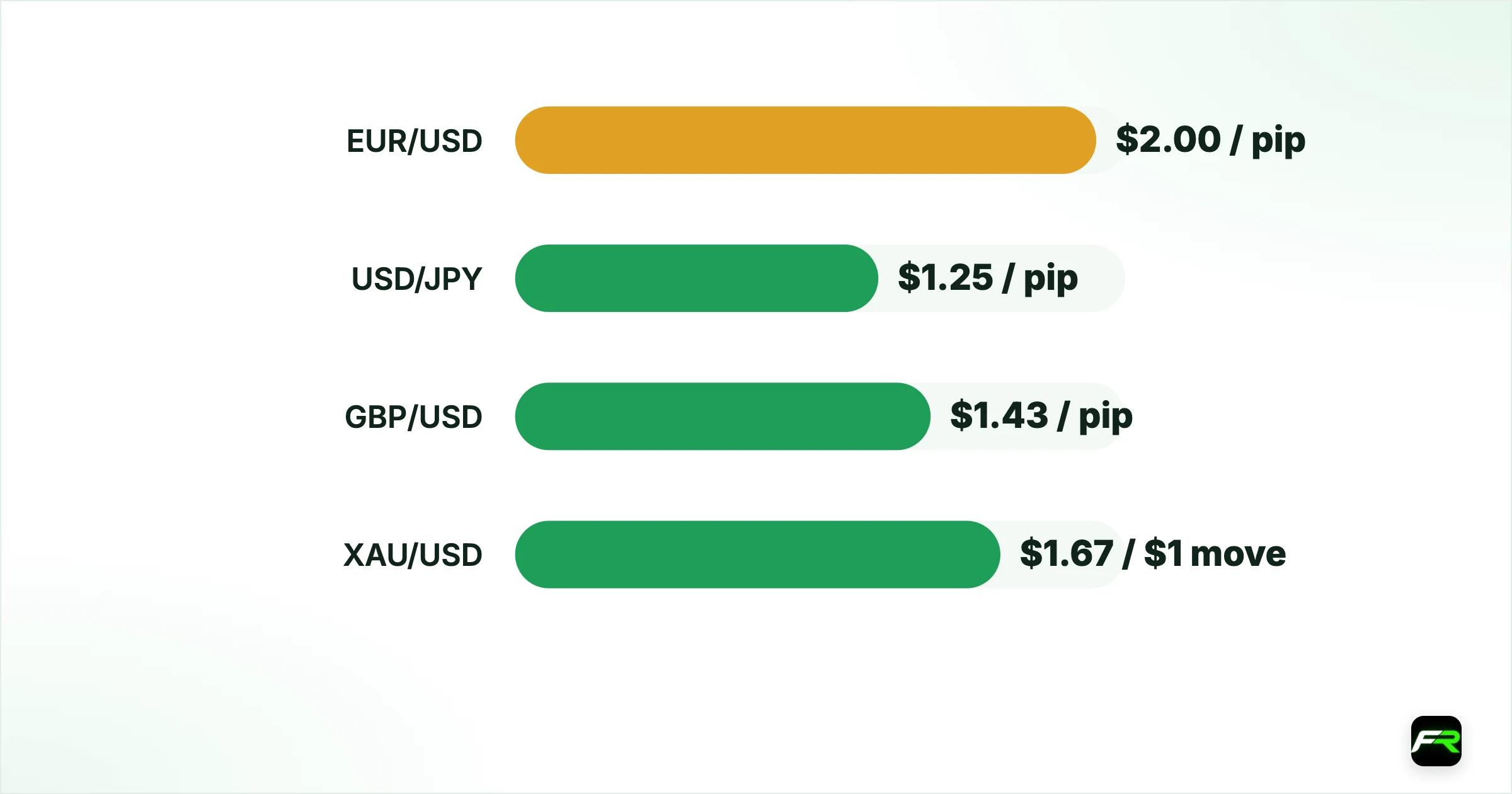
| Pair | Stop | Risk | Approx pip/point value needed | Lot size |
|---|---|---|---|---|
| EUR/USD | 25 pips | $50 | $2.00 / pip | 0.20 |
| USD/JPY | 40 pips | $50 | $1.25 / pip | 0.18 |
| GBP/USD | 35 pips | $50 | $1.43 / pip | 0.14 |
| XAU/USD | $30 | $50 | $1.67 / $1 move | 0.17 |
Why 1% and not 5%
A strategy with a positive edge still produces losing streaks of six, seven, eight trades. At one per cent risk, an eight-loss streak is an eight per cent drawdown: recoverable, and the strategy keeps working. At five per cent risk, the same streak is a 34 per cent drawdown, which needs a 52 per cent gain to recover and often triggers panic decisions long before that. The drawdown recovery guide shows the full table. One per cent is not cautious. It is the level at which a normal losing streak is survivable.
Margin Call
A margin call is a warning from your broker that your account equity has fallen too low to support your open positions. When you trade with leverage, the broker requires you to keep a minimum amount of your own money in the account as collateral. This is called the margin. If your losing trades eat into your balance and your equity drops below the required level, the broker “calls” for more funds or forces you to reduce your risk.
How it works:
- Used margin is the money locked to keep your open trades running.
- Free margin is the equity left over that you can use to open new trades.
- Margin level is (Equity ÷ Used Margin) × 100. Most brokers send a margin call warning when this falls to around 100%.
- Stop out is the level where the broker starts closing your positions automatically, usually starting with the biggest loser. Common stop-out levels are 20% to 50%, depending on the broker.
Simple example: You deposit $1,000 and open a large gold position that locks $500 as used margin. Your margin level is 200%. If the trade loses $500, your equity falls to $500, so your margin level drops to 100% and you get a margin call. If losses continue and the level reaches the broker’s stop-out, your position is closed automatically.
How to avoid a margin call:
- Risk only 1% or less of your account per trade.
- Always use a stop loss.
- Avoid over-leveraging, and size your lots using the risk formula (lot size = risk ÷ stop distance).
- Keep extra free margin, especially on volatile instruments like gold.
- Avoid holding large positions through major news such as NFP, Fed, or CPI.
Frequently asked
What is the fastest way to size a position?
Lot size = risk amount / (stop in pips x pip value per lot). Most platforms and many free tools have a position size calculator that does this for you; enter the risk, the stop and the pair.
Should I use a fixed dollar risk or a fixed percentage?
A fixed percentage of the current balance is standard. It scales down after losses (protecting a shrinking account) and up after gains (compounding). Some traders use a fixed dollar amount for simplicity on a stable account.
Does the leverage setting change my position size?
No. Position size is set by your risk and your stop. Leverage only affects how much margin the position uses. If correct sizing needs more leverage than 1:30, the position is too big.
What if my broker’s minimum lot size is bigger than my calculated size?
Then your stop is too tight for your account, or your account is too small for that pair. Widen the stop, choose a less volatile pair, or trade a broker offering micro lots (0.01).
How do I size for gold when it is quoted in cents?
Work in dollars of price movement. One lot of gold is 100 ounces, so a $1 move in the price is $100 on a 1-lot position. Scale from there: 0.10 lots is $10 per $1 move.
Related reading
The team behind this guide
Researched, checked and approved by five forex specialists
Every guide is written, fact-checked and edited before it goes live, and updated when the facts change. Spotted an error? Tell us.