IC Markets





































Why the Tokyo Session Has Thinner Liquidity Than You Think
Asian-hours forex turnover is a modest share of the global total, so spreads can widen and fills worsen at times. What to expect in Tokyo.
 WriterAbir KhanWriterWrites the guides · checks every figure against primary sources View profileAbout Abir →
 Market analysisTanbir Habib RiyadForex & Crypto AnalystForex and crypto analyst · technical and fundamental analysis View profileAbout Tanbir →
 Fact-checking & riskJannatul FerdaushFact-Checker & Risk AnalystFact-checks every figure · risk analysis · Applied Statistics, University of Dhaka View profileAbout Jannatul →
 Trading reviewJowel RanaCo-Founder & Forex TraderCo-founder · forex trader · reviews guides from a trader's view View profileAbout Jowel →
 Final approvalRanjan NiskrityFounder, Owner & Forex TraderFounder and owner · forex trader · signs off every guide View profileAbout Ranjan →
Key takeaways
- Tokyo is a major financial hub, but only about a fifth of daily FX turnover trades in Asian hours.
- The deepest liquidity is the London and New York overlap (12:00 to 16:00 GMT); late New York into Sydney is the thinnest.
- AUD/JPY behaves more like a JPY major in Tokyo hours; NZD/USD trades light all session.
- Lighter liquidity suits patient range strategies, with wider stops and smaller size.
New traders in Asia often assume the Tokyo session is a high-liquidity window because Tokyo is one of the world’s big financial hubs. It is, for equities and bonds. But spot forex is a global, London-centred market, and the share of daily forex turnover that happens during Asian hours is much smaller than during the London and New York sessions. Lighter liquidity is not a problem in itself, but it changes how price behaves and what your trading costs are.
Where the volume actually is
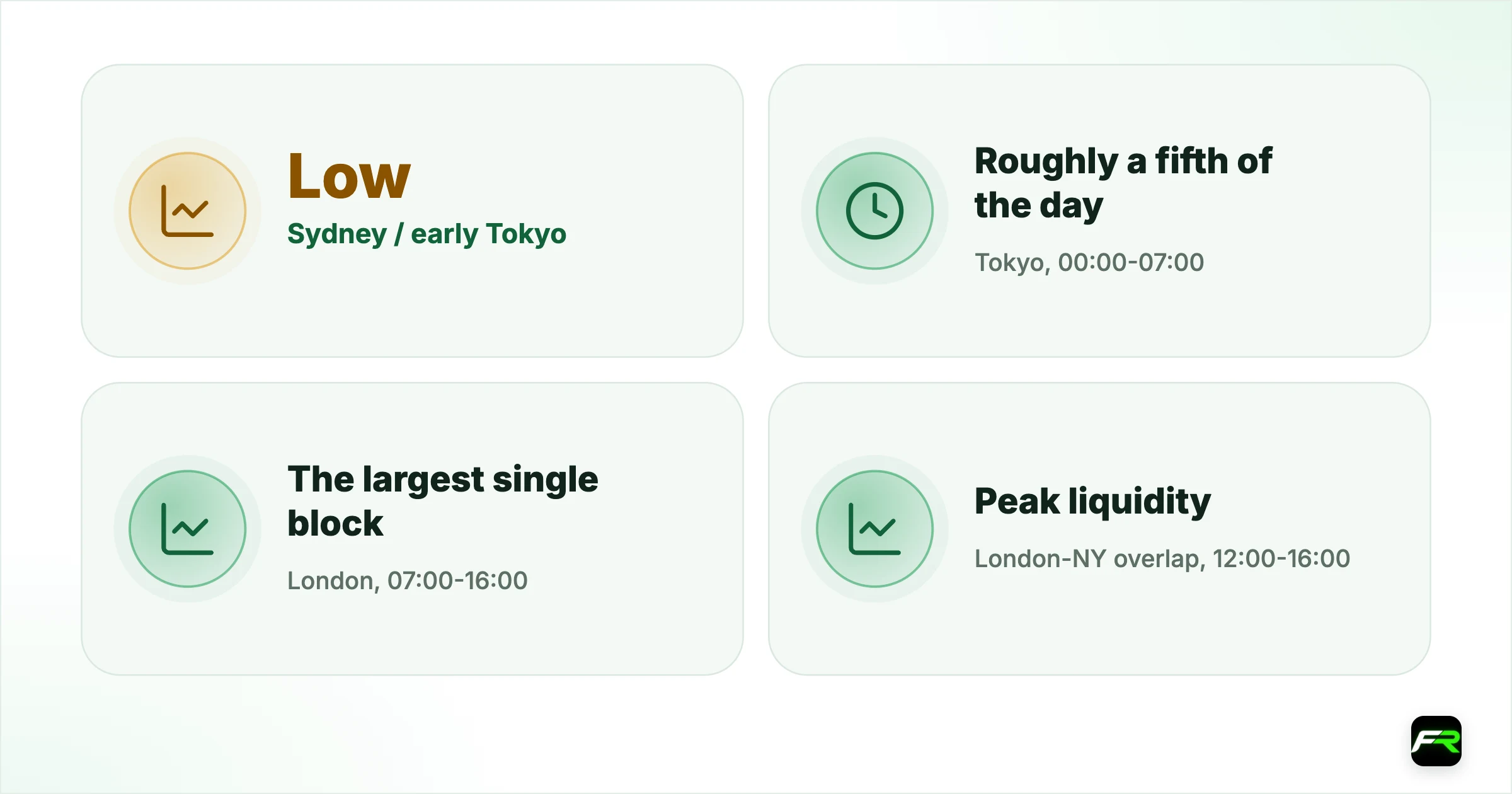
| Session (GMT) | Approx share of daily FX turnover | Character |
|---|---|---|
| Sydney / early Tokyo | Low | Thin, gappy, wide spreads |
| Tokyo, 00:00-07:00 | Roughly a fifth of the day | Moderate, range-bound |
| London, 07:00-16:00 | The largest single block | Deep, directional |
| London-NY overlap, 12:00-16:00 | Peak liquidity | Tightest spreads, biggest moves |
| Late NY into Sydney | Lowest | Very thin, avoid |
These proportions are approximate and vary by pair, but the pattern is stable: the deepest liquidity is the London-New York overlap, and the Tokyo session is a fraction of that. For JPY pairs specifically, Tokyo hours are more active than for, say, EUR/GBP, but even USD/JPY sees its heaviest flow during London and New York.
Where These Turnover Figures Come From
These session shares are not a live, precise measurement, forex trades over the counter across a global network of banks, so no single exchange sees the whole market. The benchmark the industry actually relies on is the BIS Triennial Central Bank Survey, published every three years by the Bank for International Settlements, which measures average daily FX turnover by currency, instrument and reporting location. Asian centres, Tokyo included, have consistently reported a smaller share of that turnover than London across successive surveys, which is why the pattern in the table above holds even as the exact percentages shift a little from one survey to the next.
How This Affects AUD/JPY and NZD/USD Specifically
AUD/JPY and NZD/USD sit in different spots during Tokyo hours, and it is worth treating them differently rather than lumping every non-major pair together. AUD/JPY carries genuine Asian-session interest: Tokyo institutions and the regional carry-trade flow that pairs a higher-yielding currency against the yen are active in it, so its spreads hold up reasonably well in the first two hours after the Tokyo open, more like a JPY major than a true minor. NZD/USD is a different case. New Zealand's own trading day has already closed by the time Tokyo opens, so the pair has no natural Asian-hours liquidity source of its own, and it trades noticeably lighter than AUD/JPY through the whole session, with more of the choppy, false-breakout behaviour described below. In practice, treat AUD/JPY closer to a JPY pair for Tokyo-hours liquidity, and treat NZD/USD closer to a true minor, with wider stops and smaller size, even during the supposedly liquid opening window.
What Shallow Liquidity Looks Like
- Wider spreads. The spread on EUR/USD might be 0.3 pips during the overlap and 1.0 to 1.5 pips in quiet Asian hours. On minors and exotics the difference is larger.
- Choppier price. With fewer participants, a single decent-sized order can push price further than it would in a deep market, then it snaps back. This produces the false breakouts the Asian range is known for.
- Worse fills on stops and market orders. Slippage is larger when the order book is shallow, particularly around the Tokyo fix and scheduled Japanese data such as the CPI release, the trade balance figures, or a Bank of Japan policy statement.
- Gaps. The quietest hours (late New York into Sydney) can gap on a headline because there is barely anyone quoting.
The parts of the Tokyo session that are liquid enough
The first one to two hours after the Tokyo open (00:00 to 02:00 GMT) carry the most Asian-session flow, as Japanese institutions and the fixing bring participants in. The last hour before London (06:00 to 07:00 GMT) picks up as European desks come online. The middle of the session, roughly 03:00 to 05:00 GMT, is the quietest and choppiest part, and it is where a lot of the noise-driven stop-outs happen.
Ravi trades USD/JPY and AUD/JPY in the first two hours of the Tokyo session before his commute. He found that trading the same setups between 03:00 and 05:00 GMT gave him far worse results: more false breakouts, worse fills, wider spreads eating his edge. He now simply does not trade the quiet middle of the session, and his win rate in the active first two hours is noticeably better.
Trading the Session Well
- Stick to the liquid windows: the first two hours after the Tokyo open and the hour before London.
- Use range-edge stops, not tight stops, because the choppiness will clip anything close.
- Check the spread before entering. If it is double its overlap value, factor that into your target and stop.
- Avoid market orders in the quietest hours; use limits where possible to control the fill.
- Be flat or very small before the Tokyo fix (around 00:55 GMT) if you are not specifically trading it.
Lighter liquidity is not a reason to avoid the Asian session. It is slower and more range-bound, which suits a patient strategy. It just means the tradeable hours are narrower and the costs are higher than the deep London-NY window.
Frequently asked
Is the Tokyo session bad for trading?
No, but it is different. It is slower, more range-bound, and lighter on liquidity, which suits a patient range strategy. The mistake is trading it with tight stops and expecting London-style directional moves.
Which hours of the Tokyo session are best?
The first one to two hours after the 00:00 GMT open, when Japanese institutional flow and the fixing bring in participants, and the hour before the London open. The middle of the session (roughly 03:00-05:00 GMT) is the quietest and choppiest.
Why are spreads wider in Asian hours?
Fewer market participants are quoting, so the gap between the best bid and offer is larger. This is most pronounced on minors and exotics and in the thinnest hours around the session edges.
What is the Tokyo fix?
A daily benchmark rate set around 09:55 Tokyo time (00:55 GMT) for settlement purposes. It can cause a short burst of directional flow, mainly in USD/JPY, and it is worth being flat or small around it unless you are trading it deliberately.
Is the Tokyo session more liquid for JPY pairs than other currency pairs?
Yes. JPY pairs, and especially USD/JPY and AUD/JPY, see real Tokyo-hours institutional and carry-trade flow, so their spreads hold up better in the first two hours after the open. Non-yen pairs like NZD/USD have no natural Asian-hours liquidity source and trade lighter through the whole session, with more false breakouts.
Does thin liquidity cause false breakouts?
It contributes to them. When depth is shallow, a single order can push price through a level, triggering breakout entries and stops, then price reverts because there was no real flow behind the move. The Asian range is known for this.
Related reading
The team behind this guide
Researched, checked and approved by five forex specialists
Every guide is written, fact-checked and edited before it goes live, and updated when the facts change. Spotted an error? Tell us.