





























How to Report CFD and Forex Gains on Your Self Assessment
CFD and forex gains go on the SA108 capital gains pages of your tax return. Register by 5 October, work out each disposal in sterling, claim losses within four years, then file and pay by 31 January.
 WriterAbir KhanWriterWrites the guides · checks every figure against primary sources View profileAbout Abir →
 Market analysisTanbir Habib RiyadForex & Crypto AnalystForex and crypto analyst · technical and fundamental analysis View profileAbout Tanbir →
 Fact-checking & riskJannatul FerdaushFact-Checker & Risk AnalystFact-checks every figure · risk analysis · Applied Statistics, University of Dhaka View profileAbout Jannatul →
 Trading reviewJowel RanaCo-Founder & Forex TraderCo-founder · forex trader · reviews guides from a trader's view View profileAbout Jowel →
 Final approvalRanjan NiskrityFounder, Owner & Forex TraderFounder and owner · forex trader · signs off every guide View profileAbout Ranjan →
You declare CFD and rolling spot FX profits in the UK on the capital gains pages (form SA108) of your self assessment tax return. If you are not already in self assessment, register by 5 October after the end of the tax year, so by 5 October 2026 for trades closed in 2025/26. Then work out the gain or loss on each closed trade in sterling, total them, enter the figures in the "Other property, assets and gains" section, attach your computation and pay any tax due by 31 January 2027. Spread bets are not reported at all, for the reasons in our explainer is spread betting tax free?
The rest of this page is the practical version: when you must file, how to turn a broker statement into a sterling computation, where commission and overnight funding go, how to handle a dollar account, how to claim losses, and what records to keep. Box names and numbers come from HMRC's 2025/26 SA108 notes; forms change most years, so check the current version on gov.uk before you file. For which products are taxed and at what rate, start with our forex trading tax overview.
General information, not tax advice. Your position depends on your own circumstances, and tax rules can change, including at the 28 October 2026 Budget. If your gains are large, your situation is unusual or you are unsure which regime applies, a qualified tax adviser who works with traders is worth the fee.
| Form | SA108 Capital Gains Tax summary, filed with SA100 |
|---|---|
| Section for CFDs | Other property, assets and gains (boxes 14 to 22 on the 2025/26 form) |
| Register by | 5 October 2026 for 2025/26 |
| File and pay by | 31 January 2027 (paper return 31 October 2026) |
| Annual exempt amount | £3,000 |
| Loss claim deadline | 4 years from the end of the tax year of the loss |
Do you need to report at all?
HMRC's notes say you should fill in the capital gains pages if any of these apply: you disposed of chargeable assets worth more than £50,000 in total, your gains before losses were more than £3,000, or you want to claim an allowable loss. There are other triggers for property and foreign gains, but for a forex trader those three are the ones that count. CFD gains below £3,000 with small disposal values usually need no return, unless you are in self assessment for another reason and HMRC's rules for your situation say otherwise.
Loss claims are the trigger people miss. If you lost money on CFDs this year and do nothing, the loss is gone. Report it, and it carries forward to reduce future gains. Spread bets never go on the return, because HMRC's CG56105 says no chargeable gains or allowable losses arise from them.
All of this assumes your CFD dealing is taxed as capital gains, which is the norm for individuals. HMRC treats private dealing as a trade only in rare cases, explained in our guide to HMRC's badges of trade for forex. Payouts from a prop firm are different again: they go on the self-employment pages, not SA108, as set out in how prop firm payouts are taxed. A trader with both simply fills in both sets of pages.
If you are unsure whether your figures cross the £50,000 threshold, fill in the pages anyway. A small reported gain costs you nothing but time, while failing to report when you should have can lead to penalties.
Step 1: register and get your UTR
People who already file a return for self-employment, rental income or high income simply add the SA108 pages. Everyone else needs to register for self assessment by 5 October following the tax year in which the gains arose. HMRC then posts a Unique Taxpayer Reference, which can take a couple of weeks. A missed 5 October deadline does not stop you filing, but it leaves less time before 31 January.
There is also a separate online "real time" Capital Gains Tax service on gov.uk for people outside self assessment. It suits someone with a one-off gain. Active CFD traders usually find the full return simpler, and any gains reported through the real time service still have to be included in the SA108 totals if you later file a return (box 21 on the 2025/26 form covers them).
Step 2: build the computation from your broker statement
HMRC's CG56100 explains that CFDs are commonly closed out by an equal and opposite contract, and that "all debits and credits to the account, including commission and sums equivalent to interest and dividends" go into the gain or loss calculation. In practice that means working per closed position:
- Export your full trade history for the tax year (6 April to 5 April) as a spreadsheet, rather than relying on the monthly PDF statements.
- For each closed position, take the realised profit or loss the broker reports.
- Deduct the commission charged on opening and closing that position.
- Take off overnight financing debits and add financing credits for that position; add or deduct any dividend adjustments on index or share CFDs.
- Convert each result into sterling at the date the position closed, if the account is not in pounds.
- Total the winning positions and the losing positions separately, then net them for the year.
Most brokers' annual statements show the realised figure and costs separately, and a few UK firms produce a tax summary for CFD accounts. Use it as a starting point, not as gospel: summaries sometimes leave out financing or treat currency conversion differently from HMRC's approach. Deposits and withdrawals are not disposals and do not go in the computation.
Step 3: convert foreign currency results into sterling
Capital gains are computed in sterling. Where you buy or sell in a foreign currency, HMRC's approach in CG78310 is to take the sterling equivalent at the date of each transaction. For a USD-denominated CFD account, that means converting each closed position at the rate for its closing date, not converting the year-end balance. Many traders use the Bank of England's published daily spot rates, because they are free and easy to cite. Whatever source you use, use it consistently and keep a note of it.
Two traps are common. The first is converting only the money you withdrew: tax follows closed trades, so a dollar profit left in the account still has to be converted and reported. Another is treating the dollar cash balance itself as irrelevant. Foreign currency is a chargeable asset in its own right (CG78300), so large dollar balances held and converted at a profit can create a separate small gain. A GBP-denominated account avoids both problems, which is one reason we suggest UK traders use a sterling base currency where the broker allows it.
Step 4: fill in the SA108 boxes
HMRC does not mention CFDs by name on the form. They are not shares or securities, so most accountants report them in the "Other property, assets and gains" section. On the 2025/26 form (published by HMRC as SA108 2026) the relevant boxes are:
| Box (2025/26 form) | What it asks for | For a CFD trader |
|---|---|---|
| 14 | Number of disposals | Number of CFD positions closed in the year |
| 15 | Disposal proceeds | Total sums treated as received on closing (see below) |
| 16 | Allowable costs (including purchase price) | Total sums treated as paid, including commission and financing |
| 17 | Gains in the year, before losses | Total of your winning positions |
| 19 | Losses in the year | Total of your losing positions |
| 45 | Losses brought forward and used in-year | Earlier losses used, only down to the £3,000 allowance |
| 47 | Losses available to be carried forward | Unused losses to carry forward |
Boxes 15 and 16 are where CFD traders get stuck, because a CFD has a notional contract value much larger than the money that changes hands. HMRC's manual treats the gain or loss as the net amount settled on each contract, so many advisers enter the settled amounts rather than the notional value. Approaches differ, so explain your method in the computation you send. Whatever you do, the gain and loss boxes must match your computation, and you must send the computation with the return: HMRC's notes say not to write "see attached" in the boxes themselves. Online filers can attach a PDF or spreadsheet, or put a summary in the "any other information" box (box 54).
Samir trades cable and gold CFDs in a GBP account alongside his job as a surveyor. In 2025/26 he closed 163 positions: 91 winners totalling £21,480 and 72 losers totalling £13,950, after allocating £1,120 of commission and £610 of net overnight financing to the positions they belonged to. His net gain is £7,530. He also has £2,200 of CFD losses from 2023/24, claimed on that year's return. On SA108 he puts 163 in box 14, £21,480 in box 17 and £13,950 in box 19, fills in boxes 15 and 16 using the settled-amount method his accountant recommended, uses £2,200 of brought-forward loss in box 45 (which still leaves him above the £3,000 allowance), and attaches a spreadsheet with every position. His taxable gain is £7,530 minus £2,200 minus £3,000, which is £2,330. As a higher rate taxpayer he pays 24%: £559.20, due with his balancing payment on 31 January 2027.
Step 5: losses and the four-year rule
A capital loss must be claimed within four years of the end of the tax year in which you made it. Losses from 2022/23 must be claimed by 5 April 2027, for example, and the easiest way is to include them on that year's return. If you have already filed without them, you can amend a return within 12 months of the filing deadline, or write to HMRC with the claim and your computation within the four-year window.
Losses are used in a set order. Current-year losses reduce current-year gains in full, even if that wastes part of the £3,000 allowance. Brought-forward losses are only used to bring the remaining gain down to £3,000, and anything left carries forward again. That is why box 45 and box 47 matter: HMRC keeps a running total only if you report it.
Deadlines, payment and records
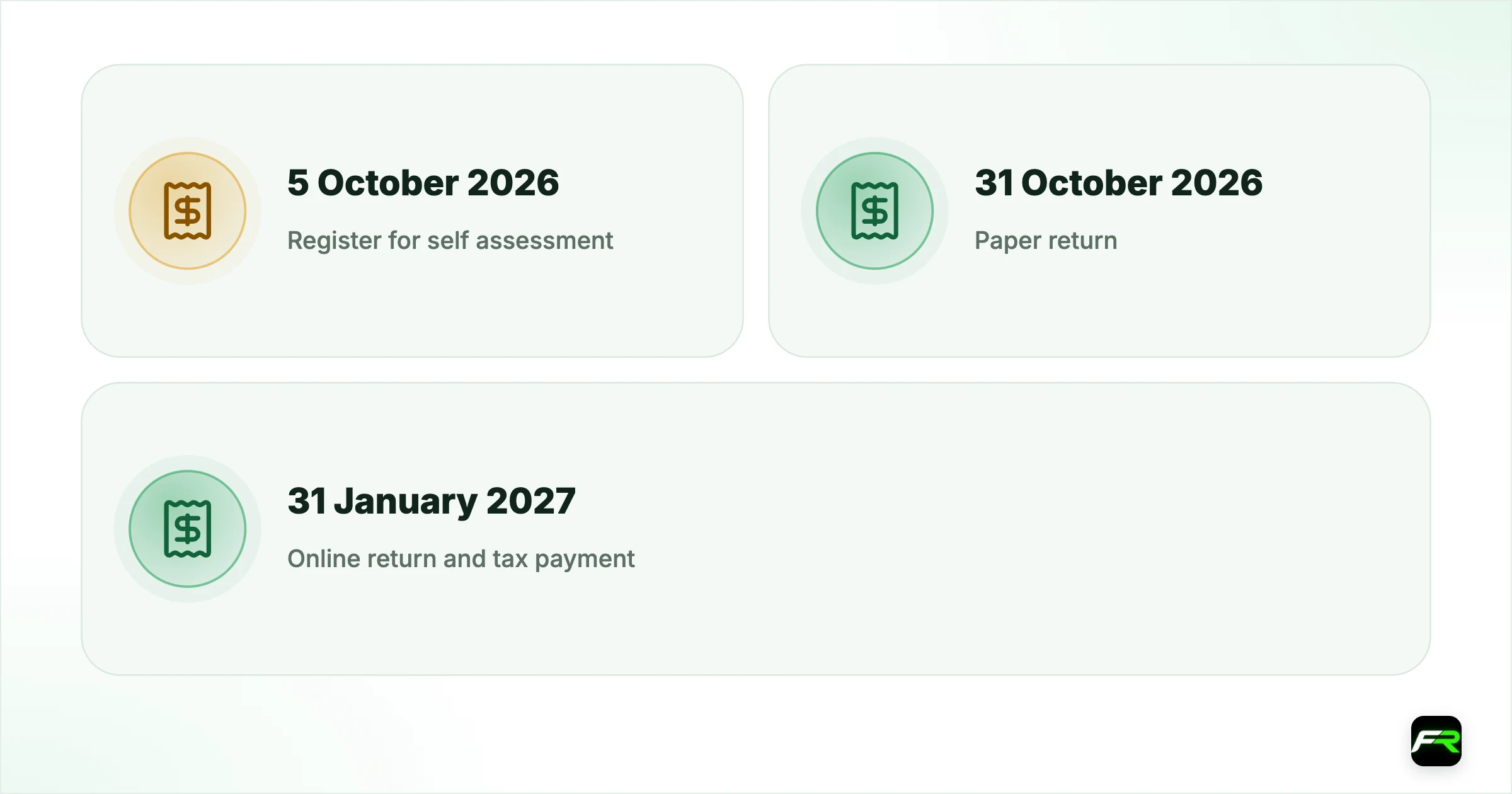
| Deadline | For 2025/26 gains | For 2026/27 gains |
|---|---|---|
| Register for self assessment | 5 October 2026 | 5 October 2027 |
| Paper return | 31 October 2026 | 31 October 2027 |
| Online return and tax payment | 31 January 2027 | 31 January 2028 |
CGT is not included in payments on account, so the whole bill falls on 31 January. A late online return gets an automatic £100 penalty even when no tax is due, with further penalties if it stays outstanding, and interest runs on late tax from 1 February. The next Budget is on 28 October 2026, and any change to CGT rates could apply from Budget day, so check the rates that applied on the date of each disposal.
Keep your broker trade exports, annual statements, the exchange rates used and your computation. The general rule for individuals who are not in business is to keep records for at least 22 months after the end of the tax year, and five years after the 31 January deadline if you are self-employed. While you are carrying losses forward, keep the records that prove them for as long as the losses are in use.
Frequently asked
Where do CFD gains go on the self assessment tax return?
On the SA108 Capital Gains Tax summary pages. CFDs are not shares or securities, so most advisers report them under "Other property, assets and gains", which was boxes 14 to 22 on the 2025/26 form. Attach your computation showing each gain and loss.
Do I need to report CFD gains under £3,000?
Not usually, if your gains before losses were £3,000 or less and the total disposal value was not above £50,000. You should still report if you want to claim a loss, or if HMRC has asked you to complete a return that includes capital gains.
How do I convert USD CFD profits into pounds for HMRC?
Convert each closed position into sterling at the exchange rate on the date it closed, following HMRC's approach in CG78310. The Bank of England's daily spot rates are a common free source. Use one source consistently and keep a record of the rates applied.
Can I deduct commission and overnight financing?
Yes. HMRC's CG56100 says all debits and credits to a CFD account, including commission and sums equivalent to interest and dividends, go into the gain or loss computation. Commission and financing charges reduce your gain; financing credits increase it.
How long do I have to claim a CFD loss?
Four years from the end of the tax year in which the loss arose. A 2022/23 loss must be claimed by 5 April 2027. Claim it on the return for that year if you can, or by amendment or letter within the window.
When is the deadline to pay CGT on 2025/26 CFD gains?
31 January 2027, the same day as the online return deadline. If you need to register for self assessment first, do it by 5 October 2026. CGT is not part of payments on account, so the full amount is due in one payment.
Does my broker report my CFD trades to HMRC?
Do not rely on either answer. HMRC has wide powers to request data from financial firms and receives information on overseas accounts through international exchange agreements. The obligation to report correctly is yours, whatever the broker does.
Do I report spread betting on self assessment?
No. For most individuals, spread bet winnings are outside Capital Gains Tax and Income Tax, so there is nothing to report and losses cannot be claimed. Only CFD, spot currency and other chargeable gains go on SA108.
HMRC sent me a letter about CFD gains. What now?
Read it carefully and reply by any date it gives. HMRC writes to people when data it holds, such as overseas account information received through international exchange agreements, suggests gains may be missing. If your returns were right, you may only need to confirm that. Where gains are missing, amend the return or use HMRC's disclosure service, ideally with an adviser's help.
Related reading
The team behind this guide
Researched, checked and approved by five forex specialists
Every guide is written, fact-checked and edited before it goes live, and updated when the facts change. Spotted an error? Tell us.