



























IC Markets vs XTB for UK Traders: Protection, Costs and Platforms
Neither offers spread betting, so tax is the same. The difference is protection: XTB is FCA authorised with FSCS and Ombudsman cover, while IC Markets serves UK clients from the Seychelles.
 WriterAbir KhanWriterWrites the guides · checks every figure against primary sources View profileAbout Abir →
 Market analysisTanbir Habib RiyadForex & Crypto AnalystForex and crypto analyst · technical and fundamental analysis View profileAbout Tanbir →
 Fact-checking & riskJannatul FerdaushFact-Checker & Risk AnalystFact-checks every figure · risk analysis · Applied Statistics, University of Dhaka View profileAbout Jannatul →
 Trading reviewJowel RanaCo-Founder & Forex TraderCo-founder · forex trader · reviews guides from a trader's view View profileAbout Jowel →
 Final approvalRanjan NiskrityFounder, Owner & Forex TraderFounder and owner · forex trader · signs off every guide View profileAbout Ranjan →
For a UK resident, XTB is the safer choice and IC Markets (now trading as IC) is the more flexible one. Neither firm offers spread betting, so your forex profits are within capital gains tax whichever you pick. That takes tax off the table and leaves two questions: who protects your money, and which platform suits your trading. XTB Limited is authorised by the FCA (FRN 522157), requires no minimum deposit and caps retail leverage at 30:1. IC offers raw spreads, MetaTrader and cTrader, but a UK resident signing up today is in practice a client of its Seychelles company, which the FCA has on its Warning List.
XTB is not a spotless alternative. Its Polish parent was fined by the Polish regulator this year, and its platform choice is narrow: xStation only, no MetaTrader. We cover both below. What XTB does give you is the UK framework: segregated client money, the FSCS, the Financial Ombudsman Service and the FCA's retail CFD rules. For most people that matters more than anything on a price table.
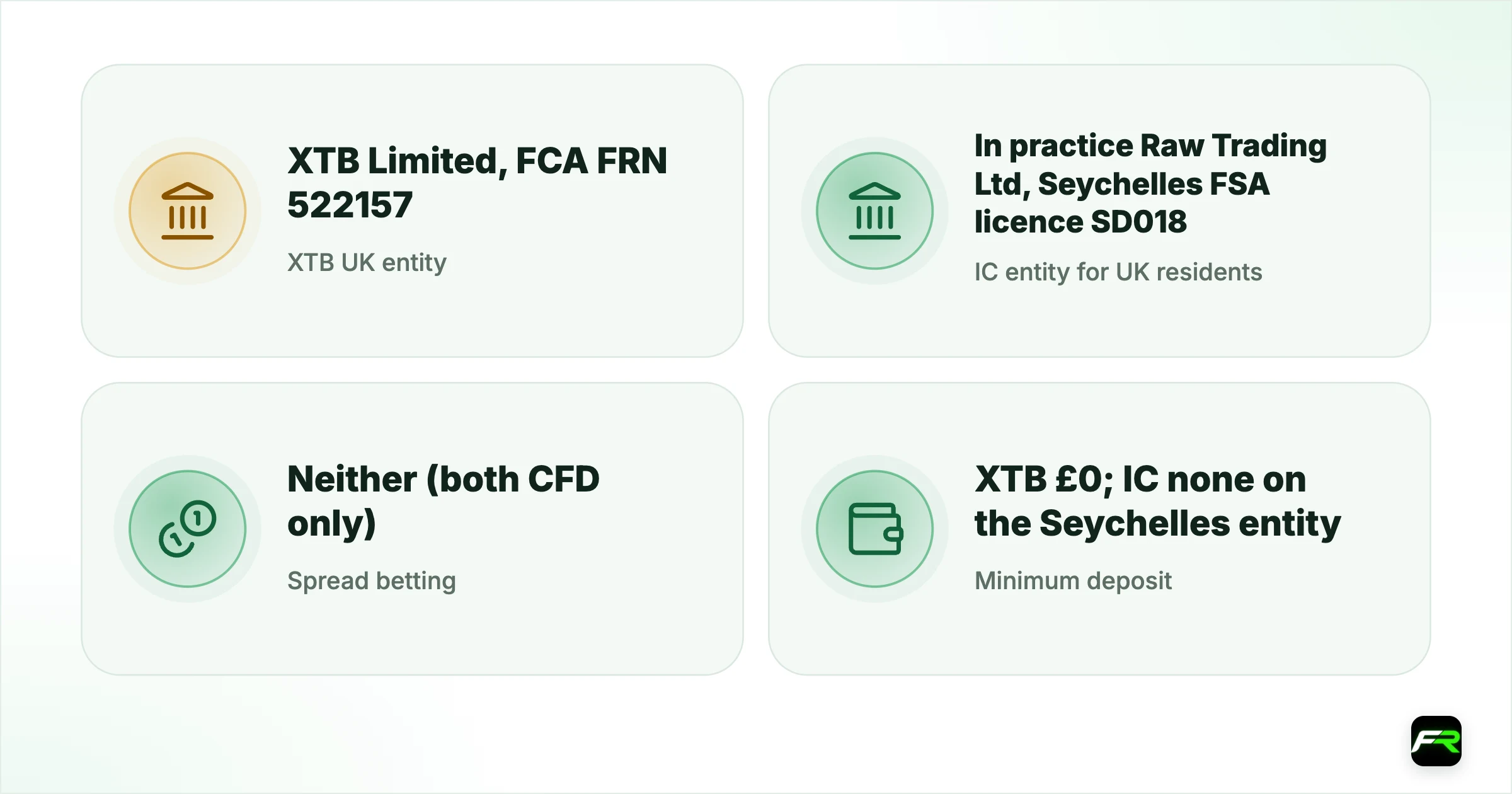
| XTB UK entity | XTB Limited, FCA FRN 522157 |
|---|---|
| IC entity for UK residents | In practice Raw Trading Ltd, Seychelles FSA licence SD018 |
| Spread betting | Neither (both CFD only) |
| Minimum deposit | XTB £0; IC none on the Seychelles entity |
| Max retail leverage, major FX | XTB 30:1; IC up to 1:5000 on MT4/MT5 |
| Retail loss figure | XTB 74% (September 2026); IC Seychelles none published |
Tax is a draw: both are CFD only
Most IC comparisons in the UK turn on spread betting, because firms like Pepperstone, IG and CMC let you trade outside CGT. XTB does not. Its UK offer is CFDs, plus real shares and ETFs, including a stocks and shares ISA. So a profitable forex trader pays the same tax at either: net CFD gains above the £3,000 annual exempt amount are charged at 18% within the basic rate band and 24% above it, reported through self assessment.
There is a practical difference. XTB lets you hold a GBP account and reports in pounds, which makes your CGT working simpler. IC also supports GBP as a base currency, but many UK clients open USD accounts to match IC's USD commission tables, and then have to convert every disposal to sterling at the rate on the day. If you have not yet chosen, a GBP account at either broker will save you an evening each January. Our self assessment guide for CFD gains shows how to report them.
General information, not tax advice. Your own position depends on your circumstances, and tax rules can change, including at the 28 October 2026 Budget.
Protection: FCA rules against an offshore licence
XTB Limited is an FCA-authorised firm based in Canary Wharf. Your money is held under client money rules, separate from XTB's own funds, and XTB says deposits are covered by the FSCS up to £85,000 per person if it became insolvent. If a complaint is not resolved, you can take it to the Financial Ombudsman Service for free. Retail clients also get the FCA's CFD protections: 30:1 on major pairs, a 50% margin close-out and negative balance protection.
IC's Seychelles company is licensed by the Seychelles FSA and holds private client money insurance of up to USD 1,000,000 for its own insolvency. It is not authorised by the FCA. The FCA's Warning List entry against IC Markets Global, updated on 10 August 2026 to include ic.com, tells UK consumers to avoid dealing with the firm and says they would have no access to the Ombudsman and no FSCS cover. Disputes go under Seychelles law. IC's help centre says a client who loses more than the balance bears the consequences, so negative balance protection is not guaranteed.
| Protection point | XTB UK | IC for UK residents |
|---|---|---|
| Regulator | FCA (FRN 522157) | Seychelles FSA (SD018) |
| FSCS | Yes, up to £85,000 | No |
| Financial Ombudsman | Yes | No |
| Negative balance protection | Yes | Not guaranteed |
| Bonuses | Banned under FCA rules | Deposit bonus offered |
| Leverage on major FX | 30:1 | Up to 1:5000 on MetaTrader, 1:1000 on cTrader |
The XTB fine in Poland
Reuters reported that Poland's Financial Supervision Authority (KNF) fined XTB S.A., the Warsaw-listed parent, 20 million zlotys, about USD 5.5 million. The penalty was first imposed on 30 March 2026 and, according to trade press reports, confirmed in a final decision on 28 August 2026 after XTB asked for reconsideration. According to the KNF, during 2022 and 2023 XTB's client questionnaires did not properly assess experience with complex products, and it also cited product targeting and CFD risk disclosures. This was a Polish decision about the parent's Polish business, not an FCA finding against XTB Limited, but it is fair to know about when judging a group.
Costs: spread-only against raw plus commission
XTB prices forex CFDs through the spread with no commission. Its spreads are variable, and we could not find a current UK minimum for EUR/USD or GBP/USD on XTB's own pages, so check the live quote in xStation at the hours you trade. Deposits and withdrawals are free. XTB charges a £10 monthly inactivity fee if there are no transactions for 365 days, which matters if you open an account and then leave it.
IC offers both models. Its Standard account is spread-only from 0.8 pips; its Raw accounts start from 0.0 pips plus commission of £2.75 per lot per side in GBP or USD 3.50 on a USD MetaTrader account. IC quotes an average EUR/USD raw spread of about 0.1 pips. For a heavy scalper, raw pricing with a flat commission is usually cheaper than an all-in spread. A trader placing a handful of trades a week will find the difference comes to a few pounds a month and does not outweigh the loss of UK protection.
Leverage in practice: a £1,000 account
The leverage gap is the difference most likely to hurt a new trader, so it is worth seeing in pounds. One standard lot of GBP/USD is £100,000 of sterling, and each pip is worth about £7.50 with the pound near 1.33. At XTB's 30:1 limit, one lot needs £3,333 of margin. A common offshore setting of 1:500 cuts that to £200.
| £1,000 account, GBP/USD | XTB at 30:1 | IC at 1:500 |
|---|---|---|
| Largest position margin allows | About 0.3 lots (£30,000) | About 5 lots (£500,000) |
| Value of a 1 pip move | ≈ £2.25 | ≈ £37.50 |
| Adverse move that wipes the account | Over 400 pips | About 27 pips |
| If the market gaps past zero | Loss limited to the balance | You may owe the difference |
High leverage does not force you to trade large, and a disciplined trader can use 1:500 with small positions. The trouble is that it allows the mistake. GBP/USD can move 27 pips in minutes around a Bank of England decision or a CPI release. The FCA caps exist because most retail accounts lose money, and XTB's own figure is that 74% of its retail CFD accounts do.
Zara opened an IC account with £1,500 after a friend showed her a 1:500 set-up. Within a month she was trading two lots of GBP/USD at a time and lost £640 in one afternoon when UK inflation came in above forecast. She moved her remaining £860 to XTB, where 30:1 margin stopped her opening more than about a quarter of a lot. These days she trades 0.1 lots, about £0.75 a pip, keeps her stop at 30 pips so a losing trade costs around £22, and uses XTB's ISA separately for long-term index funds.
Platforms and who should choose which
XTB runs one platform, xStation, in a browser and as a mobile app. It is simple to learn, and it is the same app you use for shares and the ISA. There is no MT4, MT5, cTrader or TradingView, which rules XTB out if you run expert advisers or depend on a particular charting set-up. IC covers MT4, MT5, cTrader and TradingView (through cTrader Raw), plus copy trading tools and a free VPS for active clients.
- Beginners in the UK: XTB. No minimum deposit, a straightforward app, FCA leverage limits and negative balance protection.
- Traders who also want shares or an ISA in one place: XTB.
- MetaTrader or cTrader users who want UK protection: neither is ideal. Pepperstone offers both, plus spread betting, under the FCA.
- Experienced traders who accept offshore risk for raw pricing or high leverage: IC, with a balance you can afford to have outside the UK system.
- Anyone who wants tax-free trading: neither. Look at a spread betting firm.
If spread betting is what you are after, our IC Markets vs IG comparison covers an FCA firm that offers it alongside shares and an ISA. Traders moving away from IC for MetaTrader or cTrader can use our IC Markets alternatives guide to find the closest FCA match.
Frequently asked
Is XTB FCA regulated?
Yes. XTB Limited is authorised and regulated by the FCA under FRN 522157, with offices in Canary Wharf. That means client money rules, FSCS cover up to £85,000 per person if the firm failed, and access to the Financial Ombudsman Service. Check the FRN and contact details on the FCA Register before you deposit.
Does XTB offer spread betting in the UK?
No. XTB's UK offer is CFDs plus real shares, ETFs and an ISA. Forex profits on CFDs are within capital gains tax. IC Markets is also CFD only, so tax is the same at both. For tax-free forex trading you need a spread betting firm such as IG, Pepperstone or CMC.
Does XTB have MT4 or MT5?
Not in the UK. XTB runs its own xStation platform on the web and mobile. If you rely on MetaTrader expert advisers, cTrader or TradingView, XTB will not suit you. IC offers all four but from an offshore entity; Pepperstone offers them under the FCA.
Was XTB fined in 2026?
Reuters reported that Poland's KNF fined XTB S.A., the Polish parent, 20 million zlotys, first imposed on 30 March 2026, over client assessments, product targeting and CFD risk disclosures between 2022 and 2023. It was a Polish regulatory decision, not an FCA action against XTB Limited in the UK.
What is the minimum deposit at XTB and IC Markets?
XTB has no minimum deposit in the UK. IC's Seychelles company, which serves UK residents, also has no minimum. The USD 200 figure seen on comparison sites applies to IC's Australian company. In practice, deposit enough to cover margin and a sensible buffer.
Does XTB charge an inactivity fee?
Yes. XTB charges £10 a month if there have been no transactions on the account for 365 days. It stops once you place a trade again. IC did not list an inactivity fee when we checked. If you open an account to test it, close it or use it at least once a year.
Is IC Markets or XTB better for beginners in the UK?
XTB, clearly. A beginner benefits most from the FCA's 30:1 leverage cap, negative balance protection, a simple app and a route to the Ombudsman. IC's high leverage and offshore status add risk that a new trader gains nothing from.
Related reading
The team behind this guide
Researched, checked and approved by five forex specialists
Every guide is written, fact-checked and edited before it goes live, and updated when the facts change. Spotted an error? Tell us.