IC Markets

































Forex Leverage Limits Across Asia, Compared
The leverage you can get depends entirely on which regulator your broker’s entity sits under, not where you live. Here is how the caps line up, and why 1:1000 is a warning sign, not a perk.
 WriterAbir KhanWriterWrites the guides · checks every figure against primary sources View profileAbout Abir →
 Market analysisTanbir Habib RiyadForex & Crypto AnalystForex and crypto analyst · technical and fundamental analysis View profileAbout Tanbir →
 Fact-checking & riskJannatul FerdaushFact-Checker & Risk AnalystFact-checks every figure · risk analysis · Applied Statistics, University of Dhaka View profileAbout Jannatul →
 Trading reviewJowel RanaCo-Founder & Forex TraderCo-founder · forex trader · reviews guides from a trader's view View profileAbout Jowel →
 Final approvalRanjan NiskrityFounder, Owner & Forex TraderFounder and owner · forex trader · signs off every guide View profileAbout Ranjan →
Leverage is the first number most beginners shop for, and it is the wrong one to focus on. The amount you can access is set by the regulator your broker’s entity answers to, and there is a clear pattern: the stronger the regulator, the lower the cap, because the strong regulators have decided that very high leverage harms retail traders. So when a broker offers you 1:1000, what it is really telling you is which kind of entity you are signing up with.
The caps by regulator
| Regulator | Typical retail cap on major FX pairs | Notes |
|---|---|---|
| FCA (UK) | 1:30 | Retail; tighter on minors, gold, indices, crypto |
| ASIC (Australia) | 1:30 | Since 2021; same tiered structure as the FCA |
| CySEC / EU (ESMA) | 1:30 | EU-wide retail rules |
| FSA (Japan) | 1:25 | Long-standing domestic cap |
| Bappebti (Indonesia) | ~1:100 (local rules) | Higher than the tier-one regulators, lower than offshore |
| Offshore: Seychelles, Mauritius, Vanuatu, SVG | 1:500 to 1:2000 | Light-touch; the source of ‘high leverage’ marketing |
Note what this table does not depend on: your country. A trader in Jakarta, Manila or Karachi who signs up with a broker’s CySEC entity gets 1:30. The same trader on the same broker’s Seychelles entity gets 1:500. The cap follows the entity, and the entity is often assigned based on your country of residence or offered as a choice buried in the signup flow.
How to check which entity you’re on
- Open the account terms you agreed to at signup, or your welcome email. The specific legal entity name, e.g. “XYZ Markets (Seychelles) Ltd” rather than just the brand name, is stated there along with its regulator and licence number.
- Look for a country or region selector on the broker’s website. Many brokers route different countries to different entities automatically, and the entity name in the footer or legal disclosures changes depending on which one you land on.
- Check your trading platform’s account details or a statement header. MT4 and MT5 often show the entity name your account is registered under.
- Take that exact entity name, not the marketing brand, and search it on the regulator’s own public register (the FCA, ASIC or CySEC register, for example) to confirm it is real and currently authorised.
- If none of that is clear, ask live chat directly: “Which legal entity and regulator is my account registered with?” A broker with nothing to hide answers immediately.
What the caps are for
The tier-one regulators did not pick 1:30 at random. They looked at retail trading outcomes, and both the FCA and ESMA publish data showing the large majority of retail CFD accounts lose money. They concluded that high leverage was a major contributor. It lets a small account take a position large enough that an ordinary market move wipes it out before the trader can react. Cutting the cap does not stop people losing money, but it slows the rate at which beginners blow up, which buys time to learn.
The offshore jurisdictions made a different call, or rather did not make one. They register the company, take a fee, and impose few conduct rules. That is why the brokers who want to advertise 1:1000 and pay affiliates aggressively route their Asian clients there. It is not a favour to you; it is a business model that happens to suit clients who have not yet learned why the cap matters.
Deepak opened an account on a broker’s Seychelles entity specifically for the 1:500 leverage. On his fourth trade he sized a USD/JPY position that felt small, 0.5 lots on a USD 400 account, without doing the margin maths. A 40-pip move against him, well within a normal hour, took the account to a margin call and closed the position at a USD 190 loss. He reopened with a CySEC broker at 1:30, which forced him to size positions he could survive being wrong on. He has been trading the same USD 400 for eight months since.
How much leverage a beginner needs
Almost none of what the offshore entities offer. If you are risking 1% of a USD 500 account on a trade with a 30-pip stop, the position you need is tiny, and 1:30 covers it with room to spare. Leverage only becomes a constraint when you are trying to take positions far larger than your account can prudently support, which is exactly the behaviour that empties accounts. A useful rule: if the leverage cap is stopping you opening a trade, the trade is too big.
The practical takeaway
- Treat a 1:500 or 1:1000 offer as information about the entity, not a benefit.
- Prefer a broker on FCA, ASIC or CySEC, and check you are onboarded to that entity.
- Size positions by risk (a fixed percentage of the account), not by how much margin you have available.
- If you ever feel limited by 1:30, that is a signal to trade smaller, not to find a broker with a higher cap.
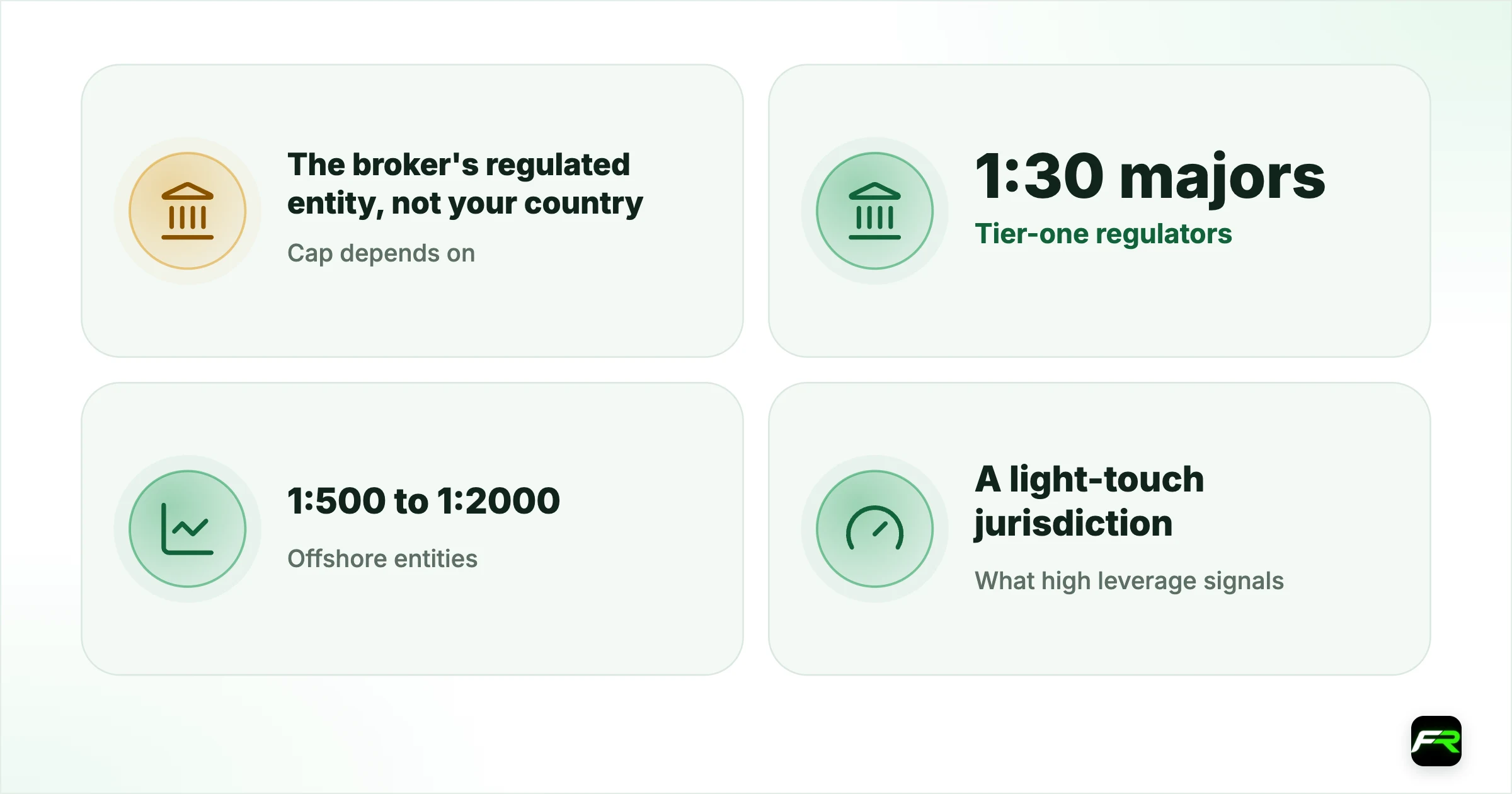
| Cap depends on | The broker’s regulated entity, not your country |
|---|---|
| Tier-one regulators | 1:30 majors (FCA, ASIC, CySEC) |
| Offshore entities | 1:500 to 1:2000 |
| What high leverage signals | A light-touch jurisdiction |
| Leverage a beginner needs | Well within 1:30 |
A broker that leads its marketing with the leverage number is aiming at traders who do not yet know why the strong regulators cap it. That is a reason for caution, not excitement.
Frequently asked
Why do some brokers offer 1:1000 and others only 1:30?
The cap is set by the regulator the broker’s entity sits under. FCA, ASIC and CySEC cap retail forex at 1:30. Offshore jurisdictions like Seychelles and Vanuatu allow 1:500 or more. The broker offering 1:1000 is doing so through a light-touch entity.
Does my country affect the leverage I can get?
Not directly. The cap follows the broker’s entity. Your country of residence often determines which entity you are assigned to, but a trader in India or Indonesia on a CySEC entity still gets 1:30.
Is high leverage good for small accounts?
It is marketed that way, but it mostly lets a small account take a position large enough that a normal market move wipes it out. Beginners lose faster with high leverage, which is why the strong regulators cap it.
How much leverage do I need to trade forex?
Very little. If you risk a fixed small percentage of your account per trade, the position size you need sits comfortably within 1:30. If a leverage cap is blocking a trade, the trade is too big for your account.
What leverage does Bappebti allow in Indonesia?
Local Indonesian rules have historically allowed around 1:100, higher than the tier-one regulators but well below the offshore entities. Licensed local brokers operate under those limits.
Can I change the leverage on my account?
Most brokers let you set a lower leverage than the maximum in the account settings, and some let you request a higher one up to the entity’s cap. Setting it lower is a reasonable way to enforce discipline on yourself.
Do professional traders use 1:30 or higher leverage?
Professionals think in terms of position size relative to capital, not the leverage ratio. Where they use a higher ratio it is for capital efficiency, to keep less money on deposit while holding the same modest positions, not to trade larger size.
The team behind this guide
Researched, checked and approved by five forex specialists
Every guide is written, fact-checked and edited before it goes live, and updated when the facts change. Spotted an error? Tell us.