





























UK 50% Margin Close-Out Rule and Negative Balance Protection
UK firms must start closing a retail client’s positions once equity falls below half the required margin, and you cannot lose more than your account balance. Both rules, worked through in £.
 WriterAbir KhanWriterWrites the guides · checks every figure against primary sources View profileAbout Abir →
 Market analysisTanbir Habib RiyadForex & Crypto AnalystForex and crypto analyst · technical and fundamental analysis View profileAbout Tanbir →
 Fact-checking & riskJannatul FerdaushFact-Checker & Risk AnalystFact-checks every figure · risk analysis · Applied Statistics, University of Dhaka View profileAbout Jannatul →
 Trading reviewJowel RanaCo-Founder & Forex TraderCo-founder · forex trader · reviews guides from a trader's view View profileAbout Jowel →
 Final approvalRanjan NiskrityFounder, Owner & Forex TraderFounder and owner · forex trader · signs off every guide View profileAbout Ranjan →
The UK margin close-out rule says that when the money in your CFD or spread betting account falls to less than 50% of the margin needed to keep your positions open, the firm must close one or more of them as soon as market conditions allow. It is calculated per account. Alongside it, negative balance protection means that as a retail client you can never lose more than the funds in that account. Both rules come from the FCA’s COBS 22.5 and have applied since 1 August 2019 to CFDs, spread bets and rolling spot forex.
| Close-out trigger | Equity below 50% of required margin (COBS 22.5.13R) |
|---|---|
| Applies to | Each account used for CFDs, spread bets and rolling spot FX |
| Maximum retail loss | Funds in the account (COBS 22.5.17R) |
| Covers | Retail clients of UK-authorised firms only |
| Does not cover | Professional clients as a right; offshore accounts |
How the 50% rule works
Three numbers sit behind the rule. Equity is your cash balance plus or minus the running profit or loss on open trades. Margin is the deposit the firm holds against those trades, set by the FCA minimums (3.33% on major pairs, 5% on minors and gold). The margin level is equity divided by margin, shown as a percentage on most platforms.
At a margin level of 100% your equity exactly covers the margin, and you cannot open new trades. Most firms send a warning around there. Once the margin level drops below 50%, the FCA rule in COBS 22.5.13R requires the firm to close positions. The rule does not tell firms which position to close first; many start with the one showing the largest loss, and some close everything. Your client agreement or the firm’s help pages should say which method it uses. If you believe a firm closed the wrong position or acted at the wrong level, raise it with the firm first; our guide to Financial Ombudsman CFD complaints covers the next step.
A firm is allowed to be stricter than 50%. Some UK brokers close out at a higher level, and some let you choose your own, but none can let a retail account run below 50% without acting. Offshore firms set their own stop-out levels, and some go as low as 20% or even 0%, which is one reason losses there can be deeper and faster. (IC’s account pages list a 50% stop-out, so check each firm’s figure rather than assuming.)
A worked example in pounds
Take a £1,500 account in sterling. You buy 0.4 lots of GBP/USD at 1.3400. The notional value is £40,000, so at 30:1 the margin is £40,000 ÷ 30, or about £1,333. Each pip is worth $4, which is roughly £2.99 at that price.
| Step | Figure | How it is worked out |
|---|---|---|
| Equity at the start | £1,500 | Cash balance, no open trades |
| Margin on 0.4 lots | £1,333 | £40,000 ÷ 30 |
| Margin level at entry | about 113% | £1,500 ÷ £1,333 |
| Close-out equity | below £667 | 50% of £1,333 |
| Loss that triggers it | about £833 | £1,500 − £667 |
| Price move that causes it | about 279 pips | £833 ÷ £2.99 per pip |
| Approximate trigger price | about 1.3121 | 1.3400 − 0.0279 |
So a fall of roughly 280 pips would see the firm close the trade, leaving you with about £667 of your £1,500. That is the rule doing its job. Without it, the position could keep bleeding until the account hit zero. Our margin calculator works out the same numbers for any pair and size.
Two details change the maths in real life. The pip value in pounds shifts slightly as the exchange rate moves, and spreads widen at quiet times, which can push the margin level down faster than the mid-price suggests. Treat the trigger as approximate, and never plan to rely on it as a stop.
The close-out rule is a safety net, not a stop-loss. A stop placed where your trade idea is proven wrong will almost always get you out earlier and cheaper than waiting for the firm to act at 50%.
Gaps and weekend risk
The close-out only works if there is a price to close at. When the market jumps, the next available price can be far beyond the level where the rule should have fired. That happens most often at the Sunday evening reopen (UK time), around central bank decisions, and after political shocks. Stops are filled at the next available price too, unless you pay for a guaranteed stop.
Sterling traders have seen this. On 26 September 2022, after the mini-Budget, GBP/USD fell to a record low near 1.035 in thin Asian trading on the Monday. Further back, on 15 January 2015 the Swiss National Bank removed its cap on the franc and EUR/CHF moved so fast that many stops were filled hundreds of pips away. Several brokers took heavy losses on clients whose accounts went negative, and Alpari UK entered administration days later. Those events are a big reason negative balance protection became a rule rather than a marketing feature.
Negative balance protection: what it does and does not do
COBS 22.5.17R limits a retail client’s liability for all CFDs, spread bets and rolling spot FX connected to an account to the funds in that account. If a gap takes your equity below zero, the firm has to write off the deficit. You do not receive a bill, and the firm cannot chase you through the courts for it.
- Your balance is not protected. You can still lose every pound in the account.
- It works per account. The cap is the cash and unrealised profit in the trading account that made the loss. FCA guidance says money held in that account for other purposes is disregarded, and an ISA at the same firm is not trading money.
- Money still counts once it is in the account. A deposit made to rescue a losing trade becomes part of the funds at risk.
- Retail only. Professional clients get it only if the firm offers it in its terms, and offshore firms may not offer it at all.
Some offshore firms advertise “negative balance protection” but define it narrowly or keep a right to recover deficits. IC Markets’ own help centre says that if you lose more than your balance “you will bear the negative consequences”. Read the actual terms, not the banner.
Why offshore and professional accounts differ
Both rules are part of COBS 22.5, which applies to retail clients of UK-authorised firms. If you become an elective professional client, the firm’s own margin policy replaces the 50% rule and negative balance protection stops being a legal right. With an unauthorised offshore broker, none of the FCA rules apply, and the firm’s terms, written under foreign law, decide what happens.
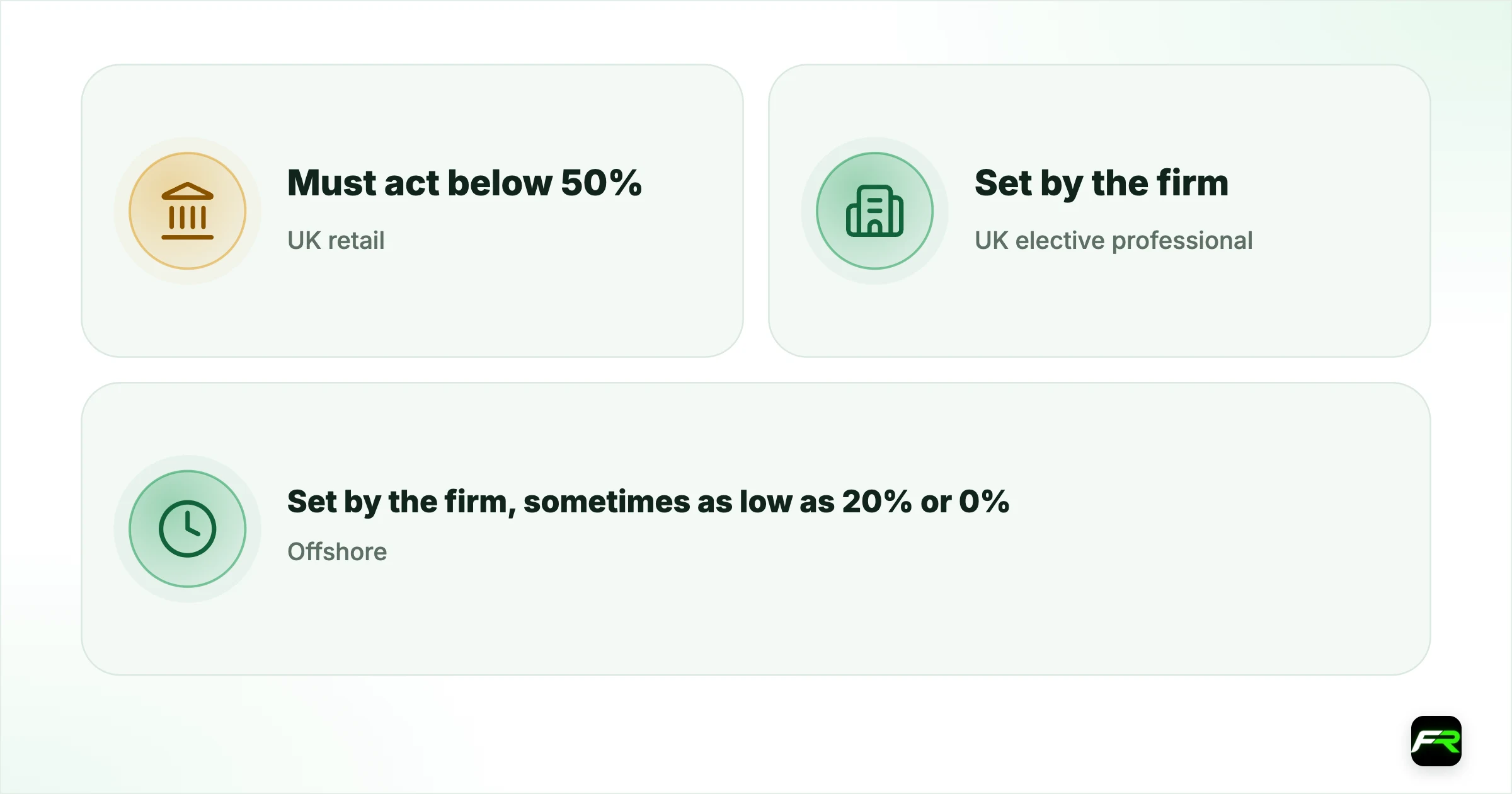
| Account type | Close-out level | Negative balance protection |
|---|---|---|
| UK retail (FCA-authorised) | Must act below 50% | Guaranteed by COBS 22.5.17R |
| UK elective professional | Set by the firm | Only if the firm’s terms offer it |
| Offshore (e.g. Seychelles, St Vincent) | Set by the firm, sometimes as low as 20% or 0% | Varies; may not be guaranteed |
Higher leverage makes the difference sharper. At 500:1 the margin on one lot of cable is about £200, so the close-out point is tiny relative to the position, and a normal London session move can take the account to zero. If a gap then pushes it below zero, whether you owe the difference depends on a contract you may never have read.
Yusuf held one lot of GBP/USD long from 1.3400 in a £4,000 retail account with an FCA-authorised firm, with margin of £3,333. By Friday’s close the trade was 250 pips down, leaving equity of about £2,135, just above the £1,667 close-out point. Over the weekend a political story broke and the market reopened on Sunday evening 600 pips below his entry. The firm closed him at the first price, a loss of about £4,476 (600 × £7.46). His account showed −£476 for a few minutes before it was reset to zero under negative balance protection. He lost his £4,000 but owed nothing. On an offshore account with no guaranteed protection, the £476 could have become a debt.
Practical sizing and stop habits
The best way to deal with the close-out rule is never to meet it. That comes down to position size, stops and how much free margin you keep. These are the habits we see in traders who last:
- Risk a small, fixed share per trade. Many traders cap risk at 1% to 2% of the account. On £1,500 that is £15 to £30. Our position size calculator turns that into lots from your stop distance.
- Place a stop on every trade at the level where your idea is wrong, not where the firm would close you out. See our guide to stop-loss and take-profit orders.
- Keep margin use low. A margin level of several hundred per cent leaves room for ordinary swings. Trade up to a 100% margin level and you have none.
- Cut size before weekends and big events, such as Bank of England decisions or UK CPI mornings, when gaps are more likely. Volatile crosses need the same care; our GBP/JPY trading guide shows how far that pair can move in a session.
- Consider guaranteed stops where the firm offers them. They cost a premium if triggered, but they cap the loss even through a gap.
- Do not top up a losing trade to avoid a close-out. It raises the funds at risk and rarely changes the outcome.
For more on sizing, our risk management guide goes further, and our article on UK leverage limits explains the margin percentages that feed into all of these numbers. Our UK beginner case studies show what happened to traders who met the close-out the hard way.
Frequently asked
What is the 50% margin close-out rule in the UK?
Under COBS 22.5.13R, when a retail client’s equity falls below 50% of the margin needed for their open CFD, spread bet or rolling spot FX positions, the firm must close one or more positions as soon as market conditions allow. It is applied per account.
Is the 50% close-out the same as a margin call?
Not quite. A margin call is usually a warning, often when your margin level reaches 100%, that you cannot open new trades and may need to act. The 50% close-out is the point where the FCA requires the firm to start closing positions for you.
Can I lose more than my deposit trading forex in the UK?
Not as a retail client of an FCA-authorised firm. Negative balance protection under COBS 22.5.17R limits your loss to the funds in the account. You can still lose all of that money. Professional clients and offshore accounts may not have this protection.
Which position does the broker close first?
The FCA rule does not say. Many firms close the position with the largest loss first, then check the margin level again; some close all positions at once. Your client agreement or the firm’s help pages will describe its method.
Why was I closed out below 50%?
Because the next available price may be worse than the trigger level. In fast markets or after a weekend gap, the firm can only close at the first price it gets, which can leave your equity well below 50% or even below zero.
Does negative balance protection apply to spread betting?
Yes. The FCA rules treat financial spread bets the same as CFDs and rolling spot forex, so a retail spread betting account is covered by both the 50% close-out and negative balance protection.
Do offshore brokers offer negative balance protection?
Some advertise it, but it is a term of the contract, not an FCA rule, and definitions vary. One large offshore firm says you bear losses beyond your balance. If you rely on this protection, a UK-authorised firm and a retail account are the way to guarantee it.
Related reading
The team behind this guide
Researched, checked and approved by five forex specialists
Every guide is written, fact-checked and edited before it goes live, and updated when the facts change. Spotted an error? Tell us.