





























Elective Professional Client UK: Criteria, Risks and 2026 Plans
To go pro in the UK you must pass a broker’s qualitative check and two of three tests on trading, portfolio size and industry work. You gain leverage and lose the FCA’s retail protections.
 WriterAbir KhanWriterWrites the guides · checks every figure against primary sources View profileAbout Abir →
 Market analysisTanbir Habib RiyadForex & Crypto AnalystForex and crypto analyst · technical and fundamental analysis View profileAbout Tanbir →
 Fact-checking & riskJannatul FerdaushFact-Checker & Risk AnalystFact-checks every figure · risk analysis · Applied Statistics, University of Dhaka View profileAbout Jannatul →
 Trading reviewJowel RanaCo-Founder & Forex TraderCo-founder · forex trader · reviews guides from a trader's view View profileAbout Jowel →
 Final approvalRanjan NiskrityFounder, Owner & Forex TraderFounder and owner · forex trader · signs off every guide View profileAbout Ranjan →
You can become an elective professional client in the UK if a firm judges that you have the expertise to make your own decisions and you meet at least two of three tests in COBS 3.5.3R: frequent trading of significant size, a portfolio above €500,000, or at least a year working in the financial sector in a relevant role. Next comes paperwork: a written request from you, a written warning from the firm, and your separate written confirmation that you understand the consequences. The price is most of the FCA’s retail CFD protection, including the leverage caps and the guaranteed limit on losses.
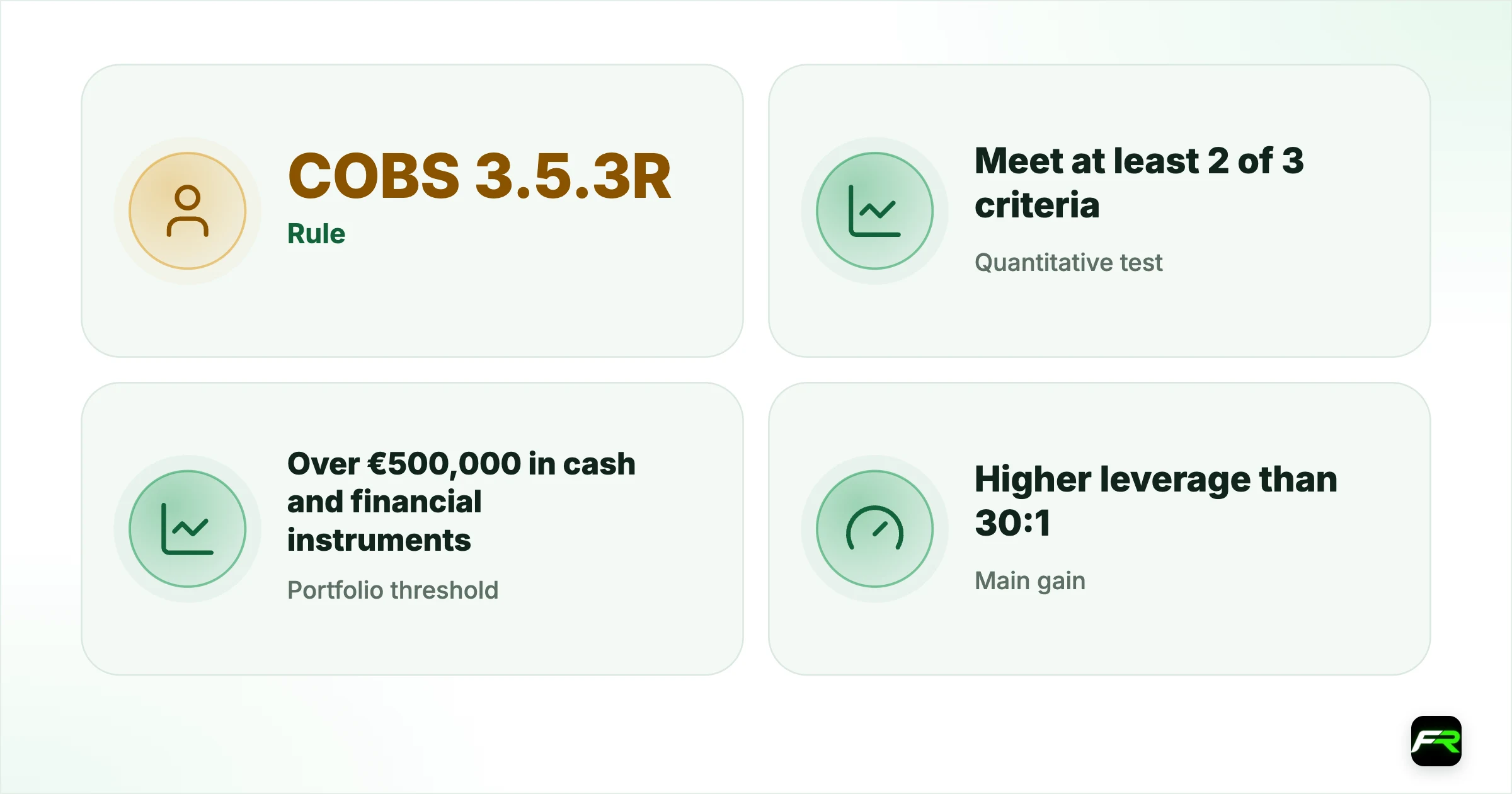
| Rule | COBS 3.5.3R (elective professional clients) |
|---|---|
| Quantitative test | Meet at least 2 of 3 criteria |
| Portfolio threshold | Over €500,000 in cash and financial instruments |
| Main gain | Higher leverage than 30:1 |
| Main losses | Leverage caps, 50% close-out, negative balance protection as a right, bonus ban, possible title transfer of your money |
| Reform | CP25/36 proposals (December 2025), no final rules as of September 2026 |
General information, not legal or financial advice. The FCA is consulting on changes to these rules, so check the current position before you apply.
The three tests in COBS 3.5.3R
There are two parts to the assessment. The first is qualitative: the firm has to assess your expertise, experience and knowledge and be reasonably satisfied that you can make your own investment decisions and understand the risks of the products involved. A tick-box form alone should not satisfy that. The second is quantitative, and you need at least two of the following:
| Criterion | What the rule says | How firms usually test it |
|---|---|---|
| Trade frequency | Transactions of significant size, averaging 10 per quarter over the previous four quarters, on the relevant market | Statements from your current broker showing 40+ sizeable trades over a year |
| Portfolio size | A financial instrument portfolio, including cash deposits and financial instruments, exceeding €500,000 | Bank, ISA, SIPP or broker statements; property does not count |
| Work experience | At least one year working in the financial sector in a professional position requiring knowledge of the transactions or services envisaged | CV, reference or employer letter |
The FCA does not define “significant size”, so each broker sets its own bar. Some look for a minimum notional per trade, others for a minimum number of lots. The euro threshold catches people out too. At an illustrative rate of about €1.14 to the pound, €500,000 is somewhere around £440,000, and the firm will check the sterling value on the day it reviews your evidence.
The work experience test is narrower than it sounds. Five years in a bank’s HR department is time in the financial sector, but the role has to require knowledge of the transactions you plan to make. A former FX dealer or derivatives risk analyst clearly fits, while a mortgage adviser may not.
The process, step by step
- Written request. You state that you wish to be treated as a professional client, either generally or for a particular service, transaction or product type.
- The firm’s warning. It must give you, in writing, a clear warning of the protections and investor compensation rights you may lose.
- Separate confirmation. You then state in writing, in a document separate from the client agreement, that you are aware of the consequences of losing those protections.
- Assessment and evidence. The firm carries out the qualitative assessment and checks the two quantitative criteria you rely on. Expect to upload statements.
- Ongoing duty. Professional clients are expected to tell the firm about any change that could affect their categorisation, and the firm should act if it learns you no longer qualify.
You can ask to go back to retail status at any time, and firms must let professional clients request a higher level of protection. In practice, switching back means your leverage drops to the retail caps, which can trigger margin calls on open positions, so do it while you are flat or lightly positioned.
What you lose by going pro
The retail rules in COBS 22.5 stop applying to you. That is the whole purpose from the firm’s side, because it is what allows higher leverage. The list is longer than many account pages make it look.
| Protection | Retail client | Elective professional |
|---|---|---|
| Leverage caps (30:1 majors, 20:1 minors and gold) | Yes | No; firm sets its own limits |
| 50% margin close-out per account | Yes | No; firm’s own stop-out level applies |
| Negative balance protection | A right under COBS 22.5.17R | Not guaranteed; only if the firm’s terms offer it |
| Ban on bonuses and trading incentives | Yes | No |
| Client money segregation | Required under CASS | Firm may use a title transfer arrangement instead |
| Financial Ombudsman access | Yes | Usually kept if you act as a consumer |
| FSCS eligibility | Yes, up to £85,000 | Not lost just by opting up, but see below |
The client money point gets the least attention and matters a great deal. Under CASS 7.11 a firm cannot use a title transfer collateral arrangement (TTCA) with a retail client. With a professional client it can. Under a TTCA your cash becomes the firm’s money, securing your obligations, rather than client money held in a segregated account. If the firm fails, you may be an unsecured creditor for that balance instead of a client with a claim on a ring-fenced pool. Ask the firm in writing whether your money will be held as client money or under title transfer.
Negative balance protection is the other big one. As a retail client, your liability for CFD and spread bet losses is capped at the money in your account. Opt up, and a weekend gap or a flash move can leave you owing the firm money. Some firms extend a version of this protection to professional clients in their terms; that is a promise in the contract, not an FCA rule, and it can change.
What you probably keep
Two protections usually survive, but keep your expectations measured. The Financial Ombudsman’s eligibility rules look at who you are and what capacity you acted in. An individual acting for purposes outside a trade or profession is a consumer, and DISP 2.7.9AR means an individual acting as a consumer can usually still complain to the Ombudsman even after opting up. Opted-up traders who run their trading through a company are in a different position.
On the FSCS, eligibility for investment protection is not lost merely because you opted up. The practical limit is what the scheme covers: money or assets the failed firm held for you. If your cash was taken under title transfer, it was not held for you as client money, which can make the position much weaker. FSCS protection also never covers trading losses. The limit for investment claims is £85,000 per person per firm; the £120,000 figure you may have seen applies to bank deposits only.
The FCA’s warning about pressure to opt up
On 30 October 2025 the FCA warned that some firms were pressuring clients to opt up to professional status. It said the retail protections stop nearly 400,000 people a year from risking more than their original stake in CFDs and provide between £267m and £451m worth of protection. The regulator also said finfluencers were steering people towards unregulated offshore firms, and that over 90,000 people had lost around £75m over four years in this way at just one firm.
High-pressure selling tends to look familiar: account managers calling to suggest you “upgrade”, forms pre-filled with answers, portfolio evidence waved through, and pro status sold as a reward rather than a trade-off. Any of that is a sign the firm values your trading volume more than your suitability. You can refuse, and you can complain to the firm and then to the Ombudsman if you were pushed into it.
Never overstate your trading history or portfolio to pass the tests. It removes protections you would have kept, and a firm that later finds false information can reclassify or close the account. Any complaint you bring may also be weakened.
CP25/36: the proposed changes
In consultation paper CP25/36, published on 8 December 2025, the FCA proposed rewriting the client categorisation rules. The consultation closed on 2 February 2026. As of September 2026 the FCA’s page still says it will publish feedback and a policy statement once it has reviewed responses, so these are proposals, not rules.
- Removal of the quantitative test for individual clients, so the 10-trades-a-quarter and €500,000 thresholds would go.
- A stronger qualitative assessment in their place, with firms expected to do more to show you understand the risks.
- Wealth-based consent for clients with investable assets that law firms report as £10m or more, who could agree to professional status without the full assessment.
For a typical UK spread bettor with a few hundred thousand pounds, the likely direction is fewer mechanical shortcuts and more scrutiny of whether you understand what you are signing. Law firms commenting on the paper have said they would not expect changes to take effect before 2027. Until a policy statement appears, the current COBS 3.5.3R tests apply.
Lewis had £470,000 across a stocks and shares ISA, a SIPP and cash savings, which at an illustrative €1.14 to the pound was about €536,000, and he had placed around 60 spread bets of £20 per point or more in the past year. He passed two criteria and opted up to trade indices at 100:1. His firm’s terms did not include negative balance protection for professional clients. A Monday gap on the FTSE 100 left one account £1,800 below zero after his positions were closed out, and he paid it. He also found his cash had been held under title transfer. In the end he switched back to retail status and now runs his larger positions with more capital at 20:1 instead.
What brokers ask for, and which UK brokers offer pro accounts
Large UK brokers run their own pro applications, usually from inside the client area. Pepperstone and CMC Markets both set out the COBS 3.5.3R tests on their professional pages as three yes-or-no questions, and IG publishes a similar pro trader page. All three state that negative balance protection does not apply to professional clients. Pepperstone adds that it will not close you out at the 50% level and advertises leverage of up to 1:500 on forex and gold for Pro clients, while IG says pro traders are not subject to the retail leverage caps and that losses can exceed deposits.
Evidence is where applications succeed or stall. Pepperstone asks you to complete a form and then upload eligibility documents. For the trading test that normally means statements from another broker showing the size and dates of your trades over the last four quarters. The portfolio test needs recent statements for your cash and investment accounts, and the work test a CV, contract or employer letter describing the role. Firms do not publish exactly what counts, so expect follow-up questions. Pepperstone also notes that switching to a Pro account does not change your tax position.
None of this is a recommendation to apply. Offshore brokers are a separate matter again: many give every client high leverage without any categorisation, because COBS does not bind them. That is not professional status. It is an account outside the UK rules, with none of the retail protections there to lose in the first place. Our guides to IC Markets leverage for UK residents and offshore brokers for UK residents explain what that means in practice.
Who should consider it, and who should not
Our view at FX Recap: elective professional status suits a small group. That means people with a long, documented trading record, capital they can genuinely afford to lose, and a reason to need more than 30:1, such as hedging a large portfolio. Even then, check the firm’s treatment of client money and negative balances before signing.
It is a poor idea if the main attraction is turning a small account into bigger positions. Higher leverage mostly shortens the time it takes to lose money, and the retail rules exist because most retail accounts already lose. Read our article on UK leverage limits first; sizing properly under the retail caps may solve the problem you thought needed pro status.
Frequently asked
What are the criteria for professional client status in the UK?
Under COBS 3.5.3R the firm must be satisfied with your expertise and experience, and you must meet two of three tests: about 10 significant trades a quarter over the past year, a portfolio above €500,000 of cash and financial instruments, or a year working in a relevant financial sector role.
Does my house count towards the €500,000 portfolio test?
No. The test looks at a financial instrument portfolio, including cash deposits and financial instruments such as shares and funds. Property is not a financial instrument. Firms typically ask for bank, ISA, SIPP or brokerage statements as evidence.
Do professional clients get negative balance protection?
Not as an FCA right. The COBS 22.5.17R limit on losses applies only to retail clients. Some firms offer a similar protection to professional clients in their terms, but that is contractual and can change, so read the client agreement.
Can I still use the Financial Ombudsman if I opt up?
Usually yes, if you are an individual acting as a consumer, meaning for purposes outside a trade or profession. DISP 2.7.9AR preserves access in that situation. If you trade through a company, eligibility depends on the company’s size and status.
Will I lose FSCS protection as a professional client?
Opting up does not by itself remove FSCS eligibility. The catch is that a firm can hold a professional client’s money under a title transfer arrangement, so it may not be client money held for you. That can weaken your position if the firm fails.
Can I go back to being a retail client?
Yes. You can ask the firm to reclassify you as retail at any time. Your leverage will fall to the retail caps, which may trigger margin calls on open positions, so it is best done with few or no trades open.
Has the FCA changed the professional client rules in 2026?
Not yet. CP25/36, published 8 December 2025, proposed removing the quantitative tests, strengthening the qualitative check and adding a wealth route. The consultation closed on 2 February 2026 and no policy statement had been published as of September 2026.
Is it a red flag if a broker calls me to suggest going pro?
It should make you cautious. In October 2025 the FCA warned about firms pressuring clients to opt up. A firm that pre-fills forms or sells pro status as a perk is putting its interests first. You are entitled to say no.
Related reading
The team behind this guide
Researched, checked and approved by five forex specialists
Every guide is written, fact-checked and edited before it goes live, and updated when the facts change. Spotted an error? Tell us.