





























Can a UK Resident Use an Offshore Forex Broker? (2026 Rules)
Yes, it is not a crime for you to open an offshore account. But you give up FCA rules, the Ombudsman, FSCS cover and guaranteed negative balance protection, and HMRC still taxes your gains.
 WriterAbir KhanWriterWrites the guides · checks every figure against primary sources View profileAbout Abir →
 Market analysisTanbir Habib RiyadForex & Crypto AnalystForex and crypto analyst · technical and fundamental analysis View profileAbout Tanbir →
 Fact-checking & riskJannatul FerdaushFact-Checker & Risk AnalystFact-checks every figure · risk analysis · Applied Statistics, University of Dhaka View profileAbout Jannatul →
 Trading reviewJowel RanaCo-Founder & Forex TraderCo-founder · forex trader · reviews guides from a trader's view View profileAbout Jowel →
 Final approvalRanjan NiskrityFounder, Owner & Forex TraderFounder and owner · forex trader · signs off every guide View profileAbout Ranjan →
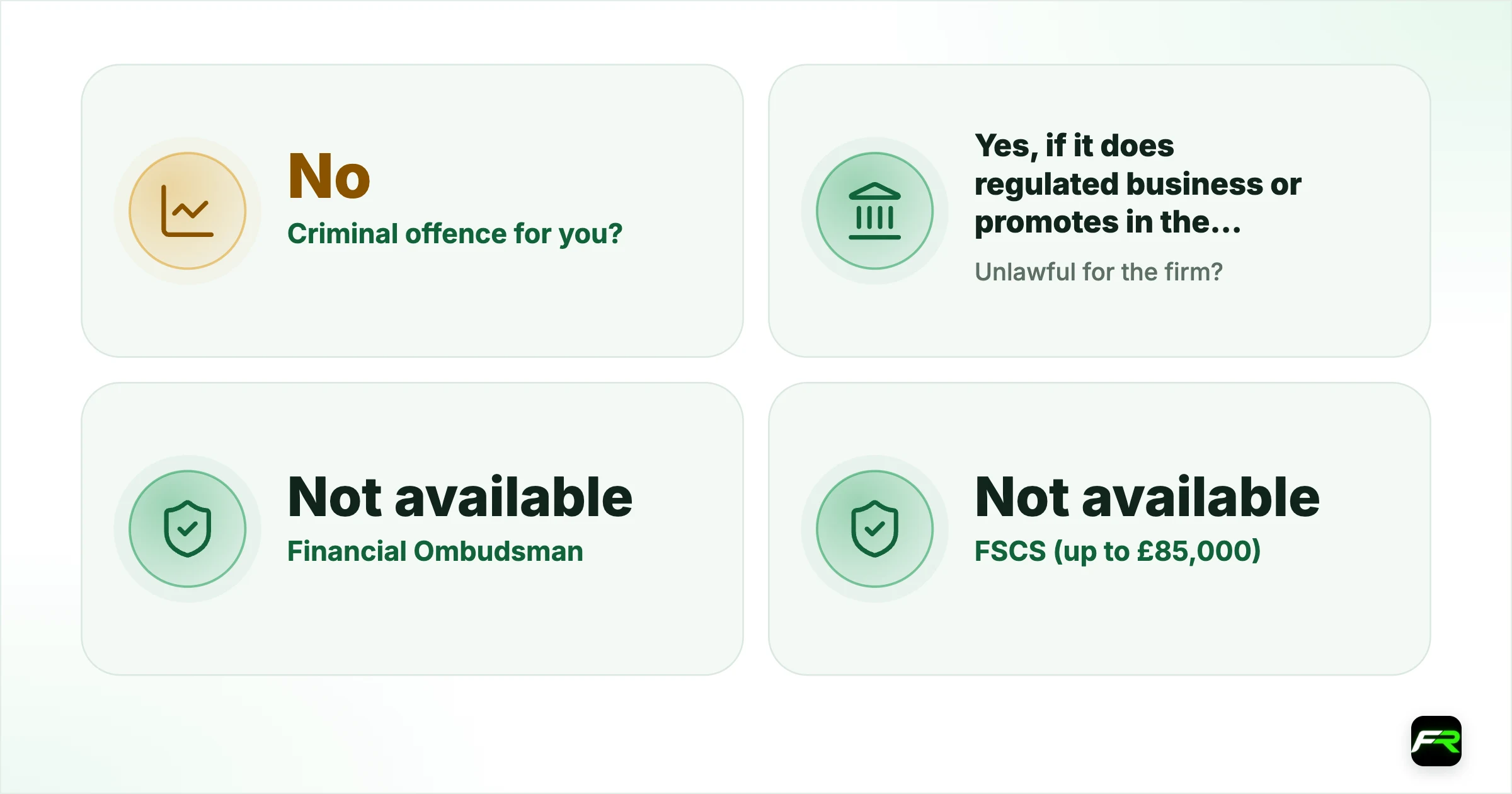
Yes, a UK resident can open an account with an offshore forex broker, and doing so is not a criminal offence for you. The law targets the firm: an overseas company that carries on regulated business in the UK or promotes itself to UK residents without FCA authorisation is acting unlawfully. What you give up is protection. An offshore account sits outside FCA conduct rules, the Financial Ombudsman Service, the Financial Services Compensation Scheme (FSCS) and the FCA’s guarantee that you cannot lose more than your balance. Your profits are still taxable in the UK.
FX Recap’s view is that this is a poor trade for most people, and especially for beginners. There are narrow cases where an experienced trader might accept the risk, and we cover those honestly further down, along with a checklist for anyone who goes ahead anyway.
General information, not legal or tax advice. FCA rules and UK tax law can change, including at the Budget on 28 October 2026. If your situation is unusual, speak to a qualified adviser.
| Criminal offence for you? | No |
|---|---|
| Unlawful for the firm? | Yes, if it does regulated business or promotes in the UK without authorisation |
| Financial Ombudsman | Not available |
| FSCS (up to £85,000) | Not available |
| Negative balance protection | Only if the firm’s own terms offer it |
| UK tax on profits | Still due |
Where the law draws the line
The Financial Services and Markets Act 2000 bans anyone from carrying on a regulated activity in the UK unless they are authorised or exempt, and separately bans unapproved financial promotions. Both rules bite on the business. Nothing in them makes it an offence for a British customer to hold an account abroad, and we are not aware of any retail trader being prosecuted simply for using an overseas broker.
The FCA’s response to offshore firms is the Warning List. When it believes an unauthorised firm is targeting UK residents, it publishes a warning that the firm "is not authorised by us" and that you should avoid dealing with it. The FCA published 2,240 such warnings in 2024 and 2,329 in 2025. A warning does not freeze your account or make your trades void. It tells you that the firm is outside UK rules and that you have no UK route to complain or claim compensation.
EU passporting is no longer a route in either. EEA firms lost their passports on 31 December 2020, and the Temporary Permissions Regime that let some carry on ended on 30 December 2023. A Cypriot or Irish broker without its own UK authorisation is, for your purposes, offshore.
What you give up
| Protection | FCA-authorised broker | Offshore broker |
|---|---|---|
| Leverage caps (30:1 on majors) | Yes | No, often 500:1 or more |
| 50% margin close-out | Yes | Firm’s own stop-out level |
| Negative balance protection | Required for retail clients | Depends on terms, often not guaranteed |
| Client money segregated under CASS | Yes | Local rules, if any |
| Financial Ombudsman (awards up to £455,000) | Yes | No |
| FSCS if the firm fails (up to £85,000) | Yes | No |
| Bonus ban | Yes | Bonuses common |
| Disputes heard in | UK | The firm’s home courts |
The last row is the one people underestimate. If an offshore broker refuses a withdrawal or voids your profits, your only formal remedy is usually a claim under that country’s law. Some offshore regulators run their own complaints processes, but they do not have the Ombudsman’s power to make a binding award in your favour, and hiring a lawyer abroad to chase £3,000 rarely makes sense.
Negative balance protection deserves its own mention. Under FCA rules, a retail client’s losses on CFDs and spread bets are capped at the money in the account. Offshore terms vary. Some firms apply a balance reset as a policy they can withdraw; others say plainly that you bear any negative balance. With leverage of 500:1, a weekend gap on a currency pair can wipe out an account and leave a debt.
The extra risks that come with offshore accounts
- Withdrawals. Delays, extra identity checks and rules that force withdrawals back to specific payment methods are the most common complaints about offshore brokers.
- Bonuses with strings. A 50% or 100% deposit bonus usually comes with a trading volume target before you can withdraw it, and sometimes before you can withdraw profits made with it. The FCA bans bonuses for UK retail clients for this reason.
- High leverage by default. Accounts often open at 500:1, against the 30:1 UK retail cap on majors. One bad position can take out the whole balance in minutes, as our look at IC Markets leverage for UK clients explains.
- Clones. Offshore brands are copied by scam sites, and without a UK register entry it is harder to verify contact details.
- Policy changes. An offshore firm can change terms, exit a market or close accounts with little notice and no UK oversight.
The FCA’s 25 September 2026 announcement adds another layer. It said 24 CFD firms have closed or are closing after it challenged firms that use a UK authorisation "as a badge" for linked overseas companies. Many UK residents think they are with an FCA firm when their contract is with an offshore sister company. Read our piece on the 2026 CFD crackdown and check the entity named in your own agreement.
Tax: offshore does not mean untaxed
HMRC taxes UK residents on worldwide gains, so a broker in the Seychelles or the Bahamas changes nothing. Offshore firms sell CFDs and rolling spot FX, not UK spread bets, which means your profits are normally capital gains. For 2026/27 the annual exempt amount is £3,000, above which gains are taxed at 18% within the basic rate band and 24% above it. Losses can be set against gains if you claim within four years of the end of the tax year.
If your account is in US dollars, each disposal has to be converted to sterling at the date it happened. A trader who made $8,000 over the year cannot just convert the total at the year-end rate. Keep full statements and export them before you close an account, because offshore brokers are not always quick to supply history later. Our guide to reporting CFD gains on self assessment walks through it, and rates could change at the 28 October 2026 Budget.
Marcus had traded for nine years and wanted raw spreads and cTrader. He opened an offshore account with £4,000 while keeping his main £20,000 with an FCA-authorised spread betting firm. Over the 2025/26 tax year the offshore account made £5,400 in net CFD gains. After the £3,000 exempt amount, £2,400 was taxable; as a higher-rate taxpayer he paid 24%, or £576, through self assessment. His spread betting profits of £3,100 at the UK firm were not taxable. He capped the offshore balance at £4,000 and withdrew profits monthly to his debit card, accepting that the money had no FSCS or Ombudsman cover.
Who might reasonably still choose offshore
We are not going to pretend nobody should ever use an overseas broker. An experienced trader who wants a particular platform, raw pricing on a specific account type, or larger size than 30:1 allows without going through professional client status might decide the trade-off is acceptable. People who live abroad for part of the year, or who hold accounts from before they moved to the UK, are in a similar position.
Those who should not: beginners, anyone who would be hurt by losing the whole balance, anyone who relies on the Ombudsman or FSCS for peace of mind, and anyone who wants tax-free spread betting, which offshore firms do not offer. If a deposit bonus or 1:1000 leverage is the main attraction, that is the clearest sign offshore is wrong for you. For a concrete example of how this plays out with one well-known brand, see our explainer on whether UK residents can use IC Markets (now trading as IC), and our check of whether IC Markets is FCA regulated.
If you still go ahead: a checklist
- Check the firm on its home regulator’s register and search the FCA Warning List. Know which you are accepting.
- Read the client agreement for the legal entity, governing law, negative balance policy and withdrawal rules.
- Refuse any bonus. It is the most common source of withdrawal disputes.
- Set leverage manually to a level you would accept at a UK firm, such as 30:1 on majors.
- Deposit only what you could lose entirely, and make a small test withdrawal before you trade.
- Withdraw profits regularly rather than letting a large balance build.
- Export statements every month for HMRC and report gains on self assessment.
- Keep your main capital with an FCA-authorised firm.
Want the lower costs without the offshore risk? Several FCA-authorised brokers offer raw spread accounts with commission, MT4, MT5 or cTrader. Compare them in our best FCA-regulated brokers list.
Frequently asked
Is it illegal for UK residents to use offshore forex brokers?
No. There is no offence for the customer. The firm may be breaking UK law if it carries on regulated business or promotes to UK residents without FCA authorisation. You simply lose UK protections, including the Ombudsman and FSCS.
Can the FCA help me get money back from an offshore broker?
The FCA does not resolve individual complaints and has no power over unauthorised overseas firms beyond warnings and action against UK promotion. Nor can the Financial Ombudsman consider complaints against firms outside its jurisdiction. You would need the firm’s own process or its home regulator and courts.
Do I pay UK tax on profits from an offshore broker?
Yes. UK residents are taxed on worldwide gains. Offshore CFD and rolling spot FX profits are normally capital gains, taxable above the £3,000 annual exempt amount at 18% or 24%. Spread betting tax treatment does not apply because offshore firms offer CFDs, not UK spread bets.
Will my bank block payments to an offshore broker?
There is no general UK rule blocking them, but banks may query or stop payments that look like fraud, and some restrict payments to crypto platforms. Card and e-wallet acceptance depends on the broker and your card issuer.
Are EU-regulated brokers safe for UK traders?
EU firms lost UK passporting rights at the end of 2020, and the temporary regime ended on 30 December 2023. Unless the firm has its own FCA authorisation, a UK resident is outside FCA rules, the Ombudsman and the FSCS. Some EU brokers state that their services are not for UK residents.
Why do offshore brokers offer 500:1 leverage?
Because their home rules allow it and it attracts customers. Higher leverage means smaller price moves can wipe out your balance. UK retail rules cap major pairs at 30:1 for that reason, and FCA firms must stop you losing more than your deposit.
Is an offshore broker the same as a scam?
No. Many offshore brokers are real businesses licensed by their home regulator. The issue is that UK protections do not apply, and clone sites copying offshore brands are common. Check the home regulator’s register and the FCA Warning List before depositing.
Can UK residents trade crypto CFDs with an offshore broker?
Some offshore firms will let you. The FCA ban on selling crypto derivatives to retail clients, in force since 6 January 2021, is a rule for firms, so you commit no offence as the customer. You would be holding a product UK firms may not sell you, usually at high leverage, with no Ombudsman, no FSCS and no guaranteed negative balance protection behind it.
Related reading
The team behind this guide
Researched, checked and approved by five forex specialists
Every guide is written, fact-checked and edited before it goes live, and updated when the facts change. Spotted an error? Tell us.