





























IC Markets vs Pepperstone UK: Raw Pricing, Different Protection
For a UK resident, Pepperstone wins on protection and tax: it is FCA authorised, covered by the FSCS and the Ombudsman, and offers tax-free spread betting. IC Markets is offshore, CFD-only.
 WriterAbir KhanWriterWrites the guides · checks every figure against primary sources View profileAbout Abir →
 Market analysisTanbir Habib RiyadForex & Crypto AnalystForex and crypto analyst · technical and fundamental analysis View profileAbout Tanbir →
 Fact-checking & riskJannatul FerdaushFact-Checker & Risk AnalystFact-checks every figure · risk analysis · Applied Statistics, University of Dhaka View profileAbout Jannatul →
 Trading reviewJowel RanaCo-Founder & Forex TraderCo-founder · forex trader · reviews guides from a trader's view View profileAbout Jowel →
 Final approvalRanjan NiskrityFounder, Owner & Forex TraderFounder and owner · forex trader · signs off every guide View profileAbout Ranjan →
For most people living in the UK, Pepperstone is the better choice, and the reason has little to do with price. Both firms offer raw spreads from 0.0 pips plus a commission, and the cost gap between them is small. The gap in protection is not. Pepperstone Limited is authorised by the FCA (FRN 684312), so your money sits under UK client money rules, the FSCS and the Financial Ombudsman Service apply, and you can spread bet with profits outside capital gains tax. IC Markets (now trading as IC) has no FCA authorisation, a UK resident is in practice onboarded by its Seychelles company, and every product it sells is a CFD, so gains fall under CGT.
That does not make IC a scam or a bad broker. IC is a large, genuinely licensed firm with deep liquidity and a strong cTrader offer. For a UK resident, though, the deal is different from the one many comparison tables imply. You will still see it said that UK clients are handled by IC's Cyprus company, but IC's EU site states that its information is not intended for UK residents. Below we set out what you give up and what you gain on each side, with the numbers checked on both firms' own pages in September 2026.
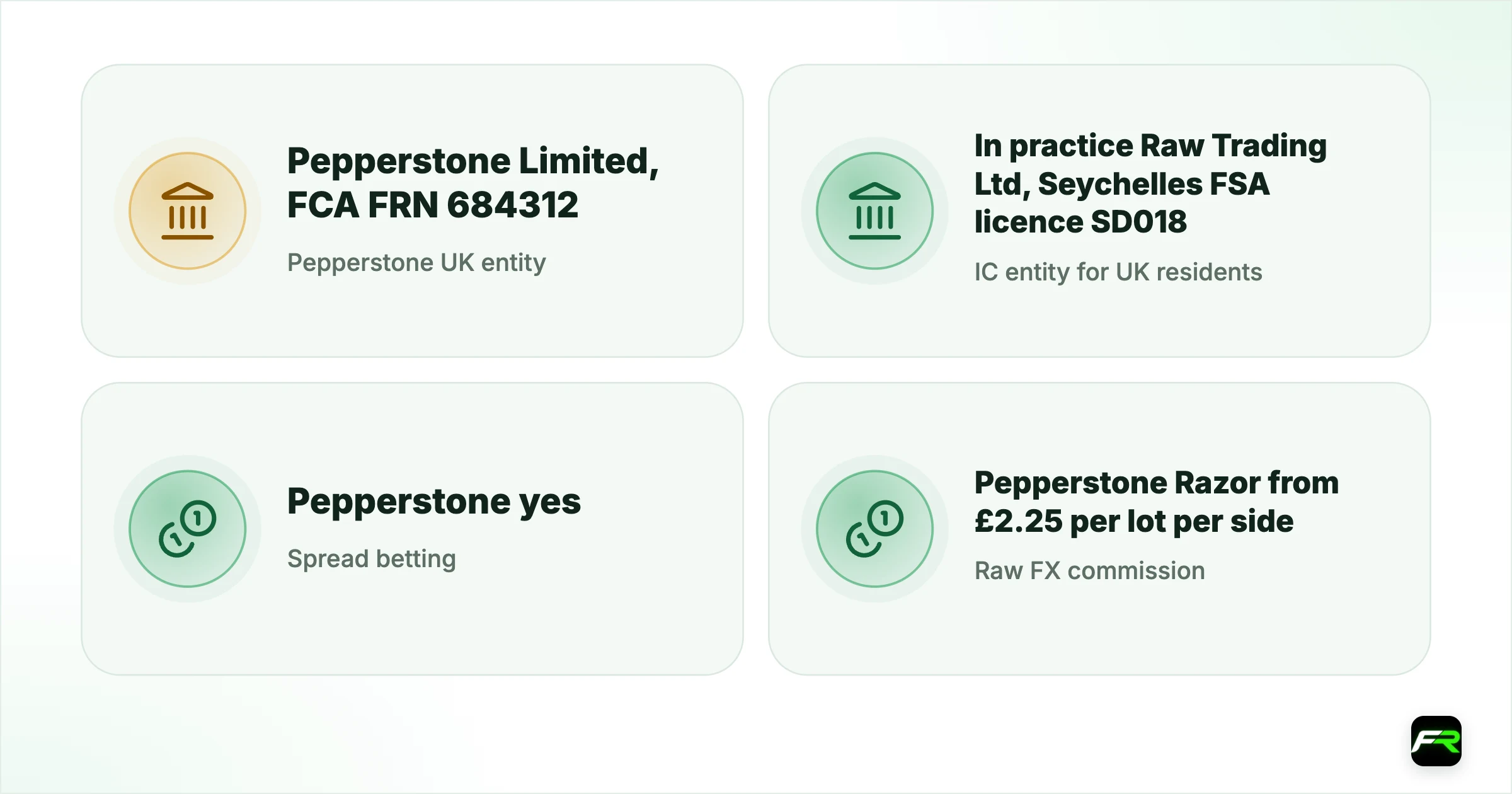
| Pepperstone UK entity | Pepperstone Limited, FCA FRN 684312 |
|---|---|
| IC entity for UK residents | In practice Raw Trading Ltd, Seychelles FSA licence SD018 |
| Spread betting | Pepperstone yes; IC no (CFDs only) |
| Raw FX commission | Pepperstone Razor from £2.25 per lot per side; IC GBP Raw £2.75 per side |
| FSCS / Ombudsman | Pepperstone yes (£85,000 FSCS limit); IC neither |
| Retail loss figure | Pepperstone 72.9%; IC's Seychelles entity publishes none |
The tax difference: spread betting versus CFDs
HMRC treats the two products very differently, and this alone decides the matter for many UK traders. A financial spread bet is treated as betting: HMRC's Capital Gains Manual says no chargeable gains or allowable losses arise from spread betting, and for an individual the winnings sit outside income tax too. CFDs are different: HMRC treats them as financial futures, so your net gains for the year go on your self assessment and are charged to capital gains tax once they pass the £3,000 annual exempt amount. The rates are 18% within the basic rate band and 24% above it.
Pepperstone runs a separate spread betting account staked in pounds per point, with costs built into the spread and no commission. IC offers no spread betting at all, so every pound of profit you make there is potentially taxable. Tax relief runs the other way, though: CFD losses are allowable and can be set against other gains, while spread betting losses give you no relief. A trader who expects to lose, or who has large gains elsewhere to offset, can reasonably prefer CFDs. Our spread betting vs CFD guide walks through that choice.
General information, not tax advice. Your own position depends on your circumstances, and tax rules can change, including at the 28 October 2026 Budget.
Protection: FCA, FSCS and the Ombudsman versus Seychelles
At Pepperstone UK you are a retail client of an FCA-authorised firm. Your money must be held in segregated client accounts under the CASS rules, away from the firm's own creditors. If the firm failed and there was a shortfall, the FSCS could pay up to £85,000 per person. Where a complaint is not resolved within eight weeks, the Financial Ombudsman Service can look at it for free, with awards of up to £455,000 for complaints referred from 1 April 2026. Leverage is capped at 30:1 on major pairs, you get negative balance protection, and a 50% margin close-out stops a position before it eats the whole account.
IC's Seychelles company operates under a different rulebook. The FCA's Warning List entry against IC Markets Global, updated on 10 August 2026 to name ic.com, says the firm is not authorised and may be targeting people in the UK, and that UK customers will not have access to the Ombudsman or the FSCS. Disputes go under Seychelles law. Leverage can reach 1:5000 on MetaTrader, a deposit bonus is offered, and IC's own help centre says that if you lose more than your balance you bear the consequences. IC does hold client money insurance of up to USD 1,000,000 for the insolvency of Raw Trading Ltd, but that is a private policy, not the FSCS, and it does nothing for a dispute over a trade.
| Protection point | Pepperstone UK | IC (Seychelles, as used by UK residents) |
|---|---|---|
| Regulator | FCA | Seychelles FSA |
| Compensation scheme | FSCS up to £85,000 | None; private insurance up to USD 1m for insolvency |
| Complaints body | Financial Ombudsman Service | No UK route; Seychelles law and courts |
| Max leverage, major FX (retail) | 30:1 | Up to 1:5000 on MT4/MT5, 1:1000 on cTrader |
| Negative balance protection | Yes, a rule for retail clients | Not guaranteed |
| Bonuses | Banned for UK retail CFDs and spread bets | Deposit bonus offered |
Commission and spreads compared
Both firms price their raw accounts the same way: a spread that can drop to 0.0 pips on major pairs, plus a fixed commission per lot. On a pound-based account, Pepperstone's Razor account charges from £2.25 per standard lot per side, and on MT4 it charges the full £4.50 round turn when you open. IC's GBP Raw account charges £2.75 per side, £5.50 round turn. IC has cheaper tiers, Raw Pro at USD 1.50 per side and Raw Pro+ at USD 1.00, but they need USD 5,000 and USD 100,000 minimum deposits and were marked early access when we checked.
Commission is only half the bill. The raw spread varies with the market, and neither firm publishes a clean, comparable GBP/USD average, so any claim that one is "0.1 pips tighter" on cable should be taken with salt. On EUR/USD IC quotes an average around 0.1 pips on Raw. For standard accounts with no commission, Pepperstone's spread betting account shows EUR/USD from 0.5 and GBP/USD from 0.8 points, while IC's Standard CFD account starts from 0.8 pips. Those are minimums, not averages, so check the live spread at the times you trade.
| Cost item | Pepperstone UK | IC |
|---|---|---|
| Raw account commission (GBP) | From £2.25 per lot per side (Razor) | £2.75 per lot per side (GBP Raw) |
| Raw account commission (USD) | Varies by platform | USD 3.50 per side MT4/MT5; USD 3 per USD 100k cTrader |
| No-commission option | Standard CFD or spread betting account | Standard CFD account, spreads from 0.8 pips |
| Minimum funding | £10 | No minimum on the Seychelles entity |
| Inactivity fee | None | None stated |
A worked cost example: 10 lots of GBP/USD a month
Take a trader who buys and sells 10 standard lots of GBP/USD a month, one lot per trade, on a GBP account. One lot of cable is £100,000 of sterling, and one pip is worth USD 10, roughly £7.50 with the pound near 1.33. To keep the comparison honest we assume the same raw spread at both firms, 0.2 pips, because neither publishes a reliable cable average.
| Monthly cost, 10 round-turn lots | Pepperstone Razor (CFD) | IC GBP Raw (CFD) | Pepperstone spread bet at £7.50/pt |
|---|---|---|---|
| Commission | 10 × £4.50 = £45.00 | 10 × £5.50 = £55.00 | None |
| Spread (assumed 0.2 pips raw; 0.8 pts minimum for the spread bet) | 10 × 0.2 × £7.50 = £15.00 | 10 × 0.2 × £7.50 = £15.00 | 10 × 0.8 × £7.50 = £60.00 |
| Total dealing cost | £60.00 | £70.00 | £60.00 at the minimum spread |
| Tax on profits | CGT above £3,000 | CGT above £3,000 | None for most individuals |
On these assumptions Pepperstone's Razor account is about £10 a month cheaper than IC, or £120 a year. Spread betting costs roughly the same only if you get the minimum spread; in busier or quieter hours it will cost more. Where spread betting pulls far ahead is tax. Suppose the trader ends the year £8,000 up. On CFDs at either broker, £5,000 is taxable after the annual exemption, which is £900 at 18% or £1,200 at 24%. As a spread bet, the same profit is normally tax-free. That £900 to £1,200 dwarfs any commission difference.
Rhys had traded GBP/USD on IC's cTrader Raw account for two years. He liked the fills, but when he sat down to do his 2025/26 self assessment he found £6,400 of net CFD gains, £3,400 of it above the exemption. As a higher-rate taxpayer he owed about £816. He opened a Pepperstone spread betting account for his discretionary cable trades and a Razor CFD account for the few trades he wanted on cTrader, and kept a small IC balance for testing. Over the next six months his dealing costs were within a few pounds of before, but the spread bet profits no longer went on his return, and his money now sat with an FCA firm under the FSCS.
Platforms, tools and account set-up
On platforms the two are close. Pepperstone UK supports MT4, MT5, cTrader, TradingView and its own web and mobile platform, and its account page lists all five for spread betting as well as for the Razor CFD account. That is unusual in the UK: few FCA brokers let you spread bet on cTrader or TradingView, as our spread betting brokers by platform table shows. IC offers MT4, MT5, cTrader, TradingView (through its cTrader Raw account), WebTrader, and copy trading through IC Social, ZuluTrade and Signal Start. It also gives a free VPS to clients trading 15 lots or more a month of FX and metals.
Both accept GBP as a base currency. Pepperstone's minimum funding is £10. IC's Seychelles entity has no minimum; the USD 200 figure quoted on many sites belongs to its Australian company. IC takes GBP by card, PayPal, Neteller, Skrill, wire, Rapidpay and Klarna, plus crypto, and does not charge deposit or withdrawal fees itself. Withdrawals follow its rules on returning money to the original method, and some traders report compliance checks slowing things down. Our GBP deposits and withdrawals guide goes through the detail.
Education, research and support
Pepperstone's UK site groups its learning material under Insights: trading guides, market analysis, an economic calendar and webinars. Its contact page offers support 24/7 by phone on a UK freephone number, 0800 046 5473, and by email. Demo accounts are available on each of its platforms, so you can try cTrader or TradingView with virtual funds before you commit any money.
IC runs its own education section, with getting-started videos, a web TV channel, webinars and a podcast, plus research tools such as Trading Central and an economic calendar. Its contact page promises 24/7 live chat. The phone number it lists is in the Seychelles, +248 467 19 76, and there is no UK line. Trustpilot reviewers often praise the live chat, while complaints tend to focus on slow, templated email replies and delays in account verification.
Broker education is partly marketing, and none of it will make a strategy profitable. What separates the two firms here is what happens when support cannot fix a problem. A complaint about Pepperstone can go to the Financial Ombudsman once eight weeks have passed; a complaint about IC has no UK route at all. For independent grounding that no broker will push, our forex risk management guide is a better starting point.
Our verdict by trader type
Pick by what you need, not by headline spread. For the majority of UK residents Pepperstone is the sensible default: same style of raw pricing, slightly cheaper commission in pounds, and the full set of UK protections.
- Beginner or casual trader: Pepperstone, ideally the spread betting account. Tax-free profits, capped leverage and negative balance protection matter more to you than a fraction of a pip.
- Active discretionary trader in the UK: Pepperstone. Razor for tight costs, spread betting for tax, and both on cTrader or TradingView if you want them.
- Trader who relies on CFD losses for tax relief: either firm on CFDs, but Pepperstone still gives you the FSCS and Ombudsman.
- Experienced trader who accepts offshore risk: IC can make sense for high leverage, the Raw Pro tiers, or a strategy built around its cTrader set-up. Go in knowing you have no UK safety net and keep balances modest.
- Anyone who is not UK resident: the comparison changes, because IC's Australian or Cyprus companies may be available to you. Check which entity your country is served by.
We compare IC with other FCA firms in the same way. Our IC Markets vs CMC Markets comparison looks at raw majors plus spread betting under one roof, and IC Markets vs XTB covers a CFD-only FCA broker where tax is the same at both.
If you already hold an IC account, check the company named in your client agreement. Should it name Raw Trading Ltd, you are dealing with a Seychelles firm and the FCA's warning applies to it. That is not a reason to panic, but it is a reason to think about how much you leave there.
Frequently asked
Is IC Markets cheaper than Pepperstone on a GBP account?
Usually not. IC's GBP Raw account charges £2.75 per lot per side against £2.25 on Pepperstone's Razor account. In our worked example of 10 round-turn lots of GBP/USD a month with the same 0.2 pip spread, Pepperstone cost £60 and IC £70. Some comparison sites call IC the cheapest for GBP accounts; on published sterling commissions it is not.
Do both offer swap-free accounts?
IC does. Its swap-free account replaces overnight interest with a flat holding fee, for example USD 7 per lot on GBP/USD. We did not find a swap-free account on Pepperstone's UK site; its swap-free pages sit on its international and EU sites. If you need one under FCA rules, ask Pepperstone UK directly before you open an account.
Which is better for copy trading?
IC has more choice: IC Social, ZuluTrade, Signal Start and cTrader's copy trading. We found no copy trading page on Pepperstone's UK site, although its international site has one. A copied trade carries the same risk as your own, and the FCA has warned about finfluencers steering people into unauthorised schemes, so check who you would be copying first.
Can I spread bet with IC Markets in the UK?
No. IC offers CFDs only, on every platform and account type. If you want tax-free spread betting you need an FCA-authorised firm that offers it, such as Pepperstone, IG, CMC Markets or Spreadex. Profits on IC CFDs are within capital gains tax.
Is IC Markets FCA regulated like Pepperstone?
No. Pepperstone Limited is FCA authorised under FRN 684312. IC holds no FCA authorisation and the FCA's Warning List has an entry against IC Markets Global, including ic.com. The group is licensed in Australia, Cyprus, the Seychelles, the Bahamas and Kenya, but none of those licences brings UK protections.
Which is better for cTrader in the UK?
Both offer cTrader. Pepperstone UK lets you use it for its Razor CFD account and for spread betting, under FCA rules. IC's cTrader Raw account charges USD 3 per side per USD 100k and also powers its TradingView link, but you trade as a client of an offshore firm.
Why do some sites say IC Markets serves UK clients from Cyprus?
They are out of date or wrong. IC's EU site says its information is not intended for residents of the United Kingdom, among others. In practice a UK resident signing up today is onboarded by Raw Trading Ltd in the Seychelles. Your client agreement names the entity, so check it.
What leverage do I get at each broker?
Pepperstone UK caps retail clients at 30:1 on major pairs and lower on other markets, under FCA rules. IC's Seychelles entity allows up to 1:5000 on MT4 and MT5 and 1:1000 on cTrader, tiered by balance, with higher margin around news and weekends. Higher leverage means faster losses.
Related reading
The team behind this guide
Researched, checked and approved by five forex specialists
Every guide is written, fact-checked and edited before it goes live, and updated when the facts change. Spotted an error? Tell us.