





























Best Forex Broker in the UK for Beginners
A beginner needs an FCA-authorised broker with negative balance protection, a low minimum, a demo account and a simple app. IG, Pepperstone, CMC, XTB and Capital.com qualify. Start small.
 WriterAbir KhanWriterWrites the guides · checks every figure against primary sources View profileAbout Abir →
 Market analysisTanbir Habib RiyadForex & Crypto AnalystForex and crypto analyst · technical and fundamental analysis View profileAbout Tanbir →
 Fact-checking & riskJannatul FerdaushFact-Checker & Risk AnalystFact-checks every figure · risk analysis · Applied Statistics, University of Dhaka View profileAbout Jannatul →
 Trading reviewJowel RanaCo-Founder & Forex TraderCo-founder · forex trader · reviews guides from a trader's view View profileAbout Jowel →
 Final approvalRanjan NiskrityFounder, Owner & Forex TraderFounder and owner · forex trader · signs off every guide View profileAbout Ranjan →
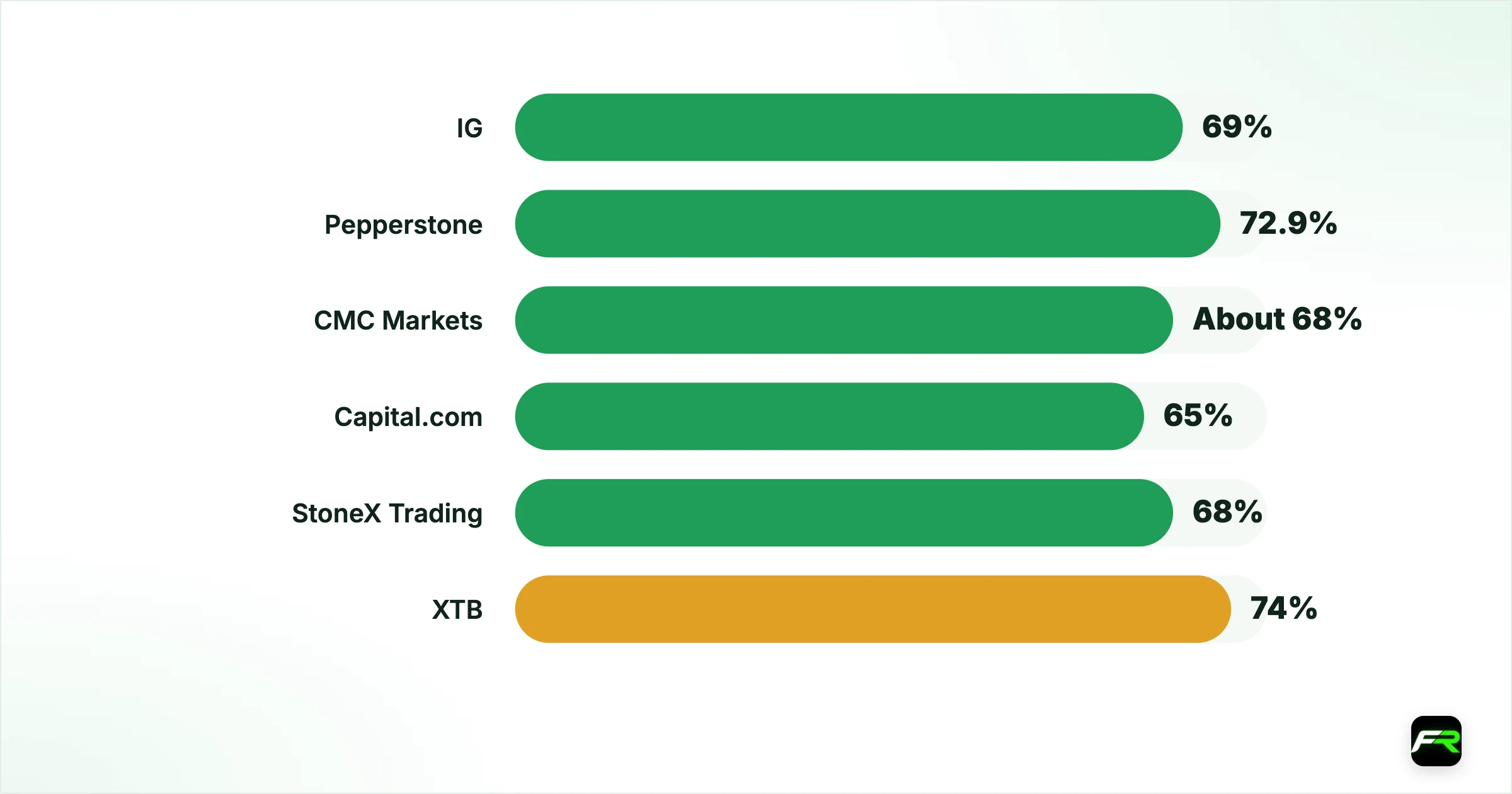
The best forex broker for a UK beginner is an FCA-authorised firm with a free demo account, a low minimum deposit, a clear app and, ideally, spread betting in pounds per point. IG, Pepperstone, CMC Markets and Capital.com tick all of those boxes; XTB does too, apart from spread betting. Any of them will protect you from the worst mistakes: leverage is capped at 30:1 on major pairs, you cannot lose more than the money in your account, and you can go to the Financial Ombudsman if something goes wrong. What no broker can do is make a new trader profitable. Between 65% and 74% of retail accounts at these firms lose money.
Most beginner lists stop at naming brokers. We also show what a small first deposit really buys you under UK margin rules, because the numbers surprise people, and we explain the two routes that cost beginners the most: finfluencer schemes and offshore brokers promising high leverage and bonuses.
What a beginner needs from a broker
- FCA authorisation for the company you sign with. Check the name on your agreement against the FCA Register; our step-by-step Register guide shows how. This brings segregated money, the Ombudsman and FSCS cover up to £85,000.
- Negative balance protection. A rule for FCA retail clients: your losses stop at your balance. Offshore firms often do not guarantee it.
- A small or no minimum deposit. Pepperstone asks for £10 and XTB has none. You should start with an amount you would be comfortable losing entirely.
- Spread betting, if you can. A stake in £ per point is easier to follow than lots and pip values in dollars, and profits are normally outside UK tax.
- A free demo account. CMC and StoneX Trading both give £10,000 of virtual funds; the others offer demos too. Use one for at least a month.
- Education and a decent app. Clear order tickets, visible stop-losses and a margin display matter more than dozens of indicators.
Our beginner shortlist
| Broker | FRN | Loss % (Sept 2026) | Spread betting | Why a beginner might pick it |
|---|---|---|---|---|
| IG | 195355 / 114059 | 69% | Yes | Education, demo, one account for many markets |
| Pepperstone | 684312 | 72.9% | Yes | £10 minimum, no inactivity fee, room to grow into MT4/MT5/cTrader |
| CMC Markets | 173730 | About 68% | Yes | £10,000 demo, spread betting on its own platform |
| Capital.com | 793714 | 65% | Yes | Clean app, TradingView link |
| StoneX Trading (formerly City Index) | 446717 | 68% | Yes | £10,000 demo, web, app, MT4, TradingView |
| XTB | 522157 | 74% | No | £0 minimum, simple xStation app, shares and ISA too |
We have not put these in a strict order because the right one depends on you. If you want one account you can grow into, IG or Pepperstone; our spread betting brokers by platform table shows which platforms each supports for spread bets. For a single app that also holds a stocks and shares ISA, XTB fits, accepting that forex profits there are subject to capital gains tax. Watch the small print on inactivity: CMC charges £10 a month after a year without trading and XTB after 365 days without a transaction, which catches beginners who open an account and then stop.
Demo accounts: how long they last and what they don't teach you
Every firm on our shortlist offers a free demo. IG and CMC Markets each load £10,000 of virtual money, and Pepperstone gives an unlimited virtual balance. Expiry rules differ and are easy to miss. Pepperstone, for example, says its own-platform, MT4 and MT5 demos expire after 60 days without trading or logging in, and its cTrader and TradingView demos after 90 days. Check the terms at your chosen firm before you build weeks of history on one.
A demo teaches mechanics: where the stop-loss box sits, how margin changes as you add a position, and how much wider the spread is at 07:00 than at 14:00. What it cannot teach is how you behave when real money is moving. Fills are usually cleaner, closing a loser costs you nothing emotionally, and a £10,000 virtual balance invites stakes you would never place with £300 of your own.
Treat it as a rehearsal with rules. Trade as if the balance were the amount you will really deposit, use the stake you plan to use live, and log every trade with its reason, stop and result. A few weeks of that tells you more than months of random clicking. Expect live results to be worse at first; that gap is normal, and it is why your first live stakes should be the smallest your broker allows.
The appropriateness questions you'll be asked
Before an FCA firm lets you trade spread bets or CFDs, it has to assess whether the product is appropriate for you. Expect questions about your trading experience, how often you have dealt in leveraged products, your job and qualifications, and a short quiz on how margin, leverage and stop-losses work. Pepperstone's sign-up steps, for instance, include a stage where it checks whether its products are appropriate for you before identity checks and funding.
The FCA has looked at how firms run these tests. In a 2017 review of 23 CFD firms it found that some gave too much weight to attending a seminar or using a demo, did not properly weigh previous trading history, and let applicants who failed click straight through a warning. It said a failed applicant should not be asked to confirm they want to go ahead as the next step, and pointed firms towards cooling-off periods instead.
So a fail is information, not an obstacle. On your own answers, the firm thinks you do not yet understand how leveraged trading can go wrong. Do not change your answers just to get through: that defeats the purpose and can weaken a complaint later. If a firm let you trade after you failed its test, our guide to Financial Ombudsman CFD complaints explains how that can be raised.
What £100 really buys: the margin reality
Many people start with £100 to £500. Under FCA rules a retail client must put up at least 3.33% of the position's value as margin on a major pair. That sounds small until you work out the size of a normal position. A spread bet of £1 per point on GBP/USD, with the rate around 1.3300, controls about £13,300 of sterling. The margin on that is about £443, more than four times a £100 deposit.
| GBP/USD spread bet, £100 account | Margin needed (3.33%) | Value of a 1-point move | A 50-point move against you |
|---|---|---|---|
| £0.10 per point | ≈ £44 | £0.10 | £5 (5% of the account) |
| £0.20 per point | ≈ £89 | £0.20 | £10 (10% of the account) |
| £1 per point | ≈ £443 | £1 | Not possible: margin exceeds the balance |
So a £100 account limits you to tiny stakes, and even at £0.20 a point you have almost no spare margin. GBP/USD often moves 50 points or more in a day, and far more around a Bank of England decision. Minimum stakes also vary by broker and market, so check whether yours accepts £0.10. In CFD terms the smallest usual trade, 0.01 lots or £1,000 of GBP/USD, needs about £33 of margin and moves about 7.5p per pip.
None of this means £100 is useless. It means you are paying for practice with real consequences, not building income. A beginner who treats the first £100 as tuition, trades the smallest size and logs every trade will learn far more than one who deposits £2,000 and trades £5 a point. Our margin calculator and position size calculator let you run your own numbers.
Megan opened a Pepperstone spread betting account with £150 after two months on the demo. She traded GBP/USD and EUR/USD at £0.10 a point, with a stop-loss 40 points away on every trade, so no single loss could cost more than £4. After three months she was down £23, mostly spread costs, and had a spreadsheet of 61 trades showing she did well in the London morning and badly after 15:00. She raised her stake to £0.20 a point only for morning trades. Her account is not making her money yet, but it has not been wiped out either.
Routes to avoid
Finfluencers and signal groups
A large share of UK beginners now arrive through social media. Some influencers are simply paid to push a broker; others run signal groups, copy-trading schemes or "account management" that is unauthorised. On 20 February 2026 seven social media influencers, several known from reality TV, were sentenced at Southwark Crown Court for promoting an unauthorised trading scheme. Other finfluencers have been charged and their cases are ongoing. The FCA also warned in October 2025 about firms pushing clients to opt up to professional status, and said over 90,000 people lost about £75 million over four years at one firm through finfluencer-promoted schemes.
A simple rule: if someone on Instagram, TikTok or Telegram tells you which broker to use, and especially if they offer to trade for you, walk away. Check anything that looks like an investment offer on the FCA Warning List and report scams to Report Fraud on 0300 123 2040. Our finfluencer scams guide shows the common scripts.
Offshore brokers with high leverage and bonuses
Offshore brokers, including well-known names such as IC Markets, often attract beginners with 1:500 leverage, deposit bonuses and slick apps. FCA firms cannot offer bonuses to UK retail clients, so a bonus is itself a sign you would not be dealing with an FCA firm. High leverage lets a small account take positions large enough to empty it in minutes. You also lose the Ombudsman and the FSCS, and some offshore firms do not guarantee negative balance protection. Experienced traders sometimes accept those risks. A beginner has nothing to gain from them.
A request to become a "professional client" to get higher leverage is a red flag for a beginner. You would give up the leverage cap, the 50% close-out, guaranteed negative balance protection and the bonus ban. See professional client status.
A sensible first month
- Pick two brokers from the shortlist and open demo accounts. Place the same trades on both and compare the apps and spreads.
- Learn what a point, a stop-loss and margin mean on the actual order ticket, not in theory. Our stop-loss guide helps.
- Check the FCA Register entry of the broker you prefer, then open a live spread betting account with no more than you could lose without it hurting.
- Trade the smallest stake the broker allows, one or two pairs only, during the London session when spreads are tightest. Our guide to the best time to trade forex in the UK sets out the hours.
- Keep a log of every trade and review it weekly before raising your stake.
General information, not tax advice. Your own position depends on your circumstances, and tax rules can change, including at the 28 October 2026 Budget.
Frequently asked
Which forex broker is best for a complete beginner in the UK?
An FCA-authorised firm with a demo, a low minimum, spread betting and a simple app. IG, Pepperstone, CMC Markets, Capital.com and StoneX Trading all fit; XTB does too if you are happy with CFDs only. Try two demos and choose the one whose app you understand best.
How much money do I need to start forex trading in the UK?
Pepperstone's minimum is £10 and XTB has none, but margin rules decide what you can trade. A £1 per point spread bet on GBP/USD needs about £443 of margin. With £100 you are limited to stakes of around £0.10 to £0.20 a point.
Is spread betting or CFD trading better for beginners?
For most UK beginners, spread betting. You stake in pounds per point, so profits and losses are easy to follow, and profits are normally free of UK tax. CFDs make sense if you want losses to offset other capital gains. Both carry the same leverage limits.
Can I lose more than I deposit with a UK broker?
Not as a retail client of an FCA-authorised firm. Negative balance protection limits your loss to the money in your account, and a 50% margin close-out usually shuts positions before that. Professional status or an offshore broker can remove that protection.
Should I follow a trading influencer's broker recommendation?
No. Many are paid by brokers, some promote unauthorised schemes, and seven influencers were sentenced in February 2026 for promoting one. Choose from FCA-authorised firms, check the Register yourself, and never let someone else trade your account.
How long should I demo before trading live?
Long enough to place a few dozen trades with the stake and stop you plan to use live, which for most part-time traders means several weeks. Watch the expiry rules: Pepperstone's MT4, MT5 and own-platform demos lapse after 60 days of inactivity. A good demo record shows you understand the platform, not that you will make money live.
What happens if I fail a broker's appropriateness test?
Your answers have told the firm that leveraged trading may not suit you yet. The FCA has criticised firms that let failed applicants click straight past the warning. Spend more time on a demo and learning how margin works rather than changing answers to pass, which could also undermine a complaint later.
Related reading
The team behind this guide
Researched, checked and approved by five forex specialists
Every guide is written, fact-checked and edited before it goes live, and updated when the facts change. Spotted an error? Tell us.