





























How to Start Forex Trading in the UK: A Step-by-Step Plan
Learn the basics, pick spread betting or CFDs, check the firm on the FCA Register, pass the appropriateness test, demo, fund a GBP account, then risk about 1% a trade and keep records.
 WriterAbir KhanWriterWrites the guides · checks every figure against primary sources View profileAbout Abir →
 Market analysisTanbir Habib RiyadForex & Crypto AnalystForex and crypto analyst · technical and fundamental analysis View profileAbout Tanbir →
 Fact-checking & riskJannatul FerdaushFact-Checker & Risk AnalystFact-checks every figure · risk analysis · Applied Statistics, University of Dhaka View profileAbout Jannatul →
 Trading reviewJowel RanaCo-Founder & Forex TraderCo-founder · forex trader · reviews guides from a trader's view View profileAbout Jowel →
 Final approvalRanjan NiskrityFounder, Owner & Forex TraderFounder and owner · forex trader · signs off every guide View profileAbout Ranjan →
To start forex trading in the UK, work through nine steps in order: learn how currency prices, points and margin work; decide between spread betting and CFDs, mainly for tax reasons; confirm your broker on the FCA Register; complete its appropriateness test honestly; practise on a demo; fund a sterling account from your own bank; size your first live trades so each one risks about 1% of the balance; keep records HMRC can follow; and review every month before you raise your stake. Most people skip steps three, seven and eight. Those are the ones that decide whether a first year costs a few hundred pounds of tuition or the whole deposit.
A broker is only one of those choices, and we cover it separately in our best forex broker for beginners shortlist. This page is the process around it, with the UK rules that shape each stage and the sums a £500, £2,000 or £10,000 account can sensibly handle.
| Legal status | Legal for UK residents; firms need FCA authorisation |
|---|---|
| Max leverage (retail) | 30:1 on major pairs, 20:1 on minor pairs, gold and major indices |
| Loss limit | Negative balance protection: you cannot lose more than your account |
| Tax | Spread bet profits normally tax free; CFD gains subject to CGT above £3,000 |
| Retail loss rates | 61% to 74% at the main FCA brokers (September 2026) |
| Scam reports | Report Fraud, 0300 123 2040 |
The nine steps at a glance
- Learn the basics: pairs, bid and offer, points or pips, margin and stop-losses.
- Choose a product: spread betting or CFDs. The tax treatment is the big difference.
- Check the broker on the FCA Register, including its website and phone number.
- Pass the appropriateness test with truthful answers.
- Demo for several weeks at the stake and balance you will use for real.
- Fund a GBP account by bank transfer or debit card in your own name.
- Size each trade so a stop-loss costs about 1% of the balance.
- Keep records of every trade in sterling.
- Review monthly and only then change stake, pairs or hours.
Step 1: learn the few things that move your money
A currency pair shows how much of the second currency buys one unit of the first. GBP/USD at 1.3300 means £1 buys $1.33. Your broker shows two prices: the lower bid, where you sell, and the higher offer, where you buy. The gap between them is the spread, and it is the main cost of most trades. A move in the fourth decimal place (0.0001) is a pip, which spread betting firms call a point; on yen pairs the point sits in the second decimal place.
Margin is the deposit a broker holds while a trade is open. Under FCA rules a retail client puts up at least 3.33% of the position's value on a major pair, which is where the 30:1 figure comes from. Our UK leverage limits page lists every tier. Leverage does not change how much a point is worth to you; your stake does. It only changes how large a position your balance can open, which is why beginners with high leverage lose money quickly.
Two further ideas matter from day one. A stop-loss is an order that closes a losing trade at a level you choose, and you should set one before you enter, not after the price has gone against you. Overnight funding is a small daily charge on positions held past the broker's cut-off (10pm UK time at IG, for example). Our risk management guide and stop-loss guide go further. You do not need chart patterns or indicators yet.
Step 2: spread betting or CFDs
UK retail traders reach the forex market through two leveraged products that behave almost identically on screen. With a spread bet you stake an amount in pounds per point, so £1 a point on GBP/USD makes or loses £1 for every 0.0001 move. A CFD instead has you trading a size in lots or units, and profit arrives in the pair's second currency before being converted. Leverage limits, margin close-out and negative balance protection are the same for both.
Tax is what separates them. HMRC treats spread betting as betting, so profits are normally outside income tax and capital gains tax, and losses cannot be set against anything. CFD profits fall under capital gains tax above the £3,000 annual exempt amount, at 18% or 24%, while CFD losses can be offset against other gains. For a beginner who expects small profits or losses, spread betting is usually simpler. Our spread betting vs CFD comparison sets out when a CFD account makes more sense, and how spread betting works explains the £ per point mechanics in detail.
Steps 3 and 4: check the broker, then pass its test
Before you send a penny, look the firm up on the FCA Register. Confirm it is authorised (not just registered), that the company named on the website matches the entry, and that the web address, phone number and email on the Register match the ones you are using. Clone firms copy genuine names and FRNs and change only the contact details. Our guide to checking the FCA Register walks through each screen. A firm offering a deposit bonus or leverage above 30:1 is not treating you as an FCA retail client, whatever its adverts say.
During sign-up an FCA firm must assess whether leveraged products are appropriate for you. Expect questions on your experience with CFDs or spread bets, how often you have traded, your job and qualifications, and a short quiz on margin, leverage and stops. Answer truthfully. A fail means the firm thinks you do not yet understand how these trades go wrong, and changing your answers to get through removes a safeguard that could matter in a later complaint. If you fail, go back to step one and the demo for a few weeks, then try again.
Step 5: demo with rules, not for fun
A demo account uses live prices and virtual money. IG and CMC Markets each give £10,000 of virtual funds, and Pepperstone's demo has an unlimited balance. That generosity is the problem: a large virtual balance invites stakes you would never place with real savings. Set the demo balance, or your mental balance, to the amount you plan to deposit and use the exact stake and stop you intend to use live.
Aim for 30 to 50 logged trades over four to eight weeks, placed at the hours you can really trade. Record the entry, stop, target, reason and result. What you are testing is whether you follow your own rules, not whether you make virtual money. Our best forex demo accounts comparison lists each firm's balance, expiry and platforms.
Step 6: fund a GBP account from your own bank
Open the account in sterling so deposits, margin and profits all stay in pounds and you avoid conversion fees on each withdrawal. A spread betting account is always in pounds. Pay by bank transfer or debit card from an account in your own name; FCA firms generally refuse third-party payments, and a request to pay a personal account or crypto wallet is a classic scam sign. Our guide to funding a trading account from a UK bank covers limits and timings.
Deposit only money you could lose without affecting rent, bills or debt repayments. That is not a disclaimer for the sake of it. Between 61% and 74% of retail accounts at the main FCA brokers lose money, according to their own published figures in September 2026.
Step 7: size your first trades at about 1% risk
The 1% rule means a trade that hits its stop-loss costs about one hundredth of your balance. Work out the stake from the stop distance, not the other way round: stake per point = (balance × 1%) ÷ stop distance in points. With £2,000 and a 40-point stop on GBP/USD, that is £20 ÷ 40 = £0.50 a point. Ten losses in a row at 1% of a shrinking balance would leave you down about 9.6%, painful but recoverable. At 5% a trade, the same streak costs about 40%.
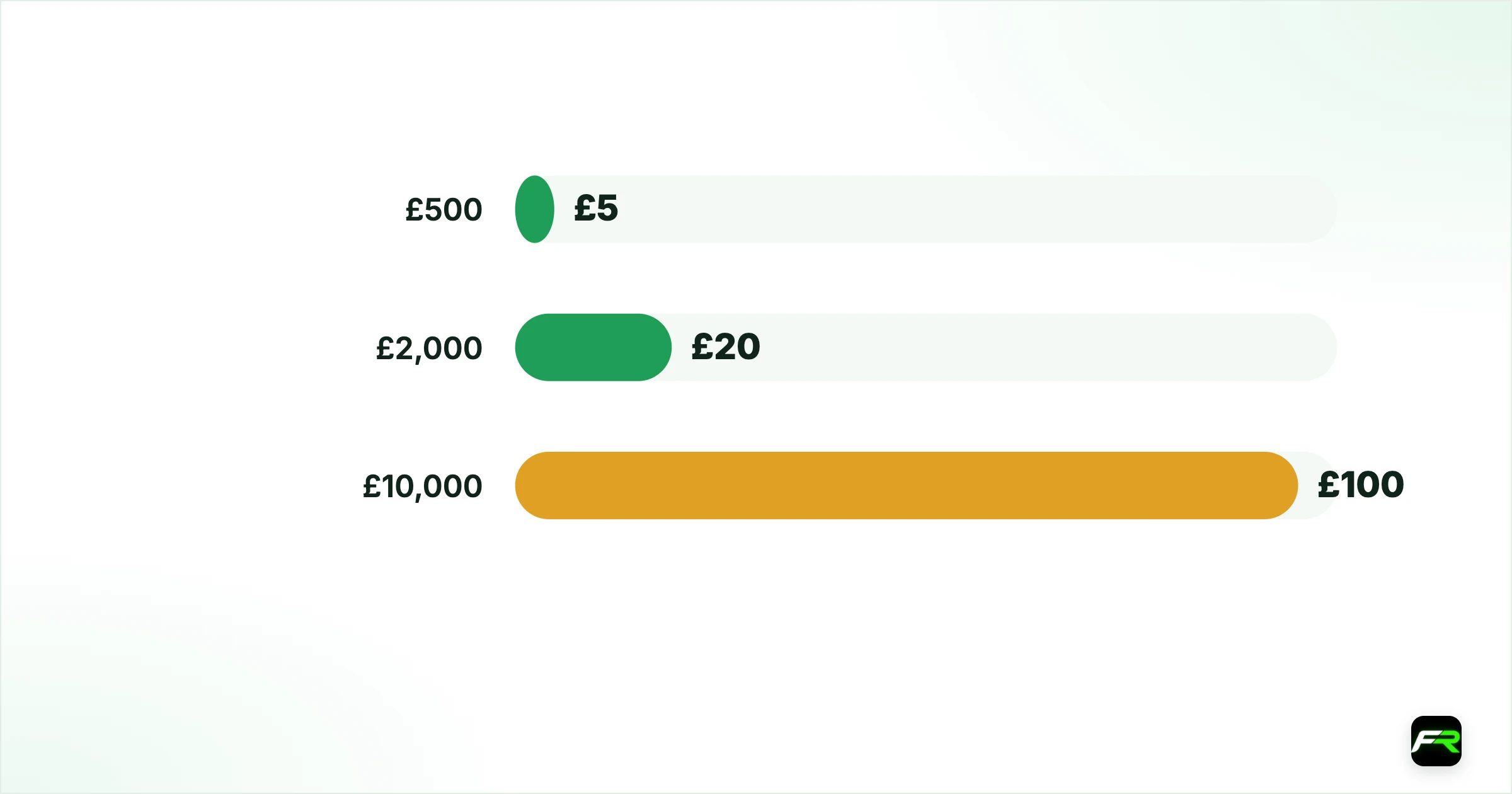
The table uses GBP/USD at about 1.3300, a 40-point stop and FCA margin of 3.33% (one-thirtieth of the position). It also shows the largest stake the 30:1 cap would let you open, to make the point that leverage allows far more risk than you should take.
| Account | 1% risk | Stake at a 40-point stop | Margin used | Largest stake 30:1 allows |
|---|---|---|---|---|
| £500 | £5 | £0.10 a point (risk £4, as £0.125 is rarely offered) | About £44 | About £1.13 a point |
| £2,000 | £20 | £0.50 a point | About £222 | About £4.51 a point |
| £10,000 | £100 | £2.50 a point | About £1,108 | About £22.56 a point |
At £500 you are trading the smallest stakes a broker offers and every spread matters, so the aim is practice, not income. A £2,000 account can hold one or two positions with room to spare. A £10,000 account at 1% risk still only makes £100 on a trade that wins 40 points, which shows how far retail trading is from the lifestyle adverts. Check minimum stakes at your broker and run your own figures in our position size calculator or margin calculator.
Trade the London session, roughly 08:00 to 17:00 UK time, when spreads on sterling pairs are usually tightest. Our best time to trade forex in the UK page has the hours in BST and GMT.
Fiona set aside £2,000 and demoed for six weeks with a £2,000 virtual balance, logging 42 trades on GBP/USD and EUR/GBP. She checked her chosen broker's Register entry, including the phone number, before opening a spread betting account. Live, she staked £0.50 a point with 40-point stops, so each loss cost £20. After three months she had 51 trades, 22 winners and a balance of £1,934, down £66. Her log showed most losses came from trades opened within 30 minutes of UK data releases, so she stopped trading those windows and kept her stake at £0.50 for another quarter.
Steps 8 and 9: keep records and review monthly
Records serve two purposes. For tax, CFD traders need each disposal's date, sterling proceeds and costs, including commission and overnight funding, to work out gains for self assessment. HMRC asks individuals to keep records supporting a return for at least 22 months after the end of the tax year it covers, and longer if the return is late. Spread bet profits are normally untaxed, but a statement history still helps if HMRC ever asks whether your betting is a trade. Our forex trading tax guide explains what to report.
For review, the same log is your best teacher. Once a month, sort trades by pair, time of day and setup. Look at average win and average loss, not just the win rate. Change one thing at a time, and raise your stake only after a quarter in which you followed your rules on nearly every trade. Our beginner case studies show how small habits compound in both directions.
Warning signs you are drifting
- Your stop-loss keeps moving further away because a trade is losing.
- A margin call has you topping up with a fresh deposit.
- Three or four trades a day have crept into a part-time schedule.
- Someone else now picks your trades through paid signals or account management.
Anyone who contacts you offering to trade for you, promising returns, or asking you to download remote-access software is almost certainly a fraudster. Check the FCA Warning List and see our guide to forex scams and reporting fraud.
General information, not tax advice. Your own position depends on your circumstances, and tax rules can change, including at the 28 October 2026 Budget.
Frequently asked
How much money do I need to start forex trading in the UK?
Some FCA brokers have minimums of £10 or nothing at all, but a realistic starting balance for 1% risk sizing is £500 or more. At £500 you are limited to about £0.10 a point with a 40-point stop. With £2,000 the same stop allows £0.50 a point.
Can I teach myself forex trading?
Yes. Broker education pages, the FCA's own consumer pages and a disciplined demo cover the basics for free. Be sceptical of paid courses and mentors, especially those sold on social media, and never pay anyone to trade your account.
Do I need to tell HMRC about forex trading?
If you trade CFDs and your gains exceed the £3,000 annual exempt amount, or your total proceeds exceed £50,000, you normally report them on self assessment. Spread bet profits are normally untaxed. Keep full records either way, as rules can change at the 28 October 2026 Budget.
How long should I practise on a demo account?
Four to eight weeks and 30 to 50 logged trades is a sensible minimum for a part-time trader. Use the same balance and stake you plan to use live, and watch expiry rules: some demos lapse after 60 days of inactivity.
Is forex trading legal for UK residents?
Yes. Individuals can trade forex freely, but the firm offering you spread bets or CFDs must be authorised by the FCA to protect you with UK rules, the Financial Ombudsman and the FSCS. Offshore brokers are not illegal to use, but you lose those protections.
What is the 1% rule in forex?
It means sizing each trade so that hitting your stop-loss costs about 1% of your account. Divide 1% of your balance by the stop distance in points to get your stake per point. It keeps a losing streak survivable.
What should I do if I fail a broker's appropriateness test?
Take it as a signal to learn more before risking money. Spend more time on the basics and a demo, then reapply later. Do not change answers just to pass, because the test exists to protect you.
Can I start forex trading with £100?
You can open an account with £100, but 1% risk is £1 a trade, which is below most minimum stakes with a sensible stop. Treat £100 as paid practice with real consequences, not as an income plan.
Related reading
The team behind this guide
Researched, checked and approved by five forex specialists
Every guide is written, fact-checked and edited before it goes live, and updated when the facts change. Spotted an error? Tell us.