





























Forex Brokers With a GBP Account: Avoiding Conversion Costs
A GBP base account stops your broker converting deposits and withdrawals and keeps HMRC records simple, but some conversion remains. Here is where the fees hide and which UK firms offer one.
 WriterAbir KhanWriterWrites the guides · checks every figure against primary sources View profileAbout Abir →
 Market analysisTanbir Habib RiyadForex & Crypto AnalystForex and crypto analyst · technical and fundamental analysis View profileAbout Tanbir →
 Fact-checking & riskJannatul FerdaushFact-Checker & Risk AnalystFact-checks every figure · risk analysis · Applied Statistics, University of Dhaka View profileAbout Jannatul →
 Trading reviewJowel RanaCo-Founder & Forex TraderCo-founder · forex trader · reviews guides from a trader's view View profileAbout Jowel →
 Final approvalRanjan NiskrityFounder, Owner & Forex TraderFounder and owner · forex trader · signs off every guide View profileAbout Ranjan →
If you live in the UK and fund your trading from a sterling bank account, open your forex account in GBP. A GBP base currency means deposits and withdrawals arrive and leave as pounds, with no conversion fee, and your statements are already in the currency HMRC wants. The big FCA-authorised firms, including IG, Pepperstone, CMC Markets and XTB, all offer GBP accounts. What a GBP account does not do is remove every conversion: profit and loss on pairs quoted in dollars or yen is still converted into pounds, and that carries a charge at many firms.
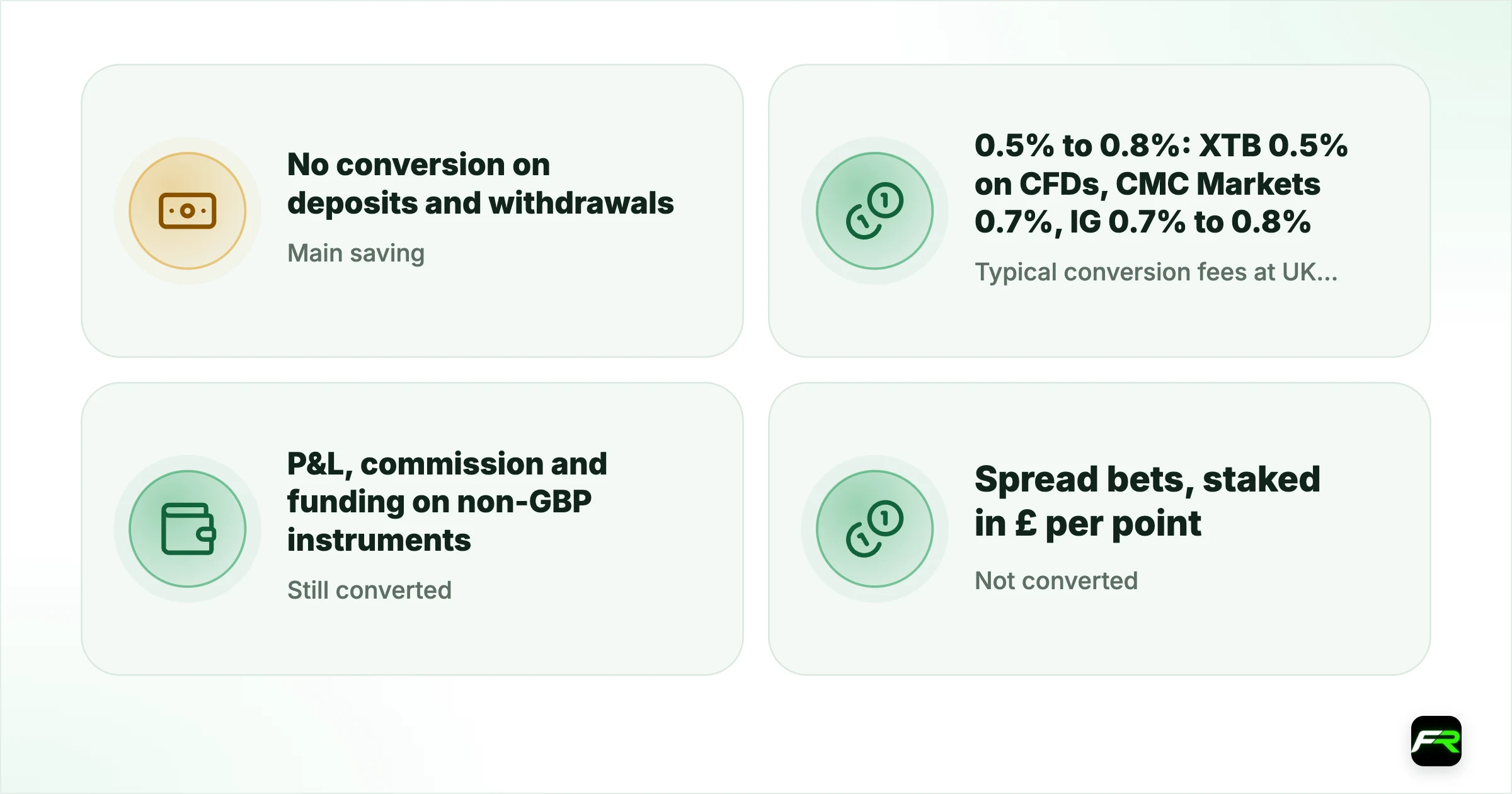
| Main saving | No conversion on deposits and withdrawals |
|---|---|
| Typical conversion fees at UK firms | 0.5% to 0.8%: XTB 0.5% on CFDs, CMC Markets 0.7%, IG 0.7% to 0.8% |
| Still converted | P&L, commission and funding on non-GBP instruments (CFDs) |
| Not converted | Spread bets, staked in £ per point |
| Tax records | Statements already in sterling for self assessment |
General information, not tax advice. Rules can change, including at the 28 October 2026 Budget.
Why the base currency matters
Your base currency, also called the account currency, is the currency your balance, margin and results are held in. Every amount that is not in that currency has to be converted, and firms usually add a markup to the exchange rate when they do it. There are three places this shows up.
- Deposits and withdrawals. Send £5,000 to a USD account and the firm, or your bank, converts it. The same happens again when you withdraw.
- Profit and loss on trades. A CFD on EUR/USD settles in US dollars, the quote currency. In a GBP account that result is converted to pounds. So is commission charged in dollars and overnight funding on dollar-priced markets.
- Tax records. HMRC needs your CFD gains in sterling, using the value at the date of each disposal (CG78310). A GBP account does most of that work for you.
For most UK residents, GBP is the right choice because your money starts and ends in pounds. A USD account can make sense if you already hold dollars, earn in dollars, or trade almost only US stocks and indices through CFDs. For everyone else it adds two conversions you did not need.
What the fees look like
Firms publish their conversion charges in their costs pages, and they are not small. At the time of writing (September 2026), IG’s help centre says its standard FX conversion fee for spread bet and CFD accounts is 0.7%, added to the best available exchange rate, though its UK charges page lists 0.8% for the same accounts, so assume the higher figure until IG confirms. CMC Markets converts foreign currency results at the mid-price of its FX cash instrument plus or minus 0.7%. Your bank may charge its own markup on top if you send a currency your account does not use.
| Scenario (0.7% conversion) | Amount | Approximate cost |
|---|---|---|
| Deposit £5,000 into a USD account | £5,000 | £35 |
| Withdraw £5,500 back to your UK bank | £5,500 | £38.50 |
| Round trip on deposit and withdrawal | about £73.50 | |
| Realised P&L on USD-quoted CFDs over a year (gross wins plus losses) | $30,000 | about $210, roughly £157 |
The last row is the one people miss. Conversion applies to losses as well as profits, so the cost scales with how much you trade, not with how much you make. An active trader can pay more in conversion than in commission without noticing, because it is built into the rate rather than listed as a fee.
Firms that run MT4 and MT5 accounts usually convert profit and loss into your account currency at a prevailing rate set by the firm. Not all of them publish a separate markup figure. If you cannot find one, ask the firm in writing and check the costs and charges disclosure it is required to give you.
Spread bets are staked in pounds per point, so the result of a bet on EUR/USD or the S&P 500 lands in sterling without a conversion step. That is one reason UK traders who use GBP accounts often prefer spread betting for dollar-priced markets. Our spread betting vs CFD comparison covers the tax side.
FCA-authorised brokers with GBP accounts
We checked each firm’s UK website in September 2026. All of the following are authorised by the FCA, and all hold client money under the UK’s CASS rules for retail clients. Account currency rules and fees can change, so confirm on the firm’s site before you open an account.
| Firm (FRN) | GBP account | What the firm says about currency |
|---|---|---|
| IG Markets / IG Index (195355 / 114059) | Yes | 0.7% (help centre) or 0.8% (charges page) FX conversion fee; base currency can be changed with no open positions |
| Pepperstone Limited (684312) | Yes | Accepts funding in GBP, USD, EUR and CHF; account currency cannot be changed after opening; no deposit fees |
| CMC Markets UK plc (173730) | Yes | Foreign currency results converted at mid ±0.7% |
| XTB Limited (522157) | Yes, alongside EUR and USD | 0.5% CFD conversion fee; one currency per account, with extra accounts possible in other currencies |
| Spreadex Ltd (190941) | Spread bets in £ per point | Check account currency options on its UK site |
The main differences come down to what else each firm offers: platforms, spread betting, minimum deposits and pricing. Our best FCA-regulated brokers article compares them on those points, and our broker comparisons go head to head.
How to pick the right currency at sign-up
Pay attention on the application form. Some firms default to USD, particularly for MT4 and MT5 accounts, and some will not let you change it later. Pepperstone, for example, says the account currency cannot be changed once the trading account has been created. XTB says the same but lets you open an additional account in a different currency. IG lets you switch base currency if you have no open positions.
- Select GBP as the account currency on the application, and check the confirmation email says GBP.
- Fund from a UK bank account in your own name, in pounds.
- Check your first statement: the balance should show £ and the deposit should match what left your bank to the penny.
- If the firm offers a choice between instant and daily conversion of P&L, pick the one that suits your record-keeping; IG, for instance, offers both.
The offshore option: IC’s GBP account
Some offshore firms also offer GBP accounts. IC Markets (now trading as IC) has a GBP-based Raw account priced at £2.75 commission per lot per side (£5.50 round turn), and it accepts GBP deposits by card, PayPal, Neteller, Skrill, wire and some other methods. For a UK trader that avoids the currency conversion on funding.
Sterling as the account currency leaves the entity behind it unchanged. A UK resident signing up with IC is in practice onboarded by Raw Trading Ltd in Seychelles, which is not authorised by the FCA and is the subject of an FCA Warning List entry. You would have no Financial Ombudsman access and no FSCS protection, and disputes would go under Seychelles law. See IC Markets GBP deposits and withdrawals and is IC Markets FCA regulated? before deciding.
Our view: for most UK traders, saving 0.7% on conversions is not worth giving up UK protections. The case for IC rests on raw pricing and cTrader, and it only makes sense for experienced traders who understand and accept the offshore risk. Anyone who does trade there should read our IC Markets tax guide, because its accounts are CFD only and every gain is within CGT.
Tax records are easier in pounds
CFD profits are taxed under Capital Gains Tax. For each disposal HMRC wants the sterling value at the time, and the CG78310 guidance says to use the rate at the date of acquisition and disposal. With a GBP account your statement already shows each result in pounds. A USD account means you, or your accountant, have to convert each closed trade at the right date, which quickly becomes a large spreadsheet.
HMRC also treats currency other than sterling as an asset for CGT purposes (CG78300), which can add a layer of complexity to holding a balance in dollars. Whether that matters in your case depends on the amounts and your circumstances, so ask an accountant. Our guide to reporting CFD gains on self assessment walks through the return.
Sophie followed an online tutorial and opened a USD account with an FCA-authorised firm. She deposited £3,000, which cost about £21 in conversion at 0.7%, and later withdrew £2,800, costing about £19.60 more. The bigger cost was her time: she closed around 180 CFD trades that tax year and had to convert each result into pounds at the date of the trade for her self assessment. A year on she opened a GBP account with the same firm and moved to spread betting for US indices. Her statements came out in pounds, and her records took an evening instead of a weekend.
Frequently asked
Should a UK trader open a forex account in GBP or USD?
GBP for most people. If your money comes from and goes back to a UK bank account, a GBP base avoids a conversion fee each way and keeps your tax records in sterling. A USD account mainly suits people who already hold or earn dollars.
Does a GBP account mean no conversion fees at all?
No. On CFDs, profit and loss on instruments priced in other currencies, such as EUR/USD, is converted to pounds, often with a markup. IG quotes 0.7% to 0.8% depending on the page, CMC Markets mid ±0.7% and XTB 0.5%. Spread bets avoid this because they are staked in pounds per point.
Which FCA brokers offer GBP base accounts?
IG, Pepperstone, CMC Markets, XTB and Spreadex all offer sterling accounts to UK clients, among others. Check the firm’s UK site at sign-up, because currency options and conversion fees change and some firms default to USD on MT4 or MT5.
Can I change my account currency later?
It depends on the firm. Pepperstone says the account currency cannot be changed after opening. XTB lets you open an extra account in another currency. IG lets you change base currency when you have no open positions.
How much do currency conversion fees cost?
At 0.7%, depositing £5,000 into a USD account costs about £35, and withdrawing £5,500 back costs about £38.50. Active CFD traders also pay on realised P&L in other currencies, so the annual cost grows with trading volume.
Can I hold both a GBP and a USD sub-account?
At some firms. XTB allows one currency per account but lets you open extra accounts in other currencies, so a USD account can sit beside a GBP one. Pepperstone says an account’s currency cannot be changed once created, so ask before assuming a second one is possible. A USD account only helps if you really hold dollars; otherwise it adds a conversion.
Does a GBP account make my tax return easier?
Usually. HMRC needs CFD gains in sterling at the date of each disposal. A GBP account reports results in pounds, while a USD account means converting every closed trade yourself. Spread bet winnings are outside CGT for most individuals anyway.
Related reading
The team behind this guide
Researched, checked and approved by five forex specialists
Every guide is written, fact-checked and edited before it goes live, and updated when the facts change. Spotted an error? Tell us.