





























IC Markets GBP Account: Deposits and Withdrawals From the UK
IC Markets offers a GBP base account and takes sterling by card, wire, PayPal, Skrill, Neteller and more. Withdrawals follow strict return-to-source rules, explained here.
 WriterAbir KhanWriterWrites the guides · checks every figure against primary sources View profileAbout Abir →
 Market analysisTanbir Habib RiyadForex & Crypto AnalystForex and crypto analyst · technical and fundamental analysis View profileAbout Tanbir →
 Fact-checking & riskJannatul FerdaushFact-Checker & Risk AnalystFact-checks every figure · risk analysis · Applied Statistics, University of Dhaka View profileAbout Jannatul →
 Trading reviewJowel RanaCo-Founder & Forex TraderCo-founder · forex trader · reviews guides from a trader's view View profileAbout Jowel →
 Final approvalRanjan NiskrityFounder, Owner & Forex TraderFounder and owner · forex trader · signs off every guide View profileAbout Ranjan →
Yes, you can hold a GBP account at IC Markets (now trading as IC) and fund it from a UK bank or card. Sterling is one of ten base currencies, the GBP Raw account charges £2.75 commission per side per lot, and IC says it does not charge deposit or withdrawal fees in normal use. Withdrawals are where UK traders get caught out: money must go back the way it came, card refunds are capped at what you deposited by card, and a bank wire can take up to 14 days. We could not confirm that IC supports UK Faster Payments, so do not assume a same-day transfer.
Remember who is holding your money. IC has no FCA authorisation, and a UK resident is in practice a client of Raw Trading Ltd in the Seychelles. Funds you send there are outside UK client money rules, the FSCS and the Financial Ombudsman. The practical detail below matters, but so does that.
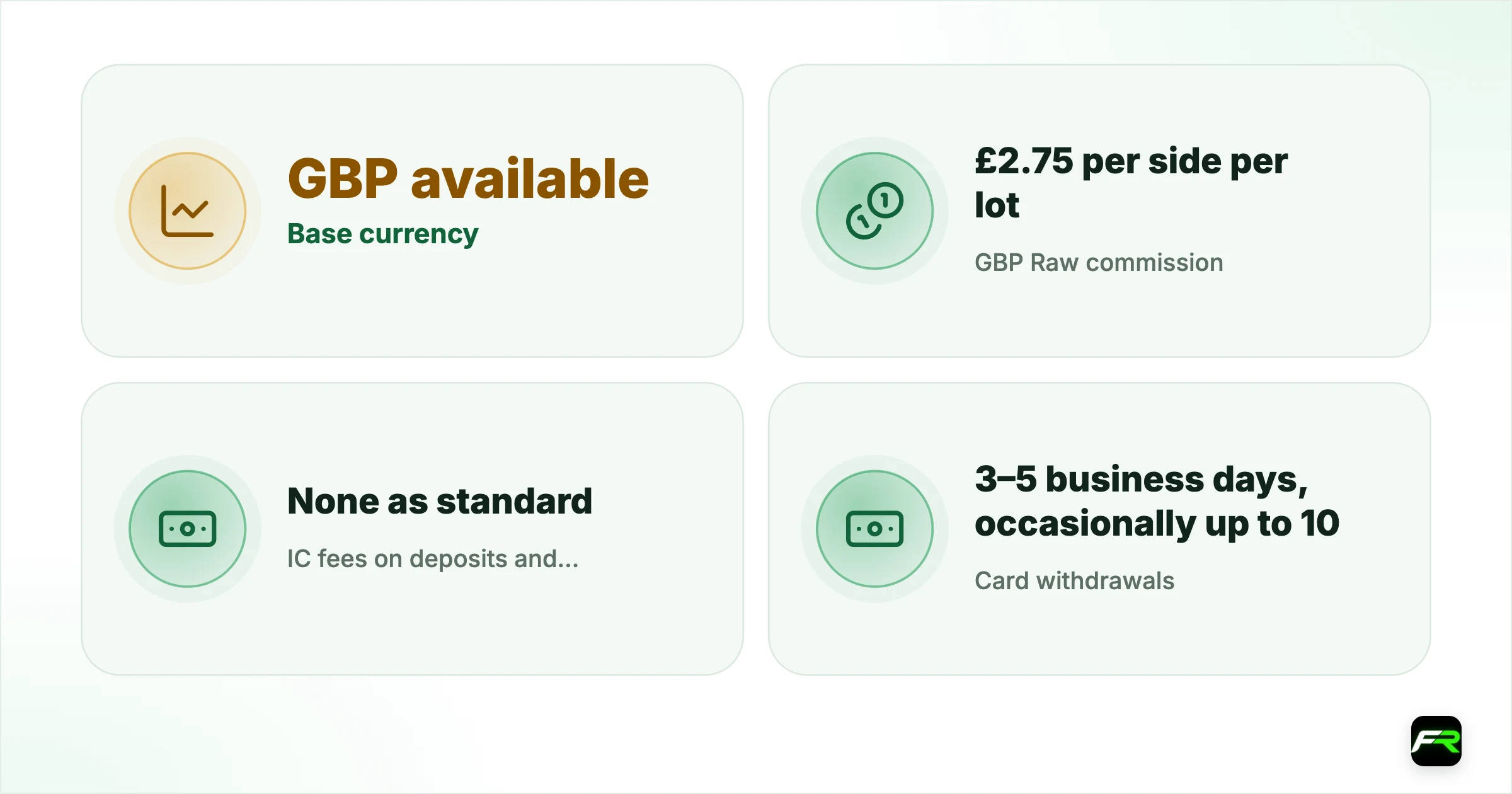
| Base currency | GBP available (one of 10) |
|---|---|
| GBP Raw commission | £2.75 per side per lot (£5.50 round turn) |
| IC fees on deposits and withdrawals | None as standard; banks and intermediaries may charge, and IC lists some exceptions |
| Card withdrawals | 3–5 business days, occasionally up to 10; capped at card deposits |
| International bank wire | Up to 14 days |
| Withdrawal cut-off | 12:00 Sydney time (AEST/AEDT) |
| Faster Payments | Not confirmed |
Why a GBP base account is worth choosing
If your bank account and your tax return are in pounds, a GBP trading account saves you two currency conversions. Deposit £2,000 into a USD account and your bank or card issuer converts it at its own rate, often with a fee of a few per cent. Withdraw later and it converts back again. With a GBP account, sterling stays sterling, and IC converts the profit or loss on each dollar- or euro-priced trade into pounds at the time it closes.
It also simplifies tax. HMRC wants your gains in sterling, and a GBP statement gives you that directly, rather than a column of dollar figures you must convert trade by trade. Our IC Markets tax guide explains the conversion rules if you already run a USD account. Commission on the GBP Raw account is £2.75 per side per standard lot, a little dearer than the USD 3.50 on the USD Raw account, which is about £2.61 with cable near 1.34.
Ways to deposit in pounds
| Method | Accepts GBP? | Notes |
|---|---|---|
| Debit or credit card | Yes | Card withdrawals capped at the amount deposited by card |
| Bank wire | Yes | International transfer; intermediary banks may deduct fees |
| PayPal | Yes | Withdrawals go back to the same PayPal account |
| Skrill / Neteller | Yes | Withdrawals go back to the same wallet |
| Rapidpay | Yes (GBP and EUR only) | Withdrawn by bank wire |
| Klarna | Yes (GBP and EUR only) | Withdrawn by bank wire |
| Crypto (BTC, ETH, USDC, USDT) | No, crypto only | IC’s Help Centre lists Bitcoin deposits as withdrawn by bank wire |
IC does not accept third-party payments. The card, bank account or wallet must be in your own name and match the name on your IC account. A deposit from a partner's card or a company account will usually be returned, and can trigger a compliance review that holds up everything else.
A note on UK banks. We found no general block by UK high street banks on paying CFD brokers, and no FCA rule that bans funding a CFD account by credit card; acceptance is down to the broker and card issuer. Some banks do block or cap payments to crypto platforms, so funding IC with crypto bought through a UK exchange can hit that wall. A card payment to an offshore broker may also prompt your card issuer's fraud team to query the first transaction. Our guide to funding a trading account from a UK bank covers this in more detail.
Withdrawal rules that catch UK traders out
- Card cap. A card can only be refunded up to the total you deposited on it. Profits above that amount go by another route, usually bank wire.
- Same wallet. PayPal, Skrill and Neteller deposits come back to the same account they came from.
- Order of methods. IC may require withdrawals to go back to earlier deposit methods in a sequence it decides, so you cannot always pick the fastest.
- Rapidpay and Klarna. Deposits made this way are withdrawn by bank wire, not back through the same service.
- Same name. The receiving account must be in your name, as for deposits.
In practice a UK trader who deposited £1,000 by debit card and made £3,000 profit will get £1,000 back to the card and the remaining £3,000 by wire to a UK bank account. That wire is an international payment from overseas, so it usually arrives as an international (SWIFT) payment rather than through Faster Payments, and it may pass through an intermediary bank that takes a fee. IC says it does not charge withdrawal fees, but it also says it is not responsible for charges levied by banks in the chain. Its withdrawal page adds that a processing fee may apply if deposits have not been used for trading, and its Help Centre lists a 20 AUD bank fee on wire withdrawals of money deposited by bank transfer, FasaPay, broker-to-broker transfer or Bitcoin.
How long withdrawals take, and the UK time cut-off
IC processes withdrawals against a cut-off of 12:00 Sydney time. Requests received before it are processed that Sydney business day. For a UK trader the cut-off falls in the middle of the night, and it moves around the year because Britain and Australia change their clocks on different dates and in opposite directions.
| Period | Sydney time | UK time | 12:00 Sydney in UK time |
|---|---|---|---|
| 5 April to 3 October 2026 | AEST (UTC+10) | BST (UTC+1) | 03:00 BST |
| 4 October to 24 October 2026 | AEDT (UTC+11) | BST | 02:00 BST |
| 25 October 2026 to 27 March 2027 | AEDT | GMT (UTC+0) | 01:00 GMT |
| 28 March to 3 April 2027 | AEDT | BST | 02:00 BST |
| From 4 April 2027 | AEST | BST | 03:00 BST |
So a withdrawal you request at lunchtime in London on a Tuesday has missed Tuesday's cut-off, which passed in the early hours, and joins Wednesday's processing in Sydney. After processing, card refunds typically take 3–5 business days to appear, occasionally up to 10. International wires can take up to 14 days, although many arrive faster. Weekends and UK and Australian bank holidays add delay at both ends.
Crypto is a poor route back to a UK bank. IC’s Help Centre lists Bitcoin deposits among those withdrawn by bank wire, so check with IC how a crypto deposit would come back before using it, and remember that some UK banks restrict payments to and from crypto platforms. For most people a card refund plus a sterling wire is the least fiddly route.
IC Markets withdrawal problems: the usual causes
Before any withdrawal IC needs your identity and address verified. Expect to upload a passport or driving licence and a recent proof of address such as a bank statement or utility bill. Some clients report further document requests at withdrawal time, including repeat compliance questions about the source of funds, and forum reports from late 2025 describe withdrawals taking over a week while those questions were answered. These are individual reports rather than a measured pattern, but they are common enough to plan for.
Keep your details consistent. A change of address, a new card or a large first withdrawal is the kind of event that can prompt a review. Answer requests promptly and completely, and keep copies of what you sent. Because IC sits outside UK regulation, a long hold cannot be escalated to the Financial Ombudsman; your only route is IC's own complaints process and, ultimately, Seychelles law.
Some problems start at your own bank. IC’s Help Centre says money deposited by card goes back through Visa or Mastercard Direct, or by bank wire, so a refund can bounce if the card has since expired, been replaced after a fraud report or been closed. Where the decision to decline a withdrawal is IC’s own, it says it emails you the reason and what to do next. Before chasing IC, check the card is still live and ask your issuer whether it rejected an incoming credit. If it did, get the reason in writing and ask IC to resend the money by wire to a bank account in your name.
Anyone who contacts you offering to "release" a stuck IC withdrawal for a fee is a scammer. IC does not charge fees to "release" money, and recovery-room fraud targets people who have posted online about delays. See our IC Markets clone and scam guide, and how to report a forex scam in the UK if you have already paid one.
A practical checklist before you fund
- Open the account in GBP if your bank is in pounds, and pick it at the start rather than planning to switch later.
- Complete verification before depositing, not after you want your money back.
- Use one funding method in your own name, ideally a debit card plus a UK bank account in the same name for wires.
- Keep card deposits modest if you expect to withdraw profits, since the card cap sends the rest by wire.
- Ask your bank what it charges to receive an international payment in GBP.
- Request withdrawals before 01:00–03:00 UK time if you want them in that Sydney day's batch.
- Download statements for your tax records every month.
Hannah opens a GBP Raw account and deposits £2,500 by debit card in March. By September she is up £1,800 after commission and wants £4,000 out, leaving £300 to keep trading. She submits the request at 10:30 on a Thursday in late September, after that day's 03:00 BST cut-off, so it is processed on Friday Sydney time. The first £2,500 goes back to her card and shows in her bank four business days later. Her remaining £1,500 is sent by international wire; her bank deducts a small receiving fee, and the money arrives nine days after her request. Before either payment she had to re-confirm her address, because she had moved in the summer. None of the delay cost her anything, but she would have been in trouble had she needed the money for a bill that week.
Frequently asked
Does IC Markets offer a GBP account?
Yes. GBP is one of ten base currencies. The GBP Raw account charges £2.75 per side per lot, or £5.50 round turn. A sterling account avoids conversion fees on deposits and withdrawals and gives you sterling figures for HMRC.
How long does an IC Markets withdrawal take to a UK bank?
IC processes requests against a 12:00 Sydney cut-off. Card refunds usually take 3–5 business days after processing, occasionally up to 10. International bank wires can take up to 14 days, and compliance checks can add more.
Does IC Markets support Faster Payments?
We could not confirm it. Withdrawals to a UK bank are made by international wire, which uses the SWIFT network and may pass through an intermediary bank. Do not rely on same-day arrival.
Why can't I withdraw all my profit to my card?
Card refunds are capped at the total you deposited on that card. Anything above it, which is your profit, has to go by another route, usually a bank wire to an account in your name.
Does IC Markets charge withdrawal fees?
IC says it charges no deposit or withdrawal fees as standard, though it may apply a processing fee if deposits were not used for trading, and its Help Centre lists a 20 AUD bank fee on some wire withdrawals. Banks can still charge, including intermediary banks on international wires and your own bank for receiving an overseas payment.
What time is the IC Markets withdrawal cut-off in the UK?
12:00 Sydney time, which is 03:00 BST from April to early October, 02:00 BST for a few weeks in October and late March, and 01:00 GMT through the UK winter. A request made during the UK day joins the next Sydney day's batch.
Why was my IC Markets card refund declined by my bank?
One common reason is that the card has changed since you deposited: it expired, was replaced after a fraud report or was closed, so the issuer could not accept the credit. Ask your bank for the reason in writing, then contact IC through live chat on ic.com and ask for the money to be resent by wire to a bank account in your own name.
What can I do if an IC withdrawal is held?
Answer compliance requests quickly and keep copies. Use IC's complaints process in writing. Because IC is not FCA authorised, you cannot take the complaint to the Financial Ombudsman, and the FSCS does not cover the account.
Related reading
The team behind this guide
Researched, checked and approved by five forex specialists
Every guide is written, fact-checked and edited before it goes live, and updated when the facts change. Spotted an error? Tell us.