





























UK Forex Leverage Limits Explained: 30:1, 20:1 and the Rest
UK retail traders can use at most 30:1 leverage on major currency pairs and 20:1 on minor pairs and gold. Here is the full FCA margin table, the maths in pounds and why the caps exist.
 WriterAbir KhanWriterWrites the guides · checks every figure against primary sources View profileAbout Abir →
 Market analysisTanbir Habib RiyadForex & Crypto AnalystForex and crypto analyst · technical and fundamental analysis View profileAbout Tanbir →
 Fact-checking & riskJannatul FerdaushFact-Checker & Risk AnalystFact-checks every figure · risk analysis · Applied Statistics, University of Dhaka View profileAbout Jannatul →
 Trading reviewJowel RanaCo-Founder & Forex TraderCo-founder · forex trader · reviews guides from a trader's view View profileAbout Jowel →
 Final approvalRanjan NiskrityFounder, Owner & Forex TraderFounder and owner · forex trader · signs off every guide View profileAbout Ranjan →
The UK forex leverage limit for a retail client is 30:1 on major currency pairs, which means you must put up at least 3.33% of the position’s value as margin. Minor pairs and gold are capped at 20:1 (5% margin). Those caps come from the FCA’s permanent CFD rules in COBS 22.5, in force since 1 August 2019, and they apply equally to CFDs, spread bets and rolling spot forex. A UK-authorised firm can offer you less leverage than this, never more, unless you are classed as a professional client.
| Major FX pairs | 30:1 (3.33% margin) |
|---|---|
| Minor FX pairs, gold, major indices | 20:1 (5% margin) |
| Other commodities, minor indices | 10:1 (10% margin) |
| Individual shares and other assets | 5:1 (20% margin) |
| Crypto derivatives | Banned for retail since 6 January 2021 |
| Rule source | FCA COBS 22.5.11R, permanent since 1 August 2019 |
The full FCA margin table
The FCA sets the rule as a minimum initial margin, a percentage of the notional value of the trade. Leverage is just the other way of writing the same number: 3.33% margin is 30:1, 5% is 20:1 and so on. Your broker will usually show leverage on the account page and margin on the trade ticket, so it helps to be able to flip between the two.
| Underlying | Minimum initial margin | Maximum leverage |
|---|---|---|
| Major currency pairs | 3.33% | 30:1 |
| Non-major currency pairs, gold, major stock indices | 5% | 20:1 |
| Commodities other than gold, non-major stock indices | 10% | 10:1 |
| Individual shares and any other reference value | 20% | 5:1 |
| Cryptoassets | Not available | Retail crypto derivatives banned |
The source is COBS 22.5.11R in the FCA Handbook. When the FCA made the rules permanent in July 2019 it spelled out that references to CFDs include financial spread bets and rolling spot forex. So there is no loophole in switching product. A £10-per-point spread bet on cable carries the same 3.33% floor as a one-lot CFD on MT5.
Crypto is the odd one out. The FCA banned the sale of crypto derivatives to retail clients from 6 January 2021 and that ban still stands. A separate change in October 2025 let retail investors buy crypto exchange traded notes listed on UK exchanges, which is a different product altogether. Any UK broker offering you leveraged bitcoin CFDs as a retail client is not following the rules.
What counts as a major pair
A major pair is any pair made up of two of these six currencies: US dollar, euro, Japanese yen, pound sterling, Canadian dollar and Swiss franc. That follows the convention the FCA inherited from the EU rules. Everything else is a non-major pair and drops to 20:1.
That list surprises people in both directions. EUR/GBP, GBP/JPY, GBP/CHF and CAD/JPY all count as majors, even though traders often call some of them crosses. AUD/USD and NZD/USD do not, because the Australian and New Zealand dollars are not on the list. So a UK trader gets 30:1 on GBP/CAD but only 20:1 on the Aussie. Pairs from emerging markets, such as USD/ZAR, USD/TRY or USD/MXN also sit at 20:1, and some firms set their own lower limits on them because spreads and gaps are wider.
| Pair | Status | Retail cap |
|---|---|---|
| GBP/USD (cable) | Major | 30:1 |
| EUR/GBP | Major | 30:1 |
| GBP/JPY | Major | 30:1 |
| USD/CHF | Major | 30:1 |
| AUD/USD | Non-major | 20:1 |
| GBP/NZD | Non-major | 20:1 |
| USD/ZAR | Non-major | 20:1 |
| XAU/USD (gold) | Gold | 20:1 |
Major stock indices have their own list in the FCA Glossary: the FTSE 100, CAC 40, DAX, Dow Jones Industrial Average, S&P 500, NASDAQ Composite, NASDAQ 100, Nikkei 225, ASX 200 and EURO STOXX 50. Those get 20:1. A smaller index, such as the FTSE 250, falls to 10:1.
Worked margin examples in pounds
Margin is easiest to follow with real numbers. Take one standard lot of GBP/USD, which is £100,000 of sterling, bought at a price of about 1.3400. The position is worth $134,000. If your account is in pounds, the notional in your own currency is simply £100,000, because you are buying pounds.
- Notional value: 1 lot = £100,000 (or $134,000 at 1.3400).
- Retail margin at 30:1: £100,000 ÷ 30 = £3,333 (the same as 3.33% of £100,000).
- Pip value: one pip on a standard lot of GBP/USD is $10, roughly £7.46 at 1.3400.
- Effect of a 100-pip move: about £746 profit or loss, or 22% of the margin you put up.
Now shrink it to something closer to what a new trader would place. A mini lot (0.1) of GBP/USD is £10,000 notional, so the margin is about £333 and each pip is worth around 75p. Spread bets work in pounds per point, and one point on cable is one pip. A £1-per-point bet at 1.3400 has a notional value of 13,400 points × £1, or £13,400, so the 3.33% margin is about £447. Each pip is worth exactly £1, a little more than the 75p on a mini lot.
For a minor pair, the maths moves up. One standard lot of AUD/USD is A$100,000. At an illustrative AUD/GBP rate of about 0.53, that is roughly £53,000 notional, and at 20:1 you need around £2,650 of margin. Had AUD been a major, 30:1 would have meant about £1,770. You can check your own numbers quickly with our forex margin calculator and our leverage calculator.
Margin is the deposit to open a trade, not the most you can lose on it. Your real risk is set by your position size and your stop. A 30:1 cap does not make a one-lot trade on a £4,000 account safe; it just means you are allowed to open it.
How the UK compares with offshore brokers
Offshore brokers licensed in places such as Seychelles, St Vincent, Vanuatu or the Bahamas are not bound by COBS 22.5, and many advertise leverage of 500:1, 1000:1 or more. IC Markets (now trading as IC), for example, advertises up to 1:5000 on MT4 and MT5 and 1:1000 on cTrader through its Seychelles entity, with tiers and higher margins around news and weekends. It holds no FCA authorisation and the FCA has a Warning List entry against it, which we cover in our IC Markets leverage article.
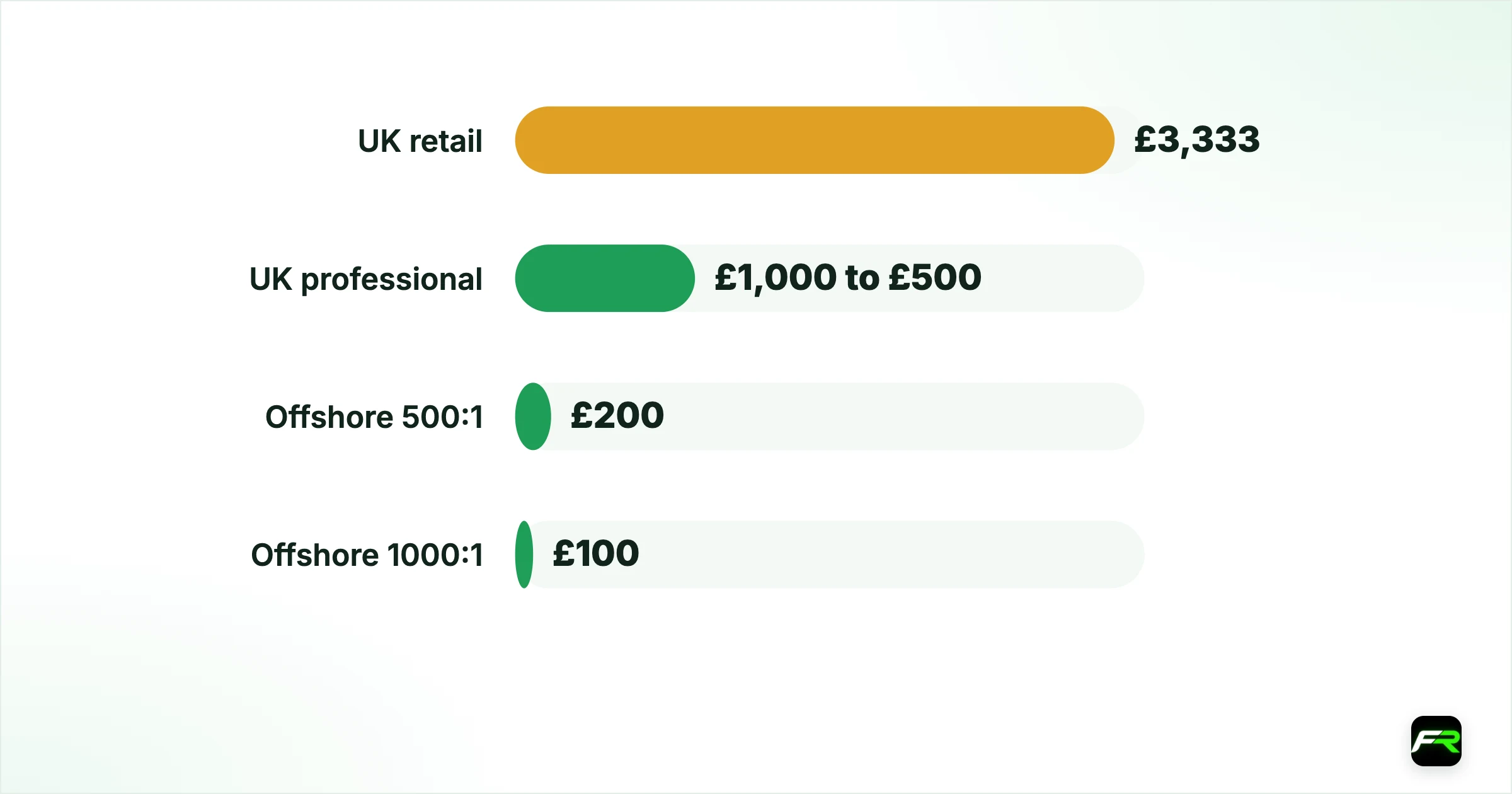
| Setting | Margin for 1 lot GBP/USD | Pips to lose the margin |
|---|---|---|
| UK retail (30:1) | £3,333 | about 447 pips |
| UK professional (often 100:1 to 200:1) | £1,000 to £500 | about 134 to 67 pips |
| Offshore 500:1 | £200 | about 27 pips |
| Offshore 1000:1 | £100 | about 13 pips |
The professional figures in that table are typical broker offers, not an FCA number, since there is no statutory cap for professional clients. What matters in the comparison is the last column. At 1000:1 a normal morning’s wobble in cable can wipe out the whole margin on the trade. Lower margin also means you can open far bigger positions than your account can survive, and that is where the damage is done.
Other large regulators went the same way as the UK. The EU rules the FCA copied in 2018 use the same table, and Australia’s ASIC brought in 30:1 on majors for retail clients in 2021. So the UK is not an outlier here. High leverage is now mostly an offshore product, and it comes without the FCA’s other protections, including negative balance protection and access to the Financial Ombudsman.
Why the caps exist
The FCA restricted leverage after years of evidence that most retail CFD accounts lost money, and that losses rose with leverage. They arrived as a package: leverage limits, a 50% margin close-out rule and negative balance protection, a ban on bonuses and trading incentives, and a standard risk warning that forces every firm to publish the share of its retail accounts that lose money, updated each quarter.
Those warnings still make sobering reading. At the time of writing (September 2026), IG’s UK figure is 69%, Pepperstone’s is 72.9% and XTB’s is 74%. Even with lower leverage, most retail accounts still lose. Think of the cap as a seat belt rather than a strategy: it slows down how fast a bad habit empties an account, which gives you more time to notice.
A second reason is gaps. When a price jumps over your stop, such as at a weekend open or on a surprise central bank decision, the size of your loss depends on the size of your position. A 3.33% margin floor keeps positions in proportion to the account, so a single shock is less likely to take you below zero.
Ways traders get around the cap, and the catch
There are three common routes, and each costs you something.
- Elective professional status. A UK firm can lift the caps if you pass the COBS 3.5.3R tests and ask in writing. You lose the retail protections at the same time. Our professional client guide sets out the criteria and what changes.
- An offshore account. Nothing stops a UK resident from opening one, but you lose FCA conduct rules, the Ombudsman and the FSCS, and disputes go to foreign courts. See our piece on offshore brokers for UK residents.
- Bigger deposits. This is the honest route. A £6,000 account can hold the margin on one lot of cable with room left for adverse moves. It also exposes you to £6,000 of risk, so size the account to what you can afford to lose.
Firms that push you to opt up so you can use more leverage are on the FCA’s radar. In October 2025 the regulator warned about pressure selling of professional status and said the retail protections stop nearly 400,000 people a year from risking more than their original stake. If a salesperson calls to talk you into it, treat that as a red flag.
Jasmine opened a £2,000 GBP account with an FCA-authorised broker and wanted to trade one lot of GBP/USD at 1.3400. The platform rejected the order: the £3,333 margin was more than her balance. She dropped to 0.3 lots, needing about £1,000 of margin, with a 40-pip stop, which put about £90 at risk (0.3 × £7.46 × 40). That was 4.5% of the account, still too high by her own 2% rule, so she settled on 0.13 lots and about £39 at risk. What she took from it: the leverage cap had never been the thing stopping her from overtrading. Her own position sizing was.
How to check the leverage on your account
Open the contract specifications or market info panel for the pair on your platform. It will show the margin rate, often as a percentage. On MT4 and MT5 it may appear as the account leverage (1:30) combined with a per-symbol margin percentage. Spread betting platforms tend to show it as a margin factor next to the market. If you see figures below 3.33% on a major pair and you are a retail client, ask the firm why, and check which entity holds your account on the FCA Register.
Firms can and do set stricter limits than the FCA minimum, especially on exotic pairs and ahead of events such as general elections or Bank of England decisions. That is allowed. What a UK retail account cannot do is give you more.
Still choosing a firm? Our guide to the best forex broker for UK beginners shows what a small first deposit buys under these caps and which FCA brokers suit a new trader.
Frequently asked
What is the maximum forex leverage in the UK?
For retail clients it is 30:1 on major currency pairs (3.33% margin) and 20:1 on minor pairs and gold (5% margin). These are FCA limits under COBS 22.5 and apply to CFDs, spread bets and rolling spot forex. Professional clients are not bound by these caps.
Is EUR/GBP a major pair for leverage purposes?
Yes. Any pair made of two of the US dollar, euro, yen, sterling, Canadian dollar and Swiss franc counts as major, so EUR/GBP, GBP/JPY and GBP/CHF all get 30:1. AUD/USD and NZD/USD are non-major and capped at 20:1.
How much margin do I need for one lot of GBP/USD in the UK?
One standard lot is £100,000 of sterling. At 30:1 the margin is £100,000 ÷ 30, about £3,333, whatever the exchange rate, if your account is in pounds. A mini lot (0.1) needs around £333.
Does spread betting have the same leverage limits as CFDs?
Yes. The FCA rules say references to CFDs include financial spread bets and rolling spot forex. A spread bet on cable carries the same 3.33% minimum margin as a CFD on the same pair.
Can a UK broker give me 1:500 leverage?
Not as a retail client. A UK-authorised firm can only go beyond 30:1 if you are categorised as a professional client. Offers of 1:500 aimed at UK residents usually come from offshore firms that are outside the FCA’s rules and protections.
Why does my broker offer less than 30:1?
Firms may set tighter limits than the FCA minimum, particularly on exotic pairs, over weekends, or before big events like elections and central bank decisions. The FCA figure is a ceiling for retail accounts, not a promise.
Can I trade crypto with leverage in the UK?
Not as a retail client. The FCA banned the sale of crypto derivatives such as crypto CFDs to retail consumers from 6 January 2021, and the ban remains. Crypto ETNs listed on UK exchanges have been open to retail since 8 October 2025, but those are unleveraged exchange products.
Related reading
The team behind this guide
Researched, checked and approved by five forex specialists
Every guide is written, fact-checked and edited before it goes live, and updated when the facts change. Spotted an error? Tell us.