





























Can You Trade Forex or Spread Bet in an ISA? (UK 2026/27)
No. CFDs, spread bets and foreign currency cash are not qualifying ISA investments. You can get currency exposure through funds and some exchange-traded products, and spread bets are already tax free.
 WriterAbir KhanWriterWrites the guides · checks every figure against primary sources View profileAbout Abir →
 Market analysisTanbir Habib RiyadForex & Crypto AnalystForex and crypto analyst · technical and fundamental analysis View profileAbout Tanbir →
 Fact-checking & riskJannatul FerdaushFact-Checker & Risk AnalystFact-checks every figure · risk analysis · Applied Statistics, University of Dhaka View profileAbout Jannatul →
 Trading reviewJowel RanaCo-Founder & Forex TraderCo-founder · forex trader · reviews guides from a trader's view View profileAbout Jowel →
 Final approvalRanjan NiskrityFounder, Owner & Forex TraderFounder and owner · forex trader · signs off every guide View profileAbout Ranjan →
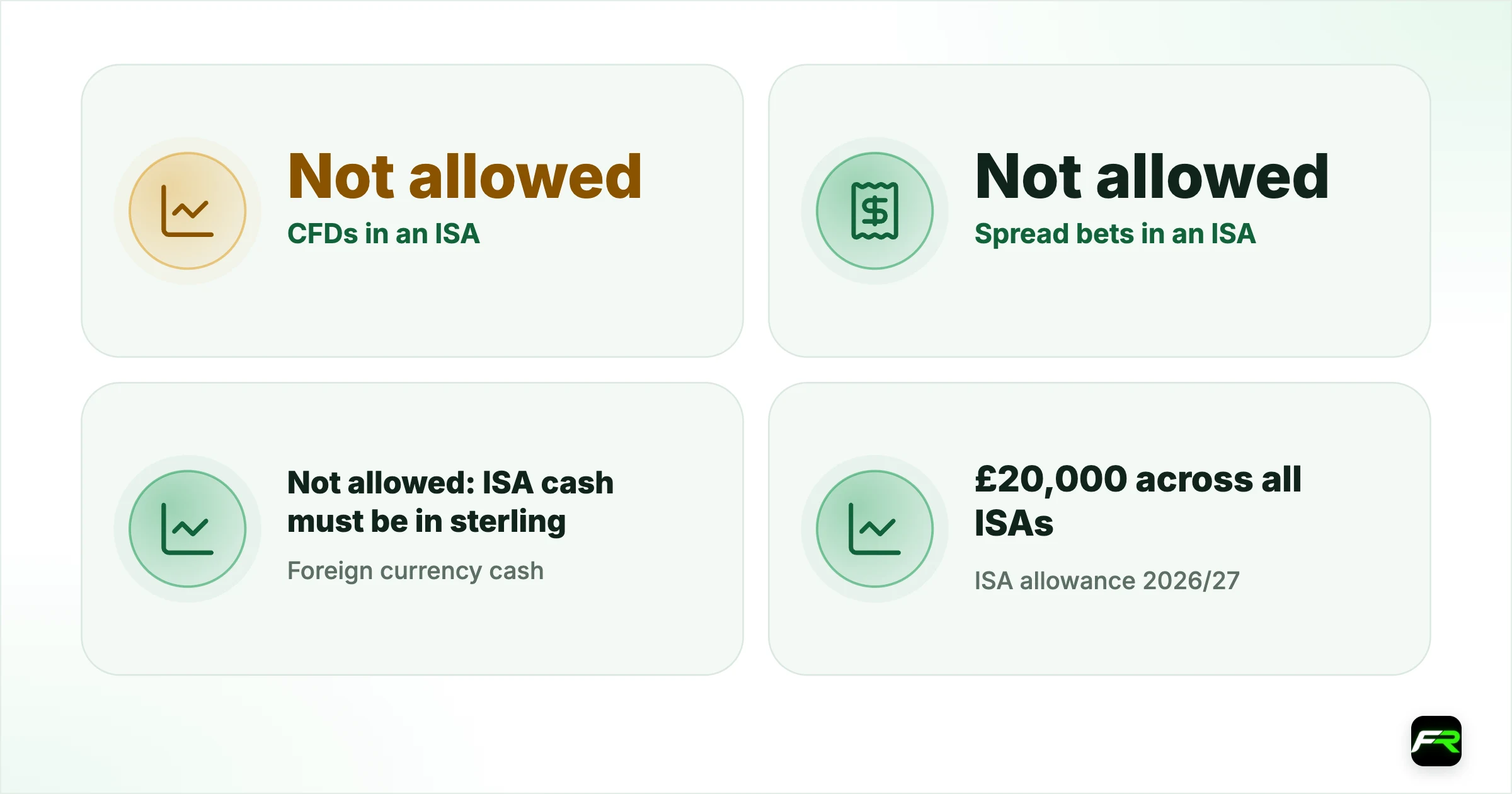
No, you cannot trade forex CFDs or place spread bets inside an ISA. HMRC's rules only let an ISA hold qualifying investments, and leveraged derivatives such as CFDs, spread bets, futures and options are not on the list. Foreign currency cash is excluded too: HMRC's guidance for ISA managers says cash in a stocks and shares ISA may be held only in sterling. What you can hold is shares, funds and certain listed securities that give you currency exposure indirectly. For most active traders the question is less pressing than it looks, because spread bet winnings are already outside tax.
Below we explain what the rules exclude and why, what you can hold if you want currency exposure in an ISA, where crypto ETNs fit after the April 2026 change, and the sensible set-up for a UK trader who also invests.
General information, not tax advice. Your position depends on your own circumstances, and tax rules can change, including at the 28 October 2026 Budget. If your gains are large, your situation is unusual or you are unsure which regime applies, a qualified tax adviser who works with traders is worth the fee.
| CFDs in an ISA | Not allowed |
|---|---|
| Spread bets in an ISA | Not allowed (and not needed for tax) |
| Foreign currency cash | Not allowed: ISA cash must be in sterling |
| ISA allowance 2026/27 | £20,000 across all ISAs |
| Crypto ETNs | Innovative Finance ISA from 6 April 2026, not stocks and shares ISA |
| Currency exposure | Possible through unhedged global funds and some listed products |
Why derivatives are excluded
An ISA is a tax wrapper for saving and investing, and the list of qualifying investments is set by the ISA Regulations and HMRC's guidance. HMRC's guidance for ISA managers lists what a stocks and shares ISA may hold: shares and securities listed on a recognised stock exchange, gilts and corporate bonds, authorised funds and investment trusts, and a few other categories. It states that futures and share options are not qualifying investments. CFDs and spread bets are not mentioned as permitted anywhere, and no ISA manager offers them.
The logic is simple. A leveraged contract can lose more than the sum you put in, requires margin top-ups and can be closed out automatically. None of that fits a product designed to hold assets you own, with a fixed annual subscription limit.
Foreign cash is excluded for a similar reason. The guidance says cash held within a stocks and shares ISA may be held only in sterling, deposited in a designated ISA account. So even a plain dollar balance, with no leverage at all, cannot sit in the ISA as a currency position. Some platforms let you buy US shares inside an ISA and handle the conversion for you, but the cash side stays in pounds.
The same limits run across the whole ISA family. A Lifetime ISA or Junior ISA invested in stocks and shares follows the same qualifying-investment rules, a cash ISA holds only cash deposits, and an Innovative Finance ISA holds peer-to-peer loans, certain crowdfunding debentures and, since April 2026, crypto ETNs. No type of ISA permits leveraged trading of any kind, so moving provider or switching ISA type will not open a route to forex CFDs.
Why people ask, and whether it matters
The question usually comes from one of two places. Some CFD traders pay Capital Gains Tax at 18% or 24% on gains above £3,000 and would like to shelter them. Others have heard that ISA gains are tax free and assume an ISA must be the best home for any kind of trading.
For the first group, the product matters more than the wrapper. Spread bets priced in pounds per point are, for most individuals, outside CGT and Income Tax already: HMRC's CG56105 says no chargeable gains or allowable losses arise from them. A profitable forex trader who switches from CFDs to spread betting at an FCA-authorised firm gets the same result on profits that an ISA would give, without using any of the £20,000 allowance. The trade-off is that spread bet losses cannot be set against anything, which we cover in spread betting vs CFDs.
For the second group, the honest answer is that an ISA is a poor fit for short-term leveraged trading even if the rules allowed it. ISA losses are not relievable either, and the £20,000 annual limit caps how much you can put in. Its real value is for long-term investing, where decades of tax-free dividends and growth add up.
What you can hold for currency exposure
If you want your ISA to reflect a view on sterling, or simply want to understand your currency risk, there are legitimate routes. None of them is forex trading in the usual sense, and none uses leverage.
- Unhedged global funds and ETFs. A fund tracking US or global shares that is not currency hedged rises in sterling terms when the dollar strengthens against the pound, and falls when sterling rallies. That makes it a currency position whether you intended one or not.
- Currency-hedged share classes. Many index funds and ETFs offer a GBP-hedged version that strips out most of the currency effect. The pick between hedged and unhedged versions is the closest an ISA investor gets to a deliberate currency decision.
- Overseas bonds and gilts. Foreign government bond funds carry the same currency choice, hedged or unhedged.
- Some exchange-traded products that track currencies. A small number of currency-tracking exchange-traded products are listed on the London Stock Exchange. Whether a platform allows a particular one in its ISA depends on the product's structure and the platform's own eligibility checks, so look for the ISA-eligible flag rather than assuming.
If you already trade GBP/USD and hold a large unhedged US equity fund in your ISA, you have two positions on the same currency pair. A sharp move in cable affects both. It is worth knowing which way you are exposed before you add a trade.
Crypto ETNs: a separate case
Crypto exchange-traded notes are sometimes confused with forex products, so it is worth being precise. The FCA allowed retail investors to buy crypto ETNs listed on UK exchanges from 8 October 2025, while the ban on retail crypto derivatives (CFDs and spread bets on crypto) stayed in place. For a short period those ETNs could be held in a stocks and shares ISA. From 6 April 2026, HMRC's guidance says UK cryptoasset ETNs cannot be held as qualifying investments in a stocks and shares ISA, and no new purchases or transfers into one are allowed. They now fit in an Innovative Finance ISA instead, and holdings already in a stocks and shares ISA before 6 April 2026 can stay there.
None of that changes the forex position. A crypto ETN is an unleveraged, exchange-listed note on an asset. Forex CFDs and spread bets are leveraged derivatives with a broker, and they are still excluded from every type of ISA.
Chloe had £18,000 in a stocks and shares ISA and a CFD account where she traded GBP/USD and EUR/GBP. After making £9,500 on CFDs in 2025/26 she owed £1,170 in CGT at 18% on the £6,500 above the allowance, and asked her platform whether she could move the trading into the ISA. The answer was no. She kept investing in the ISA, where £12,000 of her money went into a global tracker that is not currency hedged, and moved her short-term forex trading to a spread betting account with an FCA-authorised broker. When she worked out her currency exposure, she found the unhedged fund already gave her a sizeable long-dollar position. She now avoids adding large long USD trades on top of it.
A sensible set-up for traders who also invest
A structure that works for many UK traders is three separate pots:
- An ISA for long-term investing in shares, funds and bonds, using as much of the £20,000 allowance as you can afford. Gains and income inside it are tax free, and nothing needs reporting.
- A spread betting account with an FCA-authorised firm for short-term trading you expect to be profitable. Winnings are outside tax for most individuals, and losses give no relief.
- A CFD account, if you need one, for strategies or platforms only available on CFDs, or in years when you expect losses that could offset other capital gains.
Keep the money for each pot separate and never fund margin calls by withdrawing from the ISA. Money taken out only goes back in without using fresh allowance if the ISA is flexible and you replace it in the same tax year. From 6 April 2027, savers under 65 will only be able to put £12,000 a year into cash ISAs, although the total limit stays at £20,000. That change affects savers, not traders, but it is a reason to check your ISA plans before the 2027/28 tax year starts. Rules can also change at the 28 October 2026 Budget.
Be wary of any firm that claims to offer an "ISA forex account" or "tax-free CFD ISA". No genuine ISA manager offers leveraged forex, and the claim is a common hook in unauthorised investment schemes. Check the firm on the FCA Register and read our guide to forex scams in the UK.
Frequently asked
Can I trade forex in a stocks and shares ISA?
No. Forex CFDs, rolling spot FX and spread bets are leveraged derivatives, and HMRC does not treat them as qualifying ISA investments. Foreign currency cash cannot be held in the ISA either. You can hold funds or shares that give indirect currency exposure.
Is there a spread betting ISA?
No. Spread bets cannot be held in any ISA. For most UK individuals they do not need one, because spread bet winnings are outside Capital Gains Tax and Income Tax already. The downside is that losses cannot be used against other gains.
Can I hold US dollars in my ISA?
HMRC's guidance for ISA managers says cash in a stocks and shares ISA may be held only in sterling. You can buy US shares or funds in the ISA, and the platform converts your pounds, but you cannot hold a dollar cash balance as a currency position.
Can I hold crypto ETNs in an ISA?
From 6 April 2026, crypto ETNs belong in an Innovative Finance ISA rather than a stocks and shares ISA. New purchases into a stocks and shares ISA are no longer allowed, though holdings bought before that date can stay. Crypto CFDs and spread bets remain banned for retail clients.
Can I trade CFDs in a SIPP instead?
Pension rules and provider terms are separate from ISA rules, and leveraged CFD trading is not a normal feature of UK pension products. If a firm offers leveraged forex inside a pension, check its FCA authorisation carefully and take regulated financial advice first.
What is the ISA allowance for 2026/27?
£20,000 across all your ISAs for the tax year from 6 April 2026 to 5 April 2027. From 6 April 2027, people under 65 can put no more than £12,000 of that into cash ISAs, with the rest available for stocks and shares, innovative finance or Lifetime ISAs.
Are currency-hedged ETFs allowed in an ISA?
Generally yes, where the fund or ETF is itself a qualifying investment, such as a UCITS fund. The currency hedging happens inside the fund. Your platform will show whether a specific share class is ISA-eligible.
Related reading
The team behind this guide
Researched, checked and approved by five forex specialists
Every guide is written, fact-checked and edited before it goes live, and updated when the facts change. Spotted an error? Tell us.