





























Bank of England Rate Decisions and Sterling: How to Trade the MPC
A BoE rate decision moves sterling on the surprise: the vote split and guidance matter as much as the rate. Here are the 2026–27 dates, the 12:00 format and a decision-day risk plan.
 WriterAbir KhanWriterWrites the guides · checks every figure against primary sources View profileAbout Abir →
 Market analysisTanbir Habib RiyadForex & Crypto AnalystForex and crypto analyst · technical and fundamental analysis View profileAbout Tanbir →
 Fact-checking & riskJannatul FerdaushFact-Checker & Risk AnalystFact-checks every figure · risk analysis · Applied Statistics, University of Dhaka View profileAbout Jannatul →
 Trading reviewJowel RanaCo-Founder & Forex TraderCo-founder · forex trader · reviews guides from a trader's view View profileAbout Jowel →
 Final approvalRanjan NiskrityFounder, Owner & Forex TraderFounder and owner · forex trader · signs off every guide View profileAbout Ranjan →
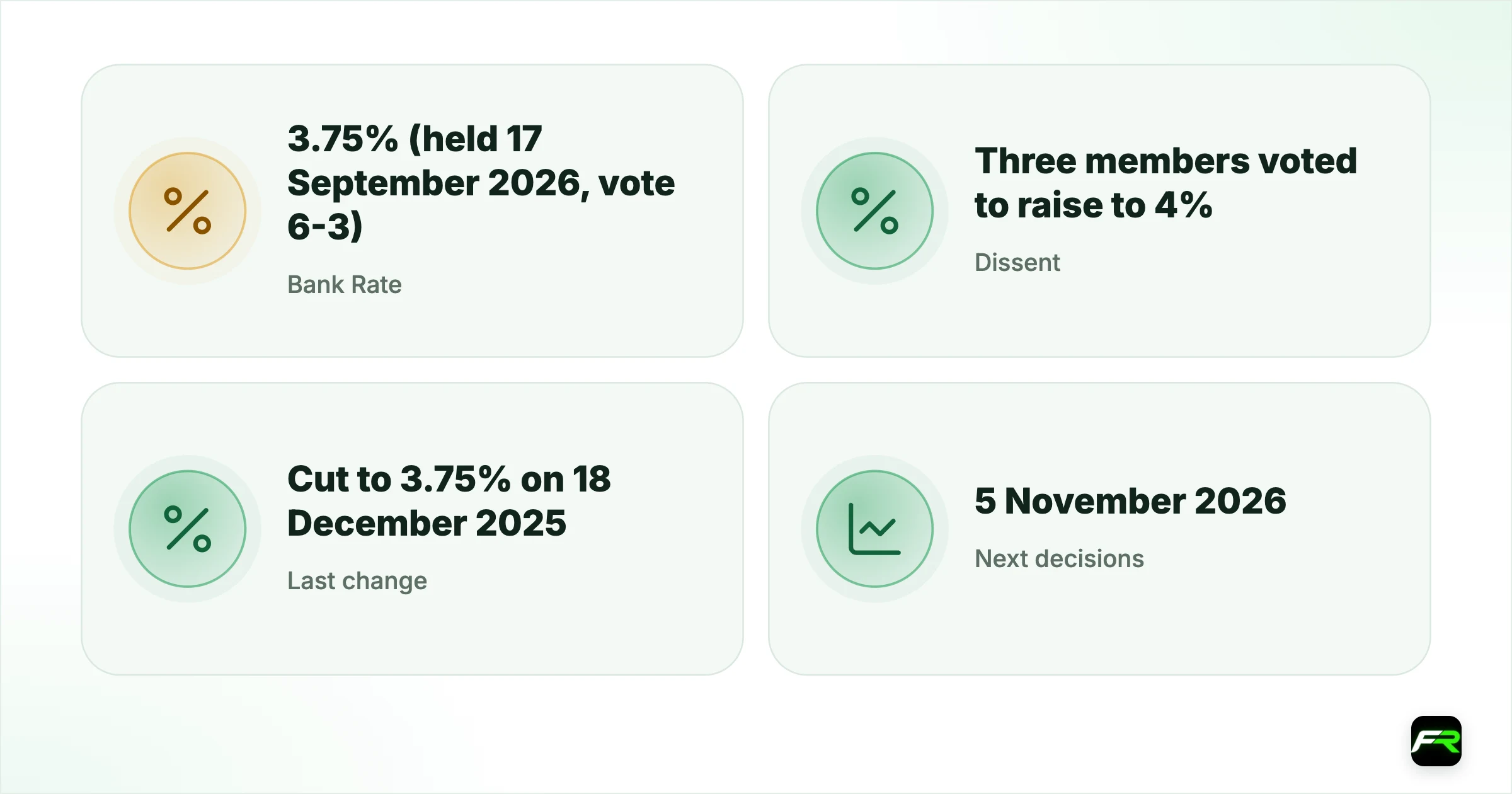
A Bank of England rate decision is published at 12:00 UK time on a Thursday, and sterling reacts to how the result compares with what the market expected, not to the rate on its own. The vote split, the wording of the Monetary Policy Summary and, four times a year, the new forecasts in the Monetary Policy Report often move the pound more than the headline. On 17 September 2026 the Bank held Bank Rate at 3.75% by 6-3, with three members voting to raise it to 4%. The next decision is on Thursday 5 November 2026.
Date lists for the MPC are easy to find. Here you get the dates, how the release is structured minute by minute, the ways a split vote and guidance shift the pound, and a practical plan for the half hour around 12:00, when spreads widen and fills get worse.
Market education, not investment advice. FX Recap does not give trade signals or price targets. Price levels quoted here are approximate, dated and will have moved by the time you read this. CFDs and spread bets are leveraged and most retail accounts lose money.
| Bank Rate | 3.75% (held 17 September 2026, vote 6-3) |
|---|---|
| Dissent | Three members voted to raise to 4% |
| Last change | Cut to 3.75% on 18 December 2025 (5-4) |
| Next decisions | 5 November 2026 (with Monetary Policy Report), 17 December 2026 |
| Release time | 12:00 UK time |
| BoE CPI projection | About 3¾% in Q4 2026, slightly above 4% in Q1 2027 |
Where rates stand in September 2026
The Monetary Policy Committee cut Bank Rate to 3.75% on 18 December 2025 by a narrow 5-4 vote and has held it at every meeting in 2026 since. At the September 2026 meeting, six members voted to hold and three voted for a quarter-point rise to 4%. The Committee pointed to higher energy prices linked to the Middle East conflict, said it saw little evidence so far of material second-round effects, and said it "stands ready to act as necessary". Several members noted that policy may have to tighten if the conflict persists and those effects appear.
For currency traders the shift in tone matters more than the level. A year ago the debate was about how fast rates would fall. Now three of nine members want a hike, UK CPI was 3.1% in August and the Bank expects it slightly above 4% in early 2027. Each MPC meeting is therefore a live event where a hike, a hold with a bigger hawkish minority, or a softer message are all plausible outcomes.
MPC dates for 2026 and 2027
All announcements are at 12:00 UK time on a Thursday. Check the Bank of England's Bank Rate page before each one, as dates can change.
| Date | Notes |
|---|---|
| Thursday 5 November 2026 | With the Monetary Policy Report and new forecasts; a week after the 28 October Budget |
| Thursday 17 December 2026 | Last decision of 2026 |
| 4 February 2027 | 2027 schedule begins |
| 18 March 2027 | |
| 29 April 2027 | |
| 17 June 2027 | |
| 29 July 2027 | |
| 16 September 2027 | |
| 4 November 2027 | |
| 16 December 2027 |
The 5 November meeting deserves a note of its own. It follows the Budget by eight days and will carry fresh forecasts, so the Committee will have seen the fiscal plans and the Office for Budget Responsibility numbers. Clocks will also have changed: from 25 October the UK is on GMT, and US clocks move on 1 November, so the usual gap between London and New York is back to five hours by then.
What comes out at 12:00
The Bank publishes its decision, the Monetary Policy Summary and the minutes together at the same moment. That means the whole package hits at once rather than in stages, and the market has to digest several things within seconds.
- Decision: Bank Rate up, down or unchanged.
- Vote split: how many of the nine members voted for each option, and who. A 6-3 hold with three hike votes reads very differently from a 9-0 hold.
- Monetary Policy Summary: a short statement of reasons and, most useful for traders, any guidance about the direction of future policy.
- Minutes: a fuller account of the discussion, including the arguments each group made.
- Monetary Policy Report: in four meetings a year, including 5 November 2026, new projections for growth and inflation, followed by a press conference.
Read the Summary's final paragraphs first. That is where the Committee usually signals whether it is leaning towards tightening, easing or waiting.
Reading what the market has priced in
Sterling does not react to a decision as such. It reacts to the gap between the decision and what was already expected. Before each meeting, traders turn prices in short-term sterling interest rate markets into a rough probability for each outcome. Overnight index swaps that settle on SONIA, the overnight rate the Bank of England itself administers, and SONIA futures both carry a view on where Bank Rate will sit after the next meeting and the ones beyond it. When those instruments imply a rate a little above 3.75% for the weeks after 5 November, the market is attaching some chance to a hike.
You do not need a professional terminal to use this. Financial news and broker research notes usually translate the pricing into plain odds, such as "markets see roughly a one-in-three chance of a rise" (an illustration, not a current figure). The Bank leans on the same information: its Monetary Policy Report forecasts are conditioned on the path for Bank Rate implied by these market rates, averaged over the 15 working days before the Report, as set out in the Bank's yield curve statistics.
With the pricing in hand, the question on the day becomes simple: did the outcome, the vote and the guidance land hawkish or dovish relative to it? Suppose a hold is priced at about 90%. The decision alone then moves little, and the vote and wording do the work. Were a hike priced at 60% and the Committee held, the pound could drop within seconds as positions built for a rise are unwound. Write the implied odds into your plan the night before so you judge the release against them, not against your own opinion.
How the split and the guidance move sterling
By the day itself the rate decision is often close to certain in market pricing, so the surprise usually lives in the vote and the words.
The vote split
Suppose the market expects a hold with two hike votes. A hold with four hike votes is hawkish, because it shows the Committee is closer to raising than thought, and sterling would tend to rise. Were nobody to vote for a rise, the hold would read as dovish, and the pound would tend to fall. Traders watch individual names too, because a move by a usually cautious member carries more signal than a vote from a known hawk.
The guidance
Phrases such as "stands ready to act" or "policy may have to tighten" are read word by word. A change from last time, even a small one, can matter more than the vote. When guidance and the vote point in different directions, the first move is often reversed within the hour as analysts work out which carries more weight.
The forecasts
In Report months the inflation projection two to three years ahead is a signal of whether the Bank thinks current market rates are too high or too low. If the projection shows inflation above target at the horizon, the implication is that rates need to be higher than markets price, which tends to support the pound.
| Outcome versus expectations | Typical first reaction in GBP | Why it may not last |
|---|---|---|
| More hike votes than expected | Tends to rise | Guidance may lean dovish |
| Fewer hike votes than expected | Tends to fall | Forecasts may still show inflation above target |
| Surprise rate rise | Usually a sharp rise | If framed as one and done, gains can fade |
| Hold with softer guidance | Tends to fall | US data later that day may dominate |
These are tendencies, not rules. The pound's reaction also depends on the dollar, the euro and global risk that day, which is why an MPC surprise can show more cleanly in EUR/GBP, where the dollar drops out of the price. A rise in UK rates driven by inflation fears can sit alongside a weaker pound if investors worry about growth.
A decision-day risk plan
The practical risk around 12:00 is not only direction. Liquidity thins in the seconds before the release as market makers step back, spreads widen, and orders can be filled some distance from the price you saw. A stop placed 10 pips away can close 20 or 30 pips away if price jumps.
- Check the time and date on the economic calendar the day before and write down the consensus: hold or change, and the expected vote split.
- Decide whether to trade the release at all. Many experienced traders close or reduce positions before 12:00 and trade the second move after 12:15, once spreads return to normal.
- If you hold through the release, size the position for a wider stop and for slippage. A stake of half your normal size is a reasonable starting point.
- Consider a guaranteed stop if your broker offers one. You pay a premium, but the fill is fixed.
- Avoid market orders in the first minute. Limit orders protect the price, at the cost of sometimes not being filled.
- Write down afterwards what you expected, what happened and how the fill compared with your plan.
The first 15 to 30 minutes after 12:00
The first reaction at 12:00 is driven by fast systems reading the headline and the vote count, and by stops being triggered in thin liquidity. It is often not the move that lasts. Once people have read the Summary and the minutes, price can retrace part or all of the spike, sometimes within a quarter of an hour, and in Report months the press conference that follows can start another leg.
Treat 12:00 to roughly 12:30 as information time rather than trading time. Watch where spreads settle, note whether the first move still holds after 15 minutes, and check whether short-dated gilt yields moved the same way as sterling: a reaction that both markets agree on is easier to trust than one they disagree on. Remember too that US data at 13:30 can override the whole thing, as the data timetable in our best time to trade forex guide shows.
Negative balance protection means an FCA-authorised broker cannot pursue a retail client for more than the account balance, but a gap can still take most of that balance. Keep only what you are willing to lose on the account over an MPC day.
Rory trades part time with £8,000 in a spread betting account. Before the September decision he notes that markets expect a hold and that two or three hike votes are likely. He decides not to hold a position through 12:00. At 12:20, once the 6-3 result and the guidance are out and spreads have settled, he looks at GBP/USD. He risks 0.75%, £60, with a 40-pip stop, which is £1.50 per point. The pair drifts and he closes an hour later at his entry price, down about £2, roughly the cost of the spread. He considers that a good day: no gap, no slippage, and a trade taken on a clear view rather than a reflex.
Mistakes we see around MPC days
- Reacting to the headline rate when the vote split was the real surprise.
- Holding full-size positions through 12:00 on a normal stop.
- Forgetting that US data at 13:30 on the same day can reverse the move.
- Treating a rate rise as automatically good for sterling. In 2026 the pound's link to UK yields has been unreliable because of fiscal worries.
- Trading EUR/GBP and GBP/USD in the same direction and thinking the risk is spread.
If you are new to event trading, start with how cable behaves in general and the stop-loss basics, then watch two or three MPC days without a position to see how price and spreads behave.
Frequently asked
What time is the Bank of England rate decision in the UK?
At 12:00 UK time on the day of the announcement, which is usually a Thursday. The decision, the Monetary Policy Summary and the minutes are published together. In Monetary Policy Report months there is also a press conference shortly afterwards.
When is the next Bank of England rate decision?
Thursday 5 November 2026, with a new Monetary Policy Report. After that comes Thursday 17 December 2026. The 2027 dates are 4 February, 18 March, 29 April, 17 June, 29 July, 16 September, 4 November and 16 December.
What was the September 2026 Bank of England decision?
The MPC held Bank Rate at 3.75% by six votes to three, with the three dissenters voting to raise it to 4%. In its statement the Bank pointed to higher energy prices and said it stands ready to act as necessary to meet the 2% inflation target.
Does a Bank of England rate hike always strengthen the pound?
No. If a hike was fully expected, it may already be in the price, and sterling can fall if the guidance suggests no more hikes. In 2026 fiscal worries have also weakened the usual link between higher UK yields and a stronger pound.
Why do spreads widen at 12:00 on MPC days?
Liquidity providers pull back just before the release because they cannot know where price will be seconds later. With fewer quotes available, the gap between bid and offer widens. It usually returns to normal within minutes, which is why many traders wait.
What is the Monetary Policy Report?
A quarterly Bank of England document with forecasts for growth, unemployment and inflation, published with four of the eight decisions each year. The 5 November 2026 decision comes with one. New forecasts can move sterling as much as the rate decision itself.
How can I tell what the market expects before a Bank of England decision?
Look at what short-term sterling interest rate markets imply. Overnight index swaps and SONIA futures carry a view on Bank Rate after each meeting, and financial news and broker notes usually translate that into rough odds of a hike, hold or cut. Note those odds the day before, then judge the decision, vote and guidance against them.
Should UK beginners trade Bank of England announcements?
Our view is no, not at first. Price can jump past stops and spreads widen. You will learn far more cheaply by watching a few decisions without a position, then trading the calmer period after 12:15 with a small stake.
Related reading
The team behind this guide
Researched, checked and approved by five forex specialists
Every guide is written, fact-checked and edited before it goes live, and updated when the facts change. Spotted an error? Tell us.