





























5 UK Forex Case Studies Every Beginner Should Read
Five illustrative UK forex trading case studies, with real rules and realistic numbers in pounds: four that went wrong, one that worked modestly, and what they have in common.
 WriterAbir KhanWriterWrites the guides · checks every figure against primary sources View profileAbout Abir →
 Market analysisTanbir Habib RiyadForex & Crypto AnalystForex and crypto analyst · technical and fundamental analysis View profileAbout Tanbir →
 Fact-checking & riskJannatul FerdaushFact-Checker & Risk AnalystFact-checks every figure · risk analysis · Applied Statistics, University of Dhaka View profileAbout Jannatul →
 Trading reviewJowel RanaCo-Founder & Forex TraderCo-founder · forex trader · reviews guides from a trader's view View profileAbout Jowel →
 Final approvalRanjan NiskrityFounder, Owner & Forex TraderFounder and owner · forex trader · signs off every guide View profileAbout Ranjan →
The five UK forex case studies below show how beginners most often lose money, and what the one that worked did differently. Four are cautionary: an offshore high-leverage account wiped out on a Bank of England day, a Telegram signal group that led to a fake broker, a spread better who misread per-point sizing, and a CFD trader who nearly wasted a tax loss. The fifth is a steady spread better who made a modest, unexciting return. Each case gives the starting capital in pounds, what the trader did, the numbers and the lesson.
These are illustrative composites, not real people. They are built from common patterns in UK regulator warnings, complaints and trader experience, using the UK rules and tax treatment in force in September 2026. Names, towns and figures are invented, but the numbers are realistic and the rules are real. Nothing here is tax or investment advice, and tax rules can change at the 28 October 2026 Budget.
| Cases | 5 (four cautionary, one that worked) |
|---|---|
| Starting capital range | £2,000 to £9,500 (where relevant) |
| UK leverage cap on major pairs | 30:1 (3.33% margin) for retail clients |
| Retail accounts losing money | Roughly 61% to 74% at larger UK providers (September 2026) |
| CGT on CFD gains | 18% / 24% above the £3,000 annual exempt amount |
Case 1: the offshore 1:500 account and a Bank of England day
Daniel opened an account with an offshore broker he found through a YouTube advert, attracted by 1:500 leverage and a deposit bonus. He deposited £2,000. On a Bank of England decision day he expected a hawkish message and, at 11:55, bought 4 standard lots of GBP/USD. At 1:500 each lot needed only about £200 of margin, so the position used £800 and looked comfortable. Every pip was now worth about £30. The decision came out at 12:00 and sterling fell 60 pips in under two minutes. His broker's stop-out level closed the position with slippage, and the account was left with £140. The bonus disappeared with the losses.
The numbers. Four lots of GBP/USD is £400,000 of exposure on a £2,000 account, effective leverage of 200 times. A 60-pip move at about £30 a pip is around £1,800 before slippage. Under UK rules at an FCA-authorised provider, a retail client needs 3.33% margin on a major pair, so opening even one standard lot of cable (roughly £3,300 of margin) would have been impossible with £2,000. The largest realistic trade would have been about half a lot, where the same 60-pip move costs roughly £225.
What UK rules would have changed. Beyond the leverage cap, an FCA-authorised firm must close positions when equity falls to 50% of the margin required, must give retail clients negative balance protection (both explained in our margin close-out guide), and is banned from offering deposit bonuses. Daniel's offshore broker offered none of that, and because it was not authorised in the UK he had no route to the Financial Ombudsman or the FSCS.
The lesson. High leverage does not make you more money; it makes each pip cost more. The 30:1 cap feels restrictive until a 12:00 Bank Rate announcement moves sterling faster than you can click. Our UK leverage limits guide and offshore broker guide go into the detail.
Case 2: the Telegram signal group and the "account manager"
Kelly was added to a free Telegram group sharing forex signals. The calls seemed to work, and after two weeks an "analyst" messaged her privately offering to help her open an account on a trading platform. She paid £500 by debit card. Her dashboard showed the balance growing to £1,400 within a fortnight, and a friendly account manager encouraged her to invest more. On his instructions she opened an account in her own name at a crypto exchange and moved £9,000 through it in three payments. When she asked to withdraw, she was told she first had to pay a £1,800 "withdrawal tax". She refused and the platform went silent.
The numbers. Kelly lost £9,500. Her card issuer turned down a chargeback on the £500, which can happen when the payment went to a platform that appeared to provide a working account, and the £9,000 had gone first to her own crypto exchange account and then out as cryptocurrency. Transfers to your own account and crypto transfers generally fall outside the APP scam reimbursement rules, which cover UK-to-UK bank transfers to fraudsters up to £85,000. A month later a "recovery specialist" offered to trace her funds for £1,200. She reported the call instead of paying.
The lesson. Profit on a fake platform is only numbers on a screen, and an early small withdrawal proves nothing. Anyone who asks you to route money through a crypto account, or to pay a fee to release your own money, is running a scam. Free signal groups that hand members on to a private "analyst" are a well-worn route in, and our guide to finfluencers and Telegram groups lists the red flags. Report to your bank on 159, to Report Fraud (reportfraud.police.uk, 0300 123 2040) and to the FCA. Our scam reporting guide has the full steps.
Case 3: the spread better who misread "£ per point"
Ravi opened a spread betting account with an FCA-authorised provider and deposited £5,000, attracted by the fact that spread betting profits are generally tax-free for individuals. He placed a £5 per point bet that GBP/USD would rise, thinking of it like a bookmaker bet where £5 was his stake. No stop-loss was set. On his provider's GBP/USD market one point was one pip, so every pip against him cost £5. Over the following week cable fell 180 points and he closed the bet £900 down. Two more trades that month, sized the same way, took his total loss to £1,650.
The numbers. A £5 per point bet on GBP/USD at about 1.3350 controls roughly £66,750 of exposure (13,350 points multiplied by £5). At the 3.33% retail margin rate that needs about £2,225 of margin, which is why the platform let him open it. His real risk had no ceiling apart from his account balance and the 50% margin close-out. A trade sized to risk 1% of the account (£50) with a 50-point stop would have been £1 per point.
The tax twist. Ravi had assumed the tax-free status was a benefit. It cuts both ways. Under HMRC's guidance, spread betting produces no chargeable gains and no allowable losses for a private individual, so his £1,650 could not be set against anything. For a beginner who is more likely to lose than win, a CFD account where losses count for capital gains tax can be the more useful wrapper. Compare the two in our spread betting vs CFD guide.
The lesson. In spread betting, your stake is per point, not per bet. Work out the pound value of your stop distance before you place the order, every time. Our position size calculator does it in seconds.
Case 4: the CFD trader who used a loss properly
Helen traded forex CFDs on a USD-denominated account with an FCA-authorised provider, alongside her salaried job as a higher-rate taxpayer. In the 2024/25 tax year she ended with a net CFD loss of £4,000, calculated in sterling using the exchange rate on the date of each closing trade. Although she owed no tax that year, she was already in self assessment and reported the loss on her 2024/25 return, which counts as claiming it. In 2025/26 she had a better year, with net CFD gains of £11,000.
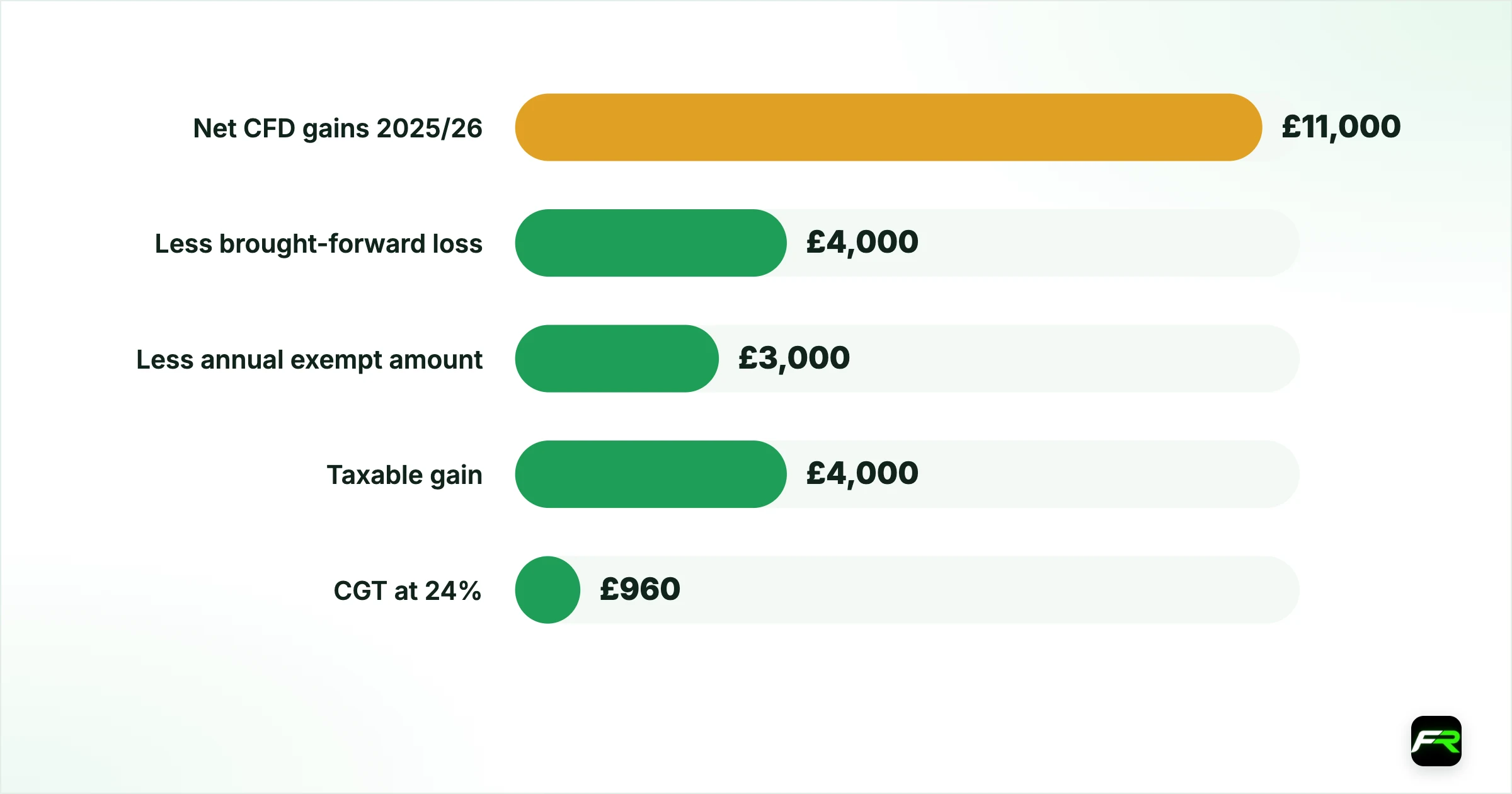
The numbers. Brought-forward losses are used only to reduce gains down to the £3,000 annual exempt amount, and here all £4,000 could be used. Her taxable gain became £11,000 minus £4,000 minus £3,000, or £4,000. At 24%, the tax due on 31 January 2027 is £960. Had she never claimed the 2024/25 loss, the taxable gain would have been £8,000 and the bill £1,920. One entry on the return for a loss-making year saved her £960.
| Loss claimed | Loss not claimed | |
|---|---|---|
| Net CFD gains 2025/26 | £11,000 | £11,000 |
| Less brought-forward loss | £4,000 | £0 |
| Less annual exempt amount | £3,000 | £3,000 |
| Taxable gain | £4,000 | £8,000 |
| CGT at 24% | £960 | £1,920 |
The lesson. CFD losses are allowable, but only if you claim them, and the deadline is four years from the end of the tax year in which the loss arose. Keep sterling records of every closed trade, not only your account balance, because gains and losses on a USD account have to be converted at the rate on the date of each disposal. The self assessment guide shows how to fill in the return.
Case 5: the steady spread better with a 1% rule
Chris spent four months on a demo account before opening a GBP-denominated spread betting account with an FCA-authorised provider, funded with £8,000 he could afford to lose. He traded only GBP/USD and EUR/GBP on the daily chart, reviewed charts for about 40 minutes each evening, and risked 1% of the account on each trade, about £80. With an average stop of 60 points that meant roughly £1.30 per point. He kept a spreadsheet of every trade and never held more than two positions at once. Over twelve months he placed 48 trades: 20 winners averaging 1.8 times his risk, 28 losers of about 1 times his risk.
The numbers. Twenty winners at 1.8R is 36R, and 28 losers at 1R is 28R, leaving a net 8R. At roughly £80 per R that is about £640. Overnight financing on swing positions cost him around £130 over the year, so he finished about £510 up, a return of roughly 6.4%. Because it was spread betting on his own account, the profit was not taxed. There was no bonus, no leverage above 30:1 and no monthly subscription.
The honest view. Six per cent in a year, with Bank Rate at 3.75%, is not a great reward for the risk and the hours. Chris lost more trades than he won, sat through a run of seven losses in a row in the spring, and at one point was down £620. No clever strategy was involved. Sizing stopped any single loss from mattering, he made no rule changes during the drawdown, and his costs stayed small because he traded rarely. Our risk management guide explains the 1% approach.
Common threads across the five cases
Line the five cases up and the same few factors decide the outcome. None of them is about finding the right indicator.
| Case | Starting capital | Outcome | Main cause |
|---|---|---|---|
| 1: Offshore 1:500 | £2,000 | Lost about £1,860 | Oversized position, no UK protections |
| 2: Telegram and account manager | £9,500 paid in | Lost £9,500 | Unauthorised firm, fraud |
| 3: Per-point misread | £5,000 | Lost £1,650, no tax relief | Did not understand position size |
| 4: CFD loss claimed | Not the point | Saved £960 of tax | Good records, claimed on time |
| 5: Steady spread better | £8,000 | Up about £510 | Small risk per trade, few trades |
- Position size decides survival. Daniel and Ravi both lost because each pip cost far more than they realised. Chris made money with a strategy no better than theirs because every loss was capped at 1%.
- Authorisation matters before anything else. Daniel and Kelly both used firms with no UK authorisation. When things went wrong, there was no Ombudsman, no FSCS and, for Kelly, no firm at all. Check the FCA Register and confirm the contact details match before depositing.
- UK rules are protections, not obstacles. The 30:1 cap, the 50% close-out, negative balance protection and the ban on bonuses all exist because of the losses in cases like these.
- Tax is part of the plan. Spread betting's tax-free status also means losses are useless for tax. CFD losses are valuable, but only if you claim them in time and keep sterling records.
- Dull beats exciting. The only positive result came from the least interesting trader: two pairs, daily charts, 48 trades a year and a spreadsheet.
- Unsolicited help is a warning sign. Every approach that came to a trader, from a signal group to a recovery specialist, was a problem.
If you are starting out, read our guides to choosing a UK broker as a beginner and checking a firm on the FCA Register, and spend real time on a demo account before risking money.
Frequently asked
Are these UK forex case studies real?
No. They are illustrative composites built from common patterns in regulator warnings, complaints and trader experience. The names, towns and figures are invented, but the UK rules, leverage limits and tax treatment are real and the numbers are realistic and internally consistent.
What do these cases show about why UK beginners lose money?
Mostly the same few mistakes: positions far too large for the account, holding through events such as a Bank of England decision, misreading per-point stakes and trusting unauthorised firms. The published figures agree that losing is the normal outcome: at the larger UK firms roughly 61% to 74% of retail accounts lost money in September 2026.
How much should a beginner risk per trade?
Many experienced traders risk 0.5% to 1% of their account on each trade. On a £5,000 account that is £25 to £50. Work out your stop distance first, then divide the risk by that distance to find your £ per point or lot size.
What does £ per point mean in spread betting?
It is the amount you win or lose for each point the market moves. On most UK providers' GBP/USD market one point is one pip, so a £5 per point bet gains or loses £5 per pip. It is not a fixed stake or a maximum loss.
Can I offset spread betting losses against tax?
No. HMRC treats spread betting by private individuals as producing no chargeable gains and no allowable losses, so losses cannot be set against other gains. CFD losses, by contrast, are allowable for capital gains tax if you claim them within four years.
Is 1:500 leverage legal in the UK?
Not for retail clients of FCA-authorised firms, which are capped at 30:1 on major pairs. Offshore brokers without UK authorisation may offer 1:500, but UK residents who use them lose FCA protections, including access to the Financial Ombudsman and the FSCS.
Can you make money trading forex in the UK?
Some people do, but most retail accounts lose money. The traders who last usually risk a small fixed percentage per trade, trade infrequently, keep costs low and use FCA-authorised firms. Even then, returns are often modest compared with the time and risk involved.
Related reading
The team behind this guide
Researched, checked and approved by five forex specialists
Every guide is written, fact-checked and edited before it goes live, and updated when the facts change. Spotted an error? Tell us.