





























EUR/GBP Trading Guide for UK Traders: Ranges, Rates and Costs
EUR/GBP trading is slower than cable: the pair often ranges, moves on ECB versus Bank of England divergence, and its small daily moves make costs matter more. Here is how to approach it.
 WriterAbir KhanWriterWrites the guides · checks every figure against primary sources View profileAbout Abir →
 Market analysisTanbir Habib RiyadForex & Crypto AnalystForex and crypto analyst · technical and fundamental analysis View profileAbout Tanbir →
 Fact-checking & riskJannatul FerdaushFact-Checker & Risk AnalystFact-checks every figure · risk analysis · Applied Statistics, University of Dhaka View profileAbout Jannatul →
 Trading reviewJowel RanaCo-Founder & Forex TraderCo-founder · forex trader · reviews guides from a trader's view View profileAbout Jowel →
 Final approvalRanjan NiskrityFounder, Owner & Forex TraderFounder and owner · forex trader · signs off every guide View profileAbout Ranjan →
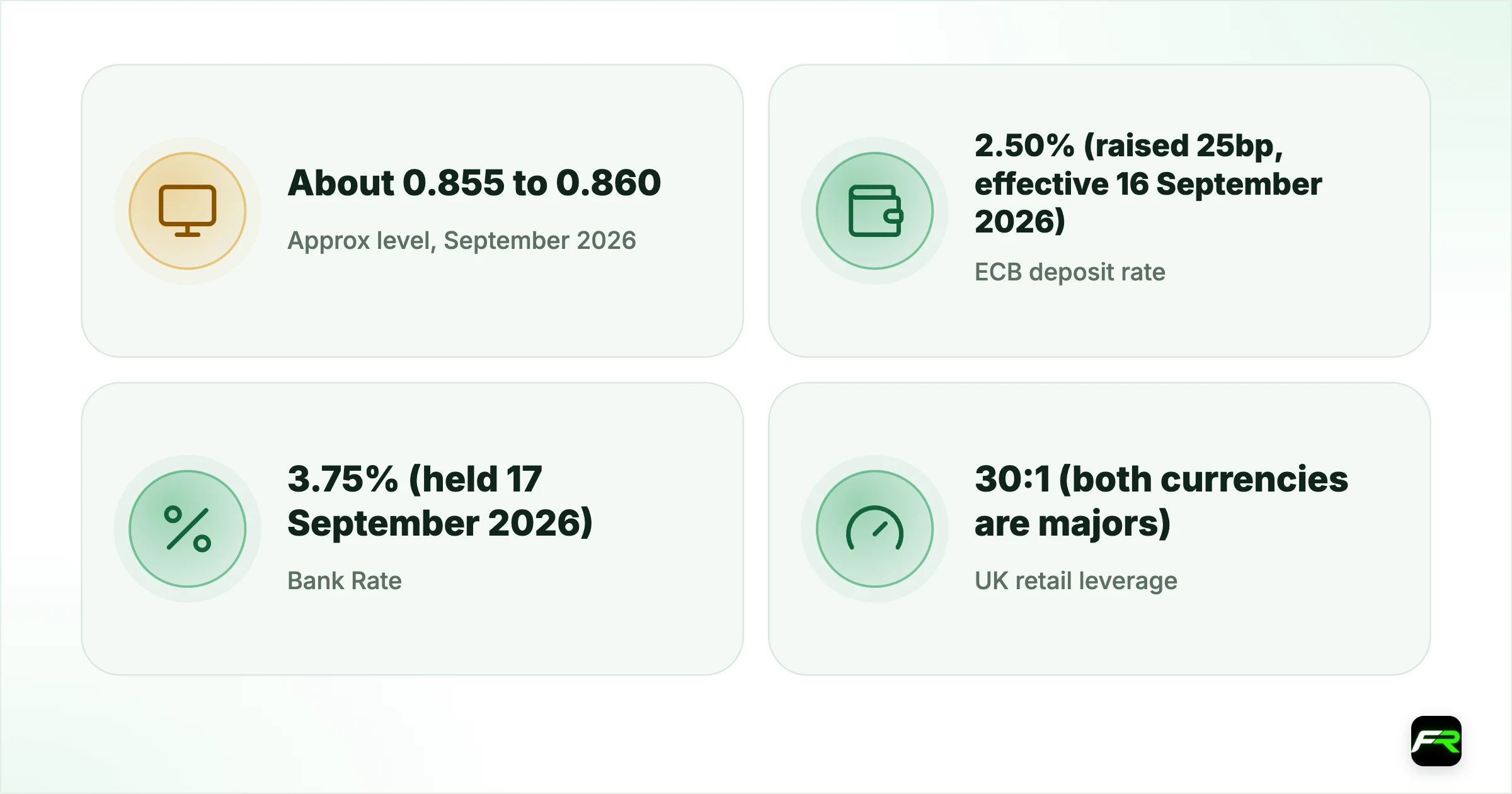
EUR/GBP shows how many pounds one euro buys, and it tends to be one of the calmer major-currency crosses. The UK and eurozone economies are closely linked and often hit by the same shocks, so the pair frequently trades in ranges and makes smaller daily moves than GBP/USD. What pushes it out of a range is usually a change in the gap between European Central Bank and Bank of England policy. In September 2026 it sat roughly between 0.855 and 0.860, with the ECB deposit rate at 2.50% after a September rise and Bank Rate at 3.75%.
Most write-ups of this pair give the definition, a chart and some generic tips, and skip the arithmetic: smaller moves mean spreads and overnight funding eat a bigger share of each trade. That is the part a UK trader most needs, so we spend time on it below, along with the policy gap and the hours when the pair moves.
Market education, not investment advice. FX Recap does not give trade signals or price targets. Price levels quoted here are approximate, dated and will have moved by the time you read this. CFDs and spread bets are leveraged and most retail accounts lose money.
| Approx level, September 2026 | About 0.855 to 0.860 (secondary sources) |
|---|---|
| ECB deposit rate | 2.50% (raised 25bp, effective 16 September 2026) |
| Bank Rate | 3.75% (held 17 September 2026) |
| UK retail leverage | 30:1 (both currencies are majors) |
| Pip value, 1 CFD lot | £10 (the pair is quoted in pounds) |
| Pip value, £1 per point spread bet | £1 |
How to read the quote
A price of 0.8580 means one euro costs 85.80 pence. If EUR/GBP rises, the euro is strengthening against the pound. A falling price means sterling is gaining. That catches people out, because a UK trader bullish on sterling has to sell EUR/GBP, the opposite of buying GBP/USD.
The quote currency is the pound, which makes the arithmetic friendly for a sterling account. One standard CFD lot is 100,000 euros, and each pip (0.0001) is worth exactly £10 with no conversion. A spread bet at £1 per point pays £1 per pip. The pip calculator confirms the figure for any size.
Why EUR/GBP tends to range
The UK and the eurozone trade heavily with each other, import energy from similar sources and are exposed to many of the same global forces. When energy prices rise, both economies feel it. If global risk appetite drops, both currencies usually weaken against the dollar together. Much of what moves GBP/USD and EUR/USD therefore cancels out in EUR/GBP.
The result is a cross that spends long periods moving sideways between levels that traders come to recognise. Range traders like that, buying near the lower edge and selling near the upper one. The danger is that ranges end, and they often end abruptly on a policy surprise. A strategy built only for ranges needs a clear rule for when the range has failed, otherwise the losses from a single breakout can wipe out months of small gains.
In effect, the cross is EUR/USD divided by GBP/USD, and that arithmetic explains how the three pairs relate. On days when the dollar drives everything, EUR/USD and cable move together and EUR/GBP barely shifts. News that concerns only Britain or only the eurozone moves one of the dollar pairs and the cross follows it: a UK-only sell-off lowers cable and lifts EUR/GBP at the same time. A view on the pound can therefore go through cable, which carries dollar risk as well, or through EUR/GBP, which strips the dollar out. Our GBP/USD guide covers how cable and EUR/USD track each other.
Mark the range you think the pair is in, and write down the price that would prove you wrong. If the pair closes a day beyond that level, stop treating it as a range trade.
ECB versus Bank of England divergence
The main driver of sustained moves in EUR/GBP is a change in the expected gap between the two central banks. If markets expect the Bank of England to raise rates while the ECB holds, sterling tends to gain and EUR/GBP tends to fall. Should the ECB turn more hawkish than the Bank, the euro tends to gain.
Both central banks were leaning the same way in September 2026. The ECB raised its three key rates by 25 basis points, taking the deposit rate to 2.50% from 16 September, citing energy-driven inflation. A week later the Bank of England held Bank Rate at 3.75%, with three MPC members voting for a rise. With both banks responding to the same energy shock, the rate gap has not changed much, which helps explain why the pair has stayed in a narrow band.
| Scenario | Tendency for EUR/GBP | Why |
|---|---|---|
| BoE hikes, ECB holds | Tends to fall | Wider rate gap in sterling's favour |
| ECB hikes, BoE holds | Tends to rise | Gap narrows, euro gains |
| Both move together | Often little net change | The gap stays the same |
| UK fiscal worries grow | Tends to rise | Risk premium on sterling assets |
| Eurozone political or debt stress | Tends to fall | Risk premium on euro assets |
Watch the data that drive each side. For the pound that means UK CPI and labour data at 07:00 and the MPC at 12:00. On the euro side, eurozone flash inflation estimates and ECB decisions matter most. Our pieces on UK CPI releases and MPC decisions cover the UK events.
Lower volatility means costs matter more
A pair that moves less gives each trade less room to earn back the spread and funding. Suppose you trade EUR/GBP and GBP/USD with a 1-pip spread on both. If cable typically moves three times as far as EUR/GBP in a day, that 1 pip is a much larger share of the EUR/GBP move. Traders who scalp or day trade the cross feel this most.
Overnight funding adds up in the same way. A range trade on EUR/GBP may need to be held for days or weeks to reach its target, and funding is charged each night. The FCA's November 2025 review of CFD firms found overnight funding charges were often poorly disclosed and in some cases not justified, so it is worth reading your broker's rate sheet before planning a swing trade.
- Compare the spread on EUR/GBP with the pair's normal daily range as well as with other pairs.
- Check the overnight funding rate for both long and short positions.
- Estimate total costs for the holding period you intend, before placing the trade.
- Prefer brokers with tight EUR/GBP pricing if this is the pair you trade most. Our FCA-regulated brokers page lists published spreads where we could verify them.
When EUR/GBP moves in UK time
EUR/GBP is a European pair, so its liquid hours are the European morning. By convention the London session runs from about 08:00 to 17:00 UK time, and most of the pair's volume comes during London and continental European trading. Eurozone data often lands between 07:00 and 10:00 UK time, UK data at 07:00, the MPC at 12:00, and ECB decisions early in the afternoon UK time with a press conference after.
Unlike cable, the New York overlap adds relatively little to this pair, and the Asian session is quiet, with wider spreads. If you trade around a job, the pair suits people who can look at charts before 09:00 or in a lunch break, and less so those who trade in the evening.
Tariq has £15,000 in a spread betting account and prefers slower markets. He notices EUR/GBP holding between about 0.8540 and 0.8620 over several weeks. Near the top, at 0.8612, he sells with a stop at 0.8645, 33 pips away, risking £100 at £3 per point. His target is 0.8560. The trade takes nine days to reach 0.8565, where he closes, making 47 pips, £141 gross. Overnight funding over nine nights costs about £9 and the spread £3, leaving roughly £129. He notes that costs took nearly a tenth of the gain, and that a failed breakout would have cost the full £100 plus funding.
Risk points specific to the cross
- Breakouts: long quiet ranges can make traders careless about stops. The break, when it comes, can be fast.
- Double event risk: the pair reacts to both UK and eurozone events, so the calendar has twice as many potential shocks.
- Correlation with cable: short EUR/GBP and long GBP/USD are both bets on sterling strength. Hold both and the risk is concentrated, not spread.
- Sterling-specific stress: UK fiscal events such as the 28 October 2026 Budget can move the pound against everything, EUR/GBP included.
For regular updates, see the EUR/GBP forecast page. Use it for scenarios and levels to watch, not as a signal to trade.
Frequently asked
Is EUR/GBP a good pair for beginners?
It is calmer than many pairs, which helps, but that also makes costs a larger share of each move. Beginners can learn a lot from its ranges if they trade small, use stops and pay attention to spreads and overnight funding. A calm pair can still lose money.
Why does EUR/GBP move less than GBP/USD?
The UK and eurozone economies are closely linked and face many of the same shocks, such as energy prices and global risk mood. Those shared forces largely cancel out in the cross, leaving mainly the difference between them, which tends to change slowly.
What moves EUR/GBP the most?
Changes in the expected gap between European Central Bank and Bank of England interest rates. Surprises in UK or eurozone inflation, MPC votes and ECB guidance shift that gap. Political or fiscal stress on one side can also move the pair.
What leverage can UK retail traders use on EUR/GBP?
Up to 30:1 under FCA rules, a margin of 3.33%, because the euro and the pound are both major currencies. One standard CFD lot of 100,000 euros at 0.8580 needs about £2,860 of margin.
If I think the pound will rise, do I buy or sell EUR/GBP?
Sell. EUR/GBP is the price of a euro in pounds, so a stronger pound pushes the number down. It is the opposite of GBP/USD, where you buy to back sterling. Beginners mix this up more often than almost anything else on the cross.
When is the best time to trade EUR/GBP from the UK?
During the European morning, roughly 08:00 to 12:00 UK time, when both London and continental markets are active and most relevant data is released. The pair is usually quiet in the Asian session and adds less during the New York overlap than cable does.
Related reading
The team behind this guide
Researched, checked and approved by five forex specialists
Every guide is written, fact-checked and edited before it goes live, and updated when the facts change. Spotted an error? Tell us.