 IC Markets




































Forex Signals: Live Forex Trading in 2026
Forex signals are trade ideas from technical or fundamental analysis. How to judge their quality and use them without losing your own judgement.
 WriterAbir KhanWriterWrites the guides · checks every figure against primary sources View profileAbout Abir →
 Market analysisTanbir Habib RiyadForex & Crypto AnalystForex and crypto analyst · technical and fundamental analysis View profileAbout Tanbir →
 Fact-checking & riskJannatul FerdaushFact-Checker & Risk AnalystFact-checks every figure · risk analysis · Applied Statistics, University of Dhaka View profileAbout Jannatul →
 Trading reviewJowel RanaCo-Founder & Forex TraderCo-founder · forex trader · reviews guides from a trader's view View profileAbout Jowel →
 Final approvalRanjan NiskrityFounder, Owner & Forex TraderFounder and owner · forex trader · signs off every guide View profileAbout Ranjan →

Forex signals have come a long way from the basic buy/sell alerts traders relied on decades ago. Today they function as complete decision-support tools, combining price data, market psychology, economic events, and increasingly, machine-learning models to help traders act with more confidence.
Whether a signal comes from a seasoned analyst or an automated system, the core job remains the same: cut through market noise and give a trader something actionable.
This matters most in live forex trading, where decisions need to happen in seconds. Currency prices can shift 30–80 pips in minutes during major news releases, and a trader who hesitates or second-guesses often exits worse off than one following a structured plan. Signals help create that structure.
This article breaks down what forex signals actually are, how different types work, how to evaluate their real accuracy (not just win rate), and where most traders go wrong when using them. Real examples, actual calculations, and honest failure cases are included throughout.
What a Forex Signal Actually Contains
A forex signal is a recommendation to enter or exit a currency trade under specific conditions. A complete signal typically includes:
- Currency pair: e.g., EUR/USD, GBP/JPY
- Direction: Buy or Sell
- Entry price: The level at which to enter
- Stop-loss: Where to exit if the trade moves against you
- Take-profit: The target price if the trade works
- Rationale (in better services): Why the signal was generated
Here’s a straightforward example. EUR/USD is trading at 1.0840. A signal system detects a bullish breakout pattern forming above a key resistance zone. The signal reads:
Buy EUR/USD at 1.0850 | Stop-loss: 1.0820 | Take-profit: 1.0910
That’s a 30-pip risk and a 60-pip reward, a 1:2 risk-to-reward ratio. The signal doesn’t just tell you what to do; it defines the risk before you commit capital. Understanding stop-loss and take-profit mechanics is essential to making proper use of any signal you receive.
The Four Main Types of Forex Signals
1. Technical Analysis Signals
These are generated by reading price charts, patterns, levels, and indicators applied to historical price data. Common inputs include moving averages, RSI, MACD, Fibonacci retracements, and candlestick patterns.
Technical signals are popular because they are objective and testable. If you’re not already familiar with the tools behind them, reviewing what forex indicators are and how to read forex charts gives you a much clearer picture of what’s being flagged.
A classic example: when the 50-day moving average crosses above the 200-day moving average, this “golden cross” formation has historically preceded upward momentum in major pairs.
2. Fundamental Analysis Signals
These are driven by economic data and policy decisions, interest rate announcements, inflation figures, employment reports, and geopolitical developments. Understanding forex market hours helps here, fundamental signals are most impactful during the London and New York opens when volume and liquidity are highest.
For example, if the US Federal Reserve signals a rate hike cycle, USD typically strengthens against lower-yielding currencies like JPY or CHF. A fundamental signal might recommend buying USD/JPY ahead of or following the announcement, with wider stop-losses to account for initial volatility.
3. Sentiment-Based Signals
These signals read the crowd and often trade against it. If positioning data shows that 74% of retail traders are long on GBP/USD while price remains flat or falling, sentiment-based models may flag a short opportunity, the logic being that when most small traders are positioned one way, institutional players often push the other direction.
Contrarian sentiment analysis works best when combined with technical confirmation rather than used alone.
4. AI and Algorithm-Driven Signals
Automated systems now generate a substantial portion of forex signals globally. These models process millions of data points, price, volume, order flow, correlations across asset classes, and macroeconomic inputs, simultaneously. They’re particularly useful in identifying liquidity zones and order imbalances that aren’t visible on standard charts. The most reliable setups often combine algorithmic signals with human interpretation, which is exactly what better forex signal providers now offer as hybrid services.
How Traders Actually Use Signals in Live Trading
Entry Timing
Signals pinpoint entry windows, particularly useful during high-volatility periods like the London-New York session overlap. Rather than watching charts all day, a trader can act when the signal fires.
Defining Risk Before Entering
A properly formatted signal includes both stop-loss and take-profit levels. This forces the trader to define their risk before they commit, one of the most important habits in forex risk management.
Confirming Personal Analysis
Experienced traders rarely follow signals blindly. Instead, they use them to confirm what their own analysis already suggests. If a signal and independent analysis agree, conviction is higher. If they conflict, many professionals simply skip the trade.
Automated Execution
MetaTrader 4 and MetaTrader 5 remain the most commonly used platforms for signal-based automated execution, and both support algorithmic signal integration that removes emotional interference from trade entry entirely.
A Quick Calculation on Risk-to-Reward
Say you receive a signal to sell GBP/USD at 1.2760, with a 30-pip stop-loss and 80-pip take-profit:
Reward (80 pips) ÷ Risk (30 pips) = 2.66:1 ratio
That means for every £1 risked, the potential gain is £2.66. Most experienced traders target a minimum of 1.5:1. Anything above 2:1 gives you room to be profitable even with a sub-50% win rate. Understanding pip values and lot sizing is necessary to translate these ratios into actual monetary risk.
Signal Accuracy: What the Numbers Actually Mean
Signal providers often advertise win rates, “75% accuracy!”, as if that alone determines profitability. It doesn’t. Profitability depends on the combination of win rate and average pip gain vs. average pip loss.
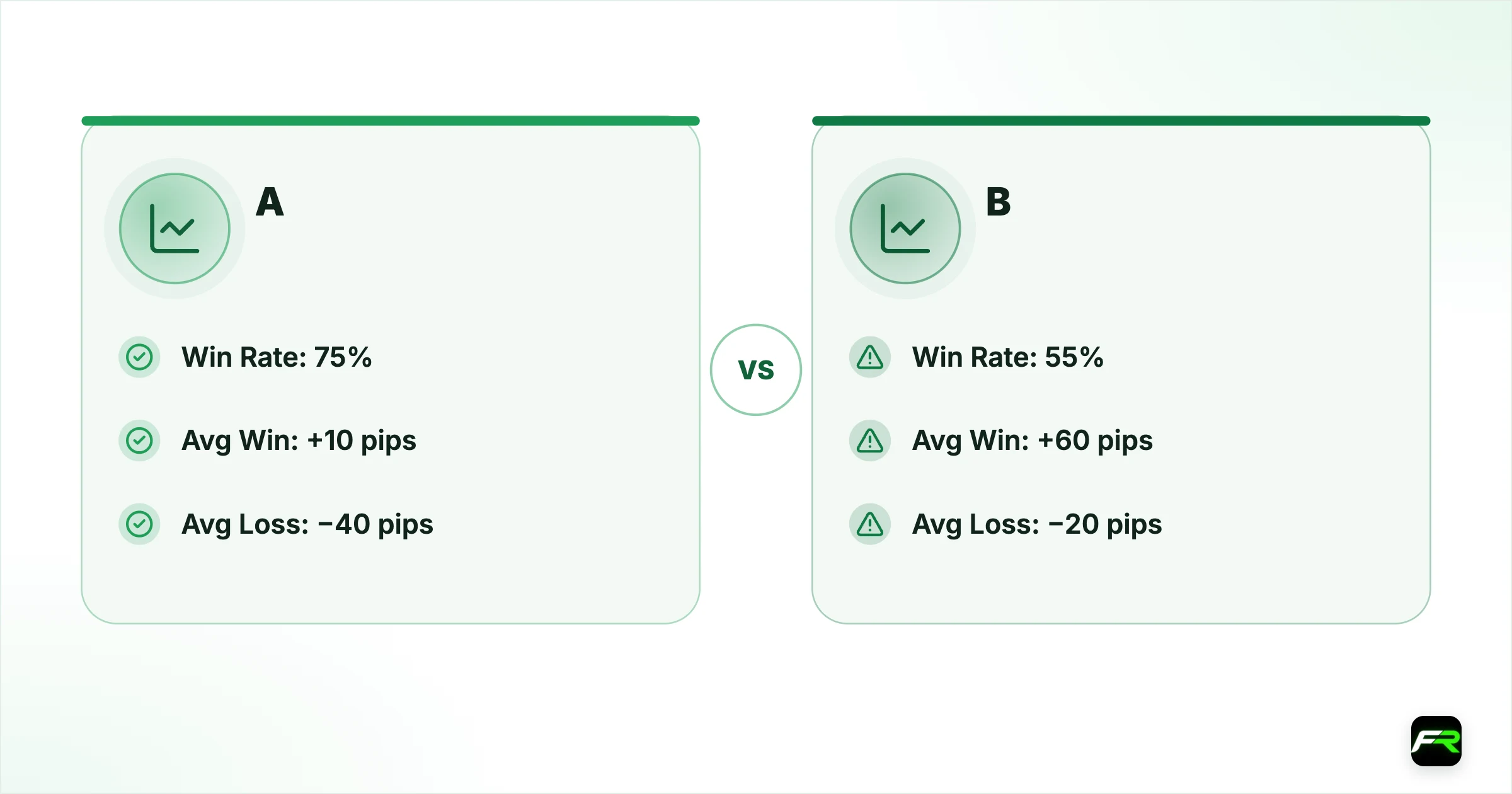
| Trader | Win Rate | Avg Win | Avg Loss | Net (per 100 trades) |
|---|---|---|---|---|
| A | 75% | +10 pips | −40 pips | 75×10 − 25×40 = −250 pips |
| B | 55% | +60 pips | −20 pips | 55×60 − 45×20 = +2,400 pips |
Trader A looks better on paper. Trader B makes far more money. The difference is risk structure, not accuracy.
“A signal is only as good as the risk structure behind it. Win rate matters, but reward-to-risk ratio determines whether you actually keep the money.” – David Larson, currency analyst
Real Trader Experiences: What Works and What Doesn’t
Maya: The Disciplined Cross-Checker
Maya, a 32-year-old trader based in Singapore, struggled with timing. She understood the market reasonably well but consistently entered too early or too late. She subscribed to a signal service focused on major currency pairs and changed one key habit: she only took a trade when the signal and her own chart analysis pointed in the same direction.
Over 12 months, she executed 480 confirmed trades. Her account grew by 38%, driven not by hitting big wins, but by staying out of bad setups and keeping losses contained. Her stop-losses held. Her position sizes stayed consistent.
Her experience reflects something worth stating plainly: signals work best when they validate your own thinking, not when they replace it entirely.
Tom: The Telegram Follower
Tom, an engineering student in London, started trading looking for quick returns. He joined several Telegram groups promising high-accuracy signals, placed trades immediately on every alert, and skipped any verification. He frequently widened stop-losses when trades moved against him, convinced they’d recover.
Six weeks in, his account was down to under $150. The failure wasn’t really about the signals, some may have been legitimate. It was the absence of any risk discipline, position sizing logic, or basic understanding of what he was trading. Spending time on a demo account before trading signals with real money would have made an enormous difference.
How to Evaluate a Signal Provider
Not all signal services are equal, and several are outright fraudulent. Before trusting any provider with your capital, verify the following:
- Verified track record: Look for at least 12 months of independently verifiable results. Screenshots of winning trades don’t count, anyone can cherry-pick those.
- Risk-to-reward consistency: A legitimate provider targets at least 1.5:1 per signal. If average wins are smaller than average losses, the service is bleeding you slowly regardless of win rate.
- Trade frequency: More signals don’t mean better results. Providers generating 15–20 signals per day are often filling volume to justify subscriptions. Quality providers are selective.
- Clear methodology: Every signal should come with an explanation of what pattern, indicator, or data point triggered it. Vague or absent reasoning is a red flag.
- Regulatory transparency: Signals from licensed analysts or regulated firms carry more accountability. Understanding how to identify a trustworthy forex broker also helps you vet the environments where these signals are often promoted.
Adapting Signals to Your Own Trading Style
Signals shouldn’t override your own trading approach, they should fit into it. A conservative trader receiving a buy signal on USD/JPY at 152.80 with a 50-pip stop might reduce exposure by halving position size or tightening the stop to 35 pips based on a nearby support level identified independently. A more aggressive trader might scale in across two entries.
This kind of adaptation requires understanding forex leverage and margin requirements so that position sizing decisions are grounded in actual account capacity, not just confidence in the setup. Traders using different account types, standard, mini, or micro, will also need to adjust how they interpret pip-based risk from any given signal.
The Most Common Mistakes Traders Make with Signals
Following blindly without context
A buy signal on EUR/USD right before a major ECB announcement is a very different trade to the same signal during a quiet Asian session. Context matters. Signals don’t automatically account for timing or upcoming events.
Ignoring position sizing
A correct signal with an oversized position can still blow up an account. Proper sizing is part of risk management, not optional.
Taking every signal without filtering
Volume isn’t discipline. Many traders overtrade by acting on every alert, then wonder why their results are inconsistent. Selectivity, only taking signals that align with your own reading of the market, separates consistent traders from erratic ones.
Moving stop-losses after entry
This is the most costly habit. Moving a stop further away when price approaches it turns a defined-risk trade into an undefined one. Signals lose their structural value the moment stop-loss discipline breaks down.
Where Forex Signals Are Heading
Automated execution with dynamic risk adjustment
Rather than sending an alert for a trader to act on, newer systems execute trades directly with position sizes calculated in real time based on account balance and current volatility.
Adaptive stop-loss algorithms
Static stop-loss levels are being replaced by systems that trail stops dynamically as price moves, locking in profits without requiring manual adjustments.
Cross-asset signal integration
Increasingly, forex signals are being generated by correlating currency movements with equities, commodities, and even crypto markets. A spike in oil prices, for example, might feed directly into a CAD/JPY signal through automated cross-market analysis.
“AI is getting better at finding the opportunities. The human role is shifting toward deciding which ones are worth the risk.” – Irene Wallace, professional trader
The Bottom Line
Forex signals are useful, genuinely useful, when a trader approaches them with the right mindset. They reduce reaction time, add structure to entries, and provide a framework for risk management that many traders, especially newer ones, haven’t yet built on their own.
But signals don’t make trading effortless, and they don’t compensate for a lack of discipline. The traders who benefit most are the ones who understand what they’re being told, verify it against their own analysis, manage position size carefully, and don’t abandon their stop-losses the moment a trade goes against them.
For anyone starting out, spending time on a demo account before trading signals with real money is still the most practical advice available. The forex signals master guide is worth reading alongside this as a deeper reference.
Markets move fast. A good signal gives you a starting point. What you do with it determines the outcome.
The team behind this guide
Researched, checked and approved by five forex specialists
Every guide is written, fact-checked and edited before it goes live, and updated when the facts change. Spotted an error? Tell us.
Related Articles
 Education
5 min read
Education
5 min read

 Education
8 min read
Education
8 min read
 Education
14 min read
Education
14 min read
 Education
8 min read
Education
8 min read
 Education
9 min read
Education
9 min read
 Education
7 min read
Education
7 min read