





























How to Fund a Trading Account in the UK: Bank, Card and PayPal
Bank transfer and debit card are the simplest ways to fund a UK trading account. Here is what to know about credit cards, PayPal, Revolut or Monzo, name checks and bank blocks.
 WriterAbir KhanWriterWrites the guides · checks every figure against primary sources View profileAbout Abir →
 Market analysisTanbir Habib RiyadForex & Crypto AnalystForex and crypto analyst · technical and fundamental analysis View profileAbout Tanbir →
 Fact-checking & riskJannatul FerdaushFact-Checker & Risk AnalystFact-checks every figure · risk analysis · Applied Statistics, University of Dhaka View profileAbout Jannatul →
 Trading reviewJowel RanaCo-Founder & Forex TraderCo-founder · forex trader · reviews guides from a trader's view View profileAbout Jowel →
 Final approvalRanjan NiskrityFounder, Owner & Forex TraderFounder and owner · forex trader · signs off every guide View profileAbout Ranjan →
The simplest way to fund a trading account in the UK is a bank transfer from an account in your own name, which usually travels by Faster Payments, or a debit card, which normally credits instantly. FCA-authorised brokers generally charge no deposit fee for either. Credit cards are accepted by some firms, PayPal by fewer, and every firm rejects money from someone else’s account. UK banks do not block payments to FCA-authorised CFD and spread betting firms as a category, though several restrict payments to crypto platforms.
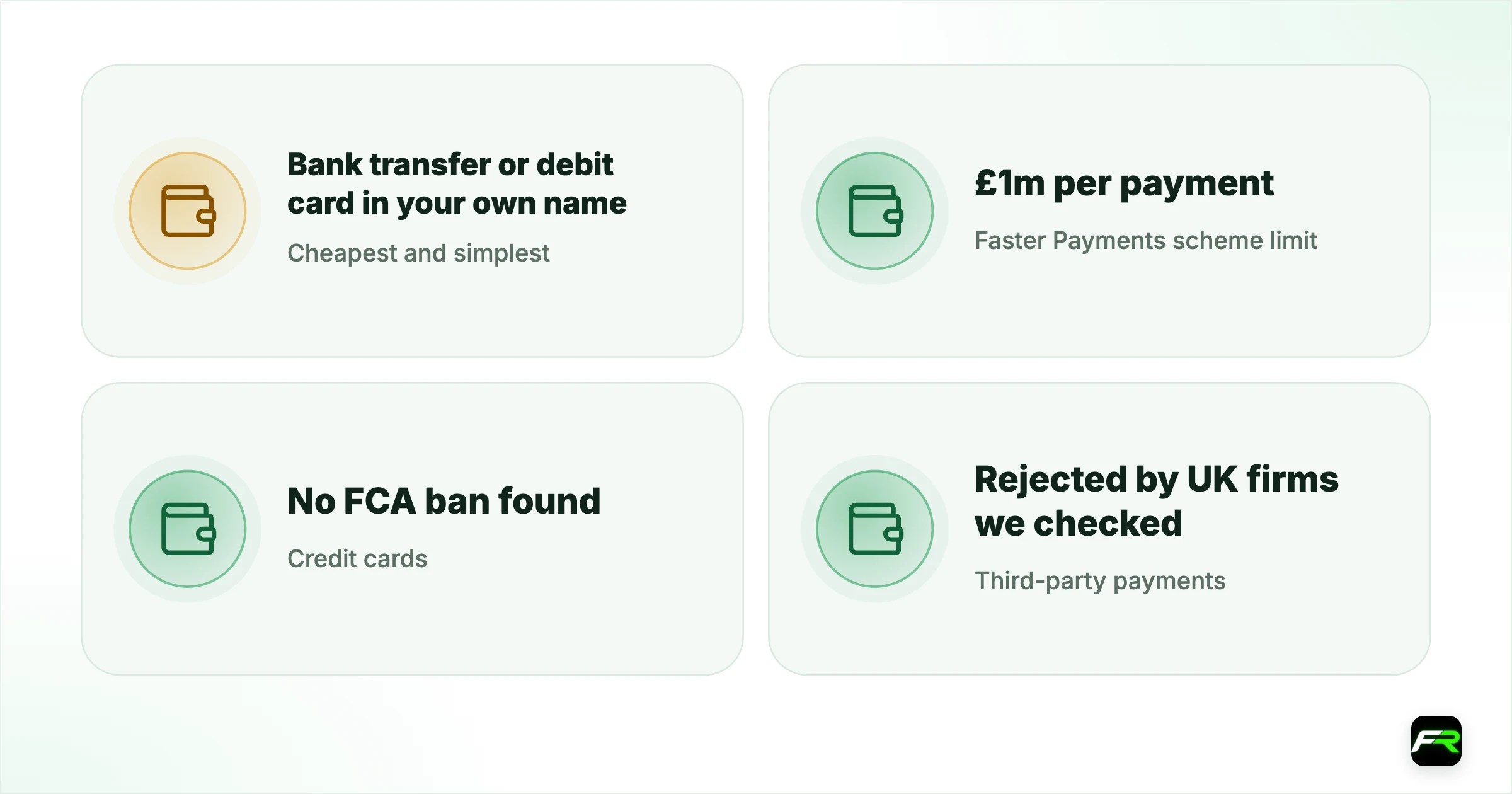
| Cheapest and simplest | Bank transfer or debit card in your own name |
|---|---|
| Faster Payments scheme limit | £1m per payment; your bank sets a lower limit |
| Credit cards | No FCA ban found; firm and card issuer policy |
| Third-party payments | Rejected by UK firms we checked |
| Withdrawals | Usually back to the method and account you paid from |
Bank transfer and Faster Payments
A UK bank transfer is the default route for larger deposits. When you pay a sterling account at a UK broker from your banking app, it normally goes by Faster Payments and often arrives within minutes, though the broker then has to match it to your account. The Faster Payments scheme allows payments of up to £1m, but that is the ceiling for the system, not your personal allowance. Your bank sets its own daily and per-payment limits, which can be much lower, and it may apply a lower limit to a new payee.
Broker timescales vary. XTB says UK bank transfers are normally added within one working day. Pepperstone gives a range from the same day up to seven working days for bank transfers. IG does not charge for bank transfers, but warns that international payments, or ones needing a currency conversion, can take one to three working days. CMC Markets also offers an online banking option that connects to your bank so you approve the payment in your banking app, which avoids typing account details by hand.
- Use the exact reference the firm gives you, usually your account number and name. A missing reference is the most common reason a deposit sits unallocated.
- Expect a Confirmation of Payee check. Your bank compares the name you type with the name on the receiving account. A “close match” or “no match” warning is a reason to stop and check the details on the firm’s own website.
- Send pounds to a GBP account. Sterling paid into a USD account gets converted, at a cost; see our guide to GBP base accounts.
Debit and credit cards
Debit cards are the quickest way in. Pepperstone, IG and XTB all say card deposits are credited immediately. None of the four large firms we checked, CMC Markets included, charges a UK deposit fee at the time of writing (September 2026). Limits differ: IG lists a debit card maximum of £99,999 per transaction in sterling, CMC Markets allows up to £50,000 per card transaction, and Pepperstone has a £10 minimum for cards. Your own bank may set lower limits.
Credit cards are where people get confused. We found no FCA rule that bans funding a CFD or spread betting account with a credit card. The April 2020 credit card ban you may have read about came from the Gambling Commission and covers gambling operators, not FCA-authorised spread betting firms, even though spread bets are gambling for tax purposes. Whether you can use a credit card is up to the firm and your card issuer. IG lists a credit card limit of £30,000 per transaction. CMC Markets accepts credit cards but warns that your issuer may treat the payment as a cash advance.
A cash advance usually means a fee and interest from day one, with no interest-free period. Borrowed money on a credit card also layers debt on top of leverage. Our view: do not fund a trading account with a credit card unless you clear the balance immediately, and preferably not at all.
PayPal and e-wallets
PayPal support at FCA-authorised brokers is patchy and changes often, so verify it on the firm’s UK funding page rather than trusting a comparison table. When we checked in September 2026, the UK funding pages of IG, CMC Markets, Pepperstone and XTB listed cards and bank transfers, but did not list PayPal as a method for UK clients, even though some of these firms mention PayPal on pages for other regions. XTB’s UK help centre lists only bank transfer and debit or credit card.
Where PayPal is accepted, the PayPal account has to be in your name, and withdrawals normally go back to the same PayPal account up to the amount you paid in. Offshore firms tend to accept more e-wallets, including Skrill and Neteller, but that comes with the offshore trade-offs set out in our offshore broker guide.
Revolut, Monzo, Wise and name matching
App banks and e-money accounts are fine for most brokers as long as the account is in your name and holds pounds with a UK sort code and account number. The deposit is then just another Faster Payment. Problems usually come from three places:
- Name mismatch. Your trading account and bank account must be in the same name. A nickname, missing middle name or maiden name on one side can trigger a manual check or a returned payment.
- Third-party money. Pepperstone, IG and CMC Markets all say they reject payments from anyone else, including a partner. Joint accounts are accepted by Pepperstone only if you are a named holder, and it will not accept money from a business account into a personal trading account.
- Account type. Some firms treat e-money accounts differently from bank accounts, or ask for a statement showing the account is yours. Keep a PDF statement with your name and sort code ready.
Withdrawals are usually closed loop: money goes back the way it came. A firm will often return a card deposit to the same card first, up to the amount deposited, and send any profit to a verified bank account in your name. That is an anti-money laundering control, not a sign that something is wrong, and it means you should plan to withdraw to a bank account you will keep.
Bank blocks: crypto versus FCA brokers
Several UK banks restrict payments to crypto exchanges. Starling, Chase UK, Metro Bank and TSB block them, and Barclays and HSBC cap them. That is a crypto policy. We found no general UK bank block on payments to FCA-authorised CFD or spread betting firms, and paying IG or CMC Markets from a high street account is routine.
A bank may still pause a first large payment to a new payee and ask what it is for. That is normal fraud screening. Answer honestly: “funding my trading account with [firm name]”. If your bank refuses a payment to a firm that calls itself a broker, take it seriously. Check the firm on the FCA Register, and confirm that the bank details, website and phone number match what the Register shows. Offshore firms that push crypto deposits are the ones most often caught by bank blocks, which is part of why they push them.
APP scam protection: what it covers
Since 7 October 2024, banks and payment firms have had to reimburse most victims of authorised push payment (APP) scams, where you are tricked into sending money by Faster Payments or CHAPS. The limit is £85,000 per claim, your bank may deduct an excess of up to £100, and you have 13 months from the last payment to claim. Card payments, crypto transfers and international payments can fall outside the scheme.
That protection is for being tricked, for example by a clone firm using a real broker’s name, or a fake account manager on social media. It does not cover trading losses at a genuine broker. If you think you have paid a scam firm, call your bank straight away and report it to Report Fraud (0300 123 2040), which replaced Action Fraud. Our scam reporting guide has the steps.
Lucy opened a GBP spread betting account with an FCA-authorised firm and paid in £500 by debit card, which credited instantly. A week later she sent £3,000 from her Monzo account by Faster Payments. Monzo’s Confirmation of Payee check matched the firm’s name, and the money arrived the same afternoon. Later she asked to withdraw £1,200. The firm returned £500 to her debit card, matching the card deposit, and sent the other £700 to her Monzo account. When her partner offered to top up her account from his own bank, the firm’s rules meant it would have been returned, so he did not.
Frequently asked
What is the best way to fund a trading account in the UK?
A bank transfer or debit card from an account in your own name. Both are usually free at FCA-authorised firms, debit cards credit instantly, and bank transfers by Faster Payments often arrive the same day. Use the exact payment reference the firm gives you.
Can I use a credit card to fund a spread betting account?
Sometimes. We found no FCA rule against it; the Gambling Commission ban covers gambling operators, not FCA firms. Acceptance is up to the broker and card issuer, and some issuers treat it as a cash advance with fees and immediate interest.
Do UK brokers accept PayPal?
Some do, but it is less common than cards and bank transfer. In September 2026 the UK funding pages of several large FCA firms did not list PayPal for UK clients. Check the firm’s own UK funding page before relying on it.
Can I deposit from Revolut, Monzo or Wise?
Usually yes, if the account is in your name and holds pounds with a UK sort code and account number. The name must match your trading account. Some firms may ask for a statement proving the account is yours.
Can I deposit with Apple Pay, Google Pay or open banking?
At some firms. Pepperstone’s UK site lists Apple Pay and Google Pay as payment methods alongside cards and bank transfer. CMC Markets offers an online banking option through its open banking partner, TrueLayer, where you approve the payment in your own banking app. Methods change often, so check the firm’s UK funding page rather than a comparison table.
How long do withdrawals take to reach a UK bank?
Usually from one to several working days after the firm’s own checks. Pepperstone, for example, says card, Apple Pay and Google Pay withdrawals take up to one business day, while bank transfer withdrawals may take up to seven working days, and it processes requests only on working days.
Why did my bank block a payment to a broker?
Several UK banks block or cap payments to crypto platforms, and banks may pause a first large payment to a new payee for fraud checks. We found no general block on FCA-authorised CFD firms. If a payment to a supposed broker is refused, check the firm on the FCA Register.
Will my bank refund me if a fake broker scams me?
If you were tricked into a Faster Payments or CHAPS transfer, the APP reimbursement rules usually apply: up to £85,000, a possible £100 excess, claims within 13 months. Card, crypto and international payments may fall outside. Trading losses at a genuine firm are not covered.
Related reading
The team behind this guide
Researched, checked and approved by five forex specialists
Every guide is written, fact-checked and edited before it goes live, and updated when the facts change. Spotted an error? Tell us.