





























Spread Betting vs CFDs for UK Traders: Tax, Costs and Which to Use
Spread betting wins on tax for profitable traders with no other gains; CFDs win when you have losses to use. Here is a decision table by profit and tax band, plus the cost and sizing differences.
 WriterAbir KhanWriterWrites the guides · checks every figure against primary sources View profileAbout Abir →
 Market analysisTanbir Habib RiyadForex & Crypto AnalystForex and crypto analyst · technical and fundamental analysis View profileAbout Tanbir →
 Fact-checking & riskJannatul FerdaushFact-Checker & Risk AnalystFact-checks every figure · risk analysis · Applied Statistics, University of Dhaka View profileAbout Jannatul →
 Trading reviewJowel RanaCo-Founder & Forex TraderCo-founder · forex trader · reviews guides from a trader's view View profileAbout Jowel →
 Final approvalRanjan NiskrityFounder, Owner & Forex TraderFounder and owner · forex trader · signs off every guide View profileAbout Ranjan →
For a UK trader who expects to make money and has no other capital gains, spread betting is usually the better choice, because the winnings are free of Capital Gains Tax while CFD gains above £3,000 a year are taxed at 18% or 24%. CFDs come out ahead in a different situation: when you are likely to lose, or when you have gains elsewhere (a share sale, a second property, crypto) that a trading loss could shelter. Costs, leverage limits and FCA protections are broadly the same for both, so tax and how you prefer to size positions are the real deciding factors.
Below we set out a decision table by profit size and tax band, work through £2,000, £10,000 and £40,000 profit years and a loss year, and explain the practical differences in pricing, position sizing and platforms.
General information, not tax advice. Your position depends on your own circumstances, and tax rules can change, including at the 28 October 2026 Budget. If your gains are large, your situation is unusual or you are unsure which regime applies, a qualified tax adviser who works with traders is worth the fee.
Same trade, different wrapper
A spread bet and a CFD on GBP/USD track exactly the same price. Both are leveraged, both are closed out for cash, and under FCA rules both count as CFDs for retail protection purposes: the same 30:1 maximum leverage on major pairs, the same 50% margin close-out, the same negative balance protection and the same ban on bonuses. An FCA-authorised firm offering either one also brings access to the Financial Ombudsman Service and, if the firm fails holding your money, the FSCS.
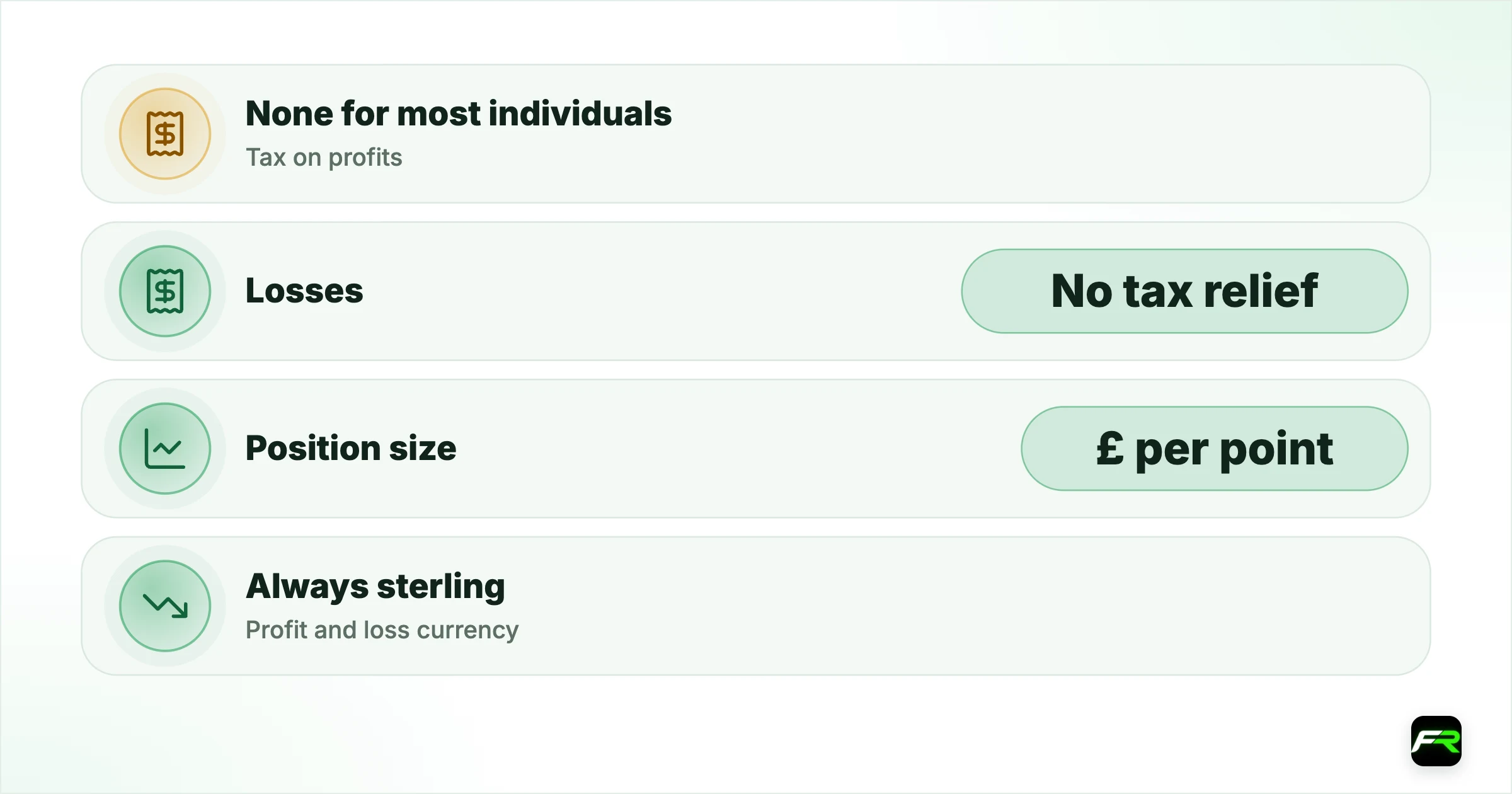
The legal form is what differs. A spread bet is a bet priced in pounds per point, which HMRC treats as gambling. Its manual at CG56105 says no chargeable gains or allowable losses arise from it. A CFD is a contract to exchange the difference in value of a position, which HMRC's CG56100 treats as a financial future within Capital Gains Tax. Everything else in this comparison follows from that single legal distinction.
| Feature | Spread bet | CFD |
|---|---|---|
| Tax on profits | None for most individuals | CGT at 18% or 24% above £3,000 |
| Losses | No tax relief | Allowable against other gains, can be carried forward |
| Position size | £ per point | Lots or units of the base currency |
| Profit and loss currency | Always sterling | Usually the quote currency (USD on GBP/USD) unless converted |
| Tax reporting | None | SA108 if gains above £3,000 or disposals over £50,000 |
| Retail leverage cap | 30:1 on majors | 30:1 on majors |
| Available from offshore brokers | Rarely | Yes |
| Stamp duty on share positions | None | None |
Decision table by profit size and tax band
The table assumes the profit is your only capital gain in the tax year, the standard £12,570 personal allowance and the 2026/27 CGT rates. For an individual, the spread bet column is always £0. "Basic rate" assumes a salary of £30,000, which leaves £20,270 of basic rate band for gains.
| Net trading result for the year | CFD tax, basic rate payer (£30,000 salary) | CFD tax, higher rate payer | Spread bet tax | Better choice on tax |
|---|---|---|---|---|
| £2,000 profit | £0 (within £3,000 allowance) | £0 | £0 | No difference |
| £10,000 profit | £1,260 | £1,680 | £0 | Spread bet |
| £40,000 profit | £7,663.80 | £8,880 | £0 | Spread bet |
| £8,000 loss, no other gains | £0, loss carried forward | £0, loss carried forward | £0, loss wasted | CFD if you expect future gains |
| £8,000 loss plus £12,000 share gain | Saves £1,440 | Saves £1,920 | No saving | CFD |
The worked numbers
£2,000 profit. The whole gain sits inside the £3,000 annual exempt amount, so a CFD trader pays nothing, exactly like a spread bettor. At this level the only difference is paperwork: if your total CFD disposal proceeds went over £50,000 you might still need to fill in the capital gains pages, which a spread bettor never does.
£10,000 profit. Taxable gain is £7,000. A basic rate taxpayer with room in the band pays 18%, which is £1,260. Someone in the higher rate band pays 24%, which is £1,680. That is money the spread bettor keeps.
£40,000 profit. Taxable gain is £37,000. For a higher rate taxpayer that is £8,880 at 24%. The basic rate trader on £30,000 has taxable income of £17,430, leaving £20,270 of band: £20,270 at 18% is £3,648.60 and the remaining £16,730 at 24% is £4,015.20, a total of £7,663.80. At this level of profit the tax difference pays for a lot of wider spreads.
Loss years. Suppose you lose £8,000 on CFDs in the same year you sell shares held outside an ISA for a £12,000 gain. Without the loss you would be taxed on £9,000 (the gain minus the £3,000 allowance). With it, the net gain falls to £4,000 and only £1,000 is taxable. At 24% that saves £1,920. A spread bettor with the same £8,000 loss gets no relief, and still pays tax on the share gain. If you have no other gains, the CFD loss carries forward and can shelter future profits, provided you claim it within four years.
Nadia, a software tester on £44,000, opened her first trading account in 2024/25. She chose CFDs because the platform she liked offered nothing else, and lost £5,200 in her first year, a loss she claimed on her return. In 2025/26 she made £9,600 on CFDs. Her brought-forward loss reduced that to £4,400, and after the £3,000 allowance only £1,400 was taxable, costing £252 at 18%. By the time she was consistently profitable she had used up the loss, so for 2026/27 she opened a spread betting account with an FCA-authorised firm for new positions. She kept the CFD account open for a small, separate strategy but now does most of her trading where winnings are not taxed.
Costs are closer than most people think
Brokers price the two products in similar ways. Spread bets usually carry no commission: the cost sits in the spread and in overnight funding on positions held past the daily cut-off. CFDs come in two flavours. Standard CFD accounts also build costs into the spread, while raw or commission accounts offer tighter spreads plus a fixed commission, such as Pepperstone's Razor pricing from £2.25 per lot per side. On a like-for-like basis, the total cost per trade is often within a fraction of a pip.
Overnight financing deserves more attention than it gets. In its November 2025 review of CFD pricing, the FCA found wide variations in overnight funding charges that firms could not adequately justify and often did not disclose well, including cases where funding was charged on both legs of a hedged position. The finding covered CFD-type products generally, so it applies to spread bets too. Whichever product you use, check the funding rate on the firm's website before holding trades for weeks.
£ per point versus lots and units
A spread bet stake is quoted in pounds per point. On GBP/USD a point is usually 0.0001, so £1 per point makes or loses £1 for every pip. A £10 per point long at 1.3500 has a notional value of roughly £135,000 and, at the 3.33% retail margin on major pairs, needs about £4,500 of margin. The maths is simple and always in sterling, which is one reason many UK traders find spread betting easier to manage.
CFDs are sized in lots (100,000 units of the base currency) or units. One standard lot of GBP/USD has a pip value of $10, and the profit or loss is booked in dollars unless the platform converts it. For tax, that means valuing each closed trade in sterling on the date of disposal, under the approach in CG78310. Our pip calculator and position size calculator handle both formats.
Non-tax differences: expiry, DMA and guaranteed stops
Spread bets come in two shapes. A daily funded bet, as IG calls it, has no fixed end date and carries a small overnight funding adjustment for every day it stays open. Forward or dated bets build the holding cost into a wider spread and run to a set date instead; IG’s forex forwards work on quarterly dates and roll over automatically unless you ask otherwise. In broad terms, daily bets suit positions held for days or a few weeks, while forwards can work out cheaper for a view you plan to hold for months.
Direct market access (DMA) sits on the CFD side. With DMA, an order on a share goes into the exchange order book at the price you set, rather than being filled from the broker’s own quote. IG’s L2 Dealer platform, for example, offers DMA on share and forex CFDs and is not available for spread betting. That matters to active share traders who want to see and join the queue at each price level; for a GBP/USD position the practical gap is small.
Guaranteed stop-loss orders are offered on both products by many UK firms. A guaranteed stop closes your position at exactly your chosen level, even through a weekend gap, and you pay a premium for that certainty. IG charges the premium only if the stop is triggered, whereas some providers charge it up front, so read the terms before relying on one. Sizing is the last everyday difference, covered in the section above: £ per point on a spread bet, lots or units on a CFD.
Platforms and who offers what
Most large FCA-authorised firms offer both products, including IG, CMC Markets, Pepperstone, Spreadex, FXCM UK, StoneX Trading and Capital Com. Some firms, XTB for example, offer CFDs only. Offshore brokers almost never offer spread betting, which is why UK residents using a firm such as IC Markets are always in the CGT regime (our note on IC Markets and spread betting lists the closest FCA alternatives). Platform support can differ between the two account types at the same broker: MT4, MT5, cTrader and TradingView are not always available for spread betting, so check before you open. Our list of spread betting brokers by platform sets out the current options.
Do not try to manufacture tax losses by holding opposite positions in a CFD account and a spread betting account. HMRC has a targeted anti-avoidance rule that denies capital losses arising from arrangements whose main purpose is a tax advantage, and the funding costs on both sides eat into any benefit anyway.
Our verdict
Pick spread betting if you expect to be profitable, trade mainly forex and indices, have no other large gains to shelter and are happy with £ per point sizing. CFDs make more sense if you are new and statistically likely to lose in year one, have significant gains from other assets in the same period, need a platform or market that your broker only offers on CFDs, or trade through a company. Our UK beginner case studies show what that first year can look like in pounds. Many experienced UK traders hold both and decide per strategy. Either way, use an FCA-authorised firm: the tax difference is worth nothing if the broker does not return your money.
Frequently asked
Is spread betting better than CFDs in the UK?
On tax, spread betting is better for a profitable trader with no other gains, because winnings are outside CGT. CFDs are better when you have losses to use against other gains. Leverage limits, FCA protections and costs are broadly the same, so the choice mostly comes down to your expected results and sizing preference.
Do CFDs and spread bets have the same leverage limits?
Yes. The FCA treats financial spread bets and rolling spot forex as CFDs for its retail rules, so both have a 30:1 limit on major currency pairs, 20:1 on minor pairs and gold, the 50% margin close-out and negative balance protection.
Can I hold both account types, or switch mid-year?
Yes. Many brokers let you hold a spread betting account and a CFD account side by side. CFD trades closed before the switch still count for CGT in that tax year, and spread bets afterwards are outside tax. Keep records that clearly separate the two accounts.
Which is cheaper, a spread bet or a CFD?
Usually neither by much. Spread bets build the cost into the spread; CFD accounts use either wider spreads or raw spreads plus commission. Overnight funding applies to both. Compare the all-in cost per round turn for the pairs you trade at your chosen broker.
Why do offshore brokers only offer CFDs?
Financial spread betting is largely a UK product, built around the UK tax treatment of bets. Offshore firms serve a global client base with CFDs. For a UK resident that means CGT on profits and no FSCS or Financial Ombudsman cover.
Can I use spread betting losses against CFD gains?
No. Spread bet losses are not allowable capital losses, so they cannot reduce CFD gains, share gains or any other gains. Only losses from CFDs and other chargeable assets can be offset, which is why traders who run both account types need to keep the records completely separate.
Do I pay stamp duty on share CFDs or spread bets?
No. You never own the underlying shares with either product, so UK stamp duty does not apply. This is one reason both are popular for short-term trading of UK shares, although overnight funding makes them expensive for holding shares over many months.
Related reading
The team behind this guide
Researched, checked and approved by five forex specialists
Every guide is written, fact-checked and edited before it goes live, and updated when the facts change. Spotted an error? Tell us.