





























Trading Forex Around a 9 to 5 Job in the UK (2026 Guide)
You can trade forex with a full-time UK job if you use the London open, the 13:30 US data slot or evenings, trade slower timeframes and let orders work while you are at your desk.
 WriterAbir KhanWriterWrites the guides · checks every figure against primary sources View profileAbout Abir →
 Market analysisTanbir Habib RiyadForex & Crypto AnalystForex and crypto analyst · technical and fundamental analysis View profileAbout Tanbir →
 Fact-checking & riskJannatul FerdaushFact-Checker & Risk AnalystFact-checks every figure · risk analysis · Applied Statistics, University of Dhaka View profileAbout Jannatul →
 Trading reviewJowel RanaCo-Founder & Forex TraderCo-founder · forex trader · reviews guides from a trader's view View profileAbout Jowel →
 Final approvalRanjan NiskrityFounder, Owner & Forex TraderFounder and owner · forex trader · signs off every guide View profileAbout Ranjan →
Yes, you can trade forex with a full-time job in the UK, and the timing works in your favour more than it does for traders in most countries. The London open around 08:00 happens before many people start work, the main US data drops at 13:30 UK time, which is lunchtime, and the market stays open all evening. What does not work is trying to day trade from your desk. Part-time traders who last tend to use slower timeframes, pending orders and alerts, and treat the job as the thing that pays the bills.
Below are the realistic windows for a UK worker, how to choose between swing and day trading, how to set orders so you are not glued to your phone, the employer rules that catch people out (especially in financial services), how prop firm evaluations fit around work, a short tax reminder and the burnout problem that ends more part-time trading careers than bad trades do.
The three realistic windows
A standard 9 to 5 in the UK leaves three slots that line up with meaningful market activity. Each suits a different style.
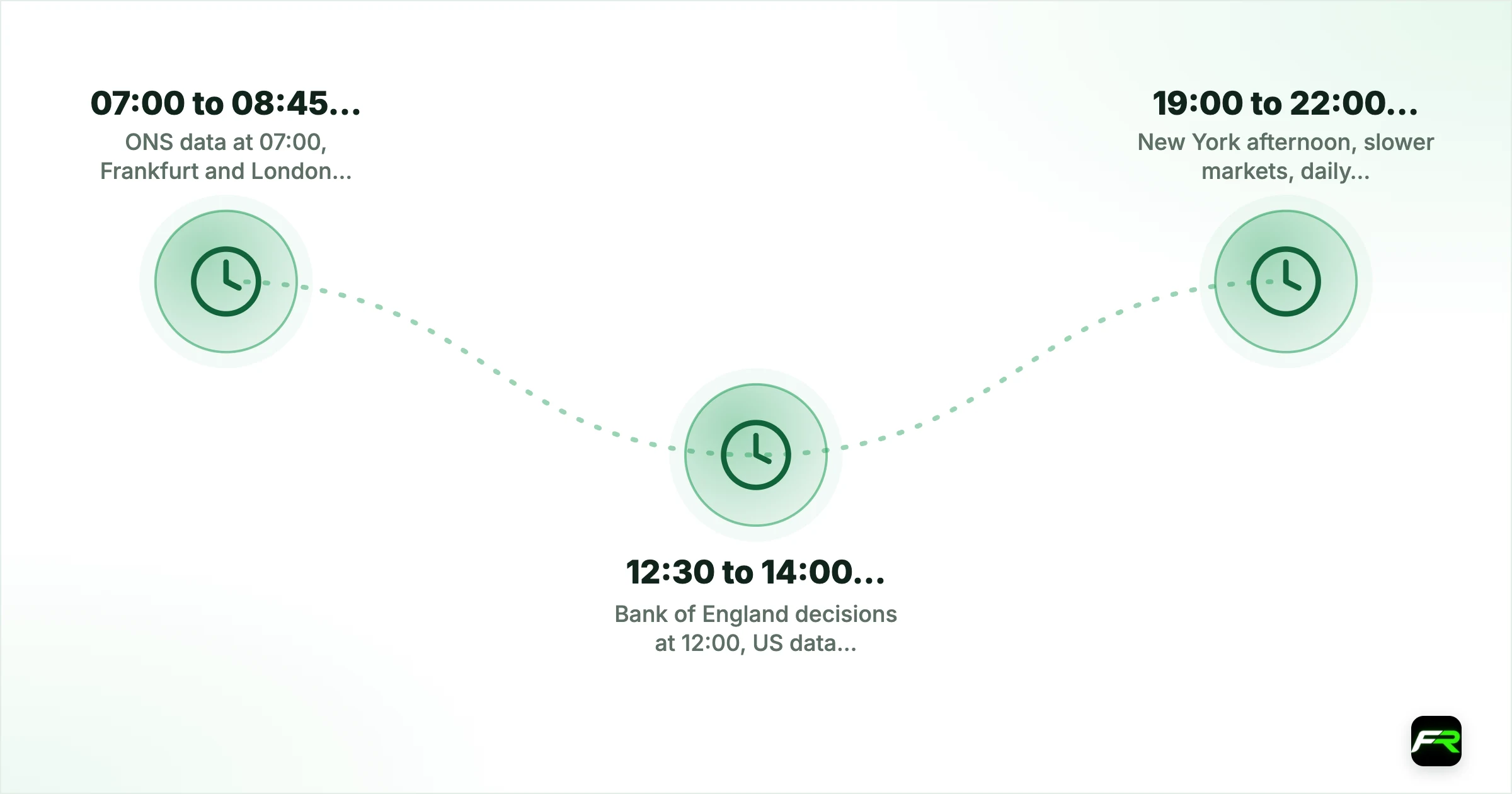
| Window (UK time) | What is happening | Best suited to | Watch out for |
|---|---|---|---|
| 07:00 to 08:45, before work | ONS data at 07:00, Frankfurt and London opening, sterling setting its early range | Checking overnight moves, placing or adjusting pending orders, the odd London-open trade | Thin prices before 08:00 and the temptation to trade on the train |
| 12:30 to 14:00, lunch | Bank of England decisions at 12:00, US data at 13:30, New York opening | Reviewing positions, planned trades around scheduled releases | Fast moves after data while you are due back at your desk |
| 19:00 to 22:00, evening | New York afternoon, slower markets, daily candles near completion | Analysis, swing trade planning, setting orders for the next day | Wider spreads near the 22:00 rollover and fatigue |
The London/New York overlap from 13:00 to 17:00 is the deepest part of the day, which is exactly when most employees are least free. That is not a disaster. It simply means your strategy has to accept that you will not be watching when the big moves happen. For the full session map, see our best time to trade forex in the UK guide.
Note the mismatch weeks. From 26 to 30 October 2026, and again for two weeks in March 2027, the US data slot moves to 12:30 UK time because the UK and US change clocks on different dates. If your lunch break is fixed at 13:00, you will miss it those weeks.
Swing trading or day trading?
Day trading means opening and closing positions within the same session, often several times. It needs attention while trades are open, and the moves you are trying to catch are small relative to the spread. With a job, you end up either trading the worst hours or trading on your phone under the desk. Neither tends to end well.
Swing trading means holding positions for a few days to a few weeks, usually based on the four-hour or daily chart. You can do the analysis in the evening, set an entry order, a stop-loss and a target, and let the market come to you. The trade-off is overnight financing (the daily charge for holding a leveraged position past the rollover) and gap risk over weekends. In its November 2025 review of CFD firms, the FCA found overnight funding charges were often poorly disclosed, so check yours before holding for weeks.
| Day trading | Swing trading | |
|---|---|---|
| Typical holding time | Minutes to hours | Days to weeks |
| Chart timeframe | 1 to 15 minutes | 4 hours to daily |
| Screen time needed | Several hours, during market hours | 30 to 60 minutes a day, any time |
| Main costs | Spread and commission on many trades | Overnight financing, fewer spreads |
| Fits a 9 to 5? | Poorly | Well |
Our view is that a swing approach on the daily chart, with one or two open positions at a time, is the realistic default for most employees. Position trading, holding for weeks around big themes such as Bank of England policy, is another option if you have the patience for it.
Alerts, pending orders and letting trades run
The tools that make part-time trading possible are the ones that act without you. Every UK broker's platform supports them, and they matter more than any indicator.
- Limit and stop entry orders: decide your entry the night before and let the platform fill it, instead of chasing price at 10:00 from a meeting room.
- A stop-loss on every position: set as soon as the trade opens. Guaranteed stops, which some UK brokers offer for a premium, protect you from gaps too.
- Take-profit orders: fix your exit in advance so you are not tempted to check the phone every ten minutes.
- Price alerts: most platforms and TradingView can notify you when a level is hit, so you only look when something relevant happens.
- Calendar reminders: a note in your diary for 07:00 CPI mornings and 12:00 Bank of England days prevents nasty surprises on open positions.
Size positions so that a stop-out costs an amount you can shrug off at your desk, say 0.5% to 1% of the account. If a loss would ruin your afternoon, the position is too big for someone who cannot watch it. Our position size calculator does the arithmetic.
Employer rules: check before you place a trade
Most employment contracts say something about personal use of work time and equipment. Trading on a work laptop or during paid hours can be a disciplinary matter, and some employers monitor network traffic. Keep trading on your own device, on your own time, and read your contract and staff handbook before you start.
If you work in financial services, the rules go much further. FCA-authorised investment firms must have personal account dealing rules for their staff under COBS 11.7 and 11.7A of the FCA Handbook. In practice that usually means you must declare your trading accounts, get pre-clearance before certain trades, meet minimum holding periods and send your firm copies of statements. Some firms ban spread betting and CFDs outright for staff, and others restrict trading in anything the firm deals in or advises on. A breach can cost you your job and, in serious cases, your regulatory standing. Ask compliance before you open an account, not after.
Never trade on anything you learn through your job that the market does not know. Market abuse rules apply to everyone, not only to people in finance, and "it was only a small spread bet" is not a defence.
Prop firm evaluations alongside a job
Prop firm adverts aim squarely at people with jobs: pay a fee, pass an evaluation on a simulated account, then trade the firm's capital for a share of the profits. The appeal is obvious, since your own savings are not on the line beyond the fee. Where it bites is the rulebook. Evaluations usually set a daily loss limit, a maximum total drawdown and a profit target, sometimes with a deadline, and breaching any one of them ends the attempt.
Those rules fit badly with a 9 to 5. A daily loss limit can be hit by a position you could not watch during a meeting, and a deadline pushes people into the hours they would otherwise skip. If you try one, favour an evaluation without a time limit, keep to the same slow swing approach described above, and treat the fee as money you expect to lose. Read your employment contract as well, since some employers want outside business interests declared.
Payouts are taxed differently from your own spread bets or CFDs. UK accountants generally treat them as self-employment or trading income reported through self assessment on top of your salary, and Class 4 National Insurance may apply. Our article on prop firm payouts and tax sets out how that works.
A short tax reminder
Your job does not change how your trading is taxed, but it does change the rate. Spread betting profits are generally outside income tax and capital gains tax for individuals, and losses cannot be offset either. CFD and forex profits are normally taxed under capital gains tax: after the £3,000 annual exempt amount, gains are taxed at 18% within your basic rate band and 24% above it. A salary that already uses up your basic rate band means most of your gains will be at 24%. HMRC starts from the presumption that an individual dealing in financial instruments is not trading, so a few evenings a week at the charts will not make you a trader for tax purposes; our badges of trade guide explains the tests.
If you have CFD gains to report for the 2025/26 tax year and are not already in self assessment, the deadline to register is 5 October 2026. Online returns and payment are due by 31 January 2027. See our UK forex tax guide and spread betting vs CFDs comparison for the detail.
General information, not tax advice. Your position depends on your circumstances, and rules can change at the 28 October 2026 Budget.
Burnout, sleep and the real risk
Fatigue is a bigger threat to a part-time trader than any bad trade. Late nights for the evening session, a midnight look at the Asian open and a 07:00 alarm for the data wear people down within weeks. Tired decisions are worse decisions, both at the desk and on the chart, and a job performance problem is a far bigger financial hit than a missed trade.
It also helps to be honest about the numbers. The FCA requires every UK CFD provider to publish the share of its retail accounts that lose money, and at the time of writing (September 2026) the figures for the larger UK firms sit between roughly 61% and 74%. A salary is a steady income; trading, for most people, is an uncertain one. Keep your emergency fund separate, never fund an account with money you need for bills, and set a fixed monthly limit on how much you will deposit.
- Choose one window and stick to it for at least a month.
- Cap your screen time, for example 45 minutes a day.
- Keep a written plan for each trade, written before you open it.
- Take at least one day a week with no charts at all.
- Stop and review if trading starts affecting your sleep, your work or your relationships.
Kofi works in logistics from 08:30 to 17:00. He opened a £2,000 spread betting account and tried scalping GBP/USD on his phone during breaks. In six weeks he placed around 90 trades and was down £410, most of it spread costs and stops hit while he could not watch. He switched to swing trading EUR/GBP and GBP/USD on the daily chart, reviewing charts from 20:00 to 20:45 on weeknights and risking £20 a trade at £1 to £2 per point. Over the next three months he placed 14 trades, won 6 and finished up £95. Not life-changing, but he stopped losing money to noise and got his lunch breaks back.
Frequently asked
Can you trade forex with a full-time job in the UK?
Yes. The London open before work, the 13:30 US data slot at lunch and the evening all give you access to the market. Most employees do better with swing trading on the four-hour or daily chart, using pending orders and alerts, than with day trading from a desk.
What is the best time to trade forex before work in the UK?
Between about 07:00 and 08:45. The ONS releases UK data at 07:00 and the London session opens around 08:00. Prices before 08:00 can be thin, so many part-time traders use this window to check overnight moves and place or adjust orders rather than trade live.
Is day trading possible with a 9 to 5 job?
Technically yes, practically it is hard. Day trading needs attention while positions are open, and the busiest hours, 13:00 to 17:00, fall in the working day. Most people who try it end up trading poor hours or trading on their phone at work.
Can my employer stop me trading forex?
Your employer can set rules on using work time and equipment, and firms authorised by the FCA must have personal account dealing rules for staff. These can require you to declare accounts, get pre-clearance or avoid spread betting and CFDs entirely. Check your contract and ask compliance.
Does my salary change the tax rate on my trading profits?
It can. Spread betting profits are generally tax-free for individuals, so your salary makes no difference there. CFD gains fall under capital gains tax, and because a salary uses up some or all of your basic rate band, most gains above the £3,000 allowance are likely to be taxed at 24% rather than 18%.
How much time do I need to trade forex part-time?
A swing trader on the daily chart can manage with 30 to 60 minutes a day, mostly in the evening. That covers reviewing charts, setting orders and keeping a trading journal. Much more than that and fatigue tends to creep in.
Should I quit my job to trade forex full-time?
Most people should not. The FCA's required loss disclosures show that between roughly 61% and 74% of retail accounts at the larger UK providers lose money. A long record of consistent profit over several years, and savings to cover a bad run, would be the bare minimum.
Related reading
The team behind this guide
Researched, checked and approved by five forex specialists
Every guide is written, fact-checked and edited before it goes live, and updated when the facts change. Spotted an error? Tell us.