





























IC Markets Leverage UK: 1:30 vs 1:500 and What You Give Up
UK residents at IC Markets are offered offshore leverage far above the FCA's 1:30 cap. Here is the margin maths in pounds, and the protections you lose in exchange.
 WriterAbir KhanWriterWrites the guides · checks every figure against primary sources View profileAbout Abir →
 Market analysisTanbir Habib RiyadForex & Crypto AnalystForex and crypto analyst · technical and fundamental analysis View profileAbout Tanbir →
 Fact-checking & riskJannatul FerdaushFact-Checker & Risk AnalystFact-checks every figure · risk analysis · Applied Statistics, University of Dhaka View profileAbout Jannatul →
 Trading reviewJowel RanaCo-Founder & Forex TraderCo-founder · forex trader · reviews guides from a trader's view View profileAbout Jowel →
 Final approvalRanjan NiskrityFounder, Owner & Forex TraderFounder and owner · forex trader · signs off every guide View profileAbout Ranjan →
A UK resident who opens an account with IC Markets (now trading as IC) today is, in practice, onboarded by Raw Trading Ltd in the Seychelles, which advertises leverage of up to 1:5000 on MT4 and MT5 and up to 1:1000 on cTrader. An FCA-authorised broker can offer a UK retail client no more than 1:30 on major currency pairs. That gap is the main thing IC's offshore account offers a UK trader, and it comes with a cost: the FCA's retail protections do not apply, including the 50% margin close-out and guaranteed negative balance protection.
Several review sites say UK clients at IC are capped at 1:30, or are routed to a CySEC or Mauritius entity. Neither matches what we found. IC's EU website says its information is not intended for UK residents, and IC has no UK company. Check the entity named in your own client agreement, because that decides your leverage, your rules and your rights. How UK residents are onboarded at IC shows where to find it.
| FCA retail cap, major FX pairs | 1:30 (3.33% margin) |
|---|---|
| IC offshore maximum, MT4/MT5 | Up to 1:5000, tiered |
| IC offshore maximum, cTrader | Up to 1:1000, tiered |
| Margin around news and weekends | Higher at IC: new FX positions capped at 1:200 in these periods |
| Negative balance protection at IC | Not guaranteed |
| Regulator context | CySEC fined IC Markets (EU) EUR 200,000 in July 2024 (reported) |
FCA limits and IC's offshore limits side by side
The FCA's retail CFD rules have been permanent since 1 August 2019 and cover CFDs, spread bets and rolling spot forex. Initial margin is set as a percentage of the position's value in the Conduct of Business Sourcebook (COBS 22.5.11R). Majors are pairs made of two of USD, EUR, JPY, GBP, CAD and CHF, so GBP/USD, EUR/GBP and USD/JPY all qualify for 1:30.
| Market | FCA retail limit | IC offshore (Raw Trading Ltd) |
|---|---|---|
| Major FX pairs (e.g. GBP/USD) | 1:30 (3.33%) | Up to 1:5000 MT4/MT5, 1:1000 cTrader, tiered |
| Minor FX, gold, major indices | 1:20 (5%) | Much higher, varies by instrument |
| Other commodities, minor indices | 1:10 (10%) | Varies by instrument |
| Individual shares | 1:5 (20%) | Varies by instrument |
| Crypto derivatives | Banned for UK retail | Offered |
The headline 1:5000 is not what every account gets. IC describes its leverage as dynamic and tiered, so the maximum depends on your account and position, and margin requirements rise around major news releases and over weekends. On MT4 and MT5 major pairs, 1:5000 applies to the first 25 lots, then 1:3000 up to 50 lots, 1:1000 up to 100 and 1:500 beyond. During IC’s higher margin periods (around the daily close, from an hour before Friday’s close until shortly after Monday’s open, and from 15 minutes before to a minute after high-impact news), new FX positions are capped at 1:200. Its site-wide risk warning adds: "Our leverage is dynamic and may change at any time. Such changes may affect your positions and margin requirements." In other words, the figure you sign up with is not a promise.
That matters most at exactly the wrong moment. Suppose you hold a large position into a Friday close or a Bank of England announcement at 12:00 UK time. If a broker raises the margin requirement beforehand, your free margin shrinks without the price moving at all, and a position that looked comfortable can sit much closer to stop-out. IC says its higher margin rates apply to new positions and that margin is recalculated when the period ends, but its risk warning also says leverage changes may affect existing positions. Under FCA rules the margin percentages for retail clients are fixed in the Handbook, so a UK-authorised firm cannot quietly take you above 1:30 and then pull it back.
Weekend gaps are the other risk. Currency markets close on Friday evening UK time and reopen on Sunday night, and prices can open well away from Friday's close after political news. At high leverage a gap of 50 or 100 pips can take an account below zero before any stop is filled. With an FCA firm, negative balance protection means the loss stops at your deposit; offshore, the shortfall can be pursued as a debt.
The margin maths on GBP/USD in pounds
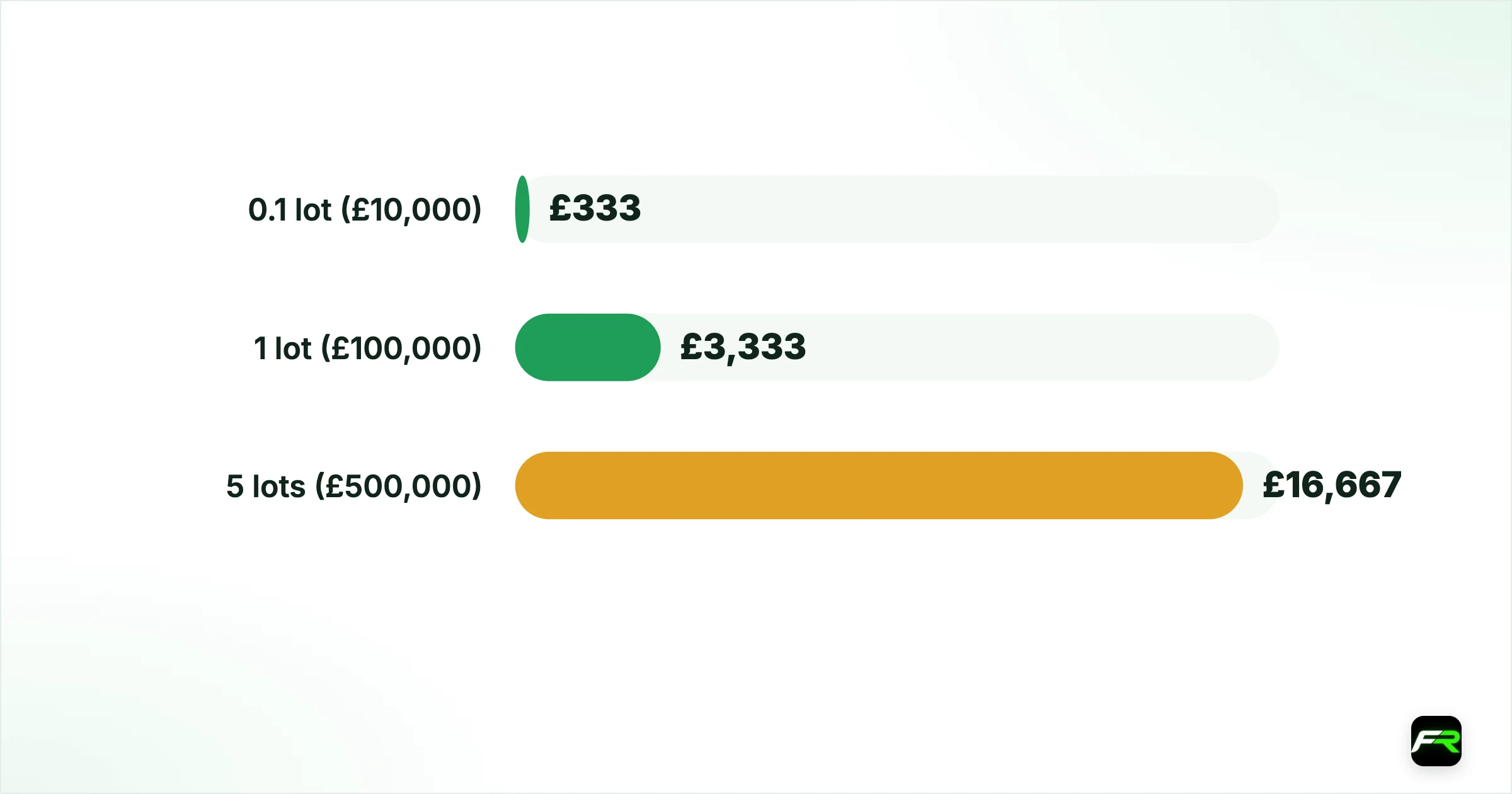
Margin is the deposit a broker holds while your trade is open. On GBP/USD one standard lot is £100,000 of sterling, because the pound is the base currency. That makes the arithmetic easy in a GBP account: divide the position size by the leverage.
| Position on GBP/USD | Margin at 1:30 | Margin at 1:500 | Value of 1 pip (at about 1.34) |
|---|---|---|---|
| 0.1 lot (£10,000) | £333 | £20 | USD 1, about £0.75 |
| 1 lot (£100,000) | £3,333 | £200 | USD 10, about £7.46 |
| 5 lots (£500,000) | £16,667 | £1,000 | USD 50, about £37.31 |
Leverage does not change what a pip is worth. It changes how big a position a small balance can open. With £1,000 in a UK retail account you can hold at most about 0.3 lots of GBP/USD. At 1:500 the same £1,000 could, in theory, carry five lots. With five lots open, a 27-pip move against you costs about £1,000, a move cable can make within minutes of a Bank of England decision or a UK CPI release.
Beginners are the ones most exposed. The ratio itself rarely wipes out an account; the damage comes because high leverage lets people size positions far beyond what their stop loss and balance can stand. Use our margin calculator and position size calculator to see your own numbers, and read what forex leverage is if the terms are new.
Protections you give up for higher leverage
The FCA's 2019 rules came as a package: the leverage cap plus a set of protections that only apply to firms it authorises. Trade offshore and the whole package goes.
- 50% margin close-out (COBS 22.5.13R): an FCA firm must close positions when your equity falls to half the margin required, which usually leaves something in the account. Offshore stop-out levels are set by the broker and can be far lower.
- Negative balance protection (COBS 22.5.17R): UK retail losses are limited to the money in your account. IC's Help Centre says that if you lose more than your balance, "you will bear the negative consequences".
- Bonus ban (COBS 22.5.20R): FCA firms cannot offer UK retail CFD clients bonuses or incentives. IC offers a deposit bonus on its offshore arm.
- Standard risk warning: FCA firms publish the percentage of retail accounts losing money, updated quarterly. Raw Trading Ltd publishes no figure.
- Complaints and compensation: no Financial Ombudsman Service, no FSCS, and disputes go to Seychelles law and courts under IC's terms. Our page on IC, the FSCS and the Ombudsman explains what IC offers instead.
The FCA's Warning List entry against IC Markets Global says the firm is not authorised and may be targeting people in the UK, and that UK customers won't have access to the Ombudsman or the FSCS. Our explainer on margin close-out and negative balance protection shows how these rules play out on a bad day.
The CySEC fine and why it matters here
In July 2024 the Cyprus regulator, CySEC, fined IC Markets (EU) Ltd EUR 200,000, according to trade press reports. The reported issue was that EU clients had been offered leverage of up to 1:1000 through the group's offshore arms, rather than the 1:30 EU retail limit. We have not seen the full decision text, so treat the detail as reported.
For a UK reader the point is simple. European and British regulators both regard offshore high leverage as something retail clients in their countries should not be steered into. An offer of 1:500 from a well-known brand is not designed with UK retail protections in mind.
Legitimate ways to trade with more than 1:30 in the UK
If you need more leverage and qualify, the UK route is elective professional status at an FCA-authorised firm. Under COBS 3.5.3R you need a qualitative assessment plus two of three tests: significant-sized trades averaging 10 a quarter over the last year, a portfolio of cash and instruments above EUR 500,000, or at least a year working in a relevant professional role in finance. You lose the retail protections, but you keep an FCA-regulated counterparty, and individuals acting as consumers usually keep access to the Ombudsman.
Most people do not qualify, and the FCA warned in October 2025 that firms were pressuring clients to opt up. Our guide to professional client status covers the tests, and UK forex leverage limits sets out the full retail table.
Who might accept the trade-off
An experienced trader who sizes by risk, uses stops, and only wants the higher leverage to free up margin on other positions might knowingly accept IC's offshore terms. The cost is the loss of UK redress. A beginner who is attracted by 1:500 because it lets a £500 deposit open big trades is exactly who the FCA rules were written for, and should stay with a UK-authorised firm. The FX Recap view is that high leverage is rarely the reason a trader succeeds, and often the reason one fails. For the same trade-off across every overseas firm, see using an offshore broker as a UK resident.
Jamie deposits £1,500 in a GBP account with IC's offshore entity and sets leverage at 1:500. An hour before a Bank of England announcement at 12:00, before IC’s higher margin window starts, he buys four lots of GBP/USD, which uses only £800 of margin. The Bank holds rates, sterling drops 45 pips in two minutes, and each pip costs him about £29.85. His loss is roughly £1,343 before the position is stopped out, leaving under £160. At an FCA firm with £1,500 he could have opened no more than about 0.45 lots of GBP/USD, where the same 45-pip move would have cost around £151. If the price had gapped past his balance at IC, he would have had no guaranteed negative balance protection to fall back on.
Never lie about your country of residence to get different terms. If you live in the UK, say so. A false residency declaration can void your agreement and leave you with no remedy at all.
Frequently asked
What leverage does IC Markets give UK residents?
UK residents are in practice onboarded by IC's Seychelles entity, which advertises up to 1:5000 on MT4 and MT5 and 1:1000 on cTrader, tiered and subject to change. Check the entity in your client agreement, since that decides your terms.
Is IC Markets leverage capped at 1:30 for UK clients?
Not on the offshore account UK residents are generally given. The 1:30 cap is an FCA rule that applies to authorised firms, and IC has no FCA authorisation. Some review sites say otherwise, but we found no UK-specific cap on IC's offshore arm.
How much margin does one lot of GBP/USD need at IC Markets versus a UK broker?
One lot is £100,000 of sterling. A UK broker must hold at least 3.33%, about £3,333, from a retail client. At IC’s offshore account set to 1:500 the figure is £200, rising around news and weekends. The pip value is identical at both, USD 10 or roughly £7.46, so only the size of position you can open changes.
Does IC Markets have negative balance protection for UK traders?
Not guaranteed. IC's Help Centre says that if you lose more than your balance you will bear the negative consequences. FCA firms must limit UK retail losses to the funds in your account.
Why was IC Markets fined by CySEC?
Trade press reported in July 2024 that CySEC fined IC Markets (EU) Ltd EUR 200,000 because EU clients had been offered up to 1:1000 leverage through the group's offshore arms, above the EU retail limit of 1:30.
Can I get higher leverage legally in the UK?
Only by qualifying as an elective professional client at an FCA firm, which needs two of three tests including trading volume, a EUR 500,000 portfolio or relevant finance experience. You lose retail protections but keep a UK-regulated counterparty.
Does IC change leverage around news?
Yes. IC describes its leverage as dynamic and says margin requirements can rise around major news and weekends, and that leverage may change at any time, which can affect open positions.
Related reading
The team behind this guide
Researched, checked and approved by five forex specialists
Every guide is written, fact-checked and edited before it goes live, and updated when the facts change. Spotted an error? Tell us.