





























How Prop Firm Payouts Are Taxed in the UK (2026/27)
UK accountants generally treat prop firm payouts as self-employment income: Income Tax plus Class 4 NI through self assessment, with the £1,000 trading allowance or real expenses. Offshore firms change nothing.
 WriterAbir KhanWriterWrites the guides · checks every figure against primary sources View profileAbout Abir →
 Market analysisTanbir Habib RiyadForex & Crypto AnalystForex and crypto analyst · technical and fundamental analysis View profileAbout Tanbir →
 Fact-checking & riskJannatul FerdaushFact-Checker & Risk AnalystFact-checks every figure · risk analysis · Applied Statistics, University of Dhaka View profileAbout Jannatul →
 Trading reviewJowel RanaCo-Founder & Forex TraderCo-founder · forex trader · reviews guides from a trader's view View profileAbout Jowel →
 Final approvalRanjan NiskrityFounder, Owner & Forex TraderFounder and owner · forex trader · signs off every guide View profileAbout Ranjan →
Prop firm payouts are not tax free in the UK, and they are not usually capital gains either. UK accountants generally treat money a funded-trader programme pays you as self-employment (trading) income, reported through self assessment and taxed at your Income Tax rate of 20%, 40% or 45%, with Class 4 National Insurance on top once profits pass £12,570. The first £1,000 of gross trading income is covered by the trading allowance. It makes no difference that the firm is based in Dubai, the US or the Czech Republic: UK residents are taxed on their worldwide income.
HMRC has not published guidance aimed specifically at prop firm payouts, so what follows is the general position most advisers take, with worked numbers, the expenses question, Making Tax Digital and the regulatory status of the firms themselves. If your payouts are meaningful, a one-off session with an accountant is money well spent.
General information, not tax advice. Your position depends on your own circumstances, and tax rules can change, including at the 28 October 2026 Budget. If your gains are large, your situation is unusual or you are unsure which regime applies, a qualified tax adviser who works with traders is worth the fee.
| Usual treatment | Self-employment (trading) income |
|---|---|
| How reported | Self assessment, self-employment pages |
| Trading allowance | £1,000 of gross income a year |
| Class 4 NI 2026/27 | 6% on profits £12,570 to £50,270, 2% above |
| Making Tax Digital | Gross self-employment plus property income over £50,000 from April 2026, £30,000 from April 2027 |
| FCA authorisation | Prop evaluation firms are generally not FCA authorised |
Why payouts are income, not gains or winnings
With a typical retail prop firm you pay a fee for an evaluation or "challenge", trade an account the firm controls (often a simulated one), and receive a share of the profits, commonly 80% or 90%, if you pass and keep to the rules. You never own the account or the positions. What you are paid for is your trading performance, under a contract with the firm.
That structure looks like a service arrangement. You are not disposing of an asset, so the Capital Gains Tax rules in CG56100 that cover your own CFD trades do not fit. Nor are you placing bets on your own account, so the spread betting exemption in CG56105 and BIM56900 does not help, even if the firm's platform shows the trades as spread bets. Most advisers therefore treat regular payouts as income from self-employment. A one-off small payout might be described as miscellaneous income instead, but the tax rates are the same and the reporting is similar.
One exception is real employment. If a London trading firm hires you on a salary and bonus, that is employment income taxed through PAYE, and none of the self-employment rules below apply. The online funded-trader model is almost never employment. Many firms' terms describe the trader as an independent contractor, which sits comfortably with the self-employment treatment. Read your own agreement, because the way the firm labels the payments (profit share, reward, performance fee) is useful evidence for your adviser, even if it does not decide the tax on its own.
How much tax: worked numbers
Payouts are added to your other income. A trader with a full-time job pays tax on prop income at the rate that applies on top of the salary, which for many people is 40%. The figures below use 2026/27 rates for England, Wales and Northern Ireland (Scotland has its own Income Tax bands) and assume allowable expenses of £1,000 or the trading allowance.
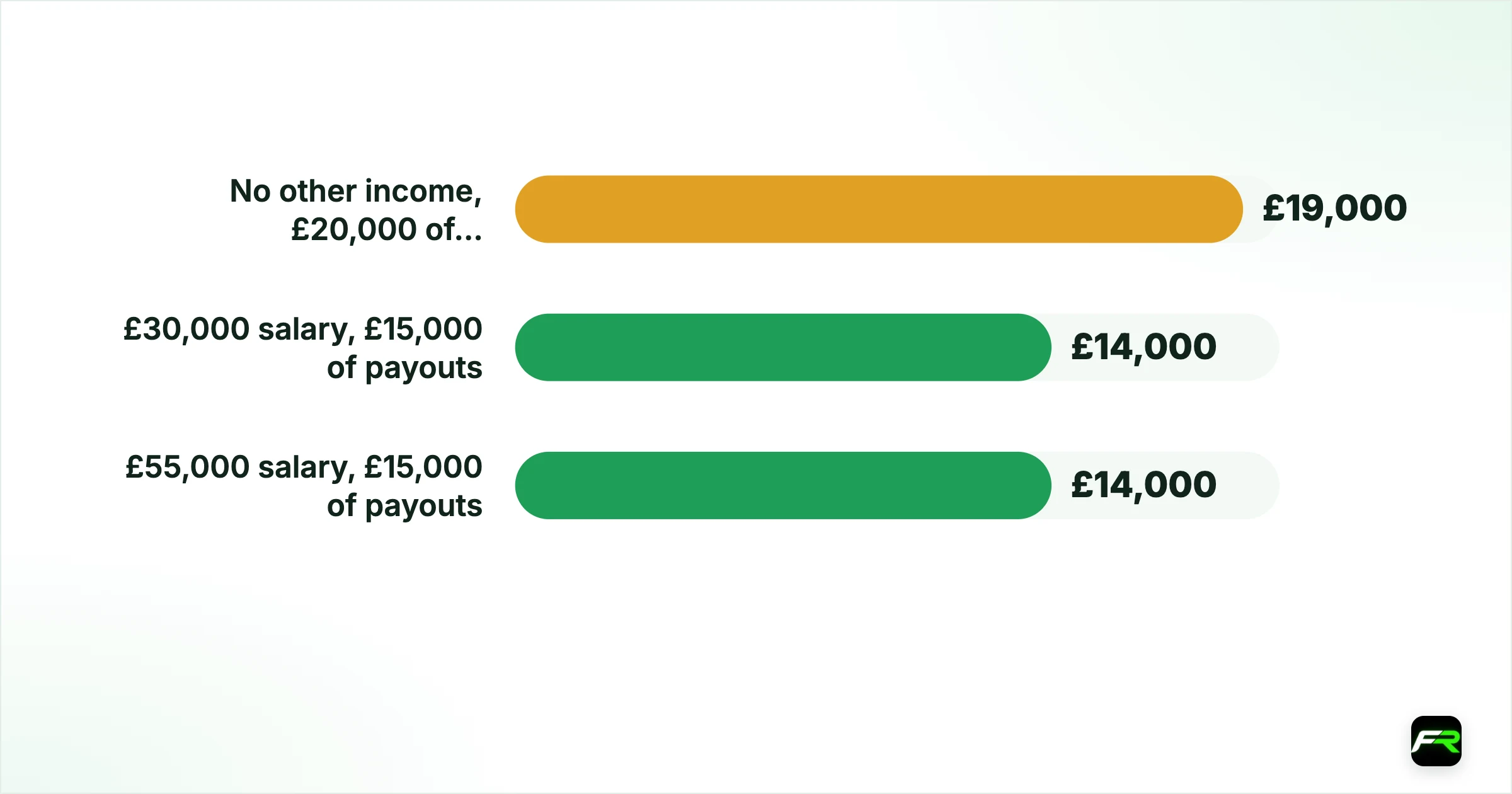
| Scenario | Taxable prop profit | Income Tax | Class 4 NI | Total |
|---|---|---|---|---|
| No other income, £20,000 of payouts | £19,000 | £1,286 (20% above £12,570) | £385.80 | £1,671.80 |
| £30,000 salary, £15,000 of payouts | £14,000 | £2,800 (20%) | £85.80 | £2,885.80 |
| £55,000 salary, £15,000 of payouts | £14,000 | £5,600 (40%) | £85.80 | £5,685.80 |
In the first row the personal allowance covers the first £12,570, so Income Tax falls on £6,430 at 20%, and Class 4 NI at 6% applies to the same £6,430. The second and third rows differ because the salary has already used up the personal allowance, so the whole £14,000 is taxed at 20% or 40%. Class 4 NI works differently from Income Tax: the £12,570 lower profits limit is measured against your self-employed profit alone, ignoring your salary. A £14,000 prop profit therefore bears Class 4 only on £1,430, which is £85.80, whatever your job pays. Class 2 NI is no longer charged for most self-employed people since April 2024.
If your self assessment bill is over £1,000, HMRC will usually also ask for payments on account towards next year's tax, unless at least 80% of your total tax was already collected at source, such as through PAYE. Each payment is half of this year's bill, due on 31 January and 31 July. A trader's first bill can therefore be about 150% of the tax on the year's payouts. Set money aside from every payout.
The £1,000 trading allowance and expenses
The trading allowance lets you receive up to £1,000 of gross trading income a year without reporting it, provided that is your total gross income from all your trades and nothing else requires you to file a return. Above £1,000 you choose one of two routes: deduct £1,000 from your gross income, or deduct your actual allowable expenses. You cannot do both.
For many prop traders the expenses route is better, because challenge fees add up quickly. The general principle for self-employed expenses is that costs incurred wholly and exclusively for the purpose of the trade are deductible. Evaluation fees, data and platform subscriptions, a VPS and a share of equipment costs used for trading are candidates. Fees paid for challenges you failed before you ever received a payout raise a timing question (whether the trade had started yet, and pre-trading expenditure rules), and personal education courses can be harder to justify. These are exactly the points to confirm with an accountant rather than guess.
Refunds count too. Many firms refund the challenge fee with the first payout. If you have deducted the fee as an expense, the refund is part of your taxable receipts.
Jordan works in retail on £26,000 and passed a $100,000 evaluation with an overseas prop firm in 2025/26 after three attempts. He paid £1,650 in challenge fees across the year and £240 for a charting subscription. His payouts, received in dollars and converted at the rate on each payment date, totalled £11,800, including a £420 fee refund. The accountant he used agreed that the fees for the attempts in the same year counted as expenses, so his taxable profit was £11,800 minus £1,890, which is £9,910. At 20% that is £1,982 of Income Tax. Because his profit is below £12,570, no Class 4 NI is due. His bill is over £1,000, so HMRC also asked for payments on account for 2026/27, and his total due on 31 January 2027 is £2,973. He now moves 30% of every payout into a separate savings account the day it lands.
Registering, reporting and Making Tax Digital
Once your gross trading income is above £1,000, register for self assessment as self-employed by 5 October after the end of the tax year: 5 October 2026 for 2025/26 payouts. You then complete the self-employment pages of the return and file and pay by 31 January 2027. If you also made gains on a personal CFD account, those go on the separate capital gains pages, as our guide to reporting CFD gains on self assessment explains. Keep the payout confirmations from the firm, bank or crypto wallet records showing what arrived, the exchange rate on each date, and every invoice for fees and subscriptions.
Making Tax Digital for Income Tax adds quarterly digital updates for people whose qualifying income is high enough. From 6 April 2026 it applies to sole traders and landlords with gross self-employment and property income over £50,000, falling to £30,000 from April 2027 and £20,000 from April 2028. The test is based on gross income before expenses, from an earlier tax year's return. Capital gains and spread bet winnings never count, but prop payouts treated as self-employment income could. A trader with £35,000 of payouts on the 2025/26 return could therefore be brought into MTD from April 2027. Check the gov.uk eligibility tool once your figures are in.
Offshore firms, crypto payouts and regulation
Many retail prop firms are based outside the UK and pay by bank transfer, card rails or cryptocurrency. None of that changes the tax. UK residents are taxed on worldwide income, and HMRC receives financial account data from many countries under international exchange agreements. Payouts in USDT or USDC still need to be valued in sterling on the date you receive them; if you then hold the stablecoin and sell it later, that disposal can create a separate small capital gain or loss.
Regulation is a separate issue from tax, and an uncomfortable one. Retail prop evaluation firms are generally not authorised by the FCA, and the evaluation product is usually not a regulated investment. So if a firm refuses a payout, changes its rules or collapses, there is normally no Financial Ombudsman complaint and no FSCS claim. Check any firm's claims against the FCA Register, treat unpaid payouts as a real risk, and never pay tax-related "release fees" to get money out, which is a classic scam pattern covered in our forex scams guide.
Frequently asked
Are prop firm payouts tax free in the UK?
No. UK accountants generally treat them as self-employment income, taxed at 20%, 40% or 45% with Class 4 National Insurance on profits above £12,570. The spread betting exemption does not apply, because you are paid for performance under a contract rather than placing bets on your own account.
Do I pay CGT or Income Tax on funded account profits?
Usually Income Tax. You do not own the account or the positions, so there is no disposal of an asset for Capital Gains Tax. Payouts are normally reported as self-employment income, or occasionally as miscellaneous income for a one-off small amount.
Can I deduct challenge fees from my prop firm income?
Often yes, under the general rule that costs incurred wholly and exclusively for your trade are deductible. Fees for challenges failed before any payout can raise timing questions, so confirm with an accountant. You can claim real expenses or the £1,000 trading allowance, not both.
Does it matter that my prop firm is offshore?
Not for tax. UK residents are taxed on worldwide income, so a payout from a firm in Dubai or the US is taxed the same as a UK one. HMRC receives financial account data from many countries under international exchange agreements.
Do prop firm payouts count for Making Tax Digital?
They can, if treated as self-employment income. MTD applies from April 2026 where gross self-employment plus property income exceeds £50,000, then £30,000 from April 2027 and £20,000 from April 2028. Capital gains and spread bet winnings never count.
How do I convert dollar or crypto payouts into pounds?
Use the sterling value on the date you received each payout. For bank transfers, the amount credited in pounds is the simplest evidence. Stablecoin payouts need a reliable exchange rate on the day and a note of it, because a later sale of the coins can create its own gain or loss.
Are prop firms regulated by the FCA?
Retail prop evaluation firms are generally not authorised by the FCA, and the evaluation product is usually not a regulated investment. That means no Financial Ombudsman complaint or FSCS protection if payouts are refused or the firm fails.
Do I need to register as self-employed for my first payout?
If your gross trading income in the tax year is £1,000 or less and you have no other self-employment, the trading allowance means you do not need to report it. Above £1,000, register for self assessment by 5 October after the end of the tax year.
Can I take prop firm payouts through a limited company?
Only if the firm's terms let a company hold the account, so check before you set one up. Company profits pay corporation tax at 19% up to £50,000 and 25% above £250,000, with marginal relief in between, and taking the money out as salary or dividends is taxed again. Accounts, filing and advice costs add up, so take advice before choosing that route.
Do prop firm payouts affect Student Loan repayments or Universal Credit?
They can, if taxed as self-employment income. HMRC works out student loan repayments from the income on your self assessment return, combined with any salary. On Universal Credit you must report self-employed income and expenses every month, and once you count as gainfully self-employed, a minimum income floor based on minimum wage earnings may be used if your actual earnings fall below it.
Related reading
The team behind this guide
Researched, checked and approved by five forex specialists
Every guide is written, fact-checked and edited before it goes live, and updated when the facts change. Spotted an error? Tell us.