IC Markets





































The Asian Trading Session, Explained
It is the quiet part of the day. For a lot of people in this region it is also the only session they can watch live, and it rewards patience more than it rewards being right.
 WriterAbir KhanWriterWrites the guides · checks every figure against primary sources View profileAbout Abir →
 Market analysisTanbir Habib RiyadForex & Crypto AnalystForex and crypto analyst · technical and fundamental analysis View profileAbout Tanbir →
 Fact-checking & riskJannatul FerdaushFact-Checker & Risk AnalystFact-checks every figure · risk analysis · Applied Statistics, University of Dhaka View profileAbout Jannatul →
 Trading reviewJowel RanaCo-Founder & Forex TraderCo-founder · forex trader · reviews guides from a trader's view View profileAbout Jowel →
 Final approvalRanjan NiskrityFounder, Owner & Forex TraderFounder and owner · forex trader · signs off every guide View profileAbout Ranjan →
The forex market runs in a loop of overlapping regional sessions: Sydney opens, then Tokyo, then London, then New York, then round again. The Asian session is the Sydney and Tokyo block. If you live anywhere from GMT+5:30 to GMT+9, so Mumbai, Dhaka, Bangkok, Jakarta, Manila, Singapore or Tokyo, this session runs through your evening and the following morning. That is exactly why it matters to you and why this guide exists.
Why this overview is your best starting point
The articles on this site about individual pairs (such as USD/JPY), a specific range strategy, or a country's tax rules all assume you already know the shape of the session itself: when it runs, how it typically behaves, and where the traps are. This page is the one to read first, before a specific pair guide or a specific strategy, because the hours table, the volatility pattern and the London-open warning below apply regardless of which pair or approach you end up using.
When it runs
Tokyo trading is roughly 00:00 to 09:00 GMT. You may also see the Asian session cited starting closer to 23:00 GMT elsewhere, that is not a competing figure for Tokyo itself, it is a wider Asia-Pacific framing that folds in Sydney, which opens a couple of hours before Tokyo. Converted to local time across the region:
| Where you are | Tokyo session, local time |
|---|---|
| Tokyo, Seoul (GMT+9) | roughly 09:00 to 18:00 |
| Manila, Singapore, Kuala Lumpur (GMT+8) | about 08:00 to 17:00 |
| Jakarta, Bangkok, Hanoi (GMT+7) | about 07:00 to 16:00 |
| Dhaka (GMT+6) | about 06:00 to 15:00 |
| Mumbai, Colombo (GMT+5:30) | about 05:30 to 14:30 |
The single most active window is the first hour or two after the Tokyo open, when Japanese institutions and the Tokyo fix bring volume in. After that it usually settles into a slow drift until London starts waking up around 07:00 to 08:00 GMT.
Why the week starts early in Asia
Because Sydney and Tokyo open first in the global trading day, the Asian session is also where the trading week itself begins each Monday and where each new day's price action opens after the weekend gap. Weekend news, from a geopolitical event to a shift in risk sentiment, is priced in here first, often with a wider-than-normal opening range as the market absorbs two days of headlines before London and New York are even awake. That first Monday session is worth watching a little more carefully than a typical weekday Asian session for this reason.
What the session feels like
Lower volatility, smaller ranges, and price that often moves sideways between a clear high and a clear low. Tokyo is a genuine financial centre, but Asian-hours turnover typically makes up roughly a fifth to a quarter of daily global forex volume, so you do not get the violent, trending moves you see when London and New York overlap. A pair can spend hours inside a 20-pip band.
For a beginner, that is a feature rather than a bug. Slower price gives you time to think through an entry instead of chasing a candle. Range-bound conditions are the easiest kind of market to build a first strategy around, because “where is the edge of the range” is a clearer question than “which way is the trend” in a fast market. The discipline this teaches is the discipline that carries into every other one: wait, do nothing most of the time, and act only at a defined level.
The pairs that move
- USD/JPY: the headline pair of the session. It reacts to Bank of Japan commentary, Japanese data, and the Tokyo fix.
- AUD/USD and AUD/JPY: Australia is open and active. AUD/JPY in particular often gives clean, steady swings within the session range.
- NZD/USD: thinner, but tradable, and moves on Reserve Bank of New Zealand news.
- USD/CNH and USD/SGD: these carry a local flavour and react to Chinese data releases such as the Caixin PMIs and trade figures.
- EUR/USD: you can trade it, but it is frequently flat during Asian hours and the spread is a larger share of the small move available.
If a pair is barely moving and the spread is 1.5 pips, you need a 4 to 5 pip move just to break even before you have made anything. In quiet conditions, stick to the pairs that are genuinely active and leave the flat ones alone.
A simple way to trade it
- Wait for the first hour after the Tokyo open to establish a range, then mark the high and the low.
- Only consider a trade if the range is wide enough to cover the spread plus a reward worth the risk.
- Trade toward the opposite edge of the range, with a stop just outside the edge you entered from.
- If price breaks cleanly out of the range, you were wrong about the setup. Accept it and stand aside, and do not flip and chase.
Ravi only trades the first two hours of the Tokyo session, because that is the window he has before his commute. He watches AUD/JPY, marks the overnight range, and takes at most one trade a day near an edge of it. Some mornings there is no clean setup and he closes the laptop without a trade. Over three months his win rate is unspectacular, around 48%, but his average winner is larger than his average loser and trading only two hours a day means he is not overtrading out of boredom. The constraint of the short window turned out to be the thing that made him selective.
There is one recurring trap: the London open. If you are still holding a range trade when London arrives, around 07:00 GMT during British Summer Time or 08:00 GMT during UK winter (GMT standard time), volatility can spike and blow through a tight stop. Many range traders are deliberately flat before then.
Is it right for you?
If you are in this region and you have a day job, the honest answer is that the Asian session might be your only realistic session to trade live, and that is fine. It is slower, it is more technical, and it punishes impatience more than it punishes being wrong. Learn to sit on your hands, take only the setups you can define in advance, and it is a very reasonable place to build a trading habit.
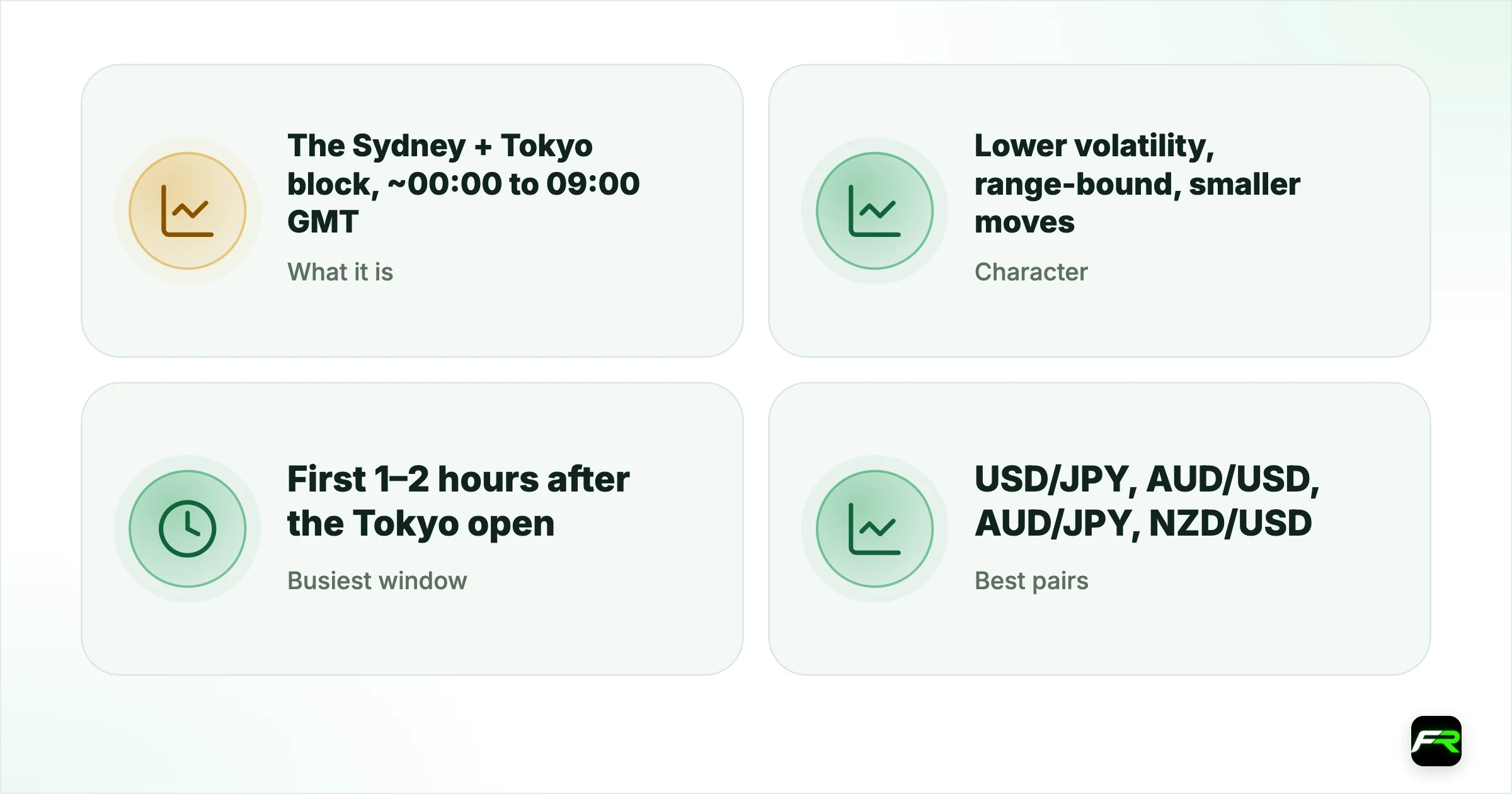
| What it is | The Sydney + Tokyo block, ~00:00 to 09:00 GMT |
|---|---|
| Character | Lower volatility, range-bound, smaller moves |
| Busiest window | First 1–2 hours after the Tokyo open |
| Best pairs | USD/JPY, AUD/USD, AUD/JPY, NZD/USD |
| Main trap | Volatility spike at the London open |
None of this makes it a shortcut. It is a calmer environment to learn discipline in. The traders who do well in it are the ones who are comfortable doing nothing for long stretches.
Frequently asked
What time is the Asian session in my country?
Tokyo runs roughly 00:00 to 09:00 GMT. Add your offset: GMT+8 (Manila, Singapore) makes it about 08:00 to 17:00 local; GMT+7 (Jakarta, Bangkok) about 07:00 to 16:00; GMT+5:30 (Mumbai) about 05:30 to 14:30.
Is the Asian session good for beginners?
Generally yes. Lower volatility and range-bound price give you more time to think and a simpler market to learn on, as long as you are disciplined about spreads and about being flat before the London open.
Which pair should I trade in the Asian session?
USD/JPY or AUD/JPY are the usual starting points. Both are active during the session and react to news you can follow, from the Bank of Japan and the Reserve Bank of Australia.
Why is EUR/USD bad in the Asian session?
It is often flat during Asian hours because the European market is closed. The small move available means the spread eats a larger share of any profit, so the risk-to-reward is poor compared with the yen and Aussie pairs.
What is the Tokyo fix?
A daily benchmark rate set around 09:55 Tokyo time, when institutions transact currency for settlement purposes. It can cause a burst of directional flow, particularly in USD/JPY, near that time.
Can I trade the Asian session profitably with a day job?
It is the most realistic session for someone with a daytime job in the region, since it runs through your morning and evening. Success comes from being selective and patient, not from the session being easy.
The team behind this guide
Researched, checked and approved by five forex specialists
Every guide is written, fact-checked and edited before it goes live, and updated when the facts change. Spotted an error? Tell us.